
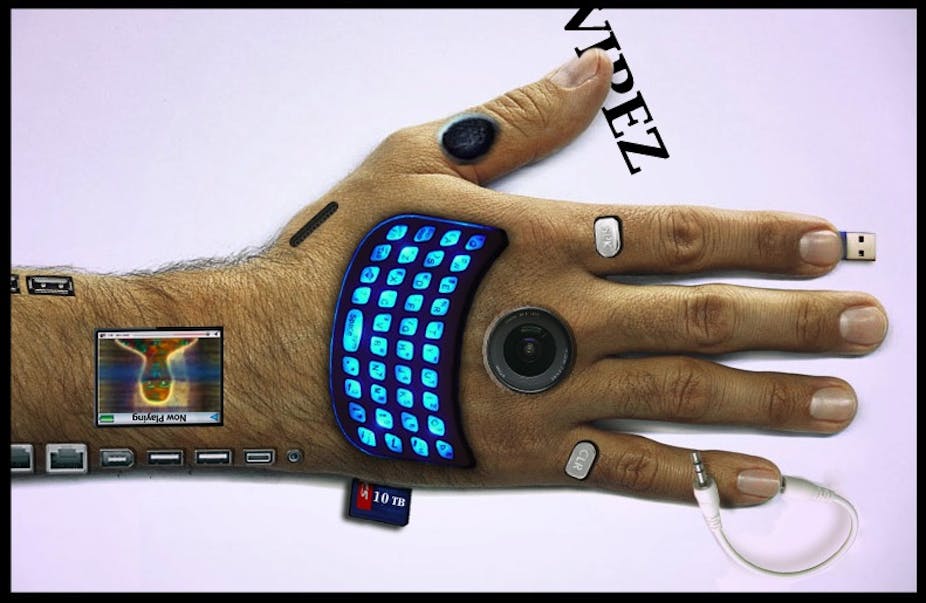
Inviting artificial intelligence into our bodies has appeal – but it also carries certain risks.
I have often wondered what it would be like to rid myself of a keyboard for data entry, and a computer screen for display. Some of my greatest moments of reflection are when I am in the car driving long distances, cooking in my kitchen, watching the kids play at the park, waiting for a doctor’s appointment or on a plane thousands of metres above sea level.
I have always been great at multitasking but at these times it is often not practical or convenient to be head down typing on a laptop, tablet or smartphone.
It would be much easier if I could just make a mental note to record an idea and have it recorded, there and then. And who wouldn’t want the ability to “jack into” all the world’s knowledge sources in an instant via a network?
Who wouldn’t want instant access to their life-pages filled with all those memorable occasions? Or even the ability to slow down the process of ageing, as long as living longer equated to living with mind and body fully intact, as outlined in the video below.
Transhumanists would have us believe that these things are not only possible but inevitable.
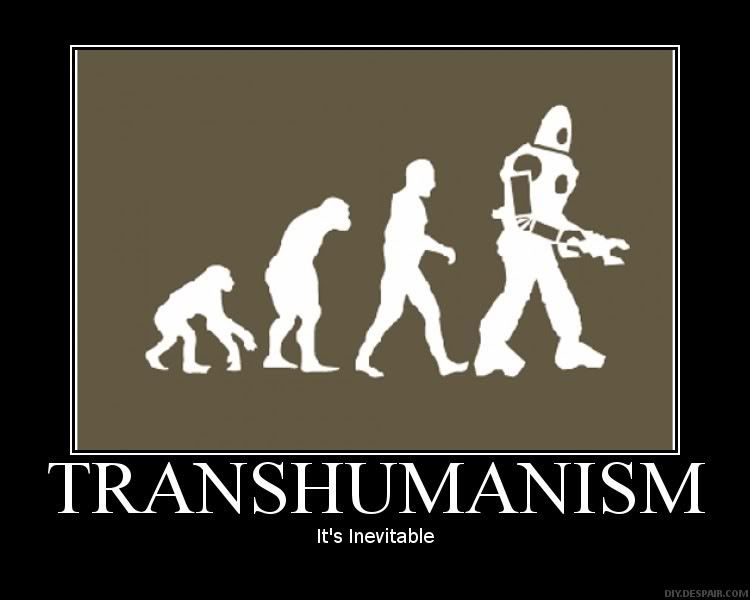
In short: we Homo sapiens may dictate the next stage of our evolution through our use of technology.
Transhumanism
Shortly after starting my PhD, I came across a newly established organisation known as the World Transhumanist Association (WTA), now known as Humanity+ (H+), which was founded by Nick Bostrom and David Pearce.
Point 8 of the Transhumanist Declaration states:
We favour allowing individuals wide personal choice over how they enable their lives. This includes use of techniques that may be developed to assist memory, concentration, and mental energy; life extension therapies; reproductive choice technologies; cryonics procedures; and many other possible human modification and enhancement technologies.
First let us consider briefly the traditional notion of a cyborg, part man/part machine, where technology can act to replace the need for human parts.
In this instance, some might willingly undergo surgical amputations for reasons of enhancement and longevity which have naught to do with imminent medical prosthesis.
This might include the ability to get around the “wetware” of the brain, enabling our minds to be downloaded onto supercomputers.
Homo electricus
Perhaps those who love the look and feel of their human body more than machinery would much rather contemplate a world dominated by a Homo Electricus – a human that will use electro-magnetic techniques to communicate ambiently with networks.
An electrophorus is thus one who becomes a bearer of technology, inviting nano and micro-scale devices into his or her body.
An Electrophorus might also use brain-wave techniques, such as the electroencephalogram (EEG), which measures the electrical activity of the brain in order to perform actions by thinking about them.
This might be the best approach to retaining our inner thoughts for recollection though there are myriad vital issues related to security, access control and privacy that must be addressed first.
Lifelogging
Twenty years ago, when I was still in high school, I would observe my headmaster, who was not all that fond of computers, walking around the playground carrying a tiny Dictaphone in his hands recording things for himself so that he could recollect them afterwards.
When I once asked him why he was engaging in this act, he said:
Ah … there are so many things to remember! Unless I record them I forget them.
He was surely onto something. His job required him to remember minute details which necessitated recollection.
Enter Steve Mann in the early 1990s, enrolled in a PhD at MIT Media Labs and embarking on a project to record his whole life – himself, everyone else, and mostly everything in his field of view, 24/7.
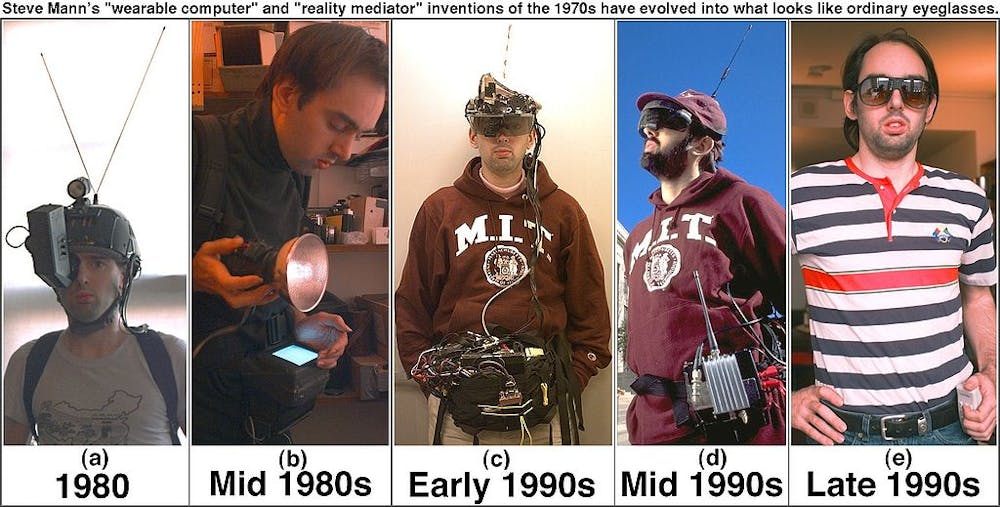
At the time it would have sounded ludicrous to want to record your “whole life”, as Professor Mann puts it. With Mann’s wearcam devices (such as Eyetap), one can walk around recording, exactly like a mobile CCTV. The wearer becomes the photoborg.
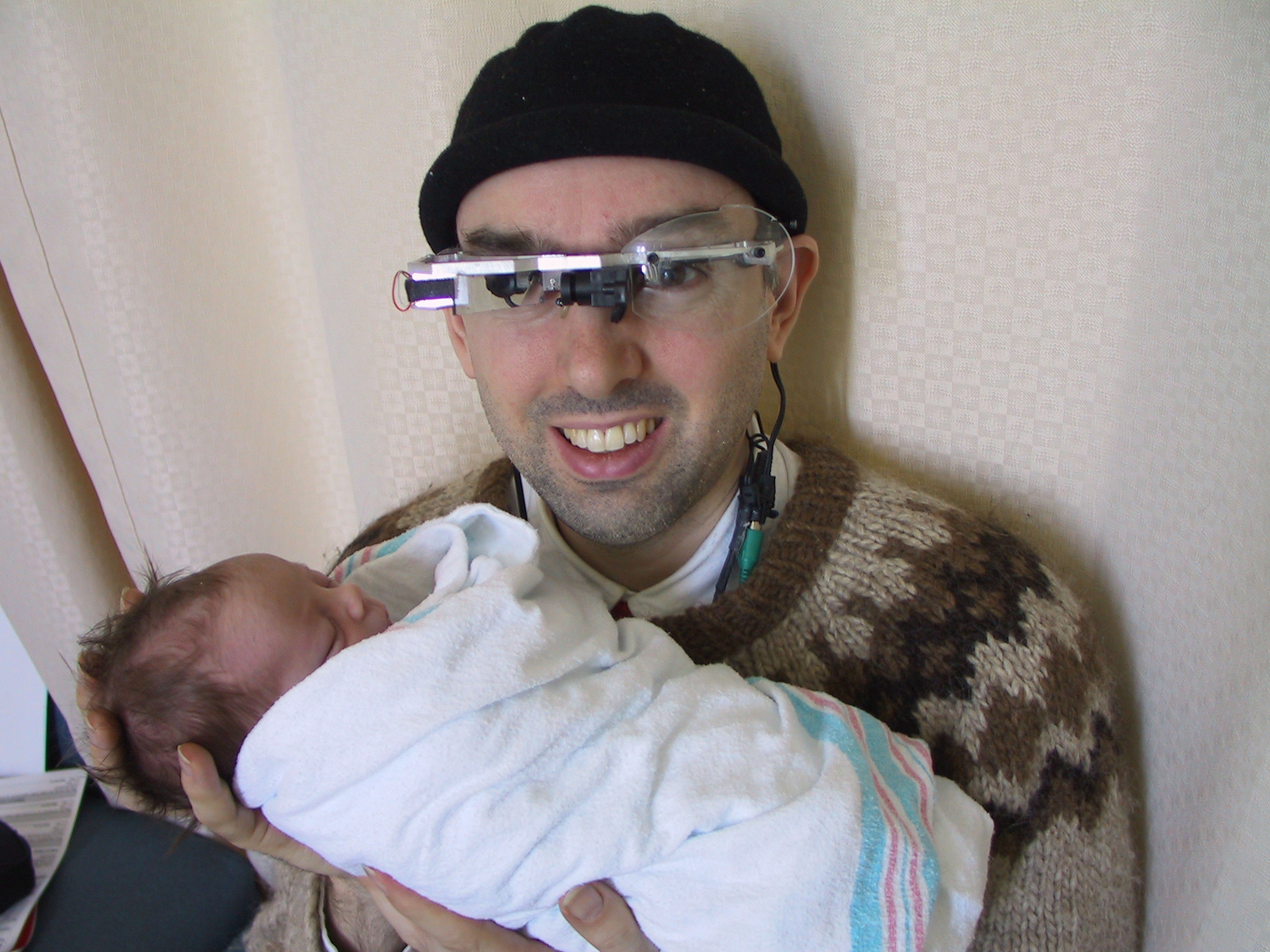
It is an act Mann has called “sousveillance”, which equates to “watching from below”.
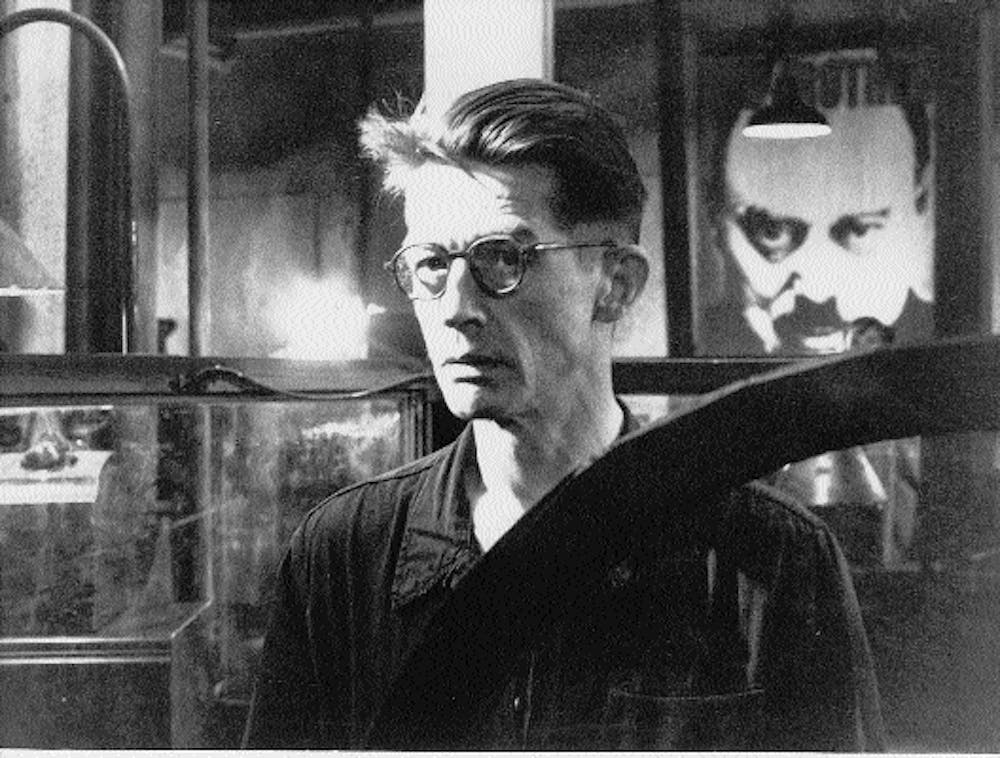
This is as opposed to watching from above, like when we are surveilled by CCTV stuck on a building wall such as in George Orwell’s dystopic Nineteen Eighty-Four.
Since Mann’s endeavour there have been many who have chosen this kind of blackbox recorder lifestyle, and more recently even Google has thrown in their Glass Project equivalent, as shown in the video below.
My guess is that we are about to walk into an era of Person View systems which will show things on ground level through the eyes of our social network, beyond just Street View fly-throughs.
Other notable lifeloggers include Gordon Bell of Microsoft and Cathal Gurrin from Dublin City University.
MIT Researcher Deb Roy lifelogged his son’s first year of life (with exceptions) by wiring up his home with video cameras.
When we talk about big data, you can’t get any bigger than this. Chunky multimedia, chunky files of all types from a multitude of sensors, and chunky data ripe for analysis (by police, the government, your boss, and potentially anyone).

But I have often wondered where these individuals have drawn the line – at which occasions they choose to “switch off” the camera, and why.
But this glogging still does not satisfy the possibility that I might be able to retain and indeed download all my thoughts for retrieval later.
A series of still photographs and continuous footage does help me to remember people I’ve met, things I’ve shared, knowledge I’ve gained, and feelings I’ve experienced. But lifelogging is limited and cannot record the thoughts I have had at every moment in my life.
However, there is an innate problem with recording all my thoughts automatically with some kind of futuristic digital neural network: I would not want every thought I have ever had to be recorded.
Let’s face it, no-one is perfect and sometimes we think silly things that we would never want stored, shared with others or replayed back to us.
These are thoughts which are apt to be misconstrued or misinterpreted, even perhaps in an e-court. We also do and say silly things at times which may not be criminal but are not the best practice for family, friends, or colleagues, even strangers to witness.
And there are those moments of heartbreak and horror alike that we would never wish to replay for reasons we might be overcome with grief and become chronically depressed.
Is more than human better?
Evolving in ways that could better our lives can only be a good thing. But evolving to a stage where we humans become something other than human could be less desirable.
Dangers could include:
- electronic viruses
- virtual crimes (such as getting your e-life deleted, rewritten, rebooted or stolen)
- having your freedom and autonomy hijacked because you are at the mercy of so called smart grids
Whatever the likelihood of these potentialities, they too, together with all of the positives, need to be interrogated.
Ultimately we need to be extremely careful that any artificial intelligence we invite into our bodies does not submerge the human consciousness and, in doing so, rule over it.
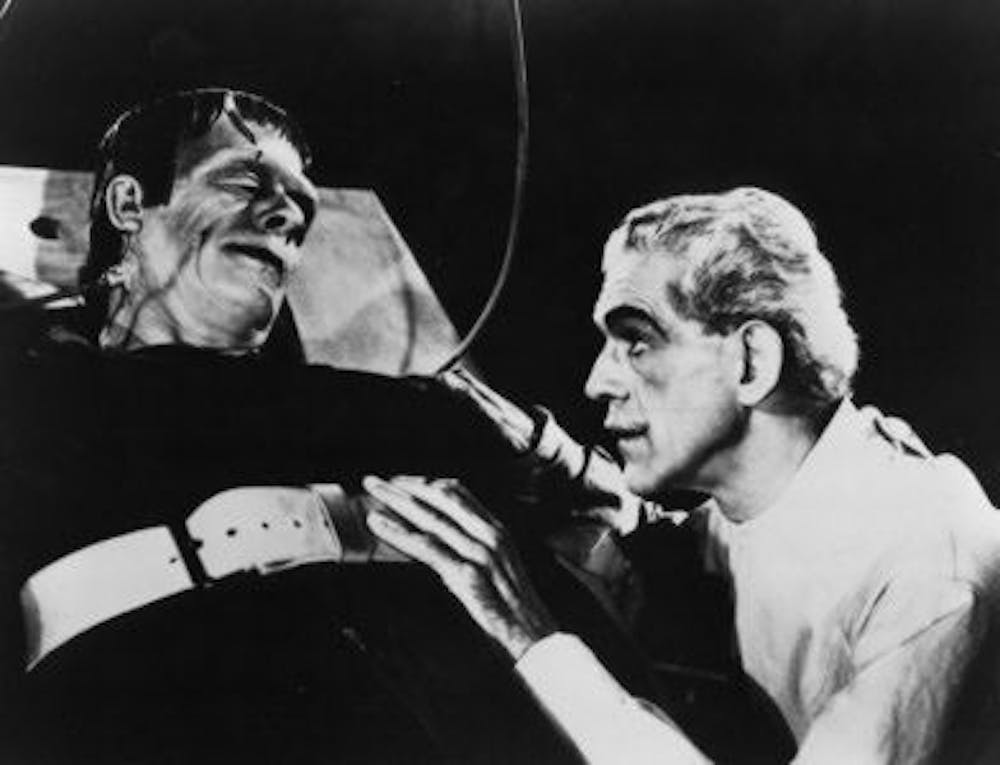
Remember, in Mary Shelley’s 1816 novel Frankenstein, it is Victor Frankenstein, the mad scientist, who emerges as the true monster, not the giant who wreaks havoc when he is rejected.
The author would like to thank her fellow collaborator Dr MG Michael, previously an honorary senior fellow at the University of Wollongong, NSW, Australia, for his insights and valuable input on the initial draft of this article.

Ryan Wittingslow
PhD student in Film and Philosophy at University of Sydney
You mention three possible dangers to which we may become vulnerable in the event that we embrace the promise of transhumanism. However I find it interesting that the three you mention merely contravene our rights, when I would think that the graver threats are existential in nature.
This is not to say that I buy into some neo-Heideggerian account of the means by which technology threatens our essential being (cf.: Fukuyama, Habermas, Kass, etcetera). I would claim, however, that we exhibit certain pro-social behavioral traits (say, art-making, bonhomie, compassion), and that extreme augmentation has the potential to change our form of life to the extent where we no longer exhibit those traits. Needless to say, this is probably an undesirable outcome.
Leo Kerr
Consultant
That could be the case Ryan but then it could equally eliminate anti-social behavioural traits (greed, envy, agression) which might be a desirable outcome
Yuri Pannikin
Director
"Ultimately we need to be extremely careful that any artificial intelligence we invite into our bodies does not submerge the human consciousness and, in doing so, rule over it."
Yes, Skynet cometh? Certainly some transhuman evolution will occur; that's inevitable. How much, and whether it will be controllable is speculative, and worth the effort of investigation.
It's always interested me how a battle might rage between inherent human/animal genes and artificial intelligence. I can't see genetics defeating the logic of advanced AI -- notwithstanding AI's human origin -- no matter how sophisticated our 'human' analysis.
Chris Booker
Research scientist
"It would be much easier if I could just make a mental note to record an idea and have it recorded, there and then."
aka memory.
Tim Scanlon
Debunker
Our memories are not actually very good at all. Not that I'm saying data storage is vastly better, because it degrades and becomes redundant as well.
Chris Booker
Research scientist
Agree our memories may be fallible, and that data storage has it's problems, but let's just think this through a bit:
- say my mate Bob said to me "let's meet up for a beer at Sammy's on the 25th, about 5".
- "sure" I say, and then forget.
Later on I decide to go back to my fancy transhuman data bank full of memories and I'm thinking, when was I meeting Bob for a beer? Now, what would be needed to get back my original memory (or video recording of the event):
- Your data bank would need…
Read moreTim Scanlon
Debunker
I agree with your points. The physicist Michio Kaku did a series that discussed how to turn sci-fi into reality, in one episode he did superhumans and the memory thing was something he talked about.
http://www.youtube.com/watch?v=t-emrD0MS4Y
Seamus Gardiner
Citizen
Thank you for the article, whilst still fantastic, it is truly fascinating. I think there's two strands to unpick in this article:
Read moreIn respect to recording neural activity, or thoughts if you wish, in what format that is coherent to others (readers?) is this to be recorded? Given that it is only when concepts are articulated by Broca's area in the brain that concepts in grammatical form are reified, how would others translate the thoughts formed by another that are sensorial or abstract? If the technology…
Peter Kinnon
Writer
While there are many interesting facets to this article there is an underlying assumption of the validity of transhumanism.
This is, of course, not at all uncommon and is a reflection of the quite natural anthropocentric bias that is the legacy of our genetic and cultural heritage.
The reality, usually completely overlooked by proponents of transhumanist fantasies, is that the evolution of the next predominant cognitive life-form on this planet is well under way. Its gestation taking place…
Read moreYuri Pannikin
Director
"The reality, usually completely overlooked by proponents of transhumanist fantasies, is that the evolution of the next predominant cognitive life-form on this planet is well under way."
I doubt the author has overlooked that. Note the quote I responded to in my earlier post. Anthropocentricity in such debates is, by definition, inevitable.
Even so, I agree that whether we need to be fearful of some future intelligence 'submerging the human consciousness', is somewhat moot.
I'm not sure that I care -- unless I was made a slave ;-).
Seamus Gardiner
Citizen
The possibility of the Internet transcending its current form and emerging into a conscious AI makes good fiction. The severest limitations to this as a possibility lay in the random architecture of the web the inability of the web to interpret its sensory inputs and the paucity of connections. The only way wet brains cando what they do is because ey are designed and pruned and configured by ruthless evolutionary pressure. The human mind is created from a modular architecture that is not a feature of the Internet.
Any emergence would be self realising, not driven bottom up from architecture.
Peter Kinnon
Writer
But, Yuri, as I am sure you would agree, in any serious discussion anthropocentricity must not be allowed to preclude objectivity.
Also, I have not suggested that the subordination of our species is something of we should necessarily be fearful.
Indeed in chapter 16 of my first book "Unusual Perspectives" I paint a picture of a very rosy future that might possibly be ours if only we are smart enough to become successful symbionts of the new cognitive entity.
That is probably over-optimistic, though!
Given the track record of our species for violence and hostility, extinction may be a more likely outcome.
But it is generally more fruitful to aspire to the positive, n'est pas?
Peter Kinnon
Writer
Au Contraire, Seamus, the relentless evolution of technology that has taken place in the collective imagination of humankind over the last 2,5 million years has reached the stage where it will have soon honed to perfection the transition of what is now the Internet into the next imaginative phase of an overall evolutionary process.
An evolutionary continuum that can be traced at least as far back as the formation of the "construction kit" of chemical elements in stars and supernovae.
Contrary to popular belief, although there is a strong stochastic component in its assembly (as with biological entities), there is no way that it can properly be described as a random structure.
Which, I suspect, if you take you time to think it through carefully, would have to admit.
Yuri Pannikin
Director
Peter, I don't hold up too much hope for a civil human future, but yes, we should aspire to utopia.
Perhaps the logic of AI will decide that it would be a better place if we all got on together and solved a few problems. On the other hand, Skynet may not give a damn about animal life. Machines R Us?
BTW, Kurzweil seems upbeat about human futures, in the short term at least.
Seamus Gardiner
Citizen
Yes the Internet is structured, but not not in a way immediately conducive to self organisation or, I suspect, sentience. It is wild speculation and good fiction at this stage. Applying teleology will not help.
Yuri Pannikin
Director
Not immediately, no, but notwithstanding the accuracy (or not) of Moore's Law, one would have to believe that some cataclysmic event would be required to prevent a future hundreds of years from now that was not inconceivably altered in terms of human-machine interaction, and perhaps consciousness.
I'm no teleologist, but one doesn't have to be.
Leo Kerr
Consultant
when the singularity happens (coming your way soonish - say 2050) - all bets are off ...... we might rightly be considered a virus as agent Smith recounted to Morpheus during his interrogation.
Yuri Pannikin
Director
And agent Smith is right. We will over-run this planet, and a logical being, in the presence of all knowledge, and some sentient emotional and perhaps cosmological attachment to biological life (?), will do the only thing that makes sense.
Cull!
Seamus Gardiner
Citizen
Yurt,
That wasn't my point. Read the thread above, it's about he Internet becoming sentient.
Yuri Pannikin
Director
Yes, I know . . . I was attempting to conceive of an internet evolved over 200 years and not just 30 -- considering the pace of technology change. Having fun with this.
I agree that a 'sentient internet' is a tall order considering that the primate brain is around 50 million years evolved, Homo (from habilis) around 2 million.
A human brain may have 100 billion neurons and 100 trillion synapses and a complex of biochemical neurotransmitters and hormones for communication and function, as I…
Read moreYuri Pannikin
Director
A few further thoughts. Cook in 1770 in that small, wooden boat could not have conceived of an iPhone or the internet - not in his wildest dreams. Unknown unknowns.
Yet now the pace of change is exponential compared to Cook's era.
What might we expect in another 250 years of increasing sophistication of biotechnology, including possible bio-quantum computers, nanotechnology and gene manipulation all melding into one biotech paradigm? We must be less than 50 years away from some form of reliable…
Read moreSeamus Gardiner
Citizen
Thinking about your comment, and its a very interesting subversion, I don't know that biological mediators of cognition could ever be grafted onto a bionic substrate. Eg. Hormones/neuro transmitters would never articulate with electrical systems, but I suspect the answer is that Artificial Sentience might apply arithmetic analogues of neurotransmitters to simulate emotion.
Yuri Pannikin
Director
"Artificial Sentience might apply arithmetic analogues of neurotransmitters to simulate emotion."
Yes, that occurred to me as well. But when you say "would never articulate with electrical systems", you will be aware that the human body makes good use of bio-electrical systems - sinus node in the heart, CNS for example.
Pure speculation of course, but I'm thinking more of 'seamless integration' in the longer term rather than 'grafted on'. But as you say, an arithmetic approach may be more applicable, depending on the bio-sophistication of the entity. If we can augment humans with semiconductor enhancements, why not augment robots with biological enhancements? Tougher call perhaps, but worth consideration.
There's an interesting discussion on TED Conversations that discusses biological and physical electrical systems similarities. Some useful comments.
http://www.ted.com/conversations/9089/our_bodies_are_amazing_nano_mi.html
Seamus Gardiner
Citizen
Yep,
I understand how the synapse works and neural transmission occurs. It is electrochemical, not electrical. Whilst an electrical stimulus will provoke neural depolarisation I'm not so sure that that bathing a electrical circuit with a fluid containing hormones will provoke any response... Or if it did you would need an analogue of cellular receptors... Why bother when you could use an algorithm to provoke the same response?
There's a deeper philosophical problem of whether you can actually program a self actualising emotion-producer. What would you do if the only way you could feel angry was to press a button on your chest marked 'angry'? Would you press it?
Yuri Pannikin
Director
Yes, cell receptors (gateway proteins for cellular absorption of biochemicals) would be required for activation of hormones etc. Clearly, sloshing droid or network circuits with chemicals is not going to work, and simulating receptors in code doesn't sound like a good idea either!
But this goes to the core of the issues of sentience and self-awareness. For example, the 'fight and flight' hormones, noradrenaline, adrenaline, and then cortisol are inherent in animal 'fitness' (evolutionary fitness…
Read morePeter Kinnon
Writer
As you point out, Yuri, we have to be rather careful in our use of the word "sentience".
For the empiricist, however, its meaning can be resolved into two components:
Firstly, that of possession by an entity of sensory input. We would generally tend to extend that definition to include within this category information input of information that pertains to that entity as a prerequisite. This, of course, equates to consciousness, awareness of self.
At a very low level your web-cam with your…
Read moreYuri Pannikin
Director
Peter, anything that you or I write is anthropocentric, even if that is not your intention, because to suggest otherwise is oxymoronic. And I would suggest that the religiosity of the Singularity movement is indeed anthropocentric.
To suggest that the future of technology advancement in which AI's do not achieve sentience or even self-awareness is not necessarily anthropocentric. It may just be good analysis! Your position is a non-sequitur.
(Personally, I am not a humanist. I see Homo as just another genus out of control, driven by an accidental big brain to wreak havoc on a fragile planet.)
Even so, I'm not ruling anything out over large timescales, if you read my posts. But the Singularity in 2050? Give us a break!
Sure, I've seen reports of the work on carbon transistors and other approaches as well, but it's not a done deal, and silicon is the standard at the moment. Lets not get ahead of ourselves.
BTW, your webcam example doesn't do it for me for sentience!
Arthur James Egleton Robey
Industrial Electrician
". I see Homo as just another genus out of control, driven by an accidental big brain to wreak havoc on a fragile planet.)"
I see humans as a part of this planet.
Your statement is just another form of exceptionalism.
However this brings me to our purpose. Our purpose is to rescue the super-organism from the SUN's 20% increase over 4.5 billion years of the planets history.
The carbon sequestration technique used by Gaia until now no longer works and this has led to the unstable climate of the recent Ice Ages. This chaotic response is typical of a negative feedback loop that is no longer powerful enough to control. And the sun will relentlessly get hotter.
So we (Gaia) have to leave the surface of the planet and head up into the Void.
But first we have to do some ruthless pruning of H.Sap. We have built his numbers up so we can put some serious evolutionary pressure on his genepool..
Humans will not rescue Gaia. They are inadequate for the task.
Tim Scanlon
Debunker
I've been interested in this field a for a while but I haven't seen an appropriate discussion of one of the major flaws of cybernetic humans: redundancy.
I look at the huge advantages prosthetics and cybernetics can deliver to the disabled or injured, but I also look at the idea of operations to insert technology into the body. Moore's law pretty much dictates, and the photo of Steve Mann also illustrates this, that by the time you implant "new" technology it will be out of date. To upgrade you need another operation. At some point your technology is redundant and incompatible, and this isn't just a matter of getting a new phone or computer, this is major surgery.
This would be the major flaw I see with transhumanism, yet it isn't addressed. What role does this play, how would we get around it?
Leo Kerr
Consultant
I would suggest Tim that to upgrade such a system a jackplug or nanopill software would be a more elegant design with the internal hardware constructed in such a way to eliminate the need for major surgery - think Matrix.
Tim Scanlon
Debunker
Yes, but I still think that that technology would become quickly redundant as well.
I was watching a panel discussion with Neil DeGrasse Tyson were he was asked about extra-terrestrials. Part of that was him talking about technology and how amazing it is. His example was that an iPhone from today taken back to the 90's would be mind blowing, possibly leading to witch burnings, because of the massive changes in such a short period of time. Just think, we've gone from 5.25" floppy disks to 3.75", to CDs, to DVDs, to pen drives, to cloud storage in about 20yrs, that's only a fraction of our lifespans.
So upgrades would still be problematic, because you are going to have compatibility issues at some point.
Dianna Arthur
Dianna Arthur is a Friend of The Conversation.
Environmentalist
Also a factor to consider is 'built-in obsolescence'.
For example, imagine if your vision depended upon the next very expensive upgrade? You've just been retrenched to make way for a robot and welfare has been abolished due to right-wing libertarianism - after all you chose to have sight in order to hold down a job.
Will have more faith in such augmentation when big-corpa build with the future in mind instead of short term gain.
Dale Bloom
Analyst
I have worked on AI systems, but often the system would be an advisory system only. The system would give advice on what to do if a problem occurred, but if there were too many problems occurring at once, the problems often compounded to produce too much complexity for the AI system to handle.
There can also be a choice between two or more evils, and that requires risk assessment to finally decide what would produce the best outcome, although whatever path was chosen would not completely solve the problem.
Human have actually been developing forms of AI systems for centuries by developing laws and codes of practice to define what we can and can not do, and also developing religious doctrine to act as a guideline to help solve various problems.
I don’t think AI implanted into humans will ever be the ultimate.
Ian Donald Lowe
Seeker of Truth
"Human have actually been developing forms of AI systems for centuries by developing laws and codes of practice to define what we can and can not do, and also developing religious doctrine to act as a guideline to help solve various problems."
And how's that working out? With the corporations poisoning our air, water, soil and food; with the super-rich stealing more money than the GDP of all nations every year; with our guvmints taking us from one unjust war to another in the name of peace; with…
Read moreIan Donald Lowe
Seeker of Truth
Believe what you like but this transhumanism is evil. We are perfect as God created us, any problems that we have in our human form are caused by our human actions. Poisoned food, poisoned water, poisoned air and radiation poisoning are all human caused problems. When you understand that the pharmecutical medicines we are given do not cure disease but simply mask symptoms, usually with multiple un-wanted side effects, then you must surely realise that evil rules this world and evil tries to rule the minds of men. But we have free will so we can turn away from evil and accept God's love if we choose to do so.
These seductive false promises of eternal life and enhanced living are evil incarnate. That is how evil works, it seduces by offering you the things you desire the most but there will always be a price to pay and you know it. Turn away from evil before the clock runs down. Time is running out.
Tim Scanlon
Debunker
So the kid that is born with no arms and legs is perfect?
So the kid born with their organs the wrong way around is perfect?
So the kid born with the heart defect is perfect?
You might want to reassess your belief structure there Ian.
Ian Donald Lowe
Seeker of Truth
That argument might have substance except that transhumanists couldn't care less about the child with birth defects, they are only interested in extending and augmenting their own selfish lives. Indeed, if they ever get near their goal, the second part of the agenda will come into focus. It has been mentioned in another comment already, the great cull of humanity. So who do you think they would choose to cull and who would they choose to allow to live (who's playing God now?)???
These defects you mention Tim are most likely caused by something manufactured. In other words, they were caused by humans. If they were not I would be very suprised. I have not suggested that people with medical problems should not be given the best possible help available but that is a totally different thing from an intellectual circle-jerk planning how to transform themselves into 'Gods'.
Seamus Gardiner
Citizen
Would a god reject a transhuman? Would only the unaugmented aspects of the soul be subject to holy audit and judgement? Would the soul be affected by transhuman augmentation? We need some clerics to sort this out pronto.
Tim Scanlon
Debunker
Rather than address my arguments you have shifted the goalposts Ian.
Also, it is completely incorrect to say that birth defects are caused by people.
Arthur James Egleton Robey
Industrial Electrician
Too late, I'm Here. And I wear glasses.
Did you humans think that you were evolution's destination?
My next problem is how to relate to my machines that are far more intelligent than I.
Suggestions, Anyone?