
The floods in Queensland and Northern New South Wales and the extensive January bushfires which caused destruction across Tasmania, Victoria and New South Wales confirm that we need to rethink how we plan for, and respond to, natural disasters.
Many believed the 2010-11 floods and cyclones in Queensland were an aberration. The term, a “one in 100 year event” provides people (including those responsible for disaster management) with a false sense of security.
How can a one in 100 year event occur twice in two years?
Changing the terminology to a “100 to one chance” of occurring every year does not clarify the risk for the person whose house or business is flooded so soon after they have rebuilt. It also ignores the fact that serious weather events are occurring more frequently, with greater severity each time.
Communicating risk
According to the United Nations Centre for Research on the Epidemiology of Disasters, the frequency of climate related disasters such as tropical cyclones, typhoons and hurricanes has increased tenfold since records began in 1950. Climate change will continue to make weather patterns less predictable and more extreme. We need to reframe our language.
In recent times there have been major improvements in the quality of warnings from the Bureau of Meteorology and SMS based systems such as Emergency Alert. But in every event, there are those who ignore the advice. Risk communication and the information given by political leaders and experts needs to change to reduce the complacency, and in some cases cynicism, in the community.
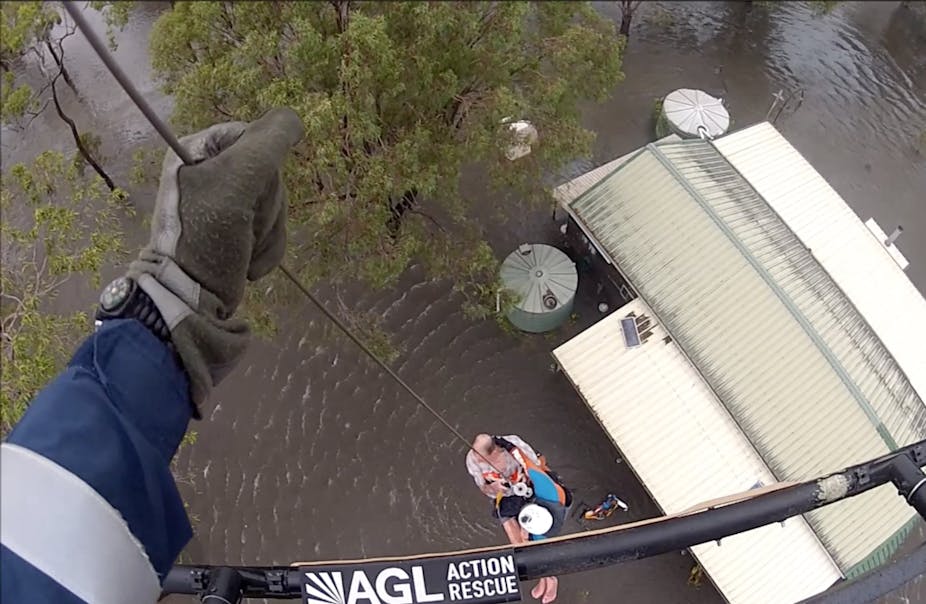
We must find a way to make people take seriously the calls to evacuate before it becomes too dangerous to do so. The images of citizens in North Bundaberg being plucked from their rooftops by helicopters, only hours after authorities had told residents to leave, or of vehicles trapped in flood waters despite the much repeated public message of “if it’s flooded, forget it”, should cause all of us to rethink this messaging.
This anti-social behaviour not only puts emergency services heroes, many of whom are volunteers, at great personal risk but also diverts resources from other critical response activities. Public messages about the dangers are just not getting through. Perhaps it is time for a community debate about stronger deterrents such as legal sanctions.
Planning for the new normal
In terms of disaster planning and preparation, the traditional orthodoxy is no longer enough.
This century we have seen hurricanes Sandy and Katrina devastate North America, earthquakes and tsunamis wreak havoc in Japan, Aceh, Sumatra, Samoa and Christchurch, and the Gulf of Mexico choked by a massive oil spill. At home, we have been battered by fires and floods, followed by more fires and more floods. These experiences have shown that our planning assumptions have been too narrow.
We must be capable of responding to unpredicted or unpredictable events. Relationships are critical to successful planning, response and recovery. They need to be developed during “peace time” so that roles and responsibilities of all agencies are clear when disaster strikes. Training must not only focus on particular skills but also on the roles and relationships of those involved in the development of an agile, flexible, scalable, and sustainable disaster management system.
The serious gap in disaster management policy in Australia is the need for integrated policy and funding focused on building resilience.
According to US National Academy of Sciences:
Resilience is the ability to prepare and plan for, absorb, recover from and more successfully adapt to adverse events. Enhanced resilience allows better anticipation of disasters and better planning to reduce disaster losses — rather than waiting for an event to occur and paying for it afterwards.
This requires a much greater injection of resources into both mitigation and adaptation to reduce the personal, economic and environmental costs of natural disasters.
Mitigation and adaptation
Greater investment in infrastructure, such as levees, sea walls, dams; and construction initiatives such as fire resistant materials, raised housing and earthquake tolerant foundations can reduce the impact of disasters.
Community awareness and information can be enhanced through initiatives to improve weather and hazard forecasting, hazard mapping, warning systems and evacuation procedures.
Regulatory reforms such as the requirement for local, district, state and national disaster plans, land use planning and zoning requirements and disclosure requirements such as flood or fire vulnerability at point of land, house or business sales are also a part mitigation and adaptation initiatives, many of which are relatively low cost.
Community expectations of what the government must do for them in the wake of natural disasters are increasing. That is how it should be.
But building resilience requires a shared responsibility between individuals, local communities and governments. Improving how we talk to people and broadening our planning assumptions are good places to start.
Felix MacNeill
Environmental Manager
Thanks for an interesting article, Jim.
Of course, because you suffer from apparently incurable rationality and dared to mention climate change, I expect that the interesting discussion around the important issues you raise will soon be derailed by the usual Conversation vultures swooping to pump out disinformation.
In the meantime, I think you point about people ignoring warnings and then relying on the SES to rescue them is important - as you say, a huge waste of public money and an avoidable…
Read moreDoug Hutcheson
Poet
"we could at least avoid 'throwing good money after bad'". Unfortunately, it is politically expedient for pollies to be seen to be "taking care of" the battlers, by giving them money to replace possessions and rebuild their houses (usually, on the same block of land - how stupid is that?). To be fair, some battlers cannot afford comprehensive insurance coverage against flood and fire. Do we further penalise impecunious "battlers" by not helping them to recover from a disaster? It is a vexed question.
Felix MacNeill
Environmental Manager
Yeah, it is vexed, Doug.
But I still think the one thing you can be pretty certain that isn't worth doing is rebuilding the same thing in the same place.
I think we absolutely must help the genuine battlers - and there are still a few of them in this country - but I think that, as a society, we have a right to require that the assistance be dependent upon actually fixing the problem, either by building elsewhere (i know that canb e complex, but it's not insoluble) or building in a more apropriate way - whatever is most sensible in the context.
George Michaelson
Person
Rather than "one in 100" I think we should refer to the frequency of floods in a 5, 25 and 100 year timeframe.
If we have had 3 floods in the last 5 years, 4 in the last 25 years and 5 in the last 100 we can see that in the immediate short term, there might be increased risk, and that its an increase against more recent, and long-term trends.
That means we can make more rational assessments on the same scale of investment: it would be foolish to assume there will be no flood in another 5 years, and insane to assume there is no flood in the next 25. Therefore investment in flood mitigation with a 5 or a 25 year payback is worth considering.
Riddley Walker
.
one in 100 was always a stupid way of measuring weather events
Dale Bloom
Analyst
There were 2 major weather systems that occurred in Nth QLD, that also affected the rest of Australia.
2 tropical cyclones developed in the Coral Sea well off the Australian coastline, and as these drifted southwards, they also took a considerable amount of moist air with them, leaving dry air to the west.
This affected Australia, and was responsible for much of the hot, dry weather experienced late in 2012 and early in 2013.
Then another small cyclone formed west of Townsville, which decreased into a rain depression that drifted west over the Australian coastline and then southwards, bringing considerable rain to many coastal areas.
The chances of such systems occurring depend on wherever cyclones or rain depressions travel, and apparently the number of cyclones forming in the Coral Sea has not changed for decades.
Grendelus Malleolus
Senior Nerd
"The chances of such systems occurring depend on wherever cyclones or rain depressions travel, and apparently the number of cyclones forming in the Coral Sea has not changed for decades."
Dale, that is true - current modelling does not predict dramatic increases in the frequency of cyclone formation and a gradual increases in wind intensity. The same modelling does predict a much higher level of precipitation from cyclonic systems and this has been observed already in the increased rate of heavy precipation events (cyclone and non-cyclone related) that are the result of a higher water vapour content in tropical atmospheric regions.
This is a critical factor in a state like Queensland that has a large number of population centres along the coastline within the tropics and subtropics that are prone to flooding.
Grendelus Malleolus
Senior Nerd
Forgot my reference!
Knutson, Thomas R., John L. McBride, Johnny Chan, Kerry Emanuel, Greg Holland, Chris Landsea, Isaac Held, James P. Kossin, A. K. Srivastava, and Masato Sugi. "Tropical cyclones and climate change." Nature Geoscience 3, no. 3 (2010): 157-163.
Dale Bloom
Analyst
A view of cyclone tracking maps of cyclones near Australia for over 100 years, shows that most cyclones occur at sea, and only a few cross our coastline.
http://www.bom.gov.au/cgi-bin/silo/cyclones.cgi?region=aus&syear=1906&eyear=2006&loc=0
In the past, one cyclone travelled all the way across Australia, while another went from WA, through the center of Australia, and then up into the Gulf of Carpentaria.
Today, such events would be blamed on Climate Change, which is a catchy prase that can be used for just about anything.
There is nothing exceptional about current cyclones, except they can affect more people, because there are more people.
As long as ponzi demograpers want to increase the population, and real estate developers continue to build houses, shops and offices in flood prone areas, there will be more flooding that affects more people.
Grendelus Malleolus
Senior Nerd
"A view of cyclone tracking maps of cyclones near Australia for over 100 years, shows that most cyclones occur at sea, and only a few cross our coastline."
Hmmm
Most cyclone start at sea (all is probably even not stretching things too much given how cyclonic systems develop).
However, BOM will also tell you that you need to be cautious in using data on cyclones prior to the satellite detection age becuase the means of knowning that a cyclone was occuring were that you had to monitor it from…
Read moreDale Bloom
Analyst
The frequency of cyclones has not increased, but the wind strength has?
No, I can’t understand that.
Regardless, much of the weather of the east and west cost of Australia in summer depends on cyclones, and whether they cross the coastline or stay at sea.
The previous QLD government allowed 400,000 people to come into the state in 5 years. They said this was a sign of growth.
Now there are a number of towns such as Mackay that are waiting time bombs, because they will go underwater eventually, and many of the new houses and new office buildings will be covered in mud.
After this lot of floods, it will be interesting to see whether the current QLD government wants even more people to come into the state, to live on flood plains and reclaimed wetland areas.
David Arthur
n/a
Thanks for the article, Jim, in which you note that "In recent times there have been major improvements in the quality of warnings from the Bureau of Meteorology and SMS based systems such as Emergency Alert," adding that "... in every event, there are those who ignore the advice."
To this problem, you propose a solution based in thoughful governance: "Risk communication and the information given by political leaders and experts needs to change to reduce the complacency, and in some cases cynicism, in the community."
Alternatively, there is the "free market" Darwinian approach favoured by advocates of small government, which will tend to "weed out" those who both ignore the advice and are not able to deal with the emergency with their own resources.
Bruce Esplin
logged in via Twitter
Good article Jim - I would add three other points:
Firstly, emergency warnings require high quality intelligence gathering to develop the situational awareness to feed the critical emergency warning systems - Emergency Alert, ABC radio, agency websites and social media - even sirens- to name a few. The technology to support intelligence gathering and development of far better situational wareness largely exists - but receives insufficient funding and even agency interest. This must change. Only…
Read moreBen Beccari
Disaster Manager
The responses to the most recent flooding that I have heard in the media are so ridiculously clichéd (e.g. I never thought it would happen to me, I thought we'd have a good 30 years before getting hit again etc.) that I wonder whether we're ever going to get our message across.
I think we need to dump all use of likelihoods and probabilities from public communications and get the media to do so too:
- People don't understand probabilities.
Read more- It doesn't tell you anything about the consequences…
Felix MacNeill
Environmental Manager
Ben, I don't think actual frequency of events is the same thing as the cost impact. Undeniably, a large part of the increased cost is indeed because we're talking more peole and more stuff in the impacted place, but I think there is, quite separately, good information indicating that the frequency and/or intensity of disaster events is objectively rising and doimng so pretty consistently.
Therefore I think it's not so much that "it's not (primarily) due to with climate change" as that "it's not only climate change, but a combination of greater frequency/intensity caused by climate change AND the fact that there are more people and things in danger" - in crude terms, a double whammy.
Felix MacNeill
Environmental Manager
Ben, I guess you sort of actually said the same thing I did - sorry if I seemed to "correct" you - not really the intention - more to build on what you said...
STABLE POPULATION PARTY
Written & authorised by William Bourke, Sydney
A central part of the solution is to stabilise population. Population growth requires more and more marginal land to be built on, exacerbating the problem - and the clean up bill for all taxpayers.
Dale Bloom
Analyst
I would agree with that. Cities such as Cairns, Townsville and Mackay exist only a few feet above sea level. Someone can dig a hole 4 feet deep and hit the water table.
Those areas are in a cyclone zone and also subject to storm surges, but the populations have increased dramatically in recent years.
Some people make money from increasing the population, but eventually a cyclone will hit the area with loss of life and massive building damage due mainly to flooding, and the taxpayers are then asked to pay for it.
The taxpayers lose their money, but the ponzi demographers and real estate developers have already left the area some time ago with full bank accounts.
Tim Scanlon
Debunker
Climate change: bringing you the one in one hundred year event every year.
Michael Shand
Michael Shand is a Friend of The Conversation.
Software Tester
Great Article, thanks for posting
Whyn Carnie
Retired Engineer
The Heading drew my attention but the content skirted the topic. There is no "new normal" only more people in positions of influence who haven't been around long enough to be able to recall the old normal. When these are then confused by others who put the environment, ecology, the meaning of 100-year events and economics into the equation in warm fuzzy terminology, we get to where we are today.
Take some for instances. Politicians took over the operation of Wivenhoe. It would have worked to everyone…
Read moreAlice Kelly
sole parent
"Community expectations of what government must do for them in the wake of natural disasters are increasing. That is how it should be."
"Improving how we talk to people and broadening our planning assumptions are good places to start"
I agree almost with everything written in the article, however It's not just the term "1 in 100 years" which needs to be re-considered. "Natural disaster", to me implies something which happened last century, or earthquakes and tsunamis. The prevalence…
Read more