Preventing suicide among gender and sexual minorities

Lesbian, gay, bisexual, transsexual, and intersex (LGBTI) people were recognised as being specific high-risk groups for suicide in a 2010 senate committee report. While every suicide may not be preventable, a focus on the particular associated predictive factors may help. Transgender individuals were…

C76d9wcf-1361250826
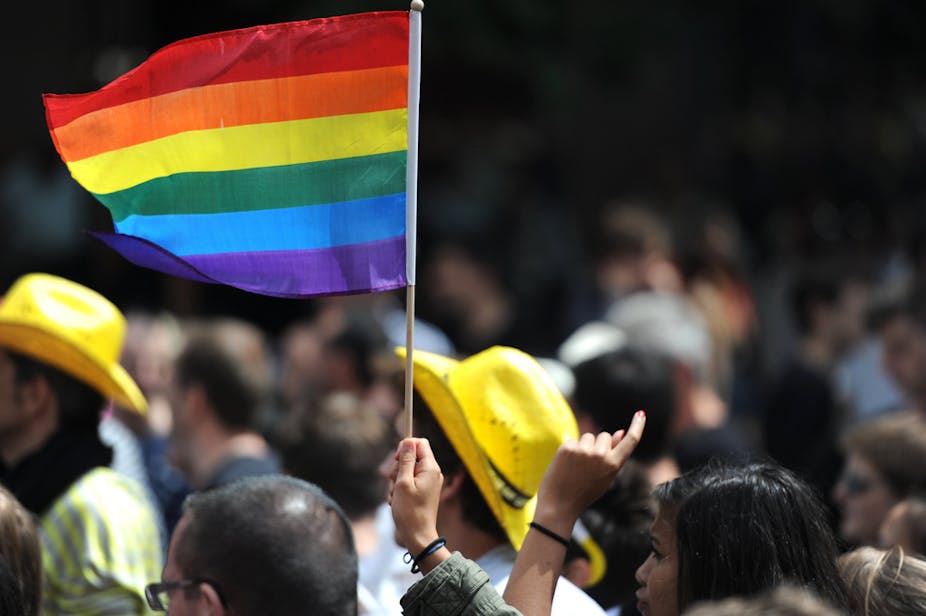
Gender and sexual minorities are known to be at high risk of suicide. Guillaume Paumier

Lesbian, gay, bisexual, transsexual, and intersex (LGBTI) people were recognised as being specific high-risk groups for suicide in a 2010 senate committee report. While every suicide may not be preventable, a focus on the particular associated predictive factors may help.

Transgender individuals were singled out as being at particular risk in the report, and the committee recommended that these groups be recognised as being more vulnerable to suicidal behaviours and that a “targeted approach” to prevention and awareness be put in place.

But what is the actual evidence for this elevated risk? And what, if anything, has been shown to be effective in terms of prevention?

While there’s been a lot of international research on suicidal behaviours among sexual minorities, particularly in the United States, there have only been a few studies carried out in Australia. Still, the international research does indeed point to a heightened level of vulnerability.

The first population-based study on the relationship between sexuality and suicidality in young males, for instance, found that gay males were 13.9 times more likely than heterosexual males to have attempted suicide during their lifetime.

Other international studies have found lesbian, gay, and bisexual individuals to be at a higher risk for suicidal ideation, suicide attempts, and suicide. Lesbian, gay and bisexual adolescents appear to be at particularly high risk.

The limited research conducted in Australia also indicates a high level of risk among lesbians, gays, and bisexuals. Although no population-based studies have been carried out, research based on a sample of 4,824 people from the electoral roll in Canberra showed that gay men were at a higher risk for suicidality than heterosexual men, and bisexual men were at a higher risk than gay men.

What’s more, statistically significant differences in “feeling suicidal” between both gay and bisexual men and heterosexuals were found in men living in Melbourne.

There have been no studies reporting the level of risk for minority gender individuals in Australia, but a US study found 32% of a group of 505 transsexual people surveyed had attempted suicide over their lifetime.

Surprisingly, given all this evidence for heightened risk, very little has been done in terms of specifically tailoring mental health campaigns (let alone suicide prevention initiatives) to minority sexuality and gender groups. One intervention carried out in Utah in the 1970s, in which individuals in a gay community were trained as advocates and staffed a 24-hour crisis line, saw emergency room visits due to suicide attempt fall from an estimated six to ten per month to just three over a seven-month period.

Given the particular risk for suicidal behaviours during the teenage years and the “coming out” process, schools have been the focus of different preventative activities. An evaluation of the implementation of the Massachusetts State Board of Education’s recommendations to improve the school environment for lesbian, gay and bisexual students found those attending schools without “gay-sensitive instruction” were at greater risk of suicide.

A supportive school environment clearly acts as a buffer to suicidal behaviours among lesbian, gay, bisexual, and transgender students. Indeed, a study of Austrian gay and bisexual individuals found that suicide attempts at school were associated with a lack of acceptance, and positive reactions to “coming out” offset this risk.

Given the evidence for this heightened vulnerability, it’s important for prevention campaigns to target lesbian, gay, bisexual, and transsexual, and intersex people by being culturally relevant, accessible, and focused on the specific factors that increase the risk for suicidality. This is particularly the case during adolescence when young people are especially vulnerable while coming to terms with their sexuality or gender-identification.

Encouragingly, the Department of Health and Ageing recently launched a national suicide prevention project specifically targeting LGBTI individuals. The initiative provides a platform for learning from the experiences of other countries and puts into place strategies that have been shown to be effective. This includes safer and more tolerant schools and communities, well-designed advertising campaigns, and the provision of help services that are sensitive to the needs of lesbian, gay, bisexual, transsexual, and intersex adults and youths. Such campaigns will need to be evaluated to measure their effectiveness.

Many suicides are preventable. When risk groups are identified, as is the case with LGBTI individuals, it is incumbent on us to use our knowledge about how to help people to the greatest possible extent.

Sign in to Favourite

Want to follow The Conversation?

Sign up to our free newsletter to get the day's top stories in your inbox each morning, with a special wrap on Saturday.

Spinner
Help us have better conversations — donate

Join the conversation

36 Comments sorted by

  1. Robert McDougall

    Small Business Owner

    i'd put this phenomena to the intrenched discrimination arising from religious traditions and how those traditions have moulded society over hundreds of years.

    This whole argument about "tolerence" is misguided. Gay people are not to be "tolerated" as there is nothing wrong with being gay. It is only the person "tolerating" that is displaying perhaps unconscious discriminiation.

    The only "acceptance" that is valid is the acceptance that the person doing the "tolerating" is being discriminatory.

    Using religion as a smoke screeen to hide or justify discrimation perhaps only decieves the "tolerator" as to their bigotry or homphobia and if you are called a bigot or a homophobe repeatedly, perhaps there is some truth to the accusation.

    The young usually don't have the skills to defend against these people, and sometimes they believe what is told them if it is repeated often enough.

    report
    1. Mark Amey

      logged in via Facebook

      In reply to Robert McDougall

      I agree, Robert, the minute one decides they will 'tolerate' someone else is the minute one realises that one is discriminatory. I'm sure that if any other facet of society had such a huge suicide rate, there would be all sorts of funding for programs. I guess the work described in the article is a good start.

      report
    2. Stephen John Ralph

      carer

      In reply to Robert McDougall

      Hi y'all

      I am a 62 y.o. gay man. So far in my lifetime I have had one acquaintance (gay) commit suicide, and that was about 20+ years ago. He had aids and drugs issues.

      As a comparison, over the past five years I have known of a dozen or more suicides involving people of one (some two) degree of separation (from me).

      I do not dispute the research, but wonder IF it treats the suicide of a gay person as being "gay" related.

      A gay person could just as easily commit suicide for drug, relationship…

      Read more
    3. Kim Darcy

      Analyst

      In reply to Stephen John Ralph

      My own lifetime experiences with suicide is similarly all over the shop. Far too many different types of people - many the most unlikely - have committed suicide to see any patterns. One thing about these sorts of articles and claims that worries me, is I have seen too many similar claims - for example, "epidemic of domestic violence against women", "rape culture", etc, which turn out to be based on research that is not only bogus, but unethical and more usefully described as "lies". And always, the people behind the research are campaigning for more taxpayer's money.

      report
    4. Kim Darcy

      Analyst

      In reply to Kim Darcy

      I also worry about this alarming trend to dump gay men and lesbians in with medical problems - intersex and transexuals, for example.

      report
    5. Stephen John Ralph

      carer

      In reply to Kim Darcy

      hi Kim

      that sort of happened over the past ten years or so.

      I'm not fussed by it, but it does seem to be a convenient acronym - LGBT - to cover a multitude of sins.
      so to speak.

      report
    6. Kim Darcy

      Analyst

      In reply to Stephen John Ralph

      I worry that it takes gay and lesbian kids today back 50 years to medicalising their sexuality be association.

      report
    7. Stephen John Ralph

      carer

      In reply to Kim Darcy

      Hi KIm

      good point - I hadn't thought of that. In "my day" there were only drags of the king and queen variety.

      And for the dragqueens, a simple tuck without the nip,was the go.

      report
    8. Reema Rattan

      Editor at The Conversation

      In reply to Stephen John Ralph

      This may not be related, Stephen, but the people with the highest rate of suicide in Australia are identified as middle aged. I can give you a definite age range tomorrow if you like but the fact that you know a dozen or more suicides from the age range of 57-62 confirms this (I'm assuming you are speaking of your peers).

      The most interesting and saddest thing about this fact is that no effort has been able to curb the suicide rate in this group.

      report
    9. Reema Rattan

      Editor at The Conversation

      In reply to Kim Darcy

      I'm not sure intersex and transexual people are medical problems, Kim.

      report
    10. Stephen John Ralph

      carer

      In reply to Reema Rattan

      Hi Reema

      In fact the majority of the suicides that I mentioned were under 40,and a good many around 20 as I recall. I don't have any specific information as these cases had all been passed onto me as "news", and about people whom I did not know personally.

      Only one was a work colleague, whom I only knew to say "hi" to in the corridors. She was in her mid 30s. Her suicide was a result of a failed marriage.

      I note that the article mentions the U.S. several times. I would personally think that with a large % of fundamental christians in that country, as well as being far more focused on religion in general than Australia, "gay: suicide rates would be far higher than here.

      report
  2. Anthony Nolan

    Ruminant

    This is a very depressing report but valuable none the less. One of my kids is gay and I love that person very dearly. Recently, I realised the depth of Australian homophobia while residing with an old mate who would, from time to time, abruptly scream, and I mean scream, "faggot" at the TV screen whenever Christopher Pyne appeared; or whenever anyone appeared on screen who seemed suspect of same sex desire to this bigoted old leftie. Made me wanna puke, the sheer prejudice and hate of such speech; and this, despite the turd having met my child, having had him as a guest in our house...etc and so on.

    We have a long way to travel on path to equality of rights but distance doesn't tire the strong of heart. We leave the weak by the wayside and may they perish in a stew of hate.

    report
    1. Kim Darcy

      Analyst

      In reply to Anthony Nolan

      Anthony, I'm sure your gay kid could more than hold their own against your 70 year old 'faggot screamer at the tele'. But you should correct your old mate. Pyne is not a 'faggot'. He is a mincing poodle. Get it right. ;)

      report
    2. Judith Olney

      Ms

      In reply to Anthony Nolan

      Anthony, I have the same reaction to the casual sexism that infests our society, such as calling someone perceived as inferior, "a girl" , "an old woman" , "a bitch" , or any number of female denigrating remarks. This is no different to the casual use of "gay", "poofta", "dyke", "leso, lesbo, etc" , "butch", "faggot" (I wont name them all as there are thousands, and many that would set a moderators teeth on edge).

      How you describe your feelings about your old mate's comments, is how I feel every…

      Read more
    3. Anthony Nolan

      Ruminant

      In reply to Judith Olney

      Hi Judith. Well, I moved out and on from my old mate because his attitude and speech about women was even worse. And I have a daughter. He seemed incapable of grasping that every time he belittled women he was speaking about my kid. What can you do?

      I now reside in the bush where cultural attitudes towards women and gays are much more backward than I had imagined; rates of depression among women are very high and I'm not surprised given that many of them are treated as of less value than farm stock and plant. So, you learn to keep your mouth shut and choose your close friends carefully. Women's liberation doesn't appear to have established much a foothold in the bush over the last four decades and it is no surprise to me that many young people, gay or otherwise, get the hell out asap.

      report
  3. Tom Hennessy

    Retired

    It's a step forward that the LBGTQ community is conceding the mental issues in the LBGTQ community is much higher than the rest of the world.
    Maybe now someone will be able to also admit this 'brain abnormality' affects much more than increased suicide , depression and mental illnesses such as bi-polar. This increase in mental illness was denied when the removal of the LBGTQ community was being considered and then finally ratified as not a medical problem , removal from the DSM , the book of mental…

    Read more
    1. Stephen John Ralph

      carer

      In reply to Tom Hennessy

      Hi Tom

      As there was some obfuscation in your comment, can you clarify IF you mean to say that homosexuality is an illness. presumably one that can be treated.

      report
    2. Tom Hennessy

      Retired

      In reply to Stephen John Ralph

      Quote: IF you mean to say that homosexuality is an illness. presumably one that can be treated

      Answer: "Lifetime rates of suicide attempts among subjects with bipolar "

      Associated disease states , such as bi-polar or depression can possibly be treated but whether sexual orientation can be reversed or prevented can only be speculative .
      Meningitis has been shown to turn someone left-handed. Meningitis damage can be prevented by the administration of phosphatidylcholine.
      Choline deficiency has been shown to cause left-handedness.
      Which would make one wonder whether choline would treat depression or bi-polar.

      report
    3. Stephen John Ralph

      carer

      In reply to Tom Hennessy

      Hi Tom

      still waiting for an answer..........not further discussion.

      is homosexuality is an illness an in your opinion. A simple yes or no will suffice.

      report
    4. Tom Hennessy

      Retired

      In reply to Stephen John Ralph

      Yes it is an illness , proven by the courts. A car accident can turn one homosexual proving one can BECOME homosexual , therefore using logic , one may be able to STOP being a homosexual if one is able to 'reverse engineer' the reason a person becomes homosexual after a car accident.

      report
    5. Todd Waite

      logged in via Facebook

      In reply to Stephen John Ralph

      Stephen,

      It wasn't hard for him to type, but it sure hurt to read.

      I've just 'learned' that my left-handedness is the result of an illness which I've never had!

      report
    6. Stephen John Ralph

      carer

      In reply to Todd Waite

      Hi Todd

      been away for a day or so........

      Tom doesn't worry me - at least he's open about his prejudice.
      I mean Tom will never change his opinion, so why waste energy!

      report
  4. Delaney Skerrett

    Research Fellow in Suicide Prevention at Griffith University

    LGBTI individuals, as I have discussed them, are grouped together as sexuality and gender minorities for sociological reasons, not biological or medical.

    report
    1. Louella McCarthy

      SL Medicine in Society

      In reply to Delaney Skerrett

      Just to reiterate Delaney's point that this focus refers to social determinants of health, not biology or brain structures or whatever. Examining health outcomes from social constructs helps us to identify disadvantage, and with some work, address these disadvantages. This is not about saying that gender (for example) causes these health outcomes, the next step is to find out the 'why', why is the health outcome occurring and how can we reduce its impact.

      report
    2. Kim Darcy

      Analyst

      In reply to Delaney Skerrett

      Delaney, oh I am aware of that. That is what I am challenging. There was an article recently on the conversation about the death of the social sciences due to their refusal to engage with the natural/physical sciences. This grouping together of gay men and lesbians with folks with medical issues, such as intersex and transsexuals has been done too uncritically, without thinking through the ramifications.

      report
    3. Delaney Skerrett

      Research Fellow in Suicide Prevention at Griffith University

      In reply to Kim Darcy

      Kim, I don't actually see gender diversity as being a medical issue. It can and has been argued that the division of biological gender into two discrete categories is a cultural construction, which is reinforced by performative gendered behaviours that produce the illusion of two natural genders (sexes).

      report
    4. Kim Darcy

      Analyst

      In reply to Delaney Skerrett

      Delaney, you stick to the drag bars, leave the science to the grown-ups. Oh, and don't forget "performative gender inclusion"! Lo-lo-lo-lo-la!

      report
    5. Stephen John Ralph

      carer

      In reply to Kim Darcy

      perhaps I haven,t been out on the gay scene for like 100 years or so (that's what it seems like).

      But it seems to me that there has been a melding (not entirely of course) of the current generation.

      It is mostly about drugs of one sort or another these days, and alcohol too. I think its about a few generations lost in ennui of the time. There's problems for everyone - pressure to succeed in school, to be popular, to take in all the news about climate change and a thousand other apocalyptic…

      Read more
    6. Kim Darcy

      Analyst

      In reply to Stephen John Ralph

      The issue is, just as the psychiatrists have been told to piss off, the anti-intellectual Genderists from the Arts faculty now turn up, trying to make money out of ordinary people who just want to have sex with their own sex. It is best to maintain the rage against ignorance and academic carpet-baggers.

      report
  5. Dania Ng

    Retired factory worker

    Research has consistently shown that there is a strong association between mental health issues and homosexuality. Perhaps that's what funding should be focused on? Young people commit or attempt suicide for all sorts of reasons, least of which is because they are are discriminated against for their homosexuality. This is not to say that we should not do anything about it, of course we should! But in some studies homosexuality does not even make the top five or six ranked causes. Why then doesn't this publication focus more on other areas, for instance the high suicide rates in rural communities?

    report
    1. Delaney Skerrett

      Research Fellow in Suicide Prevention at Griffith University

      In reply to Dania Ng

      Hi Dania, LGBTI individuals make up just one risk group for suicide and there are indeed many others, such as rural populations, as you point out. This article was just focussing on LGBTI vulnerability.

      report
    2. Dania Ng

      Retired factory worker

      In reply to Reema Rattan

      Thank you for these links, I appreciate it that you have covered other groups at risk of suicide from time to time. The linked articles make for interesting reading. My comment was partly prompted by the disproportionate amount of material your website publishes on LGBTI 'issues', this remains a problem especially when one deconstructs the kind of political messages conveyed through them. Take for instance the last article in the Tasmania series "Churning the mud, etc..". It is still promoted on your front page under the advertisement for gay marriage more than ten days after it was printed.

      report