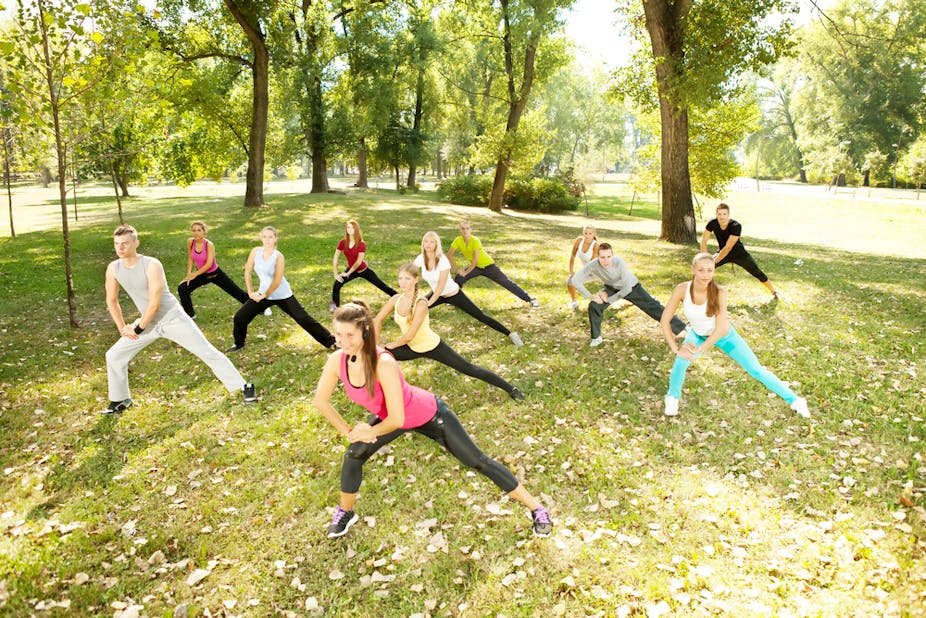
Fitness “boot camps” are becoming an increasingly common feature within Australian parks.
Typically, a personal trainer will charge a modest fee to instruct a small group that gathers in a public park to work out. Sessions usually last about an hour.
But as boot camps have grown in popularity, some park users and residents have become annoyed by the noise and competition for space. People have called for the practice to be closely regulated or banned altogether.
Is this fair and what are the alternatives?
The problem with boot camps
The trouble is that in some cities such as the Gold Coast, some park users and nearby residents are becoming fed up and complain their parks are “overrun” by boot camps. They want their local councils to do something about it.
Some boot camps have pumping music, training equipment and yelling instructors, which can disturb other park users and nearby residents. Some people also feel that businesses should not profit from public parks – at least not without giving something back to the community.
The Santa Monica City Council in the United States is considering closing down “boot camps” altogether, whereas the Gold Coast City Council, like some other Australian councils, is proposing to regulate them and charge instructors a fee for using public parks and reserves.
Boot camp supporters argue that participants have a right to use public parks, because they pay council rates too. Boot camps also benefit society by making people fitter and healthier. Some have questioned the right of local authorities to regulate park uses. This raises some important questions: Why does conflict occur in parks? Who are parks for? Who should decide what is acceptable behaviour in a park? Do local councils have the right to regulate park use?
What causes conflict in parks?
Researchers have found that conflict can occur in parks for multiple reasons. Park users may see these spaces as appropriate for some activities but not others.
Conflict can also occur because some park activities disturb or disrupt other park users, causing them to change the part of parks they visit, alter the time of day they visit, switch parks altogether, or switch the activities they undertake. Local residents can also be affected by high levels of park use.
Is conflict in parks new?
Conflict among park users is as old as parks themselves. Parks began as the hunting preserves of the social elite. Following the industrial revolution, when people flocked into cities from the countryside, urban reformers demanded private estates be opened to the general public to improve the life of residents. London’s favourite parks such as Hyde Park and Regents Park began this way.
In the United States, park designers copied the European model and deliberately created “rural-like” spaces in the city. These parks, which resembled landscaped gardens, were intended as places where people could escape the stresses of urban life, relax, and commune with nature, but also interact with each other. In principle, parks were democratic spaces.

But park designers also regarded early parks as “civilised” spaces for “passive recreation” – activities such as running and ball-games were regarded as ill-mannered and inappropriate. Some early parks developed reputations as places where prostitution, gambling, drunkenness, and robbery were common.
Park rangers and park police were created to regulate use, especially activities deemed immoral or offensive. Early Australian parks such as Sydney’s Hyde Park developed rules like “keep off the grass” to prevent park users from damaging park facilities, but also prohibited rude language, gambling, climbing trees, playing musical instruments, bathing, washing clothes and even singing.
Why and how are park activities regulated?
Regulating activities within parks and managing the behaviour of park users has occurred since the first parks were created. Usually this is done by developing local laws with penalties that apply for breaching park rules. Some rules make perfect sense. Playing golf or flying model aircraft can present a safety hazard for park users.
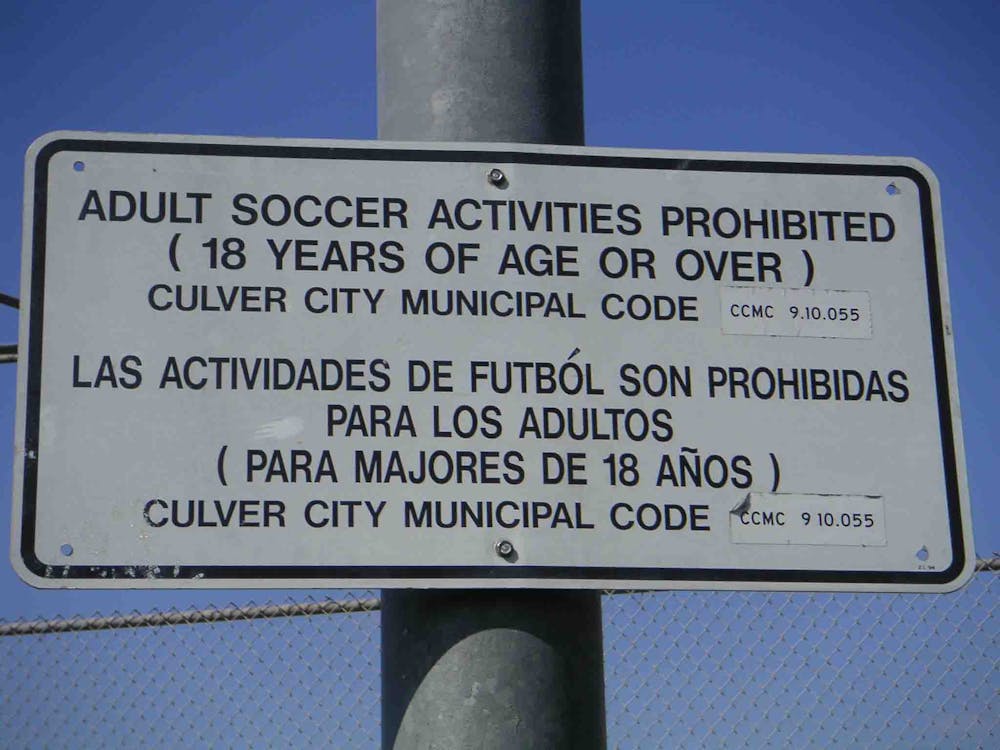
But other park rules can be discriminatory, excluding some racial or ethnic groups who enjoy particular activities. For example, Latinos in the USA have argued that prohibiting soccer excludes them from parks.
There are alternatives. Researchers have shown that the design of parks can strongly influence how parks are used and can thus reduce conflict. Carefully designing the physical space of parks may encourage some activities but make other activities difficult or unappealing. Subtle design cues can promote better behaviour without the need for fines, penalties or long lists of rules.
The space within parks can also be allocated for particular activities. Playgrounds, dog parks, skateboard parks and community gardens were once derided just as boot camps are today, yet they all have their place. And we can allocate activities according to time of day – designating places where activities are permitted at certain times but not others.
So what should be done about boot camps?
At face value, allowing boot camps in parks seems reasonable, especially in an era when public authorities are struggling to combat sedentary lifestyles and obesity. Researchers have found that parks can help people to be more physically active. Boot camps are common in parks in the United States, Canada and United Kingdom and are regulated through permits.
Instructors are required to have insurance and must operate in designated spaces at specific times of the day. Many councils around the world are also installing fitness equipment in parks. So it seems like a logical step to add boot camps to park programing.
At a time when planners and health officials are working to make parks livelier, more inclusive, and spaces that promote physical activity – boot camps surely have their place.
If rock concerts, art exhibitions, movies and food festivals are appropriate in parks – why not boot camps too?
David Sly
logged in via Facebook
Perhaps councils could embrace this and use our rates to offer free boot camp sessions for all! It would also then be much easier for councils to police the hours and locations.
Jacques de Vos Malan
author
Perhaps we should remember the saving in public expenditure on health care that will result from a fitter population?
Wil B
B.Sc, GDipAppSci, MEnvSc, Environmental Planner
Victoria is ahead of you, Jason. In 2010 the tour operator licensing scheme came into effect, meaning that anyone that was conducting recreation for profit on any public land was required to pay a per head fee (currently $2.40 for adults).
The biggest squealers were the personal trainers, who had been monopolising public land for private good.
If you’re interested you can read the regulatory impact statement where all of the thinking was laid out: http://www.dse.vic.gov.au/recreation-and-tourism/tourism-on-public-land/public-land-tour-operator-and-activity-provider-licence-reform-project
Cameron Murray
logged in via Twitter
Don't most Council parks have regulations surrounding commercial use? You need a permit and you get conditions about hours, visitor numbers etc? As Wil B notes, sometimes a fee is attached.
Nothing wrong with any of that. People will always whinge about new activities in 'their' public spaces. But my personal view is that Councils are doing a good job, and it is nice to see some people being active in the park, even if I cringe at their mock military training pantomime.
Jim Parker
logged in via Facebook
My problem is the space these groups commandeer. A boot camp occupies our small local park for an hour or two at a time, spreading its running cones and other gear around the entire space and leaving no room for people to do anything else. This particular park is also a rare dog-off-the-leash park, which means we can't exercise our dogs without them being shouted at by some lyrcra-clad, pony-tailed bimbo. When we complained to the council, the group insisted it was a non-professional club. Yeah, right.
Michael Duff
Public Servant
Derogatory generalisation = you lose.
Comment removed by moderator.
Jim Parker
logged in via Facebook
What I forgot to add is there is a principle at stake here. Parks are for public use, not for profit-making businesses. If boot camps want space, they should pay for a gym. Otherwise, this looks suspiciously like the enclosure of the commons all over again.
Trevor S
Jack of all Trades
Surely the people using the park are the public ?
You want access to a "free" exercise area for you and Snoopy, so are you banning yourself, or does this principle thing dry up suddenly ?
If Dog users were being charged, you would have a gripe.
Mat Hardy
Lecturer in Middle East Studies at Deakin University
Where I used to live in Sydney there was significant conflict over this, mainly to do with the timing. Most of the boot camps were happening in the very early morning. Being woken up at 6.30 on a Sunday by someone yelling "Just two more!" was the issue.
The only conflict I have seen in Melbourne was due to pig-headedness on the part of the instructor, who insisted that because she paid a fee to council, she had the right to run her class anywhere, any time in the park. In her opinion, this meant she had a perfect right to set up her cones on part of a football field during a match. (The club would have been paying significantly more than her to lease the space at certain periods.)
Comment removed by moderator.
Gary Cassidy
It would be sensible to regulate these activities in terms of time of day, location within a park, noise control, etc.
Through sensible regulation I think there will be ample space and opportunity for these activities to occur with affecting the amenity of local residents.
Having music pumping, instructors screeching, or activities sprawled over popular spaces would seem inappropriate.
Geoffrey Edwards
logged in via email @gmail.com
Maybe the solution relies on rediscovering and reordering the origins of public parks as "hunting preserves of the social elite."
We could turn them into preserves for the hunting of the social elite. That sould get the heart rate up.
Frank Arthur
logged in via Facebook
In Cairns, the Regional Council has for some time made available free boot camps, as well as aqua aerobics, beach volleyball, bouldering, “Boxinfun”, Heart Foundation walking, “Mumbalates”, Pilates, Sahaja yoga meditation, ViPR (Vitality, Performance and Reconditioning), yoga, and Zumba on the Esplanade. Locals and tourists can join these activities, which are generally held in the early morning or evening when it’s cooler. Because they’re free, as far as I know nobody objects!
Wren R
Policy and planning
The issue is not about having access to public parks for physical activity. Anyone can go for a run around the local park. It is that the fitness trainers are running a business in public open space. Considering these 'franchises' are frequently advertised as a great business opportunity I personally have no problem with the land manager (local/state governments) regulating the commercial use of that land. As a ratepayer I also don't want to be subsidising their business to operate in our public parks - so let them pay for the privilege.
Robert Moore
Street Sweeper
Noticed this earlier article about Boot Camps.
http://theconversation.edu.au/forget-boot-camp-exercise-doesnt-have-to-be-painful-5938
If other forms of exercise are more inclusive and possibly more effective in long term then Councils should be wary of allowing such businesses in public parks.
A sports facility like a football oval would be a better place for such activity than a park that is more focused by design or use on quiet enjoyment of gardens or views, or is close to houses.
Robert Tony Brklje
Robert Tony Brklje is a Friend of The Conversation.
retired
It would seem like boot camp fitness with a professional trainer are an ideal fit for a public park.
Read moreThey promote participation, rather than spectating and using peer pressure and cooperation should generate good results.
All that really needs to be monitored is number of trainers per park and size of classes per trainer.
The licensing and monitoring to regulate this would of course generate a cost, so fees are reasonable but a substantial portion of those fees should be returned in providing…
Simon Whyatt
logged in via Twitter
I run outdoor fitness classes in a park in Manchester (personally I hate the term "bootcamp" - I'm not ex-military, and I don't yell at people or "beast" them.
We pay to use the park, which I think is fair enough, as we are running a business.
We are respectful of other park users, stay in a designated area, keep paths free etc.
We keep a presence in the park all year around, come rain or shine, warm or cold, all through the dark nights of winter, making it a safer place for others to pass through.
My only gripe is that I wish more dog owners would be responsible and clean up after their beloved pooches, though I suppose avoiding the dog piles does help with hand eye coordination!
Mark Fletcher
Personal Trainer at fitDNA
Hmmm. Well I completely agree that there should be NO pumping music, or noise generated by the group that disturbs residents of the area, (be it shouting or use of a whistle, which I would also imagine might tick off the participants participants of the group, I wouldn't even use a whiste on my dog). But generally, the people in an outdoor fitness group are residents of the area, the groups are generally not closed off and open to anyone who would like to join the group, so it could be argued that…
Read moreCat Mack
logged in via Facebook
I don't really see what principle is at stake other than common sense. There is no reason why trainers shouldn't use parks - provided that their use does not interfere with the activities of other users. (so no loud music, sectioning off areas with cones etc). Given that the public pays for spaces (nominally public) for other profit making enterprises (football grounds, MCG!) there is doesn't seem to be reason for not encouraging active use of parks. Of course if one was faced with millions of them ... but then again .... I've been struck with balls used for park footy matches.
Rob Buttrose
University of Melbourne
"At face value, allowing boot camps in parks seems reasonable, especially in an era when public authorities are struggling to combat sedentary lifestyles and obesity"
That does not follow at all. Why should parks be impacted to deal with the obesity problem? There are plenty of ways of combating sedentary lifestyles and obesity other than granting special interest groups (e.g. fitness services) privileged access to public space. The author does seem to take seriously the impact the proliferation of these groups is having on parks and the people who use them
There is a simple test of public authorities resolve on this question and whether are really interested in health : regulate so that fitness classes in public parks must be free of charge. I believe such a change would produce the appropriate level of use of parks for boot camps and the like.