
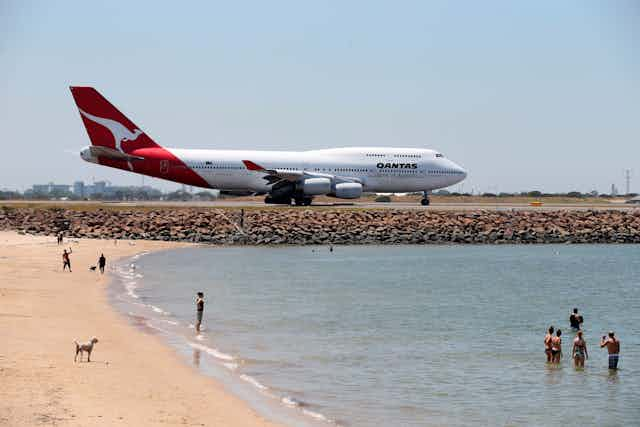


The trial of in-flight Wi-Fi on six Qantas Airbus A380s flying between Melbourne, Los Angeles and London has ended, following an announcement by the carrier last week.
So why does this matter? And could the National Broadband Network (NBN) come to the rescue, at least in Australia? Well, hypothetically, but before we get there …
If you’ve been through an Australian airport recently you would have seen the large number of Qantas billboards publicising the Wi-Fi service, a service that was offered free to first- and business-class passengers who have a Wi-Fi-enabled device.
Premium economy passengers could also access the Wi-Fi service but needed to purchase data packs during the flight.
Qantas launched the Wi-Fi trial in March utilising a system provided by OnAir, an IT services company, and the Inmarsat “SwiftBroadband” service. This service connects the aircraft to a satellite which relays data to and from the internet via a ground station.
So, what went wrong?
Cost
One important factor was the high cost of the Wi-Fi service. The cost for data varied between $12.90 and $39.90 for data packs of up to 35MB.
According to Vodafone the $39.90, 35MB data pack used on a smartphone would let you watch a 15-minute YouTube video, send or receive roughly 1,000 emails (without attachments), or browse 150 webpages.
A $35 Optus mobile phone plan provides 200MB of included data, $200 included mobile calls and unlimited national SMS.
By contrast, an in-home ADSL2+ service offered by TPG or iiNet provides about 100GB for $39.95. That’s roughly 3,000 times the amount of data, for the same price as Qantas’ Wi-Fi offering.
Time of flight
A Qantas spokesperson was last week quoted as saying:
most of our A380 services operate at night and so another dampener on demand was the fact people preferred to sleep than surf the web.
Qantas long-haul flights that operate at night are geared towards customers being encouraged to sleep for a large portion of the flight.
The editor of Australian Business Traveller, David Flynn last week reviewed Qantas’s Wi-Fi and reported that customers used the data allowance very quickly.
Flynn queried the value of the Wi-Fi service when he said:
They’ve just introduced refinements such as doonas into international business class. What the free Wi-Fi trial shows is that business travellers would prefer a better sleep than being connected in-flight.
Competitors
Two airlines that offer Wi-Fi services on long-haul flights to and from Australia are Singapore Airlines and Emirates.
The Emirates Wi-Fi service on its Airbus A380s is provided with a charge of US$15 (A$14.10) for 25MB or US$25 (A$23.90) for 100MB using a notebook or US$7.50 (A$7.20) for 5MB for mobile phones.
Singapore Airlines’s Wi-Fi service is available on selected flights with pricing ranging from US$25 (A$23.90) for 30MB and US$10 (A$9.50) for 10MB.
Emirates’ research is reported to have found three-quarters of all in-flight net use is during the “awake” hours of the flight.
So what about airline Wi-Fi services within Australia?
Providing Wi-Fi services on planes operating domestic routes is just as problematic as for the long-haul international routes. The availability of satellites that can be used for domestic airline Wi-Fi services is limited and the cost would be similar to that for international flights.
If we can assume – the arguments about whether people would rather be sleeping notwithstanding – Wi-Fi access on domestic routes will increasingly seen as desirable, there is a solution standing right in front of us.
NBN satellite-connected Wi-Fi services
NBN Co is launching two satellites in 2015 to support remote customer connections to the National Broadband Network (NBN).
A criticism I made of the NBN in an earlier article on The Conversation is the decision not to cater for moving vehicles such as planes, trains and buses – all part of important national transport systems.
The NBN satellites could be used to provide low-cost reliable Wi-Fi services to domestic planes and interstate trains and buses.
When the NBN legislation was drawn up in 2011 there seemed to have been a decision made to limit the NBN and ensure mobile operators were the only providers available for broadband connections to cars, trucks, caravans, mobile homes, planes, trains and buses.
In my opinion, the government and the opposition need to revisit this decision and agree to change the legislation so that the NBN satellites can be used to provide Wi-Fi services on domestic planes and interstate trains and buses.
There is a strong economic justification for doing this as it will ensure the satellites are an economic success and it will provide a social dividend to the travelling public who will have domestic access to Wi-Fi on interstate or long-distance domestic routes.
But if we want this to happen we need to act fast. Why?
Satellites provide coverage to large areas by using many antennae that focus on slightly overlapping regions of varying size.
Each region is allocated data capacity and the total capacity of the satellite is equivalent to the sum of the capacity allocated to the regions.
When the satellite design is completed and the satellite launched the antenna region coverage and capacity cannot be varied.
For this reason, it’s time to act now.