
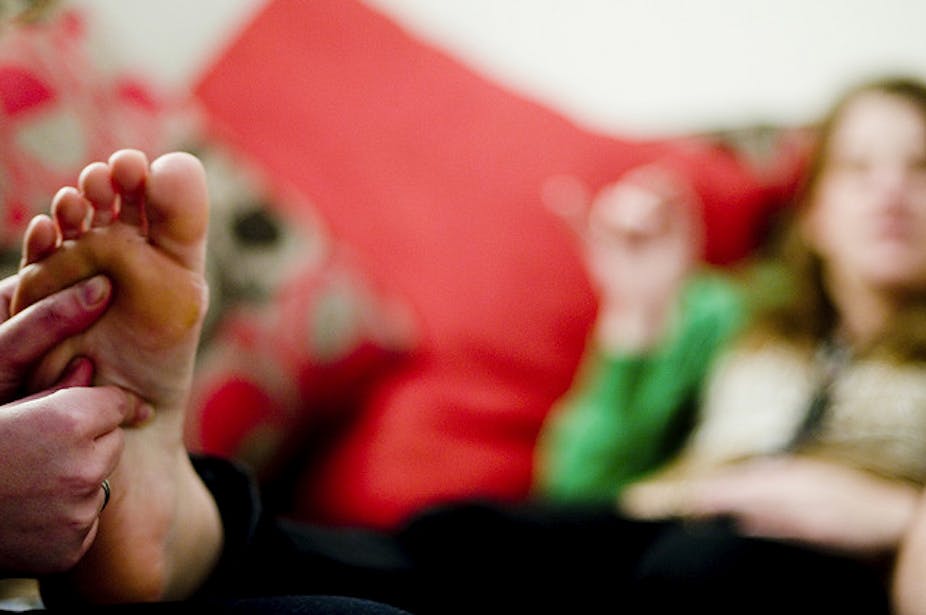
Reflexology is a form of manual therapy based on the principle that specific locations on the feet, hands and ears have connections to the rest of the body. By applying pressure to these locations using various massage techniques, reflexology is thought to stimulate the body’s natural healing processes.
A very broad range of conditions are treated with reflexology, including headache, asthma, premenstrual syndrome, irritable bowel syndrome, dementia, incontinence, diabetes, low back pain and cancer-related pain. The Reflexology Association of Australia states that “all body systems benefit from reflexology”.
A population-based survey of 1,067 Australians in 2005 found that 4% had received reflexology in the previous 12 months.
History
The history of reflexology has not been thoroughly documented, although practises resembling reflexology have been identified from ancient Egyptian, Greek, Chinese, Indian and Native American sources.
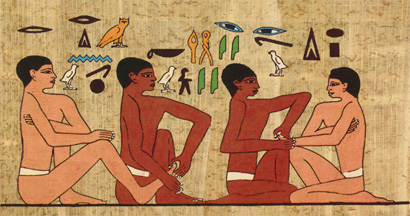
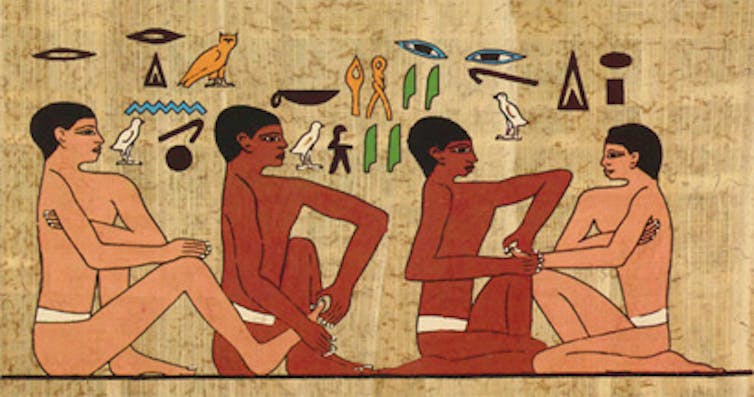
A wall painting in the tomb of Ankhmahor (c 2,330BC) in Saqqara, Egypt is often cited as one of the earliest depictions of reflexology, although it is unclear whether the image merely represents massage as opposed to reflexology.
An early form of reflexology (zone therapy) was introduced to the United States in 1913 by Dr William Fitzgerald, an ear, nose and throat specialist. Fitzgerald proposed that there were ten vertical zones in the body. By stimulating the appropriate locations on the soles of the feet, bioelectrical energy flows could be altered, leading to pain relief in other body regions.
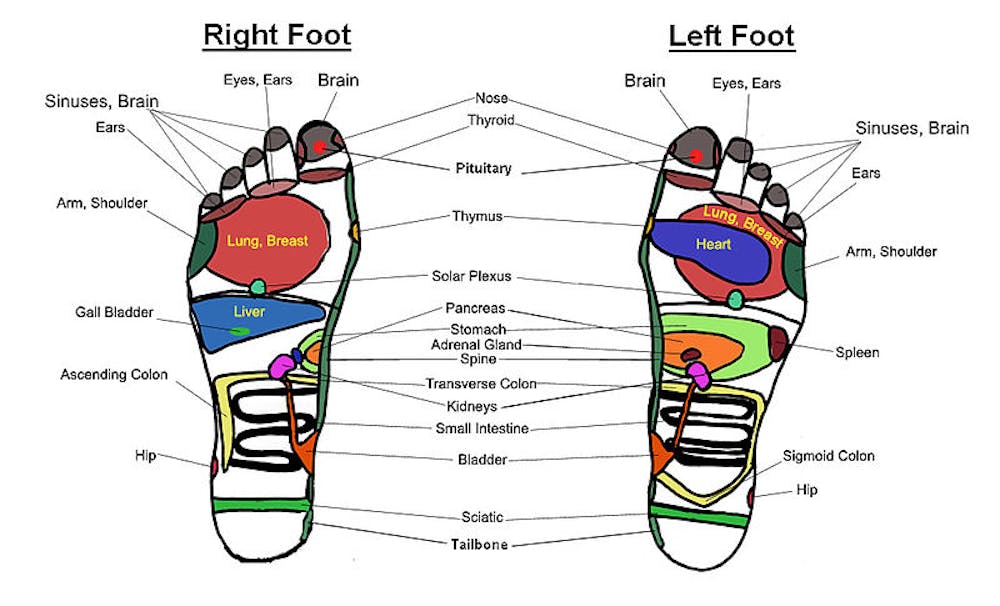
The modern practice of reflexology is primarily influenced by the work of Eunice Ingham, a nurse and physiotherapist whose 1938 text Stories the Feet Can Tell contained detailed maps of the “reflex” areas of the sole of the foot corresponding to the rest of the body, including internal organs.
Reflex areas do not correspond to either the nervous system or to acupuncture meridians, and published maps demonstrate several inconsistencies.
Mechanism
There is no clear consensus among reflexologists as to how the therapy “works”. Several mechanisms have been proposed, including the unblocking of energy fields, the removal of toxins, the breakdown of crystalline deposits in the lymphatic system, the release of endorphins, alteration of electromagnetic fields, and the increase of blood flow to internal organs.
Many of these mechanisms are inconsistent with mainstream physiological principles and are therefore unmeasurable with conventional scientific methods.
Four trials have demonstrated some evidence of a reduction in systolic blood pressure and heart rate in individuals undergoing reflexology. However, these studies did not adequately control for non-specific (placebo) effects, so it is not possible to delineate the benefit of stimulating reflex areas from the beneficial effects of simply lying down and receiving a relaxing foot massage.
Reflexology to aid diagnosis
Some reflexologists claim that the identification of tenderness at specific locations on the foot can assist in the diagnosis of medical conditions. Two studies have explored this by asking reflexologists to examine patients of whom they had no previous knowledge.
In both studies, the level of agreement between reflexologists was very low, as was the level of agreement between the reflexologists’ diagnoses and the known medical history of the patients. There was also evidence of over-diagnosis by the reflexologists. Therefore, the reflexology approach to diagnosis cannot be considered valid.
Does reflexology work?
The most recent and comprehensive systematic review on the effectiveness of reflexology found 23 trials where reflexology had been compared to no treatment, usual care, or a placebo/sham treatment. The methodological quality of these trials was generally poor, with few studies adequately controlling for non-specific (placebo) effects or blinding the assessors documenting the outcome measurements.

The review concluded that there is insufficient evidence to demonstrate that reflexology is an effective treatment for any medical condition.
It needs to be acknowledged, however, that conducting high quality trials of reflexology is inherently difficult. Possible solutions to the problems of inconsistent reflexology maps and difficulties controlling for placebo effects have recently been proposed, but have not yet been implemented.
Is reflexology safe?
There appears to be very few adverse effects associated with reflexology treatment itself. However, reflexology, like many other complementary therapies, could potentially be life threatening if used in the place of orthodox medicine for treating serious conditions (such as patients with diabetes using alternative treatments in preference to taking insulin).
The verdict
Reflexology is a popular form of manual therapy. The basic underlying premise of reflexology has no sound scientific basis, reflexology maps exhibit several inconsistencies, and there is no convincing evidence that reflexology assessment can identify underlying medical conditions.
Several low quality trials have been conducted, so it remains unclear as to whether reflexology confers any therapeutic benefits beyond those provided by generic foot massage.
This is the seventh article in our series Panacea or Placebo. Click on the links below to read the other instalments:
Tim Scanlon
Debunker
The article could have just been this sentence: "The basic underlying premise of reflexology has no sound scientific basis"
As with all the other P or P articles, this statement could also have been made. It feels like we are entertaining pseudo-science because some people like placebos.
Geoffrey Edwards
logged in via email @gmail.com
I disagree.
I agree that for those already familiar with what science has to say about a whole range of therapies, then stating "x has no scientific basis" is enough.
But...
If you are seeking to persuade an audience that is open to exploring these therapies, it is not sufficient to say science does not support the claims. That would, in fact, be rather unscientific. Merely an argument from authority, and just the kind of argument that results in mistrust.
As in science where it is not enough to simply assert, the ability you must be able to justify the assertion that is critical, in science communication a similar standard is required.
Don't think of it as entertaining pseudo-science, but doing actual science. Falsifying a claim is just as important to science as establishing the validity of a claim.
Simply dismissing something without giving your reasons is not science.
Tim Scanlon
Debunker
I know what you are saying Geoff, normally I would agree, but this series largely falls under the banner of the PRATT assertion. http://rationalwiki.org/wiki/PRATT
Essentially these "therapies" have been debunked, refuted, discredited by science for so long and in so many different ways that this is no longer a conversation about evidence. This is now an argument about the placebo effect and how much people are willing to pretend it is an actual treatment.
Greg Horgan
The Bush Philosopher
Tim, you're a legend mate. I smile each time I see an article on CM because I know the first one to make a comment will be you, and I know it will not contribute to calm debate. Without you my morning would be so dull. I can't wait for your next installment.
Pera Lozac
Heat management assistant
Not having a proper scientific knowledge to assess some phenomena does not or at least, should not, label that phenomenon as scientifically unsound. I am amazed how Conversation is constantly abused (or actively used) by vested interest driven individuals to draw conclusions and label traditional medical therapies as unscientific. I would just remind these individuals that lightning was perceived as a rage of gods in times when we did not possess sufficient scientific knowledge to explain it. I am very doubtful that current level of scientifically approved medicine is in a position to judge anyone or anything, considering the lack of understanding of basic processes in human body. These P or P posts are the exact example of pseudo-scientific evangelical preaching driven by money and greed that we see more and more in the western world today. Obviously the smelly money trail leads directly to the big pharma companies and their network of "approved" scientists and doctors.
Geoffrey Edwards
logged in via email @gmail.com
We have access to the most important scientific criteria: Patient outcome.
If it confers no recognisable therapeutic benefit, then the question of the proposed mechanism is moot.
"...considering the lack of understanding of basic processes in human body."
Which "basic processess" do you feel we have insufficient understanding of?
"Obviously the smelly money trail leads..."
Do you wish to provide your evidence for this claim. If it is "obvious" you should have no trouble producing it. Yes?
Swetha Srinivasa Murali
PhD Scholar at University of Sydney
It's incredibly disingenuous to say that we don't have an understanding of basic processes in the human body. The breakthroughs made in our knowledge of human biology have been numerous and significant over the past few decades. Yes, we have holes in the knowledge, but not knowing a few details hardly means that the big picture itself is wrong.
I'm not sure I understand what you mean by "pseudo-scientific evangelical preaching". A lot of these studies look at the efficacy of "traditional therapies" and have found them lacking in having an effect. It's hard to explain the mechanism of something that just doesn't work. I don't see how that equates to labelling something as unscientific out of hand.
A lot of traditional medicine that does work has already been incorporated into modern medicine, and the tools we have now mean that we can tell what works from what does not.
Tim Scanlon
Debunker
When something has to break the fundamental laws of the universe in order to be real, or break the laws of biology, etc, then you are no longer looking at a lack of knowledge, but rather at the effect that is actually in place. This has been consistently shown to be the placebo and nocebo effects in not-medicine. All of these alternative treatments have had decades to prove themselves, parts have even been incorporated into the mainstream, others still being investigated, but the majority are rubbish.
So the money trail is actually leading from the alt or not-medicine sales to the not-medicine companies and businesses. In Australia alone the not-medicine industry is worth billions of dollars annually. That is one hell of a vested interest in making sure not-medicine continues, despite the lack of evidence to show that it does anything, let alone whether it is safe or not. These people are nothing but charlatans and crooks.
http://www.youtube.com/watch?v=HMGIbOGu8q0
Sue Ieraci
Public hospital clinician
"I am very doubtful that current level of scientifically approved medicine is in a position to judge anyone or anything, considering the lack of understanding of basic processes in human body."
On the contrary, Pera Lozac.
Many physiological processes are understood right down to the sub-cellular level, and up to the systemic level.
IF a model is advanced that proposes some alternative physiology - like reflexology, for example, it is encumbent on the proponents to demonstrate how it is feasible. There are many more tools available now - why not use them?
Emmanuel Marshall
logged in via Facebook
title should be "reflexology: bullshit or hogwash?"
seriously though, where is the peer reviewed scientific evidence to support the claims of reflexology?
If any of the pro reflexology / "open to exploring" posters here can point to any confirmation from the serious medical literature I will eat my hat!
Sue Ieraci
Public hospital clinician
There are lots of explanations for various phenomena that were proposed as a way of understanding the world, prior to the availability of the technology to directly study those phenomena.
Examples would include:
-"Humours" in the body
- A flat earth
- The sun being carried across the sky by horse and chariot
- Acupuncture "meridians"
- Homeopathic "law of similars" and dilutions
Once we were able to view the earth from space, we no longer needed the world myths.
Once we were able to map the anatomy and physiology of nerves and blood vessels, we no longer needed "meridians, reflexology zones or humours.
We no longer use tins cans with string or smoke signals to communicate - why would be use outdated and disproven therapeutic models? If we have the ability to examine and test the human body with MRI, lab tests, the electron microscope, biopsy, nerve conduction tests etc etc, why would we ignore this evidence for a made-up model?
Mia Masters
pensioner
Just for Sue, constant and tireless defender of all things medical (meaning pure, scientific and evidence based):
"Sympathectomy is a technique about which we have limited knowledge, applied to disorders about which we have little understanding." Associate Professor Robert Boas, Faculty of Pain Medicine of the Australasian College of Anaesthetists and the Royal College of Anaesthetists http://www.pfizer.no/templates/Page____886.aspx
Just one example from the many for a little bit of perspective.
Sue Ieraci
Public hospital clinician
(A reply for Ms Masters, since I can't reply below):
And some perspective in return, Ms Masters:
When you quote "limited knowledge" and "limited understanding", you have misunderstood the context. Your citation appears to have been copied and quoted from one blog site to another - it is not an academic article or scientific paper.
It doesn't mean that we don't know anything at all about the sympathetic nervous system.
What is a sympathectomy? It's the interruption of the sympathetic…
Read morePera Lozac
Heat management assistant
Let me ask one simple question - what is the scientific explanation for the placebo effect? Everyone knows that exist - medical statistical studies are looking at it as "noise" but as a matter of fact in that noise there is something that helps people. Placebo is not part of any medicine - traditional or modern - because it holds the power of human body to heal itself. That fact is de-powering to any medical practitioner and few are prepared to investigate it. Further, on modern medical knowledge…
Read moreDan Smith
Network Engineer
The placebo effect is complex, so asking a "simple" question about it won't necessarily bring about a simple response. Scientists and evidence-based medical folk are actually very interested in it, and it is extensively studied, as you'll find if you care to do a quick internet search. I note, however, that alternative therapy proponents are less likely to mention it, and thus claim any of its beneficial outcomes as a result of their "treatments". This is where the true lack of investigation into…
Read moreSue Ieraci
Public hospital clinician
If it weren't for science-based medicine, there would not be the vaccine for anything.
Polio and smallpox vaccines came early, we now have vaccines for most of the early childhood infectious diseases, now also HiB, rotavirus and pneumococcal infection. Malaria vaccine is on the way.
How would reflexology - or homeopathy - have helped malaria vaccine come sooner?
Laurie Willberg
Journalist
It's amazing how that double standard just keeps popping up in these blogs... "no sound scientific basis" seems to merely translate into "little research has been done". When consumers apprise themselves of the fact that health technology assessments repeatedly find "unknown effectiveness" for most mainstream medical treatments (never mind "possibly harmful") they can be sure that there's no sure thing anywhere and they're just left with a feeling of uncertainty.
Read moreReflexology has never been used…
Sue Ieraci
Public hospital clinician
Laurie Willberg, proponent of homeopathy (water or alcohol with no descernable molecules of any "remedy") continues to lecture mainstream medicine about the scientific method and evidence. BOht amusing and ironic.
There are no "unfailing, sure-fire treatment with guaranteed results " in human life, just as there are no "ships that never sink" or "bridges that never fail".
The proponents of sham medicine always throw up imperfections in science-based medicine when the "therapies" they promote…
Read moreLaurie Willberg
Journalist
@Sue Ieraci who seems to be able to do offer little more than ad hominem comments and irrelevant asides that have nothing to do with this article. Trying to deflect legitimate criticism of an obvious double standard in this and other articles appearing in these blogs seems to be your specialty.
Kindly prove your assertion that reflexology zones on the foot are "a sham". You know this from intensive research do you? Stop trying to peddle your opinions as facts. In your opinion anyone who is not a mainstream practitioner is a "sham" and you've never met a form of non-mainstream therapy you didn't have negative remarks for.
Patients fortunately have the freedom to choose whatever form of therapy they wish and fortunately don't need your approval or permission to do so.
If you wish to make claims that a therapy is ineffective then the onus is on you to prove it. In the absence of research, good luck. If you don't honestly know or have evidence, then have the good grace to keep quiet.
Pera Lozac
Heat management assistant
Superb reply Laurie - finally someone who uses his intellect properly instead of replacing it for evangelical dogma of pseudo science. I applaud - I could have not said it better myself.
Diane Bruhn
ocassional activist
There have been significant scientific trials undertaken on the effects of reflexology across the world. This article references 'several low level trials' as the basis for reflexology having 'no sound scientific basis'. The number of reflexology trials/studies would be small compared to studies about traditional medicine/s for obvious reasons, there is no money in it for large corporations. A quick search of the internet however brought up this page, http://www.encognitive.com/node/3921 mentioning…
Read moreJohn Kerr
IT Education
Interesting. The human nervous system was discovered about 100 years ago probably after thousands of years of 'science' refuting that it was even there and yet, if you knew what you were looking for and had an open mind you would have known that 'something' was there that had not yet been explained.
Why is so-called 'science' so unscientific when it comes to many therapies that have been around for hundreds and in some cases thousands of years? If there was absolutely nothing in them they would…
Read moreSue Ieraci
Public hospital clinician
John Kerr - you say "I think back not that far when chiropractic was regarded as quackery by physiotherapists and yet a few of their techniques form part of physio practice there days. And Chinese Acupuncture… well who could believe that sticking needles in people could cause pain to be blocked out enough to perform operations? That was the thinking when I was a young lad."
I suggest you read the following:
Read morehttps://theconversation.edu.au/chiropractic-therapy-placebo-or-panacea-8104
Modern chiros…
Leo Kerr
Consultant
I like this series of articles although they could be inspired by big pharma and the medical industry as a means of trying to re-capture market share. Sue and Tim always chime in with their predictable inputs of evidence based this and that. I'd really like the theme to be extended to God and Religion.
Tim Scanlon
Debunker
Yes, curse Sue and I for having standards of health care above mere beliefs and superstition.
Sue Ieraci
Public hospital clinician
Leo Kerr - at least "God and Religion" are openly about beliefs and faith.
Therapeutic substances should not be about faith but about science, don't you think?
Leo Kerr
Consultant
Sue I do think therapeutic substances should be about science - not about money. I'm afraid the model is all about money - the medical industry (and I don't mean well meaning doctors and carers) is more about sickcare than healthcare it seems with pills for life. If reflexology or any of the other alternatives being bagged in these pages (whether it's placebo or not) help people, I say power to them. I've been through western medicine - it's good at times. I've also had some acupuncture, bit of chiro - it's good at times also. The drive it would seem on a global basis is to ban alternatives or completely deride them. My suspicions are this is driven for purely commercial dominance by the pharmaceutical industry - an industry rife with corruption. Perhaps TC will have a more indepth look at the corrupt practices of big pharma at some stage.
Leo Kerr
Consultant
right oh Tim - was waiting for it ......... I stand chastised .......... but where does that put Dr Placebo
Sue Ieraci
Public hospital clinician
Dr Placebo was de-registered because the community thought that it was unethical to intentionally use an inert substance as therapy. They thought is was paternalistic to give something inert just so the person could feel better, but charge money for it.
Community standards now require pharmaceuticals to be shown to be more effective than placebo.
Leo Kerr
Consultant
So nice of you to reply Sue - I was getting a little despondent - "Community standards now require pharmaceuticals to be shown to be more effective than placebo" - let's hope big pharma understand that.....
Mia Masters
pensioner
Foot massage may ease cancer symptoms
Michigan State University
Reflexology can help cancer patients manage their symptoms and perform daily tasks, a study suggests.
Researchers say women with advanced-stage breast cancer who were given foot massages by reflexologists experienced less shortness of breath and could more easily climb stairs, get dressed or go grocery shopping.
Reflexology has been practiced for thousands of years but the researchers say this is the first scientifically rigorous study of reflexology as a complement to standard cancer treatment.
https://theconversation.edu.au/foot-massage-may-ease-cancer-symptoms-10714
Tim Scanlon
Debunker
It was just relaxing, didn't actually help. When you read the full news article it is quite clear (aside from researcher bias) that the standard foot massage was actually as good or better than the reflexology.
Quote: "Also unexpected was the reduced fatigue reported by those who received the “placebo” foot massage, particularly since the reflexology group did not show similarly significant improvement. Wyatt is now researching whether massage similar to reflexology performed by cancer patients’ friends and family, as opposed to certified reflexologists, might be a simple and inexpensive treatment option" http://news.msu.edu/story/ancient-foot-massage-technique-may-ease-cancer-symptoms/
So again this is just quacks trying to pass themselves off as legitimate. There is real research to be done, real science to be develop treatments in medicine, let's not get caught up chasing fairies at the bottom of the garden.
Mia Masters
pensioner
"Once we were able to map the anatomy and physiology of nerves and blood vessels, we no longer needed "meridians, reflexology zones or humours."
"Many physiological processes are understood right down to the sub-cellular level, and up to the systemic level."
Sue Ieraci
Some are, and some are not...
Read more"More than 25% of Americans suffer from chronic pain and almost 40% do not find effective relief from existing drugs. In many common conditions such as diabetic neuropathy, no clear source of pain…
Sue Ieraci
Public hospital clinician
Ms Masters, as I said before, finding imperfections in science-based medicine does not justify continuing to believe outdated models.
The pathology of diabetic neuropathy is described - here is a relatively simple description:
http://medical-dictionary.thefreedictionary.com/diabetic+neuropathy
There is no longer a purpose served by having either "meridians" from ancient chinese medicine or "zones" from reflexology. It's not about being over-confident or snide.
If people still wanted to insist that the earth is flat because it explains some phenomenon that we understand incompletely (let's say, whether climate change is anthropogenic), would it be OK to ignore the photos we have of a round earth from space just because "science doesn't know everything"?
Mia Masters
pensioner
To clarify the quite (to Ms Ieraci). The quote
"Sympathectomy is a technique about which we have limited knowledge, applied to disorders about which we have little understanding." is from Associate Professor Robert Boas, Faculty of Pain Medicine of the Australasian College of Anaesthetists and the Royal College of Anaesthetists http://www.pfizer.no/templates/Page____886.aspx
is posted on a blog as well as on the above pfizer site (available to view). It is an article by Harald Breivik Professor quoting Robert A. Boas, (Faculty of Pain Medicine of the Australasian College of Anaesthetists and the Royal College of Anaesthetists), and his article published in:
The Journal of Pain, Vol 1, No 4, 2000: pp258-260
The title of the article is: WHAT PRICE SUCCESS? ASK THE PATIENT, where he makes this statement.
Between your (medical) background (and opinion) and Professor Boas, I think will give a vote to him on this subject, considering that this is his specialty and expertise.
Sue Ieraci
Public hospital clinician
Vote for whoever you like, Ms Masters.
Luckily physiology is not based on popular opinion.
Pera Lozac
Heat management assistant
I am only interested who is organising and paying for these salvos of purposefully malicious bad press aimed towards alternative medicine in general. Where is the money coming from Conversation? Can anyone answer? Merck, Pfizer, Bayer - all of the above? Very shameless and appalling journalism....
Sue Ieraci
Public hospital clinician
When logic fails, invoke the conspiracy theory.