
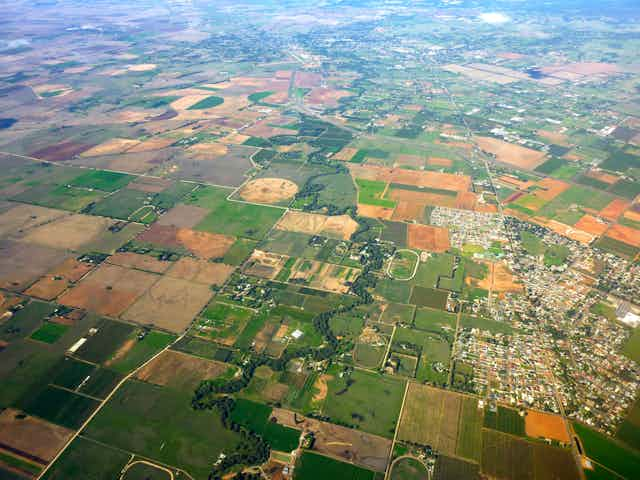


Rural research is vital. It is about 10% of our national innovation system. Annual investment exceeds $1 billion, according to the Rural Research and Development Council. The rural sector and farm-dependent economy accounts for 12% of GDP, 14% of exports, 17% of employment, 60% of the land mass and between half and two-thirds of total water use. (Mining accounts for 9% of GDP, 35% of exports and 2.2% of employment.)
A vibrant, world-leading rural, environmental and agricultural research sector is more strategically important for Australia now than ever. This is clear from authoritative reviews on climate change, biosecurity, drought policy, biodiversity conservation, food security and energy-water-carbon intersections. The Australian Government has also received the Productivity Commission Inquiry into Rural R&D Corporations and the Rural Research and Development Council’s National Strategic Rural R&D Investment Plan.
All these reviews and reports say we need more and better rural research, development and in some cases extension.
The government has responded with a National Food Plan green paper, and a Policy Statement on Rural Research and Development. The green paper has already been described elsewhere on The Conversation as “putting corporate hunger first”.
We can’t handle this one commodity at a time
The big challenges facing Australian agriculture, land use planning, and natural resource management — such as climate, energy, water, irrigation, biodiversity, biosecurity, soils, carbon, pests, weeds, land use planning and social issues — are not commodity-specific. They are cross-sectoral, demanding integrated approaches within and across geographic scales, and between government, industry and community.
The way we scope, prioritise, plan, fund, manage and disseminate rural research has to be designed to handle these big, intersecting, cross-sectoral challenges.
The strength of Australia’s rural R&D framework is the rural research and development corporations (RDCs). The internationally admired RDC model works particularly well for commodity-specific R&D. Its heart is a government–industry cost sharing partnership in which levies on production are matched by the taxpayer. This engenders high levels of industry ownership and research relevance, and strong uptake of research results and return on investment.
However, the model works much less well for cross-commodity issues. So we under-invest in these areas and in public good research generally.
The structural flaws in the RDC model were exacerbated by the abolition of Land & Water Australia (LWA) and cuts to the Rural Industries R&D Corporation (RIRDC) by the Rudd Government in the 2009 budget. These were the two corporations set up with a mandate to invest in cross-sectoral, public good research.
Could a cross-sectoral R&D corporation help?
The Productivity Commission examined this in depth in its report, after 11 public hearings and 295 submissions (mine is # 271). It recommended fundamental reform to the model, including a new cross-sectoral RDC. The government’s policy statement on rural R&D has picked up some of the Commission’s recommendations, but rejects the cross-sectoral RDC.
The policy statement says the necessary leadership and coordination of investment can be delivered in large part by the National Primary Industries Research, Development and Extension (RD&E) Framework, under the Primary Industries Ministerial Council.
The Ministerial Council endorsed the national RD&E framework in 2009. It has since approved 14 sectoral RD&E strategies and four cross–sectoral strategies (four more are underway).
How do these strategies stack up?
The “completed” RD&E strategies vary enormously in quality and comprehensiveness. They range from barely adequate to OK on context analysis, articulating knowledge needs, summarising research capacity, and proposing better coordination mechanisms.

But most are thin or silent on other crucial elements of a competent research strategy such as types of research, governance and accountability, knowledge management and evaluation. The “E” for extension is largely missing, or treated superficially. The assumption seems to be that extension happens at a regional level and does not require attention in national strategies - seriously flawed thinking.
It is notable that those sectors with strong RDCs – for example dairy, grains and cotton – do a better job in identifying new opportunities and setting out a comprehensive, ‘investment ready’ framework.
The RDCs are dedicated research purchasers, managers, brokers and coordinators. Unlike policy departments, let alone inter-jurisdictional committees, their core business is procuring and managing research and communicating the outputs of that research. It is not surprising they do a better job as research planners, purchasers and managers.
This is even more likely to be the case for cross-sectoral issues like climate, water, energy, food and biosecurity, given their added complexity and the multitude of players. But since the abolition of Land & Water Australia, we no longer have a dedicated statutory body to perform these functions.
We need a national approach to complex rural issues
We need specialist expertise to scan, scope, prioritise, design, procure, manage and disseminate research programs on these big complex issues. This won’t be delivered effectively by part-timers, or people with short planning horizons whose day job is serving a particular industry, writing policy or responding to the minister’s office.
National collaboration and coordination is crucial. But if the default mechanism for national coordination is inter-jurisdictional committees, there is a big risk of defaulting to lowest common denominator consensus — tweaking the status quo while avoiding risk or genuine innovation.

In our Federation, the latter problem bedevils COAG and its subsidiary Ministerial Councils and Standing Committees. Consensus incrementalism pervades the national RD&E strategies to date.
When was the last time a bold reform or innovative new direction was conceived, driven and implemented quickly by a Standing Committee working to a Ministerial Council? On the rare occasions it happens, it is usually in response to crisis, or influenced by a dedicated, expert statutory authority to design and champion the reform and make it happen.
The government’s policy statement sensibly acknowledges that many issues cut across the 22 strategies identified to date. The Australian Research Committee (ARCom) will be asked to provide overall system oversight of rural research and development. This is a good start on a crucial task, but will it have the power or influence to redirect resources?
The policy statement on rural research sketches a road map, but lacks a vehicle. The Productivity Commission was right. A new dedicated statutory RDC (or a substantially reconfigured RIRDC), with a mandate beyond agriculture, is needed to bring national coordination, strategic direction and intelligent research investment and management to these big, complex, intersecting issues.
This would represent real reform, and a great investment.
The need for much better, “joined up” knowledge on how best to deal with climate, energy, water and food challenges won’t go away, not in our lifetimes or those of our kids.