


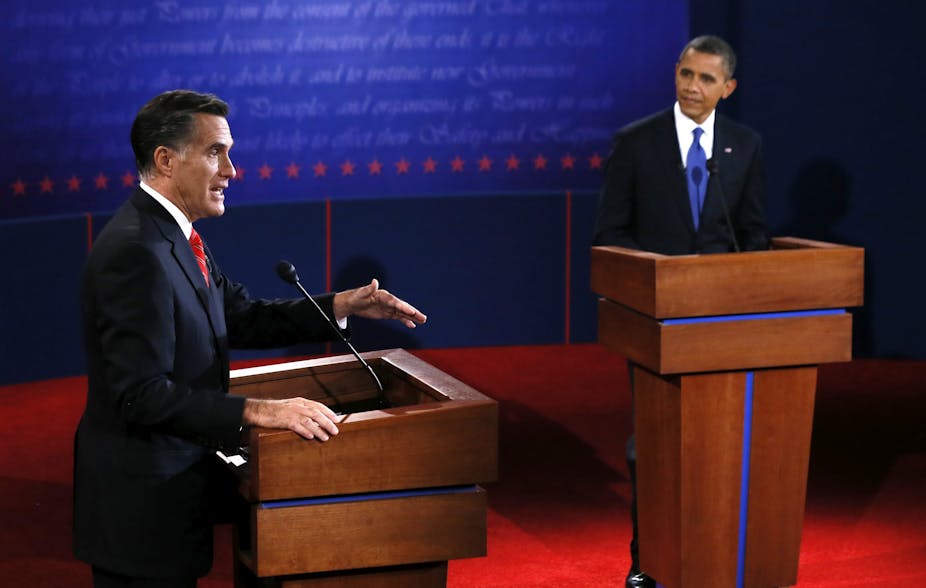
Verdicts on the first presidential debate of 2012 overwhelmingly favour Governor Mitt Romney.
Romney articulated his message with a sense of clarity about the political ideas and principles he represents. In contrast President Barack Obama conveyed his arguments with the deftness of a policy wonk, the clarity of his own vision overshadowed by dense policy explanations.
The debate was always Obama’s to lose, with a senior Romney advisor noting that voters expected Obama to prevail in the debates by a margin of 25 points. The Atlantic national correspondent James Fallows points out that Romney was destined to exceed expectations, both through his proven debating skills, and by mere virtue of being seen on an equal footing with the President.
As such the key question is not who “won” on the night, but rather what the debate reveals about the ability of each candidate to bring his own strengths to bear on his opponent’s weaknesses. The debate exposed a growing strategic divide between the candidates over the perceived importance of emphasising a clear ideological vision versus a concrete policy program. The reason for Romney’s crisp delivery may ultimately be his greatest weakness; while the source of Obama’s sometimes turgid responses may yet propel him to victory in the November election.
Romney’s performance showed his preference for clear ideological vision over policy detail. The entirety of Romney’s responses revolved around repeating a set of traditional conservative platitudes: cutting the size of federal government, reducing bureaucratic waste, devolving power to states, and deregulating the economy. The strategy of answering questions according to these first principles contributed to the clarity of Romney’s message that so impressed many viewers.
However, Romney’s failure to develop a policy program giving life to his ideological vision was conspicuous as the debate progressed. This has been a growing theme of the Democratic campaign, and Obama seized on it as Romney’s Achilles’ heel. Obama challenged Romney’s inability to demonstrate the feasibility of cutting taxes by $5 trillion, increasing military spending by $2 trillion, and yet remaining revenue neutral by closing tax loopholes and deductions.
Romney’s response included the listing of unflattering economic statistics of the past four years and studies challenging Obama’s position. Yet nowhere could Romney provide the requisite list and costing of loopholes and deductions necessary to substantiate this most pivotal policy.
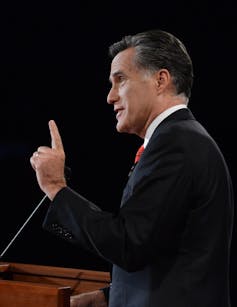
On healthcare Romney reiterated his intention to repeal “Obamacare” by referring to the article of faith that “free people and free enterprises trying to find ways to do things better are able to be more effective in bringing down the cost than the government will ever be.” Again Obama responded by attacking Romney for failing to specify what would replace Obamacare once it was repealed, while questioning the absence of details necessary to demonstrate that the alternative plan would nevertheless continue to cover people with pre-existing conditions.
Not surprisingly Romney excelled in responding to a big picture question on the appropriate role of federal government. The high-water mark of Romney’s elevation of ideological principles over policy details came when he pointed to the image of the Constitution and Declaration of Independence projected behind the candidates as the basis for his answer. Yet the election will not be decided by those who are satiated by such ideological tropes. Policy details are the red meat that will lure crucial undecided voters.
With five weeks of the campaign left Obama is well placed to continue speaking to voters in terms of a contest between competing policy programs. This will disarm efforts by the Romney campaign to cast the election as an ideological choice between “two very different paths”. As things stand Obama would wield the decisive advantage among those undecided voters who are looking for more than naked ideology of either stripe.
Clear political principles are a necessary element for an effective campaign. The internally coherent world view of George W. Bush became a key asset in his electoral victories. Yet first principles are only politically meaningful insofar as they provide the blueprint for a specific policy program. The political irrelevancy of Sarah Palin attests to the limitations of politics constructed entirely on folk wisdom that fail to progress to a workable policy program.
Romney’s efforts in a contest of political ideology will ultimately be in vain unless he can provide details of an alternative policy program converting grand principles into solutions for the country’s economic woes. Tenaciously clinging to a perceived ideological advantage could come at the expense of fulfilling this task. The great irony is that if the battle over policy is neglected the ideological war for the principles Romney touted so confidently in this first debate will also increasingly ring hollow.