
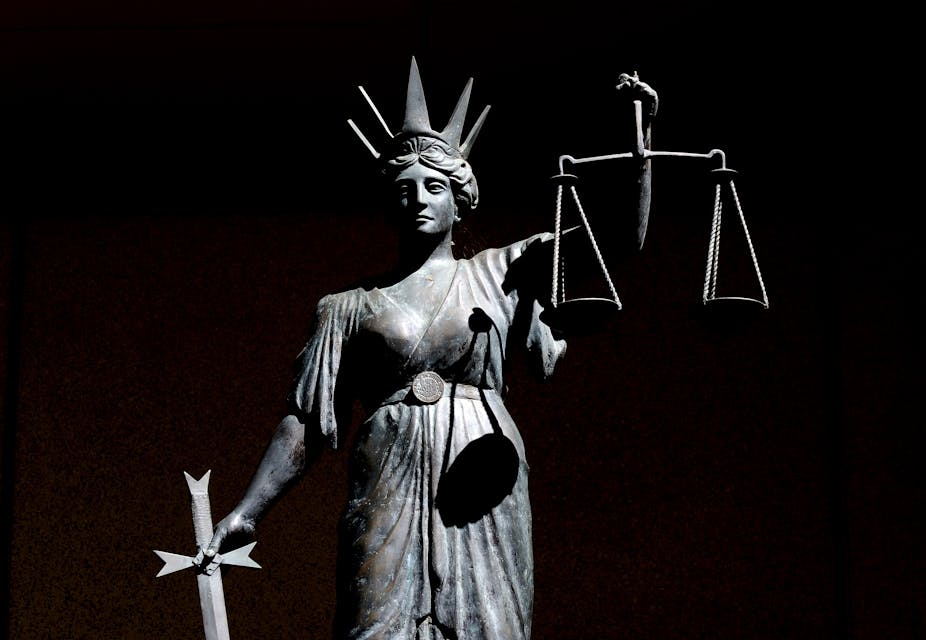
Prime Minister Julia Gillard has announced a royal commission into child abuse in churches, schools and foster homes.
The inquiry will include, but not be limited to, allegations of abuse in the Catholic Church. Opposition leader Tony Abbott has backed the move after insisting any such inquiry could not focus on only one institution, like the Church.
Announcing the inquiry, Gillard said:
These are insidious, evil acts to which no child should be subject. The individuals concerned deserve the most thorough of investigations into the wrongs that have been committed against them. They deserve to have their voices heard and their claims investigated. I believe a Royal Commission is the best way to do this.
But what are royal commissions, and is establishing one the best way of dealing with an issue of the magnitude of clergy-related abuse?
Royal commission are a type of “public inquiry”. Public inquiries are temporary ad hoc bodies appointed by executive government to provide advice or to investigate some issue; whose members are drawn from outside government; have public processes; seek community input and release their reports.
This excludes: parliamentary committees; permanent government advisory bodies; internal government reports; and inquiries initiated by government bodies such as ombudsmen, anti-corruption bodies and departments.
What distinguishes royal commissions from most other public inquiries is that they are established under specific legislation that confers specific powers of investigation on them. At the Commonwealth levels that legislation is the Royal Commission Act 1902. It was one of the first pieces of legislation introduced in federal parliament by then Attorney General, later Prime Minister, Alfred Deakin. Royal commissions had been appointed by the states prior to federation.
Importantly, Australian royal commissions at both state and Commonwealth levels, unlike their UK counterparts until recently, have always been appointed under legislation.
Such legislation conferred wide ranging coercive powers of investigation on these royal commissions (e.g. abilities to call and cross-examine witnesses, obtain evidence, rights of entry, phone-tapping) while also providing protection to witnesses and inquiry members from legal action such as defamation.
Not all inquiries appointed under this legislation are called royal commissions – sometimes just commission of inquiry. However, the “royal” connotes the issuing of letter patent from the Crown or the Crown’s representative and the recent 2009 Australian Law Reform Commission review of the Commonwealth Act believed that for reasons of status and perceptions of independence, the “royal” should continue to be used.
Royal commissions can be inquisitorial/investigatory appointed to investigate allegations of impropriety and maladministration or some catastrophic event (e.g. flood, bushfire or accident). Inquisitorial inquiries focus on finding the “truth” about an allegation or incident and are therefore inquisitorial by nature and process. This is where their powers of investigation are most used.
Or royal commissions can provide advice, information, research and options to governments about a particular policy problem. There have been royal commission on television, grain handling, health systems and welfare issues to name just a few.
These days royal commissions and commissions of inquiry appointed are mostly of the inquisitorial type. Of the 38 royal commissions appointed by the Commonwealth since 1979, only three have been of the policy type. The same trend can be seen around the states.
Since federation there have been 128 royal commissions appointed at the Commonwealth level. They reached their peak during 1910-1929 when 54 were established. Subsequently, royal commission numbers declined. Twelve royal commissions were appointed from 1929-40 and only seven from 1950-1972. The election of the Whitlam Labor Commonwealth Government (1972-75) saw 13 royal commissions established. The Fraser Coalition Government (1975-83) appointed eight royal commissions and the Hawke-Keating Labor governments (1983-1996) 12. The Howard Coalition Commonwealth Government (1996-2007) established only four royal commissions. The Rudd and Gillard governments have eschewed establishing any royal commissions.
Around the states during the 1980s and 1990s there was a spate of royal commissions into corruption and maladministration (banks, WA Inc, police). These did great damage to incumbent governments and have made all governments less enthusiastic about their use.
The end of the road?
Nevertheless, inquisitorial royal commissions remain the “institution of last resort” for governments when all other bodies are deemed unsuitable for handling issues of high political salience and sensitivity. In 2005, the Queensland Labor government appointed not one, but two royal commissions into the overseas doctors’ scandal after exhausting every alternative.
The state governments following recent major fire and flood disasters in Victoria and Queensland in 2009 and 2011 appointed commissions of inquiry to investigate the causes of disasters and to advise on post-disaster management.
There are concerns about the powers of royal commissions, the lack of review of their processes and findings and their increasing costs.
The Gillard government has yet to respond to the ALRC review of the Commonwealth act that was submitted in 2009 where these issues were canvassed.
Comments on this article are now closed.
Colin Kline
logged in via Facebook
The author of this article, Scott Prasser, is disclosed by this statement :
"Executive Director, Public Policy Institute at Australian Catholic University
DISCLOSURE STATEMENT
Scott Prasser does not work for, consult to, own shares in or receive funding from any company or organisation that would benefit from this article, and has no relevant affiliations."
This seems to be a blatant lie. The RCC certainly will benefit from Scott's plea to "avoid a Royal Commission" into the many crimes…
Read moreElisabeth Marchant
Retired school teacher
Will the Royal Commission allow for more discussion on two important premises?
1. That the Catholic Church protects its priests because of the cost involved in producing them.
2. The disinclination of men to take on the life style unless they are paedophiles.
Bruce Tabor
Research Scientist at CSIRO
A inquiry with the greatest possible powers, i.e. a Royal Commission or Commissions is clearly what is required. I have two concerns:
Read more1) Jurisdiction. This is a federally constituted RC, but it deals with breaches of state laws, which require state police to investigate. I'm concerned that some of the RC's work will be frustrated by this cross-jurisdictional construction. In might be better for the PM to persuade the premiers to set up a series of state based RC's with federal coordination.
2…
Meg Thornton
Dilletante
Royal Commissions worry governments, because Royal Commissions by their very nature aren't really all that controllable, and they aren't limited to the stuff that's going to upset one side of parliament more than the other. So yeah, a federal Royal Commission into institutionalised paedophilia and child sex abuse is going to be a powerful thing to direct at a lot of long-buried crimes and institutional structures, and yes, I should expect to see a lot of people heading for the shredders over the…
Read moreLynne Newington
Lynne Newington is a Friend of The Conversation.
Researcher
Before I fully take in what Scott Prasser has written, I'd like to say without hesitation, most clergy enter religious life with the highest of intention, a vocation usually fostered at the knee of their mothers.
Read moreIt's what and who contaminates them during their formation many seminarians caught in a web, with more than one public admission by ordained alienated for whatever reason, clergy.
On the surface, mandatory celibacy is another issue, with the expectation of the laity Not the same as the…
Venise Alstergren
Venise Alstergren is a Friend of The Conversation.
photographer, blogger.
This is not to comment on the article per se. However, it is a germane comment about the people in politics, the police, and the Church leading to the royal commission. And, how such an inquiry has been ludicrously overdue.
At the top of the Catholic Church's friends in the Coalition there is Tony Abbott-Jesuit trained; Kevin Andrews-Jesuit trained; and numbers amongst its luminaries…Mathias Corman; Scott Morrison; Eric Abetz; Sophie Mirabella; Guy Burnett; Peter Ryan (NCP) VIC, and deputy…
Read moreEileen Fraser
logged in via Facebook
Colin Kline pointed to a very salient issue here.....there is most definately a conflict of interest ,with the author being employed by the Catholic University....so how should we view this as an independent article,?
Colin Kline
logged in via Facebook
-
Melbourne Age, 14 Nov 2012, (p.4) :
"Former Royal Commissioner warns of potential heartache"
http://www.theherald.com.au/story/1084742/former-royal-commissioner-warns-of-potential-heartache/?cs=12
-
Michael Leonard Furtado
Dr at University of Queensland
Some of those named by Venise Alstergren as being Catholic clearly are not. The issues discussed here and relating to a matter as crucial as a Royal Commission - for most Australians an inquiry at the highest possible level of national investigation, despite Scott Prasser's compelling arguments against - are too crucial to risk being derailed as a result of the seemingly obsessively pejorative references and conspiracy theories about Catholics evident in nearly all of Lynne Newington's and some other…
Read moreMichael Leonard Furtado
Dr at University of Queensland
Apologies; I meant "as IS equally disturbingly alleged"
Eve Southwood
logged in via Facebook
Michael, maybe I have missed something... I don't get the sense that Scott Prasser is presenting compelling arguments against holding a Royal Commission, at least not in this article. He does pose the question of whether a Royal Commission is the best method of enquiry for an issue of this scale, but I do not see the question answered. Can you elaborate on what you see as Scott's position, please?
Sabine K McNeill
Independent Web Publisher
Are readers aware of the Royal Commission into NSW Police in 1997?
Its results were published in volumes entitled: Corruption, Reform and Paedophilia... See http://bit.ly/WQnqGn
In the UK, we are still hoping that the Government will follow suit!...
Roger Peters
Psychologist
Can we just stop calling it a Royal Commission into Child Abuse. Surely its a Royal Commission into how the community responded to child abuse in the past. We will now judge in hindsight how this matter for generations has been swept more or less under the carpet, until 1998, in families and in instituitions. Or as my Nanna said dont go dwon to the bird avery with Uncle Gordon, that was child protection 1960's style. Its odd really, we blame institions for ignoring abuse, without any thought to the role our parents, grandparents had in this given that they would have been well aware having been tragets of abuse themselves. .
David Blackall
logged in via Facebook
Agreed Roger. Institutions are where denial takes hold. Start with the institution of family name and respectability. Age 8, I was abused by my parent's friend who groomed me right under their noses. Later, as if I was being punished for speaking out, I was sent to boarding school, a state selective agricultural high school where brutality and sexual perversion prevailed. My father went to a similar state school. Parents and teachers, headmaster, all in denial about what they all knew went on. A…
Read morePamela H.
logged in via email @hotmail.com
Father Abbott's effort to water down the royal commission into decades of child abuse in the Catholic Church is not surprising since he is a defender of that institution. Just sickening.