Shifting freight to rail could make the Pacific Highway safer

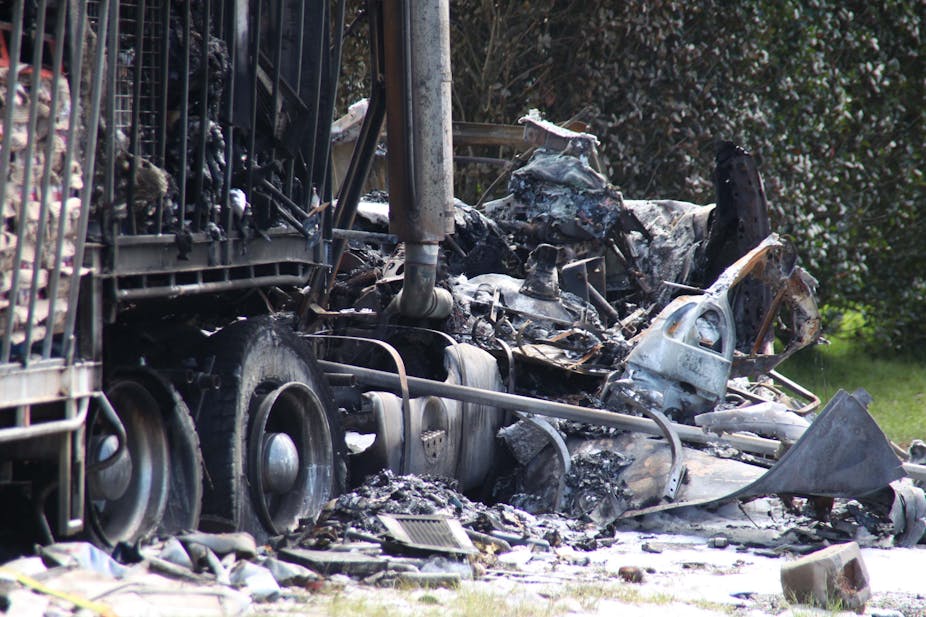
Articulated trucks such as semi-trailers and “B-Doubles” are involved in about 30% of fatal road accidents on the Pacific Highway. As the number of trucks carrying freight between Sydney and Brisbane increases, we will see more tragic incidents like the fatal crash involving a B-Double on 8 January 2012…

Yrqkkkgd-1326081294
The Pacific Highway has a long history of fatal truck accidents. AAP

Articulated trucks such as semi-trailers and “B-Doubles” are involved in about 30% of fatal road accidents on the Pacific Highway. As the number of trucks carrying freight between Sydney and Brisbane increases, we will see more tragic incidents like the fatal crash involving a B-Double on 8 January 2012 near Urunga.

In August 2002, following completion of a new section of dual carriageway between Yelgun and Chinderah, the NSW Roads and Traffic Authority gave approval for large B-Doubles to use the entire length of the Pacific Highway. This decision led to a 38% increase in the number of heavy trucks using the Pacific Highway each day. By 2006, when 168 kilometres of dual carriageway had been built, 75% of Sydney-Brisbane intercity freight was travelling by road, leaving rail with 25%.

With further Pacific Highway upgrading between Hexham and the NSW-Queensland border, 338 kilometres (about half) of this highway is now dual carriageway. Truck numbers have continued to increase. Since 2002, Sydney-Brisbane road freight has increased from about 1.5 to over 6 million tonnes per annum. Rail’s share of this intercity freight has fallen to less than 10%.

Making the entire highway dual carriageway would improve safety and reduce congestion, but this work is unlikely to be completed by 2016. Given the Kempsey Bypass is averaging over $40 million per kilometre, completing the highway is likely to cost $14 billion rather than quoted estimates of $8 billion.

The issue of heavy trucks on the Pacific Highway, and the stern safety challenges, were addressed by a committee of the NSW Legislative Council in 2006. “There was widespread community support for greater use of rail freight to reduce the environmental and safety impact of heavy vehicles,” the report noted.

Stroud Road, the long way. GRMS Media

As demonstrated between Melbourne, Adelaide and Perth, moving more heavy goods between capital cities can be accomplished with a good rail system. However, this is near impossible with the antiquated NSW system. The constraints include rail congestion around Sydney and rail alignments on the route to Brisbane that were designed for steam-age trains.

For example, the tracks between Maitland and Grafton started as branch lines, built on the cheap in the early 20th century before later being joined. As a result, a train moving between Maitland and Grafton traverses 55 circles to the left and 55 circles to the right over track with excessive curvature and extra length.¹

Basic track and signal upgrades between Sydney and Brisbane have been completed by the Australian Rail Track Corporation (ARTC). As a result, average freight train speeds between Sydney and Brisbane will be lifted from an inadequate 50 km/h to about 65 km/h. To make rail a viable alternative for freight an average speed of 80km/h is needed. This will mean rebuilding some sections of track, such as Hexham to Stroud Road, to modern engineering standards.

Quite simply, this track (and the Sydney-Melbourne track) is “…inadequate for current and future needs.”²

The chairman of the House of Representatives Inquiry into “The Great Freight Task: Is Australia’s transport network up to the challenge”, Paul Neville MP, expressed the big picture well on ABC radio: “We know that the freight task is going to double in the next 20 years, and, because of that, our roads will become totally and utterly congested if we don’t do something serious about rail in that time.

“If we’re not progressing rail in parallel with road, in other words, if rail doesn’t really catch up, all we’re doing is exacerbating the amount of freight that will go on the newly upgraded roads, and that would be ones like the Hume Highway and the Pacific Highway.”

To date the Federal and NSW Governments have given priority to rebuilding the Pacific Highway. What is really needed is a better rail system so rail is able to “really catch up” and freight can be moved off the road altogether.

The Federal Government must adopt a balanced approach to rebuilding sections of the North Coast railway as well as the Pacific Highway. Such a balance between road and rail would improve road safety and reduce the impact on the environment.

The average accident risk for road freight is about 20 times that of rail freight. Rail freight uses about one-third of the diesel that trucks use, so there are potential significant greenhouse gas reductions (more than 150,000 tonnes a year) from a “fit for purpose” North Coast line.

These are compelling reasons for a balanced approach by both the Federal Government and the NSW Government.

References

  1. Philip Laird, Sydney-Brisbane Land Transport, 2007 Australasian Transport Research Forum, at patrec.org

  2. Len Harper, Chartered Institute of Logistics and Transport The major task of increasing rail traffic on the East Coast
    Track and Signal Oct-Nov-Dec 2008 (p9-13).

Articles also by This Author

Sign in to Favourite

Want to follow The Conversation?

Sign up to our free newsletter to get the day's top stories in your inbox each morning, with a special wrap on Saturday.

Spinner
Help evidence based journalism become the norm and donate

Join the conversation

11 Comments sorted by

  1. Iain Wicking

    Director

    There you have it. A few decades of poor public sector investment and a low provision of 'public' and 'social' goods while we are now swimming in sea of private debt (160%+) of GDP. Neglecting Australia's national infrastructure has been based on idiot economic policies that sees public investment as bad and private investment as good. The consequences outlined in the article are the by product and consequences of neglect.

    report
  2. Bruce Moon

    Bystander!

    Given the apparent substantial cost to upgrade/replace the coastal rail line, one wonders why the Main Northern line (the route over the tablelands via Armidale & Wallangarra) is not resurrected as the high speed alternative rail corridor.

    As a freight corridor, freight from Brisbane to Melbourne and/or SA, WA & NT need not be directed through the greater Sydney region.

    That much of the route could be recommissioned without intruding on current rail traffic, and the route is flood free (unlike the coastal route) it seems to me that would greatly enhance freight logistics in this nation.

    Sadly, national and state governments want some consortium to come to their (budgetary) rescue and supply a high speed corridor.

    My view that the recommissioning of the Main Northern Line is of national interest and so a public good (not a private good).

    But, as governments seek to shed public good assets in order to prop up their low tax ethos, maybe I'm misguided.

    Cheers

    report
  3. Paul Richards

    logged in via Twitter

    Phillip I couldn't agree more and add my view.
    Over the last sixty years the auto industry has lobbied for government to roll out road infrastructure favouring it over rail. We are now faced with the reality that even the small scale manufacturing of large passenger vehicles we have built for generations is failing. Countless millions have been invested by our Government in oil and auto cartels, we now have a bias toward motor vehicles and not humans. Literally generations of Australians know nothing…

    Read more
  4. Ben Williamson

    logged in via Twitter

    Thanks for this article, it supports some points about rail in Australia that I'd already been putting together as examples on Counterpointy: http://counterpointy.org/7036ce07182b

    Feel free to edit, augment, agree or disagree!

    report
  5. Eddy Schmid

    Retired

    As a retired train driver with over 30 years experience driving such trains, it's abundantly clear to me, Australians have a serious problem accepting modern rail as a viable transport infrastructure.
    With the sell off of public assets, there is no longer a system in place, that can finance, or even build any such transport systems today.
    No private enterprise would ever be able to raise the neccessary funding for such a project, UNLESS the Federal Govt were to Legislate a more equitable system…

    Read more
    1. David Arthur

      n/a

      In reply to Eddy Schmid

      Light high-speed rail OR freight? In terms of both CO2 emissions and public safety, heavy freight transport would seem to be a higher priority ... ideally on a single gauge, nation-wide.

      Eventually, a light high-speed rail network should also be built.

      report
    2. Eddy Schmid

      Retired

      In reply to David Arthur

      Arthur, your suggestion requires billions of more dollars and also some serious backbone from our politicians, meaning it'll never happen.
      The reason you can't mix high speed with heavy freight is because of gradients and curvature required.
      As rail runs on a fixed axle, when the trains traverses a curve, the inner wheel goes slower then the outer because the surface of the wheels is at a desigend angle allowing for this.
      In effect then the inner wheel goes slower then the outer thus negotiating…

      Read more
    3. David Arthur

      n/a

      In reply to Eddy Schmid

      Thanks Eddy. Just as I appreciate that it is not possible to run high-speed rail on the existing rail network, I also understand that high-speed rail cannot be run on railways suitable for freight.

      My assertion that a high-speed rail network should be built is in no way intended to imply that this aforementioned high-speed rail network would use existing railways, or the augmentation of the existing rail network that would be used for expansion of rail freight.

      report
    4. Tim Paton

      Automotive Engineer

      In reply to Eddy Schmid

      The government doesn't need to mandate that all heavy freight go by rail... they just need to stop subsidising road freight and let the "invisible hand" of the market decide.

      Under the current cost model, rail is expected to cover its own infrastructure and running costs, whereas roads are considered an essential service, so are built and maintained for the common good, with little contribution from users.

      A commonly cited rule of thumb is that road damage rate scales with the third power of…

      Read more
    5. Tim Paton

      Automotive Engineer

      In reply to Tim Paton

      Apologies, a chunk of text disappeared from my post as it submitted.

      ...typical axle loads upward of 7 tonnes (compared to <2t / axle for cars, so a truck is doing something of the order of 350x the road damage).

      A road built to handle truck traffic is also much more expensive than a road that need only carry light vehicles. Consider the requirements of a road base structure that won't shift under heavy traffic. Bridges that are capable of supporting a convoy of 60t B-doubles, compared to a string of 2t cars. Big dollars.

      My point is that road freight is heavily subsidised. Vehicle registrations and fuel excise don't come close to covering their infrastructure costs.

      If the proverbial playing field were to be levelled - either by charging trucks a realistic rate for their infrastructure costs, or by providing rail infrastructure as a common good that is not expected to cover its own infrastructure costs - the market would quickly shift to using the cheaper alternative.

      report
    6. Tim Paton

      Automotive Engineer

      In reply to Tim Paton

      And again.

      I suspect the site is baulking at my use of less-than symbols, interpreting them as control characters.

      That's a problem that TheConversation needs to look at, especially considering these comments can't be edited after they are posted.

      Having written my post twice now, I've had enough.

      report