
Smoke from bushfires poses a health hazard for all of us

The bushfires currently raging across south-eastern Australia have, once again, focused national attention on the risks they pose for the community. The immediate concerns, naturally, are the direct impacts on life, property and infrastructure, including the threat to life from the intense radiation…

Pm8g8knn-1357700123
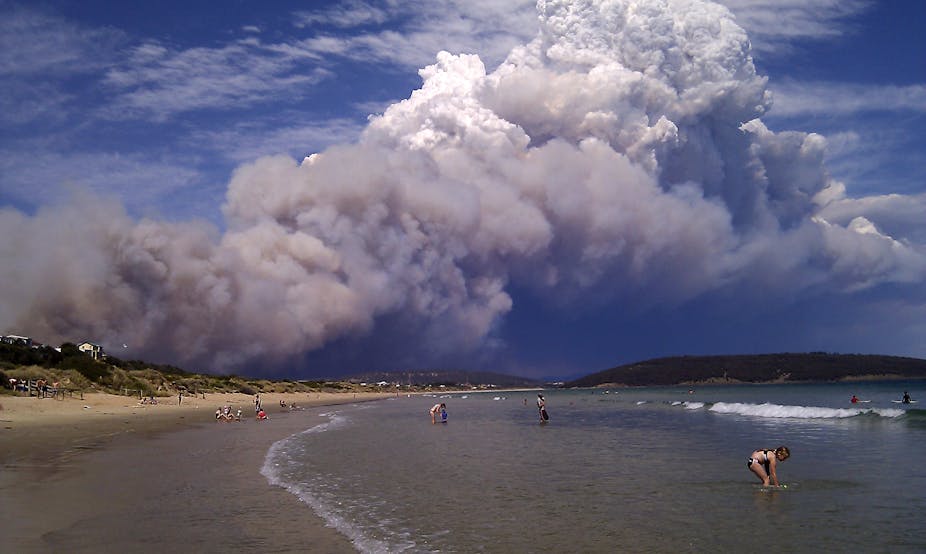
A bushfire smoke plume visible from Park Beach in Forcett, south-east of Hobart. AAP

The bushfires currently raging across south-eastern Australia have, once again, focused national attention on the risks they pose for the community.

The immediate concerns, naturally, are the direct impacts on life, property and infrastructure, including the threat to life from the intense radiation around even relatively small fire fronts. But even people living far from bushfires can be affected by the smoke they create.

Hobart, for example, is currently under a pall of smoke from large fires on the Tasman Peninsula to the east, in the southwest forest and in the urban interface to the north. This constitutes a major pollution event affecting a large fraction of Tasmania’s population.

Smoke from bushfires and fires prescribed for fuel reduction, silviculture (tree farming) and biodiversity management are the largest source of air pollutants in Australia. The major pollutants in smoke are carbon dioxide (CO₂), carbon monoxide (CO), methane (CH₄), fine particulate matter, other volatile organic compounds and oxides of nitrogen.

From extensive occupational health, toxicological and epidemiological studies, the major causes acute health impacts from bushfire smoke have been identified as fine particulate matter, CO and a small group of respiratory irritants and carcinogens within the thousands of compounds comprising volatile organic compounds – principally, formaldehyde, acetaldehyde and acrolein, benzene, toluene and some polyaromatic hydrocarbons.

The degree to which each of these poses a health risk depends on their local concentration. Concentrations of CO and fine particulate matter in fire zones commonly exceed the short-term occupational health standards and can be between 100 and 1000-fold higher than ambient air quality standards. Indeed, CO concentrations exceeding 300 parts per million and fine particulate matter concentrations of 100 micrograms per cubic metre (µg/m³) are common around bushfires.

Carbon monoxide is particularly insidious because we can’t smell it, and its effects are cumulative. But extensive monitoring of firefighters has found few cases of exposure exceeding occupational health standards.

In fact, we found that firefighters on the ground tended to avoid direct exposure to smoke, and where exposure was unavoidable, irritants in the smoke ensured that firefighters minimised exposure duration. We concluded that exposure to smoke for those fighting fires is a manageable issue.

The smoke exposure of the population in the region of a bushfire, however, appears to be a greater problem. Our measurements of ambient concentrations during and following the 2006/7 alpine fires in Victoria showed that fine particulate matter is the main hazard for the general population.

Fine particulate matter produced by bushfires comprises particles smaller than 2.5μm ( micrometres, 1μm is 10⁻⁶metres), which can penetrate and lodge deep within the lungs. Once there, their impact can be severe. Such morbidity impacts, including asthma, are difficult to quantify statistically, but there’s accumulating evidence that they can be substantial, and ongoing studies are addressing the question.

What we do know and currently accept is that average population death rate (mortality) goes up by 1% for every 10μg/m³ increase in daily average concentration of fine particulate matter. For health-impaired or susceptible groups in the population, this increase can be up to 4%.

A blanket of smoke from nearby bushfires approaches Melbourne on Friday December 8, 2006. AAP

During the 2006/7 fires, for instance, the CSIRO air quality station at Aspendale recorded that smoke affected Melbourne for eight days with concentrations of fine particulate matter reaching approximately 100 μg/m³. If the whole of the population of Melbourne had been directly exposed to this concentration, the daily death rate in the city over the period of exposure could have increased by about 10%.

Rigorously quantifying the number of people affected is major challenge and probably impossible. It’s clear that the extent of smoke dispersion affects the relative impact of smoke on the regional population, which could be significant.

And the health effects of smoke are not just direct, smoke also impacts on other air-quality measures. Secondary chemical processes, particularly photochemistry, result in products such as ozone and ultrafine secondary organic aerosol, both of which potentially pose health risks.

Ozone concentrations well above the air quality limit were frequently recorded during the 2006/7 Victorian fires – this is rare at other times.

The impact of smoke on people remote from the fires may, on occasion, substantially exceed the direct injury to people within the fire zone. But we currently lack the operational tools to understand the extent of these impacts or to manage them.

The non-lethal impacts of fine particulate matter haven’t been quantified, and although available models are reasonably reliable, the framework required to bring together all the components for forecasting smoke dispersion hasn’t yet been developed for Australia. Both are essential for managing the diffuse impacts of severe fires, and fortunately, both are now in development.

Sign in to Favourite

Want to follow The Conversation?

Sign up to our free newsletter to get the day's top stories in your inbox each morning, with a special wrap on Saturday.

Help evidence based journalism become the norm and donate

Join the conversation

19 Comments sorted by

  1. Matthew Thredgold

    Software Engineer/Secondary Teacher

    "fine particulate matter concentrations of 100 micrograms per cubic metre (µg/m³) are common"

    Levels not unknown in Australian and New Zealand towns because of winter domestic wood burning.

    Can anyone tell me if the woodsmoke from domestic heaters is magically not lethal like wood smoke from bushfires?

    And if the woodsmoke from domestic woodburning isn't magical how come it hasn't already been blanket banned from all settled areas?

    Would the Australian Home Heating Association care to comment why it thinks that it's manufacturer members' products that spew toxic pollutants under normal operation somehow magically don't pollute? Or why it, like tobacco companies, values its member's profits above community health and well-being?

    The ANZ air quality standards need to be revised (without a AHHA veto this time) to actually be consistent with the science, rather than being based on the fantasy that particulate pollution is not harmful.

    report
    1. Joe Gartner

      Tilter

      In reply to Matthew Thredgold

      Unbelievably I agree with you.... I grew up with open fires or wood heating and there is nothing better, unless you work in ED and see the asthmatics struggling to breathe. It is the ultimate selfishness if you live in a city, especially in a hollow, and have a wood fire. Unfortunately the alternative is carbon releasing Gas, coal or electricity...

      report
    2. Mark Amey

      logged in via Facebook

      In reply to Matthew Thredgold

      I agree with Matthew and Joe. generating woodsmoke is incredibly selfish (unless you are 100s of meters from your neighbor), and incredibly inefficient. I don't know what the efficiency of those modern stainless steel encrusted units is like, but an open fire is probably <10% efficient (no reference, seem to remember reading this some years back), whereas, whilst gas/electricity yield plenty of carbon dioxide, they are probably reasonably efficient (once again, don't know the exact figures).

      There are houses in my suburb that have smoke spewing from the chimney from March until September...it's not even cold!

      report
    3. Chris Saunders

      retired

      In reply to Matthew Thredgold

      Take your point on the home fires burning, but what about bush burn offs in the spring? Is there another way for firies to tackle new growth and prepare for summer’s bush fire onslaught? And the arsonists are these young teenage boys out for a lark?

      report
    4. Dorothy L Robinson

      logged in via email @gmail.com

      In reply to Matthew Thredgold

      A good example of just how bad woodsmoke is for our health was the publication this week of a study showing Launceston's woodsmoke-reduction program (which halved wood heater use) reduced wintertime deaths from cardiovasular diseases by 20% and respiratory deaths by 28%.

      With such tremendous benefits from reducing wood heater use, I suspect the vast majority would like to see another 20-28% reduction in cardiovascular/respiratory deaths by persuading the remaining 30% of households to convert…

      Read more
    5. Sue Ieraci

      Public hospital clinician

      In reply to Matthew Thredgold

      Joe Gartner - I've looked after many "asthmatics struggling to breathe" - but not because of bush fires.

      The vast majority of asthma attacks are an inflammatory reaction in response to an ordinary viral infection (most common), followed by reactions to "natural" allergens such as airborn pollen, animal hair or cold air.

      There isn't much evidence that bushfires provoke asthma, although we are always warned about it. There is good evidence, however, that the combination of barometric pressure…

      Read more
    6. Dorothy L Robinson

      logged in via email @gmail.com

      In reply to Matthew Thredgold

      Sue Leraci may like to consider a study of two cities, Palo Alto, and Fresno, where the main source of air pollution is woodsmoke. It's so bad that both cities have 'burn bans' where use of wood heaters is prohibited on days when high pollution is forecast.
      "In a study of 181 children with and without asthma in the California cities of Fresno and Palo Alto... the researchers found that air pollution exposure suppressed the immune system’s regulatory T cells (Treg), and that the decreased level…

      Read more
    7. Sue Ieraci

      Public hospital clinician

      In reply to Dorothy L Robinson

      Hi, Dorothy - I've seen the study that compared children in two cities in California - the extract you copied is frequently cut and pasted but it is interesting to look at the actual paper - which is from the Journal of Allergy and Clinical Immunology Oct 2010.

      This paper compared a small number of children with and without asthma in a relatively high-pollution and low SES area with a relatively clean-air and higher SES area in California. There were only 30 - 40 children in each group.

      The…

      Read more
    8. KHTAGH

      logged in via Twitter

      In reply to Matthew Thredgold

      Matthew

      This is such a problem in Launceston Tassie that wood fires have been banned because of that very reason, the city is in a hollow & the smoke just sits there on most winter days, causes major respiratory problem in lots of people

      report
    9. Dorothy L Robinson

      logged in via email @gmail.com

      In reply to Sue Ieraci

      Here's another research paper:
      Polycyclic aromatic hydrocarbon exposure and pediatric asthma in children: a case--control study

      Parents or guardians filled out a questionnaire consisting of demographic information which included dietary questions, area of residence (near the factory, high-traffic area, etc.), presence of a smoker at home and other pertinent questions related to asthma. I'm not sure why this information doesn't appear to be shown in the tables.

      The results nonetheless add…

      Read more
    10. Sue Ieraci

      Public hospital clinician

      In reply to Dorothy L Robinson

      Hi, Dorothy.

      The conclusion of the paper is not borne out by the evidence they found. The "pivotal" factors in childhood asthma are heredity (atopic). The data bore this out - as the major, highly-significant factors of difference were found to be the inflammatory markers (interleukins and IgE) and, surprisingly, HDL cholesterol.

      If you look at the table, you see that they found a mixture of positive and negative correlations between individual PAHs - like Naphthalene - and individual inflammatory…

      Read more
    11. George Crisp

      Medical Practitioner

      In reply to Sue Ieraci

      There is evidence for a consistent and well established link between air pollution and asthma in children though:

      - there are strong an consistent associations between air pollutant levels including Aus studies.

      - ED presentations for asthma in children mirror air pollutant levels ( within guideline ranges ) as demonstrated in Perth, (NOx, CO) Periera et al 2010 and Melbourne (PM10, NO2, O3) Erbas et al 2010

      - proximity to living near major roads is associated with increasing asthma…

      Read more
  2. Darryl Dilger

    Env Educator, Father, Rural Firefighter

    As a volunteer firefighter in my community for 15 years, I am interested in how firefighters in the study "manage" intake levels. In Qld we volunteers we are issued with the little white paper masks...useless at best. While we try to stay out of the smoke it is often impossible to protect life, property and livestock without putting ourselves in the smoke at times. I would be interested to hear what other states volunteers are issued to stop fine particulates.

    Darryl Dilger
    (not sure why my wife appears above)

    report
  3. Sue Ieraci

    Public hospital clinician

    Without wanting to diminish the risks to firefighters of their important and dangerous job, the Carbon Monoxide exposure of fire-fighters needs to be taken in context: the average smoker has a higher carboxy-haemoglobin level than most people taken to hospital for mild to moderate smoke inhalation.

    Refs
    http://www.sciencedirect.com/science/article/pii/S0954611104000034
    http://www.sciencedirect.com/science/article/pii/S0167814004003925
    http://www.sabinet.co.za/abstracts/m_samj/m_samj_v100_n2_a19.html

    report
  4. George Crisp

    Medical Practitioner

    Thanks for a very timely and useful article.

    Couple of points I would like to raise. Firstly, that chronic exposure causes a greater burden of disease for a given level of pollution. So while these high air-pollution events cause significant ill-health, long term exposure at far lower levels will cause similar morbidity and mortality.

    Secondly, it is not just respiratory disease. It has been apparent since the 1990's ( Harvard Six Cities Study and American Cancer Study) that cardiovascular diseases ( eg heart attacks ) are strongly related to fine particulate air pollution, as well as lung cancer and a range of other diseases.

    report
  5. Moira Deslandes

    logged in via Facebook

    Timely article. For those people suffering lung diseases - as someone in my house does - the smoke effects can be life threatening a long time after the fire might have passed. This group of sufferers and the various medical researchers are a potential ally for climate change activists - I have never heard anything from them. Just wondering if this might worth asking medical researchers for an op piece on ? I would be interested in reading that.

    report
    1. Mick Meyer

      Senior Research Scientist at Centre for Australian Weather & Climate Research at CSIRO

      In reply to Moira Deslandes

      G'day Mark, I m joining the discussion at a late stage. There is of course no substantial difference between wood smoke and bushfire smoke at the point of emission. There may be after its had a chance to age during transport. Woodsmoke is likely to be fresher and less affected by photochemistry. I think of it as smoke. You might be interested in our Hun Valley study published last year that has a lot about the chemistry of smoke.

      http://www.forestrytas.com.au/uploads/File/pdf/pdf2011/huon_valley_csiro_report_2011.pdf

      WRT prescribed burns- bushfires are one side of the equation, prescribed burning is the other side. The challenge the fire agencies face is balancing certain local impacts from fuel reduction burning against the risks of impact from potential wildfires. We (CSIRO, BoM and some University collaborators) are developing the tools to help with this planning with DSE Vic and the Bushfire CRC. With care there should be some optimum position possible.

      report
  6. Chris Smalley

    logged in via Facebook

    Fair enough...rather short sighted...but fair enough. The thing that everybody seems to want to believe is the inherent evils of naturally occurring cycles. As is fairly common knowledge, there are two main beliefs about the causes of climate change. Firstly, Anthropogenic greenhouse gases, and secondly, dissipation of atmospheric particulates. Now that everybody has jumped on the AGHG bandwagon, and action is being taken on it...has anybody considered that, maybe, fires have been occurring ever…

    Read more