
Still keeping women out: a short history of Australian abortion law

Tuesday marked the 40th anniversary of the US Supreme Court decision in Roe v Wade (410 U.S. 113 (1973)), which found that Texas State law prohibiting abortion was unconstitutional. The landmark decision continues to be celebrated globally and is seen by many as ushering in a new era of abortion law…

7mgsrrpg-1358994458
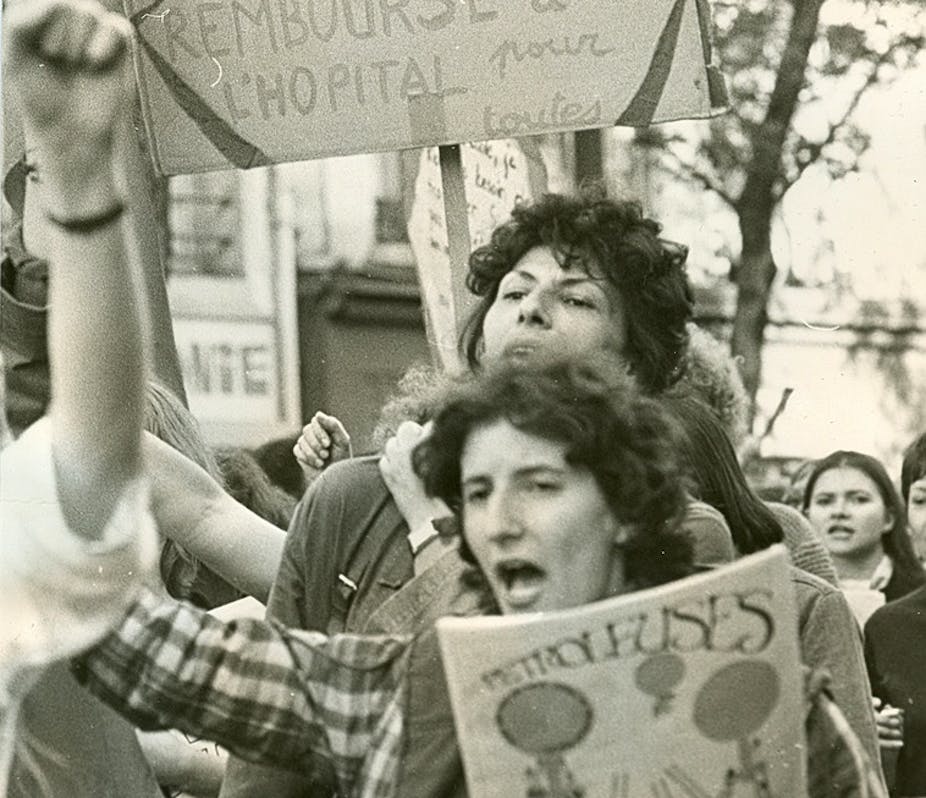
Women all over the Western world, such as these protestors in Paris in1972, have had to fight for abortion rights. Marina Urquidi

Tuesday marked the 40th anniversary of the US Supreme Court decision in Roe v Wade (410 U.S. 113 (1973)), which found that Texas State law prohibiting abortion was unconstitutional. The landmark decision continues to be celebrated globally and is seen by many as ushering in a new era of abortion law reform although reform in Australia started on a similar model in the 1960s.

But victory in Roe v Wade has proved a mixed blessing and, in some respects, its continuing influence has helped entrench a second-best approach to women’s autonomy.

Australian abortion law has largely followed the logic of “medicalisation” of abortion in Roe v Wade. In Australia this legal approach means that, contrary to second-wave feminist demands, only doctors – not nurses or midwives – are legally authorised to perform surgical abortion procedures.

Roe v Wade

One immediate effect of Roe v Wade was to override all state laws prohibiting abortion performed by doctors, at least until the point of presumed viability of the foetus. The second effect was to entrench medical authority over abortion governance and procedure.

The case marked the culmination of a decade of feminist and medical campaigns to secure abortion rights in the United States.

While feminists as diverse as New York’s Redstockings and the National Organisation for Women demanded the repeal of all abortion laws, from 1970 the American Medical Association and the American Civil Liberties Union transformed the focus of mainstream campaigns from repeal to reform.

This sidelined the most radical and materialist claims of the women’s movement – that abortion was a political claim essential for all women’s autonomy and full human rights – and set the medically-focused parameters for the judgement in Roe v Wade.

In Australia

The lack of a bill of rights or similar constitutional instrument in Australia means there’s been no high court finding on abortion here. Instead, campaigners have targeted state and territory legislatures – to varying degrees of success. But here too, the medicalisation of abortion has prevailed.

Historically, the colonies that constituted pre-Federation Australia prohibited abortion based on laws replicating 19th century British criminal prohibitions. These had always allowed the exception of “therapeutic” abortions performed by doctors to save the woman’s life.

In 1938, the English case of Bourne (King v Bourne [1939] 1 KB 687) clarified the criminal defence of abortions performed by doctors to save a woman’s life, broadly interpreted to include psychological factors. The judgement confirmed the authority of the medical establishment over abortion and was understood as persuasive authority in Australian jurisdictions.

Still, the legal and clinical situation remained undesirable and was thoroughly exploited by corrupt police and practitioners capitalising on the perceived lack of legal clarity. And the focus on “psychological health” led many women to seek patronising psychiatric assessments declaring them unstable or unfit to mother.

Inspired by reform in the United Kingdom, in 1969 the South Australian Liberal government reformed state law to clarify, once and for all, the legal protection afforded to “legally qualified medical practitioners” operating to preserve a “woman’s life or her mental or physical health (actual or reasonably foreseeable)”, or in cases of foetal abnormality.

Soon after (in response to corruption scandals on the east coast), Judge Menhennitt in Victoria (1969) and Judge Levine in New South Wales (1972) passed judgements in the lower courts clarifying legal protection of doctors operating in regard to a woman’s physical and psychological health. In New South Wales, this included the consideration of her foreseeable economic situation.

Steps forward

From the 1970s, feminists such as the Women’s Abortion Action Campaign in New South Wales lobbied for the repeal of all abortion laws, and “abortion at no cost, with no legal restrictions, no quotas in public hospitals, lots of good clinics run by women, plenty of information about abortion, contraception and sexuality, no guilt trips and no discrimination against young, black or migrant women.”

But the medicalisation of abortion governance was well and truly consolidated in Australia by this time. Indeed, since the South Australian reforms, all abortion reforms passed in Australian legislatures have consolidated medical control of the procedure.

In 2008, the Victorian parliament passed the Abortion Law Reform Act to clarify the legal conditions for abortion, on the advice of the Victorian Law Reform Commission. The Act removes the need for doctors to provide medical or psychological justifications for abortion, stating simply that a “registered medical practitioner may perform an abortion on a woman who is not more than 24 weeks pregnant.”

For procedures performed after this point, justifications made in concert with a second doctor are required.

The Victorian Act is widely recognised as both a medical and feminist success. It’s been a long time since women’s liberation framed the tenor of mainstream feminist abortion demands. But it’s still important to consider the impact of the medicalisation of abortion.

Medicalised abortion

Australia is potentially facing a crisis in abortion provision, with services dependent on the commitment of a handful of doctors performing procedures mostly in the private sector in each state and territory. And the general doctors’ shortage is keenly felt in the reproductive health sector.

Last year, the historic Croydon Clinic, which was taken over by Marie Stopes International, announced that due to changes in its medical practice, it would no longer perform abortions after 24 weeks, leaving Australian women without access to this service in the private sector.

One solution to the doctors’ shortage could be to allow nurse practitioners to perform surgical abortions which, despite the TGA’s authorisation of RU486, remain common in Australian practice.

In the United States, the Roe v Wade judgement authorises “physicians” to perform abortions, which in some states has been interpreted to include nurse practitioners, depending on local laws. A recent six-year University of California study of patient outcomes in America found that first trimester abortions are “just as safe when performed by trained nurse practitioners, physician assistants and certified nurse midwives as when conducted by physicians.”

But in Australia, entrenched medicalisation has meant that local laws such as the Victorian Act preclude anyone other than a registered medical practitioner performing surgical abortions. The radical demands of the 1970s for “lots of good clinics run by women” appear highly prescient in this light.

Articles also by This Author

Sign in to Favourite

Want to follow The Conversation?

Sign up to our free newsletter to get the day's top stories in your inbox each morning, with a special wrap on Saturday.

Spinner
Donate and become a friend of The Conversation

Join the conversation

71 Comments sorted by

  1. David Clerke

    Teacher

    A few years ago a Queensland man was convicted of an abortion because he kicked his pregnant ex girlfriend in the stomach causing her to abort. If abortion were no longer a crime how would you view this? A charge of common assault would have resulted in a much more minor sentence.

    report
    1. David Clerke

      Teacher

      In reply to David Clerke

      One thing I would have thought would have got a mention by now is the withdrawal of the 1997 National Health and Medical Research Council paper on abortion but no one seems to want to talk about it.

      report
    2. Marion Brook

      BA, Grad Dip Ed (student)

      In reply to David Clerke

      Serious assault causing injury can carry quite long jail terms - as much as 16 years in some cases. Also where abortion is legal it requires medical controls and the patient's consent to be so. A kick in the stomach during an assault episode would hardly constitute a legal abortion even if it occurred in a state where abortion has been legalised.

      report
    3. Marion Brook

      BA, Grad Dip Ed (student)

      In reply to David Clerke

      Tell him what? I think you need to go back and read what I actually wrote.

      I said his assault "would hardly constitute a LEGAL abortion". I should think the lack of consent and violent nature of the act means it certainly could constitute an ILLEGAL abortion anywhere.

      report
  2. Dale Bloom

    Analyst

    Something never mentioned when feminists celebrate abortion and the Roe vs Wade case, is that Jane Roe was actually a Norma McCorvey, who is now highly anti-abortion, and worse still for feminists, has become a dedicated Christrian (shock horror of all horrors).

    This is never mentioned by feminists, and it becomes so typical of the misinformation of feminism.

    If someone opposes or tries to reduce abortion, it is frequently said they are trying to take away women's rights, but one of feminists great heros 'has now become a strong opponent of abortion.

    Abortion has little to do with reducing the rates of unwanted pregnancies.

    Instead, abortion is now a political system for feminists, and they give it all the all the misininformation, propaganda and brainwashing they can throw at it.

    report
    1. Philip Starkey

      Physics PhD Student

      In reply to Dale Bloom

      After reading your post I honestly felt like I had just read the comments section on a climate change article on "The Punch". That isn't a good thing...

      I suggest you focus more on facts and less on conspiracy theories involving feminists.

      report
    2. Dania Ng

      Retired factory worker

      In reply to Philip Starkey

      Wow. I had my comment removed once again for simply saying that some of us are not allowed to post information that provides alternative analyses of the issue under discussion in the article above? I have just written to one of the editors, let's see his response. I wonder what the Australian Communications and Media Authority will have to say about suppressing alternative views and information on abortion and other cogent social issues?

      report
    3. Dania Ng

      Retired factory worker

      In reply to Mark Amey

      If it is you that keeps reporting me (again), care to explain which of the "standards" you think I breached? You seem to be so keen in having accurate information provided to you, so pray enlighten me on what it is I did wrong?

      report
    4. Mark Amey

      logged in via Facebook

      In reply to Dania Ng

      Mrs Ng, I reported you once for your vulgar ad hominem attack on another poster.

      The moderator will only remove your comments that have been flagged if they believe that they contravene the standards. It may surprise you that there are others who find certain of your comments to have been in breach of the standards. Please think before you post.

      report
    5. Dania Ng

      Retired factory worker

      In reply to Mark Amey

      Thanks for your reply, though it is hardly enlightening I appreciate your continuous effort to support me on these threads, Mark Amey.
      The fat remains that a comment which simply provides links to some articulate resources, including refereed research papers, and which was not aimed at anyone in particular, is deleted. I am still scratching my head in disbelief. You mentioned the "standards", but I see you are unable to provide a more precise explanations as to how I might have breached them by…

      Read more
    6. Joanne Faulkner

      ARC Research Fellow at University of New South Wales

      In reply to Dania Ng

      It may be the following clause that led to those links being removed:

      "We will remove any posts that are obviously commercial or otherwise spam-like. Our aim is that this site should provide a space for people to interact with our content and each other, and we actively discourage commercial entities passing themselves off as individuals to post advertising material or links. This may also apply to people or organisations that frequently post propaganda or external links."

      The meechanreport.com and mercatornet.com hardly constitute "peer reviewed" research. These publications are highly political and partial. I did not report you, but I'm not surprised if someone else deemed this trolling.

      report
    7. Dania Ng

      Retired factory worker

      In reply to Joanne Faulkner

      Thanks for your response, Joanne, much appreciated. Mercatornet is quite a well-informed online publication, though perhaps not to the taste of some people here. They have a couple of informative stories on the link between eugenics and the 'planned parenthood' movement which ought to be relevant to the historical context provided by the article here. I also linked to a peer reviewed academic paper, but unfortunately I can't relocate the link in my records. But not to worry, here's another paper, which indicates for at least one national context that there is no link between abortion laws and maternal mortality, but points rather to a positive correlation link between support and education and reducing mortality rates: http://www.plosone.org/article/info%3Adoi%2F10.1371%2Fjournal.pone.0036613
      Hopefully you get to see it before it gets deleted.

      report
    8. David Clerke

      Teacher

      In reply to Dania Ng

      I would also draw attention to the fact that when abortion was restricted in NZ in the late seventies there was no increase in maternal mortalities, in fact a slight fall

      report
    9. Mark Amey

      logged in via Facebook

      In reply to Dania Ng

      Mercatornet may well be very interesting, but it is not a 'peer reviewed' journal. Most of the stories are just that, stories, at best, opinion pieces.

      The plosonelink you provided is interesting, but has little to do with the title of the article, on which you have commented: 'Still keeping women out: a short history of Australian abortion law'

      report
    10. Dania Ng

      Retired factory worker

      In reply to Mark Amey

      "Mercatornet may well be very interesting, but it is not a 'peer reviewed' journal" - - Neither is this publication.
      "Most of the stories are just that, stories, at best, opinion pieces" - so are most of the the stories printed here.
      The paper I linked to demonstrates that, in terms of maternal death as a key indicator, education and support have a better outcome for maternal mothers than abortion. This is directly relevant, in my view, to the issue indicated by this article's title, "Still keeping women out: a short history of Australian abortion law". Women are "kept out" by insufficient education and support to make well informed decisions that are appropriate for them, and not merely by the argument whether doctors or nurses should do abortion surgical procedures on them.

      report
    11. Dania Ng

      Retired factory worker

      In reply to David Clerke

      Yeah, there is plenty of evidence supporting this. Like the low mortality rates in Ireland and other countries where abortion is not supported by legal systems.

      report
    12. Dania Ng

      Retired factory worker

      In reply to Dania Ng

      Just to add, I don't know what meechanreport.com is, and I don't think this site exists.

      report
    13. Mark Amey

      logged in via Facebook

      In reply to Dania Ng

      Of course, there are no figures on the number of Irish women who go to England or Europe, likewise for Kiwis who travel to Australia.

      report
    14. Dania Ng

      Retired factory worker

      In reply to Mark Amey

      Perhaps not. However, there are figures for maternal death rates for the UK and Australia. It would be easy to compare them with those of Ireland and NZ. I know that the UK figures are much higher, so does this mean that Irish women place themselves at greater risk of mortality?

      report
    15. Dania Ng

      Retired factory worker

      In reply to Dania Ng

      I meant to say, Does this mean that Irish women place themselves at greater risk of mortality if they travel to the UK for abortion procedures?

      report
    16. Mark Amey

      logged in via Facebook

      In reply to Dania Ng

      If women with morbidities directly related to pregnancy, or co-morbidities which are exacerbated by pregnancy leave one country, and go to another for abortion services, then the country which allows the women to access their abortion services is likely to have inflated maternal mortality figures, whilst the country which has no abortion services will have falsely deflated figures. No-one is pretending that abortion is completely benign, particularly for the patient who is already ill.

      I believe that changes in the way information on maternal deaths is collected may yield a MMR 0f around 8 per 100000 for Ireland: http://www.irishtimes.com/newspaper/health/2012/1204/1224327432048.html

      Interestingly, Sweden's MMR is around 4 per 100000, in spite of having legalised abortion: https://www.cia.gov/library/publications/the-world-factbook/rankorder/2223rank.html

      report
    17. Dania Ng

      Retired factory worker

      In reply to Mark Amey

      Sure, but even the 8/100k rate is lower than that of the UKs, which is somewhat over 12/100k, even accounting for the inter-country medical migration patterns. When compared to culturally similar countries where religion plays an important place in decision-making for women, like Chile, Portugal and so on, then I would guess that culture may be an important variable. I am not sure what the case is for Sweden, the point is that there are different factors at play here, which merit further investigation, rather than retreat to a model which does not hold explanatory power for every culture or national context. For example, in the US socioeconomic position is obviously a key factor, with the most disadvantaged groups being impacted the most.

      report
    18. Mark Amey

      logged in via Facebook

      In reply to Dania Ng

      Clearly the statistics don't support your thesis, so should be discarded.

      report
    19. Dania Ng

      Retired factory worker

      In reply to Mark Amey

      Oh, but they clearly do. There is a negative association between culture/national context which supports and provides access to unbiased information and health /social education, and maternal mortality rates. Otherwise we wouldn't find any stats and social research to support this.

      report
    20. Mark Amey

      logged in via Facebook

      In reply to Dania Ng

      'Sure, but even the 8/100k rate is lower than that of the UKs, which is somewhat over 12/100k, even accounting for the inter-country medical migration patterns.' No, not 'somewhat more, 12 per 100000: https://www.cia.gov/library/publications/the-world-factbook/rankorder/2223rank.html.

      Clearly the MMR for Ireland and England (and, possibly France and Spain, as these are countries which also provide abortion services to Irish women) is closely tied together. I don't know how you can say that the inter-country migration patterns don't account for this, when the numbers of Irish women seeking abortion in England, and other countries, is unknown. You seem keen to compare Ireland to Chile on the basis of them both outlawing abortion and both being Catholic. That's probably where the similarities end.

      I note that you're quick to dismiss Sweden's low MMR, in spite of it having had legal abortion since WWII.

      report
    21. Dania Ng

      Retired factory worker

      In reply to Mark Amey

      " I don't know how you can say that the inter-country migration patterns don't account for this, when the numbers of Irish women seeking abortion in England, and other countries, is unknown". I don't "say" this, please don't put words in my mouth. If there is speculation about figures, surely my speculations are just as valid as yours? I didn't dismiss Sweden at all, in fact that's what I meant by cultural/national variables, otherwise I would have mentioned Catholicism as a specific variable instead. Sweden also falls under my broad category of cultural/national. The question then becomes, What are the characteristics we can identify for each country under this category, and would they explain the variance in the statistical differences we are concerned with here? I believe, if I remember correctly from the classes in research methods I used to teach, this is called Analysis of Variance (ANOVA).

      report
    22. Mark Amey

      logged in via Facebook

      In reply to Dania Ng

      ...or 12 in 2010, which is more recent.

      report
    23. Mark Amey

      logged in via Facebook

      In reply to Dania Ng

      So, no Irish Catholic girl went to England, or Spain, or France, or anywhere else in Europe to get an abortion?

      report
    24. Venise Alstergren

      Venise Alstergren is a Friend of The Conversation.

      photographer, blogger.

      In reply to Dale Bloom

      As a female, I resent men who would prevent any female from taking charge of her own body. Equally odious, is the assumption that women who are pro-abortion are feminists.

      I am not misinformed; not one little bit. ButI am appalled at the mendacious tripe found in the following statement. ""Abortion has little to do with reducing the rates of unwanted pregnancies. "" Why should it have anything to do with reducing unwanted pregnancies? The whole point of safe abortion is it increases the ability to plan families properly and to bring them up in the best way possible.

      Why would abortion, the amputation of a toe, the speed of light or a grey horse help to stamp out stupidity? Stupidity which can be found in teen age girls, believers in a fundamentalist religion, or strident Women's Righters. Ditto, men who have no business in dictating to women about their OWN bodies.

      report
    25. Dania Ng

      Retired factory worker

      In reply to Mark Amey

      Let's re-frame it another way, just so that we can agree who should take responsibility for backing what. You postulate that the 100% difference (6 vs 12 http://whqlibdoc.who.int/publications/2012/9789241503631_eng.pdf pp.33-36) explained by Irish females traveling to the UK? Your thesis, not mine, so I suggest that the onus is on you to defend it and for me to critique. So let's hear the evidence supporting your argument. If you instead wish to be right at all costs, then say so and I will be happy to drop the discussion.

      report
    26. Mark Amey

      logged in via Facebook

      In reply to Dania Ng

      I would have thought that the onus was on you to defend your position, as you introduced it:Yeah, there is plenty of evidence supporting this.' Like the low mortality rates in Ireland and other countries where abortion is not supported by legal systems.'

      In 2011 5156 Irish women travelled to England or Wales to access abortion services. This accounts for nearly 84% of the abortions these countries provided for 'non-residents'. Link to the KK DoH website blocked by TC spam filter.

      as the data Irish women travelling to other countries for abortion services is likely to be difficult, if not impossible to find, and, this article is essentially about access to these services in Australia, I will follow Venise's advice and stop meddling in women's business.

      report
    27. Dania Ng

      Retired factory worker

      In reply to Mark Amey

      Well, the general argument I was pursuing at the time you came in was that, judging from emerging research, it seems that it is not entirely true that preventing women from having abortions leads to higher maternal death rates.This is indicated by data from countries where abortion on demand is still illegal. You then suggested that, for one of the examples used (Ireland), these figures are skewed by the fact that some women go to the UK to have abortions, thus inflating that country's maternal mortality…

      Read more
  3. Joanne Faulkner

    ARC Research Fellow at University of New South Wales

    This is an excellent article, and it's good to think through the connections and dissonances between Australian and US law, as well as the costs for women of the medicalisation/psychiatrisation of abortion.

    @ David, it would make more sense I would have thought to strengthen assault laws, and at most build into the assault charge the harm of taking a wanted foetus, rather than assert abortion laws (after all, that assault wasn't in any sense an abortion).

    @ Dale, "Jane Roe" was never a feminist hero, but rather a random pregnant woman who could have legal standing for a case that clearly concerned the rights of all women, present and future, to procure an abortion. It makes no difference what she personally thought, said or did in the years following Roe v. Wade.

    report
    1. David Clerke

      Teacher

      In reply to Joanne Faulkner

      I remember the anguish of the woman in Roe v Wade when she found out that her lawyer had herself been in a position to make a test case but had chosen to go to Mexico to have an abortion. I note in response to me you use the phrase "taking a wanted foetus" I am not sure if I interpret you correctly but wanted by whom? In the US some militant men's groups have campaigned for men to have the right to abortion meaning that on notification of a pregnancy they have so many months to choose the role of fatherhood, or paternity payer or they can tell the woman she can terminate or go it alone. I have experienced quite a few cases of women getting pregnant to the richest male they can to maximize support payments. Elizabeth Hurley being a case in point and people with fixed assets, farms and own businesses seem to be particularly popular.

      report
    2. Sue Ieraci

      Public hospital clinician

      In reply to David Clerke

      "women getting pregnant to the richest male they can "

      How do they extract the semen without the man knowing?

      report
    3. David Clerke

      Teacher

      In reply to Sue Ieraci

      He signed up for sex not parenthood. What if she tells him that she is using contraception but is not? Bettina Arndt tells of regularly receiving correspondence asking for her blessing for women to get pregnant against their partner's wishes. She does not give it. In the days before fertility controlled the maxim "you got her pregnant nor marry her" had currency but should that attitude still persist?

      report
    4. Dale Bloom

      Analyst

      In reply to Joanne Faulkner

      It does appear Norma McCorvey was simply a feminist's puppet.

      "At various times, Norma McCorvey has clarified that she did not consider herself an unwilling participant in the Roe v. Wade lawsuit. However, she felt that feminist activists treated her with disdain because she was a poor, blue-collar, drug-abusing woman instead of a polished, educated feminist.

      http://womenshistory.about.com/od/abortionus/a/norma_mccorvey.htm

      She was considered dispensible and irrelevant, like a discarded fetus.

      Abortion has little to do with people and babies, but is a political system for feminists.

      While feminist appear determined to retain abortion for political purposes, the mega billons spent on abortion worldwide could have been spent on finding better contraception.

      report
    5. Sue Ieraci

      Public hospital clinician

      In reply to David Clerke

      "He signed up for sex not parenthood."

      Sounds a bit disingenuous, David.

      "What if she tells him that she is using contraception but is not? "

      Why rely on "her"? If parenthood is not to be countenanced, have non-vaginal sex, wear a condom, get a vasectomy. No conception. Problem solved.

      report
    6. Sue Ieraci

      Public hospital clinician

      In reply to Dale Bloom

      "the mega billons spent on abortion worldwide could have been spent on finding better contraception."

      Dale, if look up the facts about contraception, you will find that all modern methods are exceptionally effective - when applied perfectly.

      No contraceptive method is perfect where human error is a factor. Long-term injected methods come close - though many don't like them. Which method do you favour?

      report
    7. David Clerke

      Teacher

      In reply to Sue Ieraci

      Well actually not true, why not believe someone who you are having a relationship with? Why should only one partner decide if a pregnancy continue. There is an old saying that a cad is someone who does not tell his wife that he has had a vasectomy until after she tells him that she is pregnant. Speaking for myself I have twice"got a girl pregnant" but only after I had a secure career and a house. Problem was I had a vasectomy at the age of twenty three. In one case she had an abortion when she found out, never found what happened in the second case.

      report
    8. David Clerke

      Teacher

      In reply to Sue Ieraci

      Well the same applies to the woman if she did not want to get pregnant in the first place!

      report
    9. Dale Bloom

      Analyst

      In reply to Sue Ieraci

      Which method do you favour?

      I would favour the ABC method.

      Abstinence, Be faithfull, and then Contraception.

      Unwanted pregnancy is a risk, and should be treated with risk management systems, and the ABC method is most closely alligned with risk management.

      Abortion is a result of risk management not being applied successfully, or a failure to adequately apply risk management.

      Of course, feminists celebrate abortion, which is now celebrating failure.

      Together with unwanted pregnancy there is also the risk of an STD, but abortion does not fix that risk. In fact, having many sexual partners (which appears to be encouraged by feminists) not only increases the risk of unwanted pregnancy, but significantly increases the risk of contacting an STD.

      In all, feminist's celebrating abortion is to celebrate failure, and if they encourage people to have many sexual partners, they are now significantly increasing the rates of unwanted pregnancies and increasing the rates STDs.

      report
    10. Sue Ieraci

      Public hospital clinician

      In reply to Dale Bloom

      Dale, being an anti-feminist, you have clearly misunderstood what feminists do and don't "celebrate" (bearing in mind that there is huge diversity amongst the population who would identify as feminist).

      Firstly, promiscuity is hardly the exclusive territory of feminists, or indeed women. (Witness David Clerke's comment "I got my share!").

      Secondly, access to effective contraception (part of your ABC strategy) was hard-won by people who would identify as feminists, to the benefit of all (even anti-feminists).

      Can you plot for us the rates of both unwanted pregnancy and rates of STD over the last few decades, identifying the trends that were influenced by "feminism", in the absence of confounding influences? If not, we'll just accept your assertion as spurious.

      report
    11. Andrew Watkins

      Neonatologist

      In reply to Dale Bloom

      As a male doctor my feminist credentials are somewhat suspect but the view that feminists "celebrate abortion" is fairyland stuff.

      Most of the feminist support ( and a lot of the other support ) for access to safe abortion has been driven by rather more important factors, like stopping women dying or being mutilated, to say nothing of the right of women to determine what happens with their bodies and lives.

      Botched abortions are still one of the leading causes of death in women worldwide…

      Read more
  4. Comment removed by moderator.

  5. Mark Amey

    logged in via Facebook

    This article really piqued my interest, as it's the first time (well, in modern times) I've heard of Nurse Practitioners and Midwives performing abortions.

    I'd be interested to know of any Australian NP/midwife out there who is interested in performing this procedure, and whether the relevant registration board would allow it?

    report
    1. Sue Ieraci

      Public hospital clinician

      In reply to Mark Amey

      Mark - abortion would not currently be within the scope of midwives, but it is conceivable (pun intended) that it could be within scope of a NP if they went through the normal process of training, documenting and having approval for the procedure.

      report
    2. Mark Amey

      logged in via Facebook

      In reply to Sue Ieraci

      Yes, Sue, I agree. As an NP, and midwife, a was taken aback by the concept, but wondered whether that was just me thinking that abortion has always been someone else's job. Yes, it would be ideal for a Midwifery Practitioner.

      I'd still like to know if there's any interest in Australia, as (from my observations) it's not a technically difficult procedure.

      report
  6. Anthony Hall

    Associate Professor at Monash University

    Kate,
    the medicalisation of abortion is a byproduct of efforts to make it safer, not efforts to take abortion out of womens hands. We have a sophisticated and legislated system of health safety and oversight to make sure all medical and surgical procedures (inc abortion) are performed in accredited hospitals and are as safe as possible. In Australia, at least, medicalisation does not mean masculinisation. For some years now the majority of medical graduates ( and I presume the majority of obstetric and gynaecology specialist graduates) have been women.

    report
    1. Joanne Faulkner

      ARC Research Fellow at University of New South Wales

      In reply to Anthony Hall

      Anthony, with respect, I don't think Kate's argument was quite that medicalisation = masculinisation... more that, regardless of the doctor's gender, the process has become one of expert medical opinion that pathologises women who seek an abortion: it becomes a health choice rather than a life choice. The appeal to allowing NPs to perform abortions isn't that more of them are women, but rather, that the present arrangements make abortion less available.

      report
    2. Andrew Watkins

      Neonatologist

      In reply to Anthony Hall

      The medicalisation of abortion was probably driven by a few other factors too - had it been driven purely by a concern for the health of women one might have seen rather more public availability over the last century or so.

      For much of the time that abortion has been medicalised it has been illegal or very restricted. One could get one quietly and relatively safely as a private patient but those unable to pay did without or saw a "backyarder". Segments of the medical profession were quite happy…

      Read more
    3. Mark Amey

      logged in via Facebook

      In reply to Andrew Watkins

      I do remember during my nursing training, in the early 80s, a couple of gynaecologists who performed abortions as part of their weekly theatre list, and had done so all of their professional lives. Naturally the women received appropriate counselling. They believed then, as most o now, that woman should have access to high quality anaesthetic and surgical services for their procedure. I'm sure they saved many a woman from having to access a 'backyarder', thereby saving lives.

      report
  7. Comment removed by moderator.

    1. David Clerke

      Teacher

      In reply to Joanne Faulkner

      The issue I was referring to was the habit of the Conversation leaving on personal abuse provided it come from the politically correct side but removing relevant points made which do not reflect the leftie liberal stance of the editors. On occasions comments pointing this out are removed and the original offensives comments left on!

      report
  8. Malcolm Forbes

    logged in via Twitter

    As Anthony Hall points out, the demographics are changing in the medical workforce. With respect to obstetrics & gynaecology, there has been a significant increase in the number of female specialists, with more and more coming through the ranks (http://www.ahwo.gov.au/).

    I wasn't familiar with the study you cited but the findings add to an earlier study published in the same journal in 2004 (http://www.ncbi.nlm.nih.gov/pmc/articles/PMC1448455/). These findings suggest one possible strategy to…

    Read more
    1. Kate Gleeson

      ARC Research Fellow in Politics at Macquarie University

      In reply to Malcolm Forbes

      Thanks for the clarification Malcolm . It can be challenging, some times, to convey complex legal and medical information with brevity, in these types of forums. But I can always strive for greater accuracy.

      I think it's actually evacuation referred to in the study (not extraction which is of course surgical)

      cheers

      report
  9. Ron Chinchen

    Retired (ex Probation and Parole Officer)

    Its somewhat a side issue but pragmatically i dont know what all the fuss is about. If we were in a society where there was a great need to have children, perhaps to ensure the survival of a tribe etc I can well understand the need to protect for the community potential children.

    But we dont live in that sort of world. In fact we live in a world that is increasingly being over populated. Women have been aborting pregnancies since humanity started, often because of resource limits in a tribe…

    Read more
  10. Janet Congues

    logged in via Facebook

    Great article, great debate! It is also great to learn about some of the history that has contributed to this the way abortion is dealt with. Personally, I am anti-abortions, but I am pro-choice! Never in a million years is abortion an easy option for any woman, but given that she is the one who carries the child, I believe that she is the one who has to make that decision. I also would like to see the stigma taken out of abortion. I believe that no woman who has an abortion, forgets. She carries that decision and that experience with her for the rest of her life - she does not need society reminding her everyday of a decision she made. Society does not honour pregnant women, nor mothers in general - without strict guidelines. Honour women simply for being the vessels of creative life and maybe, people will start honouring and taking responsibility for the choices they make in their sexual encounters.

    report
  11. Anna Zamecznik

    Broadcaster

    Reading this article has felt like reading a emotionless indictement of our society. Abortion leaves tremendous scars on women's psyches - which condition has been ignored by most of the conversationalists. How many studies have been done 20 or more years on after an abortion has taken place. How many silent tears are ripping apart women who, even with counselling, cannot look at a child without thinking what if ...? If feminism advocates the destruction of a woman's greatest gift I never want to be a feminist. Empowerment should not be about death but about life!

    report
    1. Andrew Watkins

      Neonatologist

      In reply to Anna Zamecznik

      If making statements like "abortion leaves tremendous scars on women's psyches" one should be careful to present evidence. There are a number of studies which have looked at this and the methodologically rigorous ones tend to show no adverse long term effects.
      Charles, V., Polis, C., Sridhara, S., & Blum, R. (2008). Abortion and long-term mental health outcomes: a systematic review of the evidence. Contraception, 78(6), 436–450.

      One also needs to look at the fact that one does not wake up one…

      Read more
    2. Sue Ieraci

      Public hospital clinician

      In reply to Anna Zamecznik

      Anna - there's also this: what are the consequences of the alternative?

      Some women might grieve for many years after an abortion; others are mightily relieved. Many go on to have children later, grateful that they weren't forced to have a family under different circumstances - immaturity, an abusive relationship. There is good evidence that children brought into those sorts of circumstances suffer.

      report