
Storks, cabbage patches, and the birds and the bees – our broken sex education system

In the fields of gender, sexuality, and sexual health research, it’s a no-brainer that sex education should start early, and that sex should be discussed often – both in schools and at home. But instead we talk about storks, cabbage patches, and the birds and the bees. In fact, we have a million and…

55tywdxk-1358314855
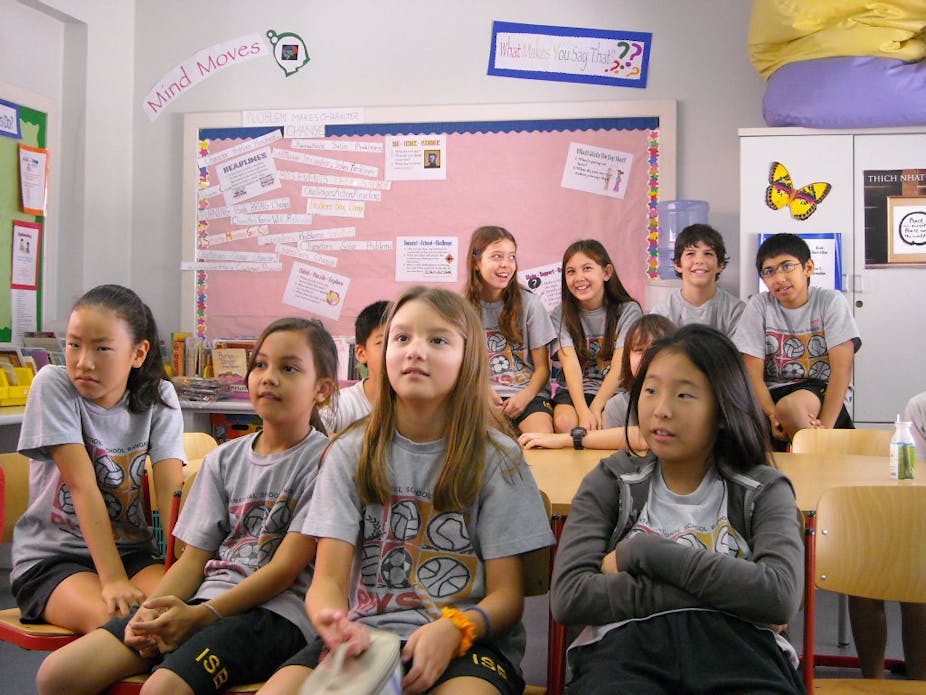
Strict regulation of children’s sexual knowledge can increase prejudice about differences. Kim Cofino

In the fields of gender, sexuality, and sexual health research, it’s a no-brainer that sex education should start early, and that sex should be discussed often – both in schools and at home. But instead we talk about storks, cabbage patches, and the birds and the bees. In fact, we have a million and one ways to avoid teaching or talking about sex and sexuality.

The only way to have open, honest dialogues is to give young people information early and often. Age-appropriate talks about body parts and respect should occur as early as pre-school; we can then continue to add to that knowledge regularly.

Research has documented that young people also want information early. And this information needs to be comprehensive, meaning that it should cover all sexual behaviours and types of relationships. But this isn’t what happens in most countries, including Australia.

The perception of sexuality as a danger to young people is linked to a fear of the consequences of exposing children to sexual knowledge “too early” and to children’s vulnerability to sexual abuse and exploitation. Research by co-author of this article Cristyn Davies and her colleague Kerry Robinson has found that young people’s access to sexual knowledge is considered “risky” and controversial because of the fraught relationship between childhood and sexuality.

But strict regulation of children’s sexual knowledge, often in the name of protection or of the child’s best interest, can paradoxically increase prejudice about differences and vulnerability to exploitation and abuse. It can also undermine the child’s ability to become competent adolescents and adults.

A fundamental reticence

One of the problems with providing young people with sexuality education is that many parents and teachers don’t feel adequately equipped or comfortable about it. Most adults didn’t grow up with a lot of information about sex, so it makes sense that they don’t feel prepared to discuss it with young people.

So, many parents and educators experience a lot of anxiety and tension when faced with teaching young people about these issues. And this tension can result in avoiding, or not effectively addressing, sex education. But there are tools available for parents, though many of them don’t know such things exist.

The irony here is that adolescents are always engaging in much more sexual behaviour than their parents and teachers assume. Teens as young as 13 are sending sexts (text messages with sexual content or images), and they’re generally engaging in sexual activity at younger ages than their parents did.

Research with women in the United States about their menstrual cycles showed parents (including mothers) don’t feel prepared to discuss even menstruation with young people. Most women didn’t receive much education about their menstrual cycles, so they don’t know what to tell their children, or when to tell them.

In fact, most young women learn about menstruation after they’re menstruating, and most young men don’t learn about it at all. This research was the motivation behind a children’s book that gives parents an opening to discuss menstruation with their children.

Euphemisms about storks and the birds and the bees are unhelpful. Matt Westgate

Lead author of this article, Spring Cooper, is working with a team of researchers to develop educational materials about HPV vaccination for adolescents in years seven and eight. When focus-testing materials with young people, she found they wanted to know more, and wanted “correct” terms used for body parts (such vulva, penis and anus) and sexual interactions (such as intercourse and oral sex).

But when testing the same materials with teachers and many school bodies, the feedback was opposite – that the names of specific body parts and any mention of sex, which is how HPV is transmitted, should be kept out of the materials if possible.

Filling the gaps

If young people aren’t given sexual knowledge early, they tend to complete the picture of sex differences, sexual relations, and other sexuality information from their imagination or by shared ignorance with friends. They actively negotiate the regulation of sexual knowledge based on cues from adults, peers, and formal and informal sources of education, such as schooling, media, storybooks, and their own experiences.

They use their knowledge about these issues collaboratively with their peers to fill gaps in their understanding, with dominant personalities often regulating what’s accepted by the group. Without correct information, they build narratives around their bodies and sexuality based on fragments of available knowledge.

So what happens if we use “private parts” to describe sexual organs and avoid topics such as menstruation and specific sexual behaviours? We could liken this type of education to abstinence-only programs, which don’t provide information about many aspects of sexuality and sexual health. Abstinence-only education programs don’t show changes in health or behaviour outcomes, while comprehensive sex education has long been shown to increase knowledge and reduce pregnancies.

Providing young people with correct information also doesn’t increase or accelerate sexual behaviour. But the positive benefits apply at many levels – at an individual level, comprehensive sex education can delay sexual initiation, increase contraceptive and protective behaviours, increase personal sexual satisfaction, and decrease anxiety and worries. At a societal level, these impacts translate into fewer unintended pregnancies and sexually transmitted infections.

So forget the birds and the bees. Opt to talk about sex with your children. Prepare first, and then do it openly, honestly, and often. Similarly, ask the schools your children attend to do the same so that this important education is reinforced, and the potential for misinformation about sex and sexuality is lessened.

Knowledge about sex and sexuality has crucial implications for young people’s health and well-being. These critical benefits for sexual health are carried into adulthood.

Articles also by These Authors

Sign in to Favourite

Want to follow The Conversation?

Sign up to our free newsletter to get the day's top stories in your inbox each morning, with a special wrap on Saturday.

Spinner
Help evidence based journalism become the norm and donate

Join the conversation

37 Comments sorted by

  1. David Paxton

    Veterinarian

    Thanks for the Conversation. I agree with openness, but, may I tell a funny story which a friend told me decades ago?

    When their daughter asked about sex, her parents decided to give her an open, explicit explanation. The little girl thought about it for a moment, then screwed up her face and exclaimed "Yuuuck!!!"

    There is a comic aspect to sex which is hard to explain to children.

    report
    1. Sue Ieraci

      Public hospital clinician

      In reply to David Paxton

      Still occurring, David. The modern version is "eeeewwwwwwww"!

      report
    2. Mark Amey

      logged in via Facebook

      In reply to Sue Ieraci

      My youngest came home after a day of sex education, at school. I asked him how it went, did he understand it all??

      Yes, he only had one question, 'How does the sperm get from the tip of the penis, into the vagina?'

      We told him the usual process.

      'That's horrible, no wonder you two only had one kid!'

      report
  2. Patricia Byers

    retired

    That little story reminded me of another from way back:
    A small child’s parents were waiting anxiously for their son to become curious about things relating to sex and prepared their answers for that time.
    One day they thought the moment had arrived when he rushed inside and asked:
    “Where did I come from?”
    They launched into a detailed description of the reproductive process and thought they had got through it all quite well.
    The child listened in a bemused fashion then said:
    “Oh, Jimmy next door came from Ballarat.”
    So, as an old teacher used to say:
    “Let a word to the wise be sufficient.”

    report
  3. Colin Stokes

    Health Educator

    Thanks for this article. I work as a Health Project Coordinator for a peak body and in that role as in previous work as a youth worker I have seen the effects of our cowardice in telling children the truth about sex. Having lived through the 70s I can assure readers that we are going backwards in this respect (as in others).

    It isn't just about the day that we decide to have "The Conversation" (apologies editors) with our already partially aware teen but the need to immerse our children in the…

    Read more
  4. Dale Bloom

    Analyst

    “In the fields of gender, sexuality, and sexual health research, it’s a no-brainer that sex education should start early”

    Well I think there should be cause for concern when a parent now has to trust some teacher to teach their children about sex and human reproduction.

    Particularly when the education system is now so heavily feminist influenced, and children 13 or younger are now having sex.

    This article does not seem to have any concerns about that, but 13 or younger is below the legal age of consent.

    I tend to think this could be an effort to take the children from their parents, and have them feminist trained and indoctrinated.

    report
    1. Colin Stokes

      Health Educator

      In reply to Dale Bloom

      Dear me Dale!

      There is cause for concern, and I agree that parents need to be more courageous in speaking directly to their children about sex. I would point out that parents do not 'have to' trust teachers or anyone. They could, with a bit less shame about their own bodies and practices, educate their children themselves.

      Your comments around feminism and education though are frankly weird. Your contention seems to be that if educated about sex, or indeed feminism, young people will choose to have more sex, earlier. You offer no evidence or experience to back this up, largely because there is none.

      report
    2. Dale Bloom

      Analyst

      In reply to Colin Stokes

      As well as too many children having sex below the age of consent (which this article doesn’t mention), there are also concerns that too many children are leaving the highly feminist education system with minimal ability to read and write.

      I do think parents should be more concerned about their children’s general education, and what they are being taught, and by whom.

      Now found in education systems such as the Finnish system, children have minimal ability to learn below the age of about 7, so sex education in preschool is much a waste of time.

      The emphasis on preschool education is also a waste of emphasis.

      report
    3. Mike Swinbourne

      logged in via Facebook

      In reply to Dale Bloom

      Poe's Law states that it is difficult, if not impossible, to distinguish between sincere extremism and a parody of that view.

      When Dale starts on about children being feminist trained and indoctrinated by a feminist education system that does not teach them to read and write, taking children from their parents, and children below the age of 7 having minimal ability to learn, I can't help but think of Poe's law.

      Dale, 'children' under the age of consent (ie early teens) have been having sex ever since humans walked the face of the earth. You can bury your head in the sand about that and accept the consequences of unwanted pregancies and easily preventable disease, or you can do something about it. And the only mechanism which has been shown to work is education.

      report
    4. Dale Bloom

      Analyst

      In reply to Mike Swinbourne

      Overall, the most important things would be to see what is in the curriculum of these so-called sex education courses, to decide whether or not they are actually some type of indoctrination program.

      This article not mentioning that so many children are now having sex below the legal age of consent is definitely a concern, and the age of consent must mean nothing to the authors.

      I sense other purpose behind these so-called “sex education” course, and the most likely purpose would be to use the courses to carry out feminist indoctrination of young minds.

      report
    5. Mike Swinbourne

      logged in via Facebook

      In reply to Dale Bloom

      Thanks Dale - sorry I doubted you.

      Your last post makes it plain that you are writing Poe.

      report
    6. Philip Starkey

      Physics PhD Student

      In reply to Dale Bloom

      In some states, the age of consent is lower if the consenting teenagers are within a certain number of years of each other. Thus it might be perfectly legal for two 13 year olds to have sex with each other.

      Some teenagers are going to want to experiment early, and other will want to do it later. Have you tried telling a teenager not to do something recently? It doesn't always go down well. Thus, creating a safe and knowledgeable environment for them to experiment is the focus of this article, not ways to try and control their behaviour.

      report
    7. Dale Bloom

      Analyst

      In reply to Mike Swinbourne

      I sense you are not pleased, so to put it another way.

      In a highly feminist education system, a teacher should not be teaching the student anything except reading, writing and arithmetic, and they can’t seem to do that very well either.

      In fact, if the education system does succeed in successfully teaching students reading, writing and arithmetic, then teachers may be able to teach students other subjects, such as chemistry, biology and physics.

      That may take some decades, so it will be a long time before feminist teachers could ever teach students about human relationships

      report
    8. Dale Bloom

      Analyst

      In reply to Philip Starkey

      Oh yes, I have had to teach teenagers something, and one of the things I taught them was that the education system is a very closed, disconnected, remote, artificial, incestuous system, and they should not believe everything a teacher tells them, particularly if the teacher were feminist.

      With the increasing rates of STD’s, it is quite dangerous to be encouraging teenagers or younger to have sex, and any teacher encouraging students to have sex below the age of consent would have to be immediately removed from the education system.

      report
    9. Mike Swinbourne

      logged in via Facebook

      In reply to Dale Bloom

      "...I sense you are not pleased, so to put it another way...."

      Not so Dale. Your poe gave me a great laugh! "Feminist education system" indeed! Hilarious!

      report
    10. Philip Starkey

      Physics PhD Student

      In reply to Dale Bloom

      I know this is a late reply, but...I didn't suggest encouraging teenagers to have sex. I don't think anyone here is encouraging them to have sex.

      It is apparent from your reply that you either didn't read my comment, or couldn't understand it. Teenagers are going to have sex whether you like it or not. So let's make sure they get a proper education where they learn about things like safe sex. Furthermore, I made it clear that teenagers as young as 13 could be having sex with each other LEGALLY, something you don't seem to be grasping.

      Again, an increasing rate of STD infections can be combated by proper sex education (E.g., if you are going to have sex when you are young, or any age for that matter, at least do it safely).

      But anyway, I think you care more about your agenda with feminists than discussing our broken sex education system.

      report
  5. Laurie Strachan

    Writer/photgrapher

    The article leaves out the main reason for parental reticence on sex matters - sheer embarrassment. Sex is a very personal thing, even in this age of mass pornography, and we don't like talking about it to anyone, least of all with our children. No amount of nicely published material will get around that. When someone comes up with a way of dispensing with the age-old problem of embarrassment then we will be getting somewhere. We have to face the fact that sex education is too hard for parents and roll out a comprehensive system where qualified third parties educate our children in this as in most other things.

    report
    1. Colin Stokes

      Health Educator

      In reply to Laurie Strachan

      Laurie it might be the case that parents have to get over it, if they want to have a well adjusted and sexually literate young adult years later. Courage is not a solution that can be found outside ourselves.

      report
    2. Laurie Strachan

      Writer/photgrapher

      In reply to Colin Stokes

      Well Colin that's fine if you have a guaranteed method of forcing or persuading millions of parents to "get over it". No one has found one yet.

      report
    3. Colin Stokes

      Health Educator

      In reply to Laurie Strachan

      I imagine it is a generational thing Laurie, that is the shame gets passed on instead of the knowledge. That's why I support this happening in schools, because parents can't handle it. I would hope though that a few generations on parents might be able to take this up directly.

      report
    4. Sue Ieraci

      Public hospital clinician

      In reply to Laurie Strachan

      Thinking about my own pre-teen times - maybe "mother-daughter" and "Father-son" nights at school were not such a bad idea.

      Out came the projector and screen, with a rattly film about sex, discussion, tea and biscuits, and a take-home book. Benefits: both parent and child heard the same information, ice broken in a neutral environment, accurate information given, collaboration between school and parent.

      report
    5. Annabelle Leve

      Researcher/Educator

      In reply to Sue Ieraci

      I went to one of those nights for my son around ten years ago. It was quite well done, boys and girls, mums and dads. The funny thing was, as a single mother of a son, we didn't quite know where to place ourselves, with the men and boys at the back of the room, or the girls and their mums up the front! Sex education must take account for the different family arrangements. When my son was in high school, I was amazed at how easy it was for him to talk with girls about their periods.

      But times…

      Read more
  6. Casey Schapel

    Social Worker

    Bravo! You managed to write an article about increasing sex education in schools/home without touching on religious aspects!
    The thing about this, that I would have been interested to see in this article is that children have access to the internet at much younger ages and are often viewing pornographic content. Other than the obvious harms that can happen as a result, quite often young adults end up having a rather skewed concept of the body, sex and relationships.
    "Why is there hair on your vagina?" etc etc.

    The other important aspect is of course that sex education needs to go beyond basic biological concepts into relationships and diversity of sexuality. I know that there is a lot of information out there, but I think parents really need to be made aware of what information and resources they can access to comfortably provide age appropriate sex education at home.

    report
    1. Dale Bloom

      Analyst

      In reply to Casey Schapel

      Children are taught sex education in schools. In fact, it is a part of their junior certificate.

      The concern is about this “relationships” aspect.

      SOS was taught in schools, with rather disastrous consequences.

      I personally know of a SOS teacher who failed most of the students in her class, including one that was eventually dux of the school, and went on to train to be a doctor.

      Human relationships are very subjective, particularly if the teacher were feminist.

      report
    2. Colin Stokes

      Health Educator

      In reply to Dale Bloom

      In fairness Dale I don't think there is anything to say that the dux of a school and future doctor would know anything more about relationships than a footy player and future street sweeper. In fact looking at the single mindedness and academic requirements of most student doctors they may well be behind the rest of us when it comes to developing and nurturing healthy relationships.

      Your obsession with feminism in education is puzzling, do you have any evidence or links to information supporting your assertion that (a) feminism is the dominant discourse in education, and (b) that damage is incurred on students as a result of that feminist slant?

      Do you think that feminists are incapable themselves of having a healthy relationship?

      report
  7. Ben Heard

    Director, ThinkClimate Consulting

    Agree.

    I'm a parent of two. Like everything else in a complex world, you need to find ways to explain things in the right way, at the right time. That does not mean bullshitting them!!! There are plenty of ways to talk it through and graduate the knowledge as they grow up. Seriously it is not that hard...

    But yes, it can be funny! When my sister explained what the "husband" does to the "wife" to her kids, my nephew said "...Does the wife know???"

    report
  8. Reema Rattan

    Editor at The Conversation

    While I was editing this article, my brother-in-law came to stay for the night. He lives in Sydney with my sister and their two kids. Eli is the younger and he is 7. One day, Eli's school called to say he was in trouble. Another boy had kicked him and he said, Hey, you kicked me in the balls. A teacher heard and he was sent home. On the way home, his father thought that perhaps colloquial terms were frowned upon so questioned the boy and taught him the word penis (as that was actually where the kick had landed).
    A few weeks later, Eli was sent home again for saying, Hey, you kicked me in the penis to a classmate.

    report
  9. Darren Parker

    logged in via Facebook

    Like Honey Boo Boo. She's only 6 and she knows babies explode out of their momma's biscuit.

    report
  10. Meg Thornton

    Dilletante

    I largely educated myself about sex, sexuality, contraception and other such matters. It grew out of an interest in anatomy and physiology which kicked off when I was about six or seven - I always had an interest in how the body worked. I was also reading about three years ahead of my peers, plus my mother was a midwife at the time. So I learned how the egg and sperm come together in the mummy's tummy to create a baby by the time I was about eight. By the time I was twelve, I was reading my mother…

    Read more
  11. Dania Ng

    Retired factory worker

    "Abstinence-only education programs don’t show changes in health or behaviour outcomes, while comprehensive sex education has long been shown to increase knowledge and reduce pregnancies"
    Not quite. There's convincing research that shows otherwise:
    http://archpedi.jamanetwork.com/article.aspx?articleid=382798
    Parental involvement (not school based sex ed) has been shown to be crucial to effective and meaningful sex education for young people. This article assumes far too much about the capacity…

    Read more
  12. Grant Phillips

    project officer

    I like to see these sorts of well reasoned messages about sex education.

    One thing. Is this statment actually a fact?

    "they’re generally engaging in sexual activity at younger ages than their parents did."

    Medievil europe had an age of consent of 12 years of age, the American colonies followed the English tradition. Places like Portugal and Spain intially set the age of consent at 10–12 years in the 18th century, and then in the late 1800's, a lot of western nations had established an age of consent at 10 or above.

    So that would indicate that teenagers were engaging in sexual activity at younger ages than today?

    Although, I realise their is a difference between the records of 'age of consent' and 'actual' sexual activity, but it does give an idea of what was happenning at the time.

    report
  13. Tim Scanlon

    Debunker

    Why educate when kids can just watch porn?

    The problem with taboos is that it creates ignorance which fosters all sorts of problems. I agree with Spring and Cristyn, parents and teachers need to be teaching kids about life and sex is a big part of that.

    report
    1. Sylvia Robinson

      Archaeologist

      In reply to Tim Scanlon

      Well, quite, Tim. Anecdotally, I understand that sex education via porn is causing dysfunction in the sexual expectations and relationships of young people.
      Personally, I learnt about sex outside the home somewhere, and when my parents sat me down to do the talk, I was already appraised of the facts. I was a lot more embarrassed than they were!

      report
  14. Zoe Brain

    logged in via Facebook

    I missed out on Sex Ed. It wasn't offered at any of the schools I attended in the 60s and early 70s.

    This was a mixed curse - I'm both Trans and Intersex, and didn't realise just how far from the norm I was. Bad Stuff happened to Trans people back then if they came to anyone's attention. Lobotomy, Aversion Therapy...

    I just made sure I showered alone, as I wasn't comfortable showering with boys. Few girls would be, even if they looked (mostly) like boys too. Not having a complete puberty in…

    Read more
  15. Eleni Donnelly

    Social Worker

    i spoke to my child about all aspects of sexual relationships when she was seven. Her Dad and I both wanted to ensure her mind was affected by all the bits and pieces of ignorant information passed on from other children at school. We are both very happy with our decision and she knows any questions she has she can come to us and we will answer. One of the most important aspects of our conversation revolved around the word No. Essentially that No means No. We don't pressure someone to do what they don't want to do and vice versa.

    Dale Bloom what is your issue? Have you mistaken the words predominantly female with feminism? Your discussions are fraught with a hatred I cannot understand.

    report
  16. Ella Phx

    Educator

    Hi, thanks heaps for this great article. I've posted a link to it on my Youtube account, and I hope you won't mind if I post a link to that here;

    If you're unsure how to discuss the squeamish finer details of sex with your teenager, don't forget there are tonnes of helpful Youtube videos. If you want to direct them to an Australian channel containing concise and informative videos on things like STDs, emotional consequences, and sexual how-to's, I aim to present the information in as clinical and educational a manner as possible, aimed particularly at young women. The Teen Sex Channel can be found at www.youtube.com/phxphx89 and is in a one-on-one video blog format. . CherryTV also has a tonne of very popular videos so I presume they're reputable although I've never watched any of their videos.

    I'm sorry if this is viewed as spam. I'm honestly just trying to join The Conversation in a helpful way. Thanks again for this article.

    report