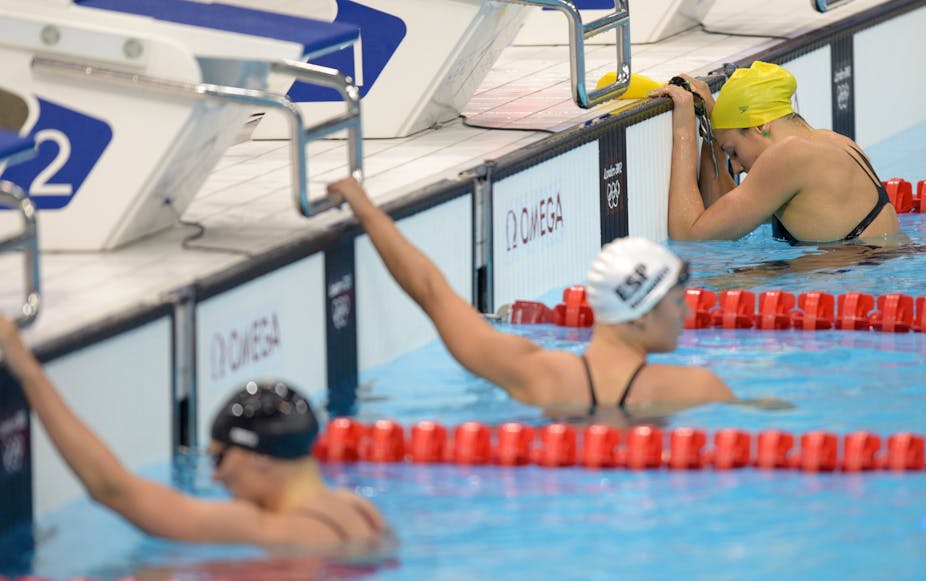
Three weeks before the Olympics, Swimming Australia imposed a new “high-performance” funding model on its swimmers, reportedly to “see medallists rewarded”. The timing made it difficult, even unpatriotic, to question the new model but in the wash-up after the Olympics, it warrants scrutiny.
The new model meant swimmers received a low base rate for participating and then a sliding scale of bonuses depending upon their performance. These performance bonuses ranged from $35,000 for individual gold medals to $4,000 for 8th position … and nothing for less than that.
The model is profoundly revealing in two ways. First, it highlights the extent to which an economic understanding of human motivation has permeated all corners of Australian society.
Second, it starkly demonstrates the limitations of financial incentives in achieving outcomes. The model failed. It is generally agreed that the Australian swimmers performed well below expectations.
An economic understanding of human motivation has been steadily gaining ground in English-speaking countries for a long time. The pioneer of this approach was Gary Becker, a Professor of Economics at the University of Chicago. In the 1980s Becker argued that human beings essentially run a cost-benefit analysis on all of their decisions, and act accordingly.
Becker proceeded to apply this logic to marriage and the family, crime and punishment, and discrimination against minorities. He argued people “marry when they expect to be better off than if they remain single, and they divorce if that is expected to increase their welfare”. In 1992 Becker was awarded the Nobel Prize in Economics for his efforts.
Becker’s analysis inspired the application of the economic approach to all fields of human behaviour. It informed public policy – neatly illustrated in the constant reference of government ministers to the “business model” of people smugglers, and in the finely calibrated compensation packages for the carbon pollution emissions scheme. And it permeated popular culture, illustrated in the blockbuster Freakonomics franchise.
An economic understanding of human motivation provides important insights into aspects of human behaviour, but is profoundly limited nonetheless. Above all, it does not take into account our sociability.
Human beings are intensely sociable animals. We are more like chimpanzees than orangutans, and more like dogs than cats. We seek each other out, we congregate together, we rely on each other, we check each other out, we copy each other, and we compete against each other. The Olympics are a social event on a global scale.
There are two ways in which our sociability shapes our motivation. First, it shapes our character. Our character is formed in the crucible of our families. Humans are unique among all animals in the length of our dependency. This means there is unique scope for social learning.
Olympic athletes almost invariably acknowledge their parents when they win their medals. Swimmers thank their mums and dads for getting up early every morning and driving them to training in their early years. For encouraging and supporting them every step along the way. For making them into the champions they have become.
I’m not convinced young swimmers do a cost-benefit analysis of becoming an Olympic champion. Not least, the rewards do not match the investment. Rather, I suspect they swim because their parents and those whom they love and respect encourage them to swim, and praise them for their efforts.
Our sociability also shapes our motivation insofar as we care about what others think about us. We are motivated by praise and peer pressure. We are motivated by the prospect of criticism and humiliation. And we are motivated by the prospect of glory. The Olympics offers all of these things in abundance.
Instantaneous media coverage and social networking websites intensify the feedback loops. The moments of glory and humiliation occur in the glare of a global spotlight, for all to see. No wonder swimmers and other athletes seem more relieved than anything else when they meet expectations and win gold!
In this context, the high-performance funding model seems grotesquely feeble. Did Swimming Australia really imagine swimmers would swim harder because of its incentives? Did it really imagine it would boost the medal tally?
But the model was perhaps worse than feeble. The swimmer Brenton Rickard said it was a distraction. Daniel Kowalski, the head of the Australian Swimmers' Association and a former Olympic medallist, said it was disrespectful. The implication here is that the model may have corroded the Olympians’ motivation and performance.
We will never know if the model actually had this effect or not. What we do know is that the model failed. The swimmers had their lowest medal tally since the 1992 Olympics, notwithstanding the record-holders in their midst.
It would be nice to think that the people responsible for the high-performance model are paid a low base rate for their efforts, with a performance-based bonus. Sadly, I’m pretty sure that won’t be the case.
Roger Eston
Head of School, Health Sciences at University of South Australia
Your article makes so much sense. It is frustrating and disappointing to think that the creators of the model would think that a 'bonus' would impact on the performance of these dedicated athletes. My feeling is that it wouldn't make one dot of difference to their performance or their extreme intrinsic motivation to win. It shows a complete lack of understanding of the psychology of elite performance. I can understand why some would regard it as disrespectful and distracting to the athletes.
Jacqui Baker
John Monash Scholar & Visiting Fellow, Department for Political and Social Change, ANU at Australian National University
You make an excellent point about the creeping (and also very forthright) market-isation of society.
Dan Pink shows very adeptly that monetary incentives actually work against actors when they are performing complex cognitive tasks. http://www.ted.com/talks/dan_pink_on_motivation.html
I think this calls into question what kind of a delicate and complex psychological activity world-class swimming is. Its surprising that the ASA could get this so terribly wrong.
Dennis Alexander
logged in via LinkedIn
A fine take on the situation. A good idea to introduce the sociability idea as, in human terms, society precedes economy.
One pertinent historical anecdote from one of Chappelli's books tells a story about World Series Cricket. In NZ, Kerry Packer turned up and offered some bonuses for wickets and, according to the story, DKL responded in line with the incentives. It is these kinds of anecdotes and instances that are interpreted as confirming the economic motivation model regardless of how…
Read moreDonncha Redmond
Software Developer
I can't imagine a CEO of a top company announcing sweeping cuts to his sales force's salary package mere weeks before they're supposed to deliver big results in the most competitive market available.
Heads should roll at the top.
David Thompson
Research Officer In Men's Health at University of Western Sydney
Dan Ariely makes a good point in his book that in fact increasing performance bonuses actually reduces performance, and applies it to executive remuneration as well as lab rats.
The logic being that it becomes quite stressful and distracting focusing on that remuneration that you're more prone to errors and mistakes.
Tim Mahon
logged in via LinkedIn
A very interesting point of view, based not only on the merit or not of the incentives given but also the timing. Not too sure if you can completely blame the swimmers performance based on this one act. Yet, many incentives within the HP environment are performance based, for example athlete scholarships at State Institutes. Achieve a certain level, get the benefits. Even the AOC offers financial incentives for Olympic medals. Maybe the whole issue needs more rigorous debate as it is more wide spread than swimming. Not too sure if you can completely blame the swimmers performance based on this one decision.
Ben Koh
Sports Doctor. PhD social Research into Athlete Motivation. ACSM (Health Fitness Instructor and Exercise Specialist). Ex-elite swimmer.
I agree with Tim's view that the high performance model is but one of several factors that MAY have contributed to the poor medal showing. Realistically, a swimmer at the Olympics (or any high level event) will strive to perform at his/her best.
In the moment of competition, and when in the "flow", the athlete's fighting instinct kicks in, and the last thing a swimmer in the midst of completing the third 50m of the grueling 200m fly event is likely to be thinking about is putting food on the…
Read moreDavid Arthur
n/a
I'm glad you mention executive renumeration. How does it compare to swimmers' renumeration at Swimming Australia, and in what way does swimming's medal count compare to performance of investment banks during the GFC?
Alan Kennedy
journalist
At Swimming Australis it appears the senior management has one rule for the swimmers and another for themselves. The senior executives, who are drawing on taxpayers money and sponsorship money, awarded themselves pay rises before London. In addition, the head coach had his job confirmed before London and his contract sees him holding the job up to and including the Rio games. If ever there was a case for some basic KPIs this is it. The head coach should be reapplying for his job after the board of Swimming Australia has conducted a top down review of the team's London performance and called for applications. The Government too should be examining the body's governance as it is our money they are playing with. It appears that while the swimmers are being marked pretty hard, the people running Swimming Australia are meeting no performance standards.
David Arthur
n/a
Perhaps the head coach wasn't involved in the renumeration decisions.
Do KPI's for Swimming Australia board members and senior executives include benchmarks for London 2012 performance?
lesposen
logged in via Twitter
It seems the field of behavioural economics has yet to reach the radar of Swimming Australia. There's another Nobel Prize winner in Economics who is worth reading on the subject: Psychologist Daniel Kahneman.
Take a look at his TED talk and other refs: http://www.ted.com/speakers/daniel_kahneman.html
First point: We humans are not calculating machines in the pure sense of addition, subtraction and maximising outcomes. We often act irrationally according to those economic models when it comes to deciding on risk. See also Bruce Schneier's work on the Psychology of Risk.
Rees @ NZRUN
logged in via Twitter
Glad to see someone mention that the current understanding of Behavioural Economics is in stark contrast to how this performance bonus policy is supposed to operate. Even a limited understanding of what motivates individuals and especially elite sportsmen and women shows that there are numerous other social an environmental factors which are necessary before any financial incentives will have any impact on performance.
We have similar pay-for-performance models operating within high performance sport in NZ, all with little to no evidence that they can or will have a positive effect on results, or even retention of athletes.
Laszlo O'Vari
logged in via email @fixia.net
Good article. If the bosses at Swimming Australia want to have a good, deep understanding of the issue, I suggest an experiment:
Go to some seriously bush fire prone area, and find the firefighter team or person who saved the most lives over the last few years. Then gather them around and tell them that from there on, they will get a $50 bonus after each saved person. Based on Gary Becker's work it all makes sense - if the guys were motivated before, they should be even more motivated with the $50.
The reaction from the firefighters should tell a few things about human motivation and how badly economists understand it.
Tim Scanlon
Debunker
I agree Michael. Personal achievement is rarely about money. To try to make it about that shows a lack of understanding on behalf of the association, especially for athletes that are not top 8 in the world.
Lloyd Rothwell
logged in via Twitter
I don't believe that motivation was the prime reason for SAL when implementing this scheme. It seems more a method of distributing funds and providing support to athletes who have made sacrifices to compete at this level.
Surely the fact that the scheme was announced a mere 3 weeks before the Games illustrates this? The hard work is well and truly done by then.
Ben Koh
Sports Doctor. PhD social Research into Athlete Motivation. ACSM (Health Fitness Instructor and Exercise Specialist). Ex-elite swimmer.
My optimistic side agrees with you that it MAY not have been the sole reason why the salary scheme was implemented by SAL.
However, my cynical side wonders if the timing and apparent lack of consultation with the athletes during the process was reasonable.
The high-performance financial incentive MAY have been a well intended means to act as an incentive (but not the sole incentive; used in collaboration of other non-tangible benefits of being an Olympian) but the delivery of that intent…
Read moreLloyd Rothwell
logged in via Twitter
There's no doubt that SAL must be more transparent with their funding of athletes - specifically the $750k, not the bonuses discussed above.
The predictions regarding gold medals from the mainstream media were wildly unrealistic. The squad that we sent were unlikely to swim the stand-out performances that are necessary to win an Olympic final. Our team, in general, was young and inexperienced,
A number of swimmers produced swims that show great potential for the future. However, there are still a few noticable gaps in the development and administration of swimming in Australia. These must be addressed if Australia is to again challenge the supremecy of the US and now China.
Bob Selden
MD The National Learning Institute
Good article, Michael. I've quoted you in my latest piece "All that glitters is not gold" at http://nationallearning.com.au/all-that-glitters-is-not-gold/
The one thing that's missing from the two SA reports is anything about groups vs. teams and paying people to perform. In both cases, SA needs to look more closely at how they manage these.