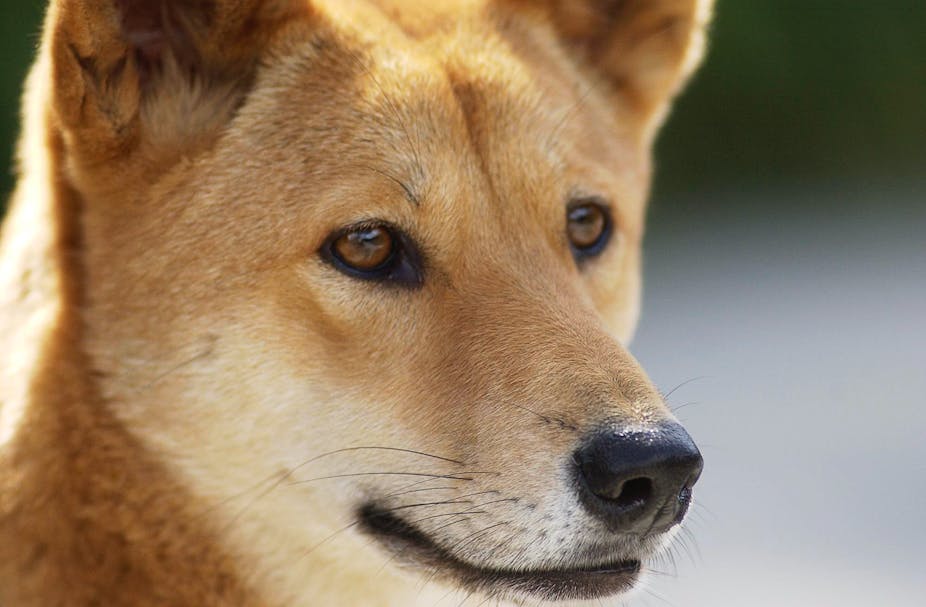
It’s the dry season in the Northern Territory, and for many people that means camping under a clear winter’s sky in the Top End. Yet rediscovering nature can be a fraught exercise in wilderness areas like Kakadu, especially when the tourist trail cuts right through the territory of native animals.
This was graphically highlighted with another frightening dingo incident at the Aurora Kakadu Lodge just over a week ago. This time a 13 year old girl woke to find she was being dragged in her sleeping bag from underneath the awning of her caravan by a dingo. This is apparently the fourth disturbance at the campsite this dry season, with dingoes previously ripping apart tents and destroying bedding.
Comparisons have already been made with the death of Azaria Chamberlain three decades ago, with the mother telling the NT Times that she “can totally understand how this can happen.” Dingoes are a national icon, and one that we should rightly respect. Wild animal behaviours often conflict with humans, especially apex predators (those at the top of the food chain) like dingoes. Yet as dingoes seem to be returning to this one campsite, it’s clear something needs to be done.
Violence is not the answer

I would strongly argue that violence is not the answer here. The alternatives to coexisting with dingoes are poisoning, trapping, or shooting, and other animals and pets will be just as susceptible to these aggressive and often lethal techniques as the dingoes. Human injuries from dingoes are extremely rare in comparison with domesticated dogs, and they are usually preventable if people are informed about living in dingo territory. Education is the answer. If we want to continue to visit their habitats, we owe it to them to understand how they behave and what we can do to co-exist peacefully.
My American colleague Camilla Fox, founder of Project Coyote, makes a strong case to not only resolve conflict with native apex predators, but to encourage coexistence between them and us. She believes we must first give the community a reasonable and realistic understanding of dingo behaviours and dingo danger, which in turn will change the form of interactions with us.
The first thing we must remember is to never feed dingoes. Nature wants us to appreciate them from a distance, as their life and our safety depend on dingoes remaining wild and naturally wary of people. For this reason it is essential to pick up trash, secure garbage, and feed any pets inside to remove the allure of them infringing on our camps.
The dry season in the Northern Territory coincides with the whelping and pup rearing season, and at this time of year it’s particularly important not to attract attention by leaving food unsecured. Some dingoes may see it as an opportunity to establish a new territory because food resources are readily available. It’s also crucial to avoid areas where dingoes may either have a den or be feeding pups – in this case, we need to know whether there’s a pack nearby, and what steps can be taken to ensure they are not disturbed by humans. Dingoes form packs to secure access to enough food and resources to survive. If we stop allowing them access to our food and resources, then they will not associate food with people, and they won’t form packs near our campsites.
Some dingoes traditionally followed indigenous camps before Europeans arrived, and acted as a cleaner or sanitiser. If Aborigines left any bones or other food scraps behind, the camp dingoes would scavenge them. Did Aborigines get attacked too? I’d like to think that they knew how to manage the wilderness situation, unlike common city dwellers looking for a desert adventure.
Techniques for keeping wild dogs away
In 2011 I studied sustainable carnivore management around the world as part of my Winston Churchill Memorial Trust Travel Fellowship to learn ways to help facilitate coexistence with wild dogs. Most tools being used by international institutions were technique to make the wolves, African wild dogs or the coyotes keep their distance. Some that could be used in Australia include:
Playing a recording of a wolf-pack howling to mimic an already resident pack;
Using scent marks (dog urine and faeces) to establish a false wild dog territory;
Bright red “fladry” tape hanging from ropes that flutters in the wind.
Human-dingo conflicts should in theory be less common if we can combine these techniques whilst ensuring we don’t feed dingoes, remove attractants such as garbage and pet food, keep pets in a secure environment and don’t let them roam, and – if a dingo is investigating your campsite – be “Big, Bad and Loud!”
Dingoes are more than simply another Australian icon; they play an important role in protecting diversity in our ecosystem by limiting the number of prey and keeping the competition in check.
By following these simple tips and keeping your campsite clean, not only will you keep you and your family safe, you’ll be ensuring dingoes can continue to protect our bio-diversity too.
Comments welcome below.
Kylie Cairns
PhD student
I completely concur, culling/trapping is unlikely to fix the issue when it seems to stem instead from humans feeding the dingoes or encouraging them to scavenge from campsites (by leaving rubbish/food in un-secured areas).
It seems that largely people don't see dingoes as a threat because they are very dog-like in appearance - educating people about the correct way to interact with wild dingoes seems to be the key.
Very succinct article Brad - just wondering why fences aren't used around camp grounds to help keep the dingoes and humans apart? Is it the cost or maintenance or some other variable I'm not aware of?
Keith Twyford
logged in via LinkedIn
Hello Kylie
Fences are used extensively around recreation sites and even whole resorts and townships on Fraser Island. But of course, you can't fence everything. And the visitor education programs are extensive. It gets to the stage where you have to ask the question: how much more do park managers have to do?
Unfortunately, some park visitors ignore all the education programs and signs and just do plain stupid things. When observed, rangers will fine them but 100% compliance is never going to be possible.
From time-to-time, the only solution is to shoot problem animals. What's important is (a) the visitor/resident doing the wrong thing needs to be made aware that their inappropriate behaviour results in the death of animals, and (b) the culling is measured in its scale so that the dingo population isn't threatened. This is a potential issue on Fraser Island where the population is probably only around 200 animals.
Dingo Simon
Owner, Durong Dingo Sanctuary Qld
Gidday Keith, there is lucky to be 60 dingoes left on Fraser Island. No one has seen any pups this year. There isn't a problem dingo on Fraser, because all the residents can live with them with out fear.
What is the problem is the foreign tourists who have been given a 45 min video presentation and plenty of information from the Park Rangers and yet they still act inappropriately near dingoes. Many tempt the dingoes in close with food at camp sites to get a photo. They tease and chase dingoes, some even run them over in their 4WD's.
Many people don't get fined.
I was fined $1200 for being on the Island with Jennifer Parkhurst , because we filmed a mother with her pups.
And we knew what we were doing.
Euan Ritchie
Lecturer in ecology at Deakin University
Hi Keith,
To follow on from your statement 'From time-to-time, the only solution is to shoot problem animals' I would ask simply this. Why when a human does something wrong, despite clear warnings not to, should the dingo (or any other animal for that matter) then be 'punished' by death because of the human's stupidity? This would seem to defy logic, not to mention morals and ethics? What long-term solution does killing a dingo provide? In my opinion none. Rather one must persist and improve education if we are serious about stopping the problems. The same situation applies to killing of sharks and crocodiles following a lethal attack. We must take responsibility for our own actions if we ever want to progress, shifting the blame to the animals only delays this.
Kylie Cairns
PhD student
Hi Keith - so there are fences and visitor education programs and signs. Yet still when an attack happens instead of the problem being the idiotic humans either not supervising their children or getting themselves into a dangerous situation the dingo is blamed and put to death. As Euan comments this defies logic, ethics and morality.
Killing a "problem" dingo particularly in a closed and volatile situation like Fraser Island seems like a short term solution to a long term problem that rather exacerbates the whole issue.
I agree with Euan where he says: "We must take responsibility for our own actions if we ever want to progress, shifting the blame to the animals only delays this."
Glen Daly
Retired
Dingoes are feral dogs and should be shot on sight or otherwise disposed of.
End of story for the doggie lovers.
David Heasley
Contracts manager
The dingoes were here first. We are the ones in their territority. We are the ones who feed and encourage them and then blame them.
Carmel de Bertaut
Ecologist
David, dingoes are an introduced species in Australia, brought there by people. Glen, normally I would say as an introduced species it should be removed from the environment but because all native predators of that size are now extinct the dingo is considered by some to be a keystone species.
Dingo Simon
Owner, Durong Dingo Sanctuary Qld
Carmel, please read this paper to fully understand how the dingoes arrived in Australia. Thank you.
http://rspb.royalsocietypublishing.org/content/early/2011/09/06/rspb.2011.1395.full?sid=670143aa-c71e-4e23-ab04-061126424828
Dingo Simon
Owner, Durong Dingo Sanctuary Qld
Glen Daley, please read this paper to further educate yourself about the origins of the dingo. Thank you.
http://rspb.royalsocietypublishing.org/content/early/2011/09/06/rspb.2011.1395.full?sid=670143aa-c71e-4e23-ab04-061126424828
Shirley Birney
retiree
Dingoes are classified as a threatened species in Victoria. Dingoes help in controlling the numbers of introduced foxes, cats and rabbits – yet another human folly. However, dingoes must now compete with feral dogs for food.
There is an estimated 30,000 feral dogs in WA alone and culling is indiscriminate (and exceedingly inhumane). The 1080 bait has been banned in every developed country in the world where carnivores exist (except New Zealand). The poisoned bait is spread through the environment and is a slow killer where the animal suffers a prolonged and horrific death.
Dingoes are not cloven hoofed ruminants that trash the landscape, emit massive amounts of methane and consume more grains than humans.
Denial, delusion and the dollar rules in the “lucky” country down under.
Dingo Simon
Owner, Durong Dingo Sanctuary Qld
Thanks Brad for an article that most of us in the know really see as common sense.
Firstly I have to say that I seriously do not think it was a dingo that chewed on Rebecca's sleeping bag.
Read moreMany locals have said that for ages there have been camp dogs ( not pure dingoes ) that are wandering and scavenging around the park. Even Rebecca said that all she saw was part of the face of the dog, not the body of the dog. The dog chewed and pulled on the edge of her sleeping bag. It did not touch her…
Jan Burgess
Retired
Interesting article, and I completely agree that culling is not an acceptable answer to human/predator problems. The current shark controversy is another case in point.
As a side note, I would like to thank the author for introducing me to a new word - fladry. Not only a new word, but a new concept. I would probably have ignorantly labelled it roadwork fencing.
Shirley Birney
retiree
How many pure dingoes are left in the wild? The pure dingo is being exterminated by unsterilised and domesticated dogs that go bush because of hunger, neglect and human abuse. In addition gun-toting, 1080 farmers are well known for their failure to sterilise their working dogs, particularly after whelping, adding to the burden of hybrid dogs in the wild. Yet they whine over feral dogs/dingoes attacking sheep and calves which are in fact, invasive species.
I was the owner of a rescued Aboriginal…
Read moreKylie Cairns
PhD student
It is largely a myth that there are large packs of feral domesticated dogs roaming.
Most of the hybridisation problems are hypothesised to occur near extensive culling/baiting areas where pack structure falls apart and female dingoes are then breeding with feral dogs/loose farm dogs etc. In situations where dingo packs are intact it is improbable for hybridisation to occur - they are fairly fierce with intruders (so I've heard).
De-sexing dogs which are allowed to roam will help but one of…
Read moreRichard Hockey
logged in via Facebook
We were staying at Aurora Kakadu a couple of weeks before this incident and saw a Dingo hanging around the fringes of the camping area. Why were they there? A short walk around the park fringe soon comes up with the answer. The unfenced resort rubbish tip is only a short distance from the camp area and from the abundant dingo tracks was a frequent haunt of the local dingos. A bit of basic housekeeping at the resort will probably resolve this problem at this locality.
R
Brad Purcell
Wildlife ecologist at University of Western Sydney
Re: dingo purity - I urge you all to read my book dingo by CSIRO publishing because purity studies are biased by ascertainment and the concept of pure wild dingoes is a romantic mindset. We need a functional predator. All pure dingoes are held behind electrified fences and only sometimes serve an educational purpose. Find me a pure wild human and I'll start looking for a pure wild dingo. Besides, hybridisation is an integral part of evolution and 'purity' is a closed system that ends in extinction. We need to mobilise toward an environmentally sustainable Australia and move away from the expenses of single species management regimes.
Kylie Cairns
PhD student
I disagree with this. Dingoes have been separated from domesticated dogs for thousands of years, during which domesticated dogs have been heavily shaped by human selective breeding. They are likely different in behaviour, (certainly) genetics and ecology. It is plausible (and has yet to be tested empirically) that pure dingoes, hybrids and dogs have different ecological impacts, profiles etc that may have very drastic ongoing effects. In wolves genetic subdivision has been associated with differences…
Read moreShirley Birney
retiree
I don’t get that Brad. How can the pure dingo become extinct when there are programmes to preserve threatened species?
Unlike domestic dogs, dingoes only have pups once per year. I have read that if the alpha male fathers a litter with another female, the alpha female will eat the other female’s puppies, hence the population remains sustainable.
Is it correct that domestic dogs and hybrid dingoes have two litters a year? Is that the reason wild dogs are increasing in outback Australia – hence more guns, more 1080 baits, more culling, more outrage from our rural folk? So how does the hybrid dingo mobilise us toward an environmentally sustainable Australia?
Euan Ritchie
Lecturer in ecology at Deakin University
Shirley - It is true that domestic dogs may under ideal cicumstances get through two litters in a year, where as dingoes will have one only. However, in the typically harsh (resource poor) conditions of arid and semi-arid Australia there is strong selection for one litter per year. A bitch who tried to rear two litters would most likely lose most if not all pups and quite possibly die herself. So what this means is there is strong slection in the wild for 'dingo like' traits. Having said this, baiting…
Read moreDanielle Stephens
Zoologist
I disagree with this too Brad. As Kylie pointed out dingoes have had their own history as a genetically isolated group for many thousands of years before they met modern domestic dogs - if we can talk sensibly about purebred dogs that have only been closed populations for a few hundred years then we can certainly understand the concept of a pure dingo.
I don't know what you mean by "biased by ascertainment" in this context - do you mean at the genetic level or at the individual level? Because…
Read moreKylie Cairns
PhD student
Agreed Danielle - but you put it much more succinctly!
It's so incredibly important to understand all aspects of the biology of the dingo before making assessments about how to correctly manage them i.e. what affect genetic integrity has on ecology/predation profiles or whether there are different types/varieties of dingoes which again may have different behaviors. Purity is a huge aspect of dingo biology, unfortunately, and it's naive to ignore it or lump dingoes and their hybrids together without knowing the full consequences.
Euan Ritchie
Lecturer in ecology at Deakin University
Hi Brad,
I agree education is the key in all of this, but we should also do our homework on what actually happened, before we talk about what dingoes did or may do as opposed to what feral/camp dogs did or may do. Otherwise we run the risk of perpetuating myths and prevent education of the general public regarding dingoes. The NT News is hardly renowned for top-shelf investigative journalism! I have been following this story, including the extended report and have heard this:
1. Rebecca Robinson reported "a dingo or a dog", because it was dark and "I could not see it that much", but the news site preferred "dingo" for its headline.
2. Longtime workers at Kakadu report few dingo sightings, but "hundreds of camp dogs" at camp sites and the town centre.
3. One guy wondered about the ability of a 25kg dog of any breed to "drag" a 45kg (human) weight.
4. Rebecca is quoted as saying "I was not going anywhere but I could feel the sleeping bag getting dragged".
Margaret Rose STRINGER
retired but interested
Violence is NEVER the answer.
To anything.
David Paxton
Veterinarian
Brad, thank you for an interesting, balanced and insightful conversation. If you have the time, please visit my website at www.compositeconversationalist.com where I argue that humans and dogs evolved as extended phenotypes within an ecosystem, which initially was the human cave. I shall be delighted to send you a copy of my book gratis if you provide a good postal address. Best wishes with your studies.