
We humans use our large brains to make and store maps of our environment; maps we then use everyday for getting around and for recalling where we’ve been. But we are nothing special – many other animals are capable of using spatial memory to make life easier.
And while many animals have this ability, spatial memory has so far only been described in animals with brains to store the memories in. Until now.
My colleagues and I – from the University of Sydney and the Paul Sabatier Université in Toulouse – found that the unicellular slime mould Physarum polycephalum, which lacks a brain or even any semblance of a nervous system, uses an ingenious mechanism to remember where it has been, and to escape from difficult situations. Our findings are published today in PNAS.
Introducing Physarum
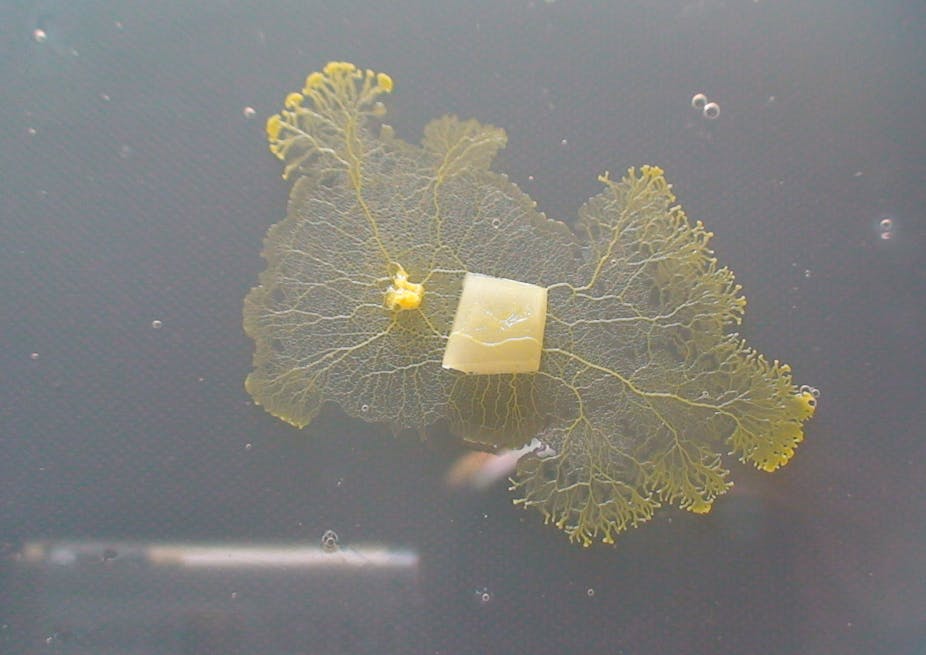
The slime mould Physarum is a large, blob-like cell that moves around like an amoeba. The whole organism is made up of bits of pulsating tissue, which are constantly expanding and contracting, using a similar mechanism to our own muscle cells.
Each part of the slime mould changes the speed at which it pulsates according to what it can sense in the environment around it – food, light or heat, for instance. These stimuli are detected by chemical receptors on the cell’s surface.
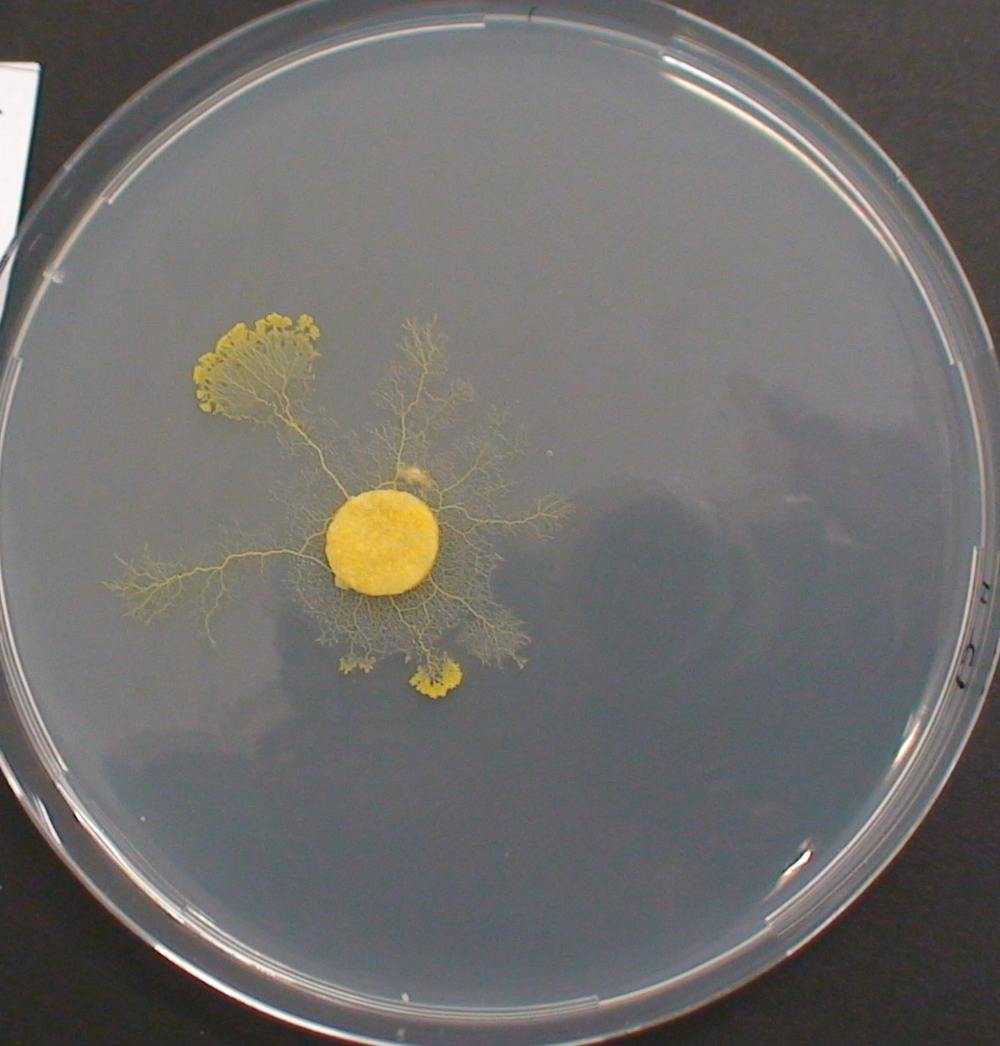
These pulsating parts are also influenced by the throbbing of their neighbours within the cell, which means the parts can communicate with one another, to pass information through the organism about what is happening in the external environment. The different speeds of contraction directly influence which direction the cell will then move in.
In this way, a seemingly simple slime mould is really a complex, collective system, which behaves much like an ant colony or a school of fish.
Getting around
The brainless slime mould leaves a trail of slime behind it everywhere it goes, which it can then detect later to recognise areas it has already been. The organism prefers to avoid previously explored areas, to prevent wasting time in its search for food.
In essence the slime mould is memorising where it has been, storing this memory in the external environment and recalling the information when it later touches the slime-coated area.
What we did
By forcing the slime mould into a U-shaped obstacle, which we placed between the creature and a sugary food source it was drawn to, we found the slime mould used its spatial memory system to help navigate its way out of the obstacle to reach the food.
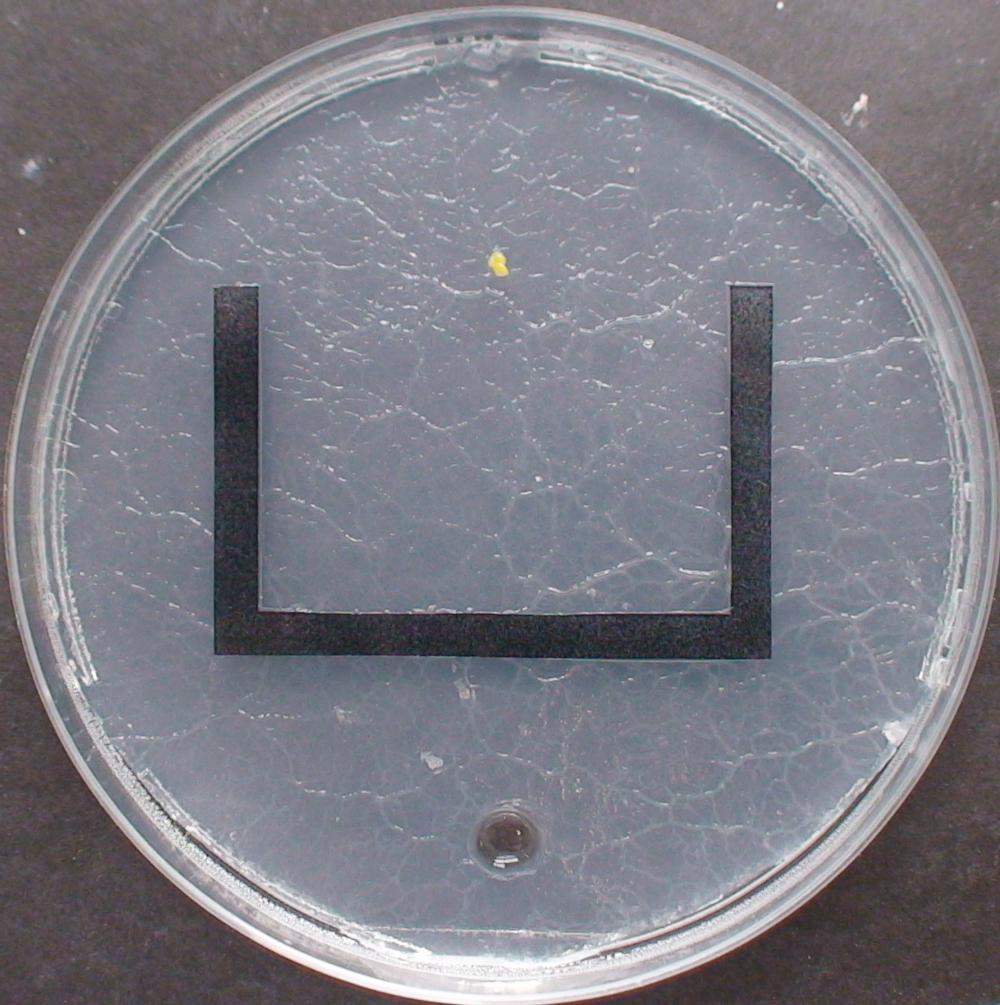
Some 96% of the test subjects in our experiment successfully navigated the trap and reached the goal within the 120 hour time limit (slime mould moves slowly!), with the average slime mould taking 57 hours to solve the problem.
When we disabled the creature’s ability to use its memory – by coating the whole environment in slime to mask its own trail – only 33% of the slime moulds reached the goal within the time limit. The 33% that did finish took much longer to do so, averaging 75 hours.
Without the benefit of memory, the slime mould spent almost ten times longer pointlessly re-exploring areas it had already been. So the organism relies on its externalised spatial memory for navigating through complex environments.
More than mould
The kind of U-shaped trap we used in our experiment has been used in the past to test the abilities of robots that navigate on their own.
Normally we hear about how nature inspires engineering and design, for instance how studying the flippers of humpback whales led to better blades for wind turbines, or how the hooks on burdock seeds inspired the birth of Velcro.
But our findings are a neat example of the reverse: how engineering studies (i.e. the use of the U-shaped trap) can sometimes influence our understanding of the natural world.
Leaving an externalised reminder of where you have been is a phenomenon behavioural ecologists call “patch-marking”. And, of course, it’s not just slime mould that does this.
After depleting the nectar from a flower, honeybees will leave a chemical mark telling them not to bother returning there until the flower has replenished its nectar reserves.
Similarly, wolves, foxes and chipmunks will all leave a chemical reminder in the form of urine on sites where they have just dug up stored food, so they can remember which stores have been depleted, and avoid searching in those areas later on.
But while many creatures are able to use spatial memory, our study is the first to demonstrate this ability in a creature without a brain.
Our study is also the first piece of evidence to support a previously untested theory that an externalised memory could have been used by primitive organisms in the distant past to solve problems tackled by complex brains like ours today.
Better still, this primitive memory system could have been the first step in the evolution of a more complex memory system in organisms with brains, we humans included.
Sean Lamb
Science Denier
"which lacks a brain or even any semblance of a nervous system, uses an ingenious mechanism to remember where it has been, and to escape from difficult situations"
Not another article about Alan Jones. Enough!
Peter Ormonde
Peter Ormonde is a Friend of The Conversation.
Farmer
That's very good Sean.
I've met a few folks related to these moulds I reckon - long memories but little if any brain. A word to the wise - don't marry 'em.
Ernest Bennett
Mr (retired)
Sean, how dare you,sir! You have pinched my line. And the Speaker affair?
Seriously chemotaxis is not memory as attributed to higher (?) sentient animals. Is it not simply a basic cellular process of seek and avoid, an adaptation of detecting concentration gradients in media? DItto following its slime track? Do snails and molluscs act similarly or are they just smoothing the road ahead/under foot?
Roy Niles
logged in via Facebook
Chemotaxis is a wholly inadequate explanation for the way that so called lower animals learn, make choices, and learn again. Amazing how these and other neo-Darwinian myths have stuck to our memories as unquestionable truths.
Peter Ormonde
Peter Ormonde is a Friend of The Conversation.
Farmer
It's a bit like trying to get an idea of a Ferrari or a Bugatti by reading the manual for a Honda Civic isn't it? All a bit basic ... there's gotta be more to it. And there obviously is.
But by looking at the simple - the things we can see - we can embark on conjectures and hypotheses and develop a better understanding of the more complex end of the show.
The thing that leaps out of this little study is the role of communication between cells - the network - that alters the nature of the…
Read moreRoy Niles
logged in via Facebook
If they can remember and learn what they remembered and then make separate choices based on what they've newly learned, then they are using at least a minimum of problem solving intelligence. in fact any creature that communicates with other creatures is using intelligence - communication must serve an intelligent purpose. And as it's turning out, all known living creatures communicate in some fashion.
As to squid and cuttlefish, they've learned and evolved such learning over time to be as deceptive a creature as we know to exist. They've evolved their strategies and their extra-chameleon like forms to boot. Except chameleons can't hold a candle to some of these cephalopods.
Peter Reefman
Project Manager
Still, I'm with Peter O on the intelligence side. There presumably is a distinction between instinctive actions, even if this includes communication, and the more reflective processes we associate with intelligence.
On a slightly different angle, I was rather blown away by some of the concepts in Bruce Lipton's book "The Biology of Belief", and in particular his assertion that it is in the cell membranes that we find the smarts and NOT the nucleus with all the DNA encoding. I lack the depth…
Read moreRoy Niles
logged in via Facebook
Instinctive actions were at some point in an organism's evolutionary history learned from applying intelligence to experience. This is an area where evolutionists have the most problems - explaining the onset of the "first" instincts, without making reference to intelligence and learning. But then, if they do, the problem reverses itself to explaining from whence came the first "intelligence." John Wheeler, the renowned physicist felt that it had long evolved as a universal strategy, stating…
Read moreRoy Niles
logged in via Facebook
Using memory for the purpose of attaining a goal by trial and error learning denotes some minimal intelligence. The mystery is where the apparently algorithmic instructions for these functional mechanisms are stored, and further, how are these tactics communicated to other cells, feedback responded to, and learning seemingly inherited when cells divide. Not to mention that in addition to solving these survival problems, they've learned to manufacture and secrete stuff that has become an instinctive process. Trial and error beats stochasticity every time.
Debra Joan Smith
Account Executive
Well, I just think it should be renamed the Hanzel and Gretel MOULD.
Roy Niles
logged in via Facebook
So much for my theories that intelligence evolves.
Debra Joan Smith
Account Executive
The advantage of a broad education is usually that you do not have to hit people over the head with your opinion. In this case, children's literature which survives for thousands of years because it transmits profound truths works. This creature simply recognizes the cue it left behind and then avoids that area just as the kids from the fairytale used cues to ensure that they could find their way home in a daunting situation. Even so, the crumbs disappeared and it was clear that they did not actually know the way- getting them into profound danger. I would love to repeat this experiment with the identical maze which was new, unslimed to see if they could actually solve it in the same time, greater time or lessor time.
Perhaps that is why no one was willing to read your book, sir, for we usually take the time to read what might add something to our thinking.
Roy Niles
logged in via Facebook
You've only demonstrated that if the slime acted like children, the slime were at least minimally intelligent. People actually do read my book, just not people like yourself. Although I mentioned it in the negative, I agree that I shouldn't have done so at all.
Debra Joan Smith
Account Executive
So are you suggesting that when plants follow the sunshine, they are demonstrating intelligence, Roy?
Roy Niles
logged in via Facebook
Yes. Show me how they evolved to acquire this complex function by accident. By the way experiments have led to the proposal that the plant root systems act similarly to brains.
Ernest Bennett
Mr (retired)
Debra Joan, I agree. Well argued. The point I tried to make in an earlier post. But I used chemotaxis as an explanation, which propmpted a strong response. The clincher for such a conclusion, the mould has memory (and so do some metals) would be, as you suggest, to place a mould colony habituated as outlined in the head article, onto a "clean-skin" plate and see if it remembers the way to the food. Or, as you say, remove the mucous "crumbs" and see if it can still find its dinner.
Peter Kinnon
Writer
If I may butt in, Debra, firstly please allow me a change in terminology.
The word "intelligence" with its many and varied shades of meaning, is the greatest contributer to the woolly-mindedness which plagues discussions of this kind. " Imagination", the ability to form, store and morph models of the external world within the neural systems of higher animals and to a lesser extent in simpler species gives us a far better handle on this feature.
Imagination can usefully be considered to be a…
Read moreDebra Joan Smith
Account Executive
Thank you Peter. I agree in that I think the major difficulty that we see in the meeting of minds in this discussion is one primarily of definition.
I do not think plants demonstrate intelligence per se. I also do not see this experiment as evidence of memory. Additionally, as i term imagination and even higher form of cognition than memory, I cannot use that term either. (If we look at where imagination is thought to arise in the brain- it is in a very high order segment that evolved quite late in the process).
I am not exactly disagreeing with the contributors as much as using my own slime mould technique of saying to myself- been there and I am pretty sure that is not it!
Roy Niles
logged in via Facebook
This is silliness. You can have intelligence with little imagination, and imagination with little intelligence, but unless you throw out the dictionary and all meaning with it, you can't call intelligence imagination, and throw out any differential meanings. Look up the meaning of rationalization while you're at it. You'll need to throw that out as well.
Peter Kinnon
Writer
Debra, I think you are still stymied by this silly term "intelligence" with its huge sliding scale of connotations, many of them emotive and most of them anthropocentric.
Now, let me ask you why you would not agree that the following definition of "imagination" does not fit. To simplify, for now, we'll say just in the case of humans.
"The ability to form, store and morph models of the external world within the CNS"
Can you think of any exceptions?
Debra Joan Smith
Account Executive
Hi Peter, thank you for this thoughtful dialogue. In answer, the greatest respect I know how to show you is to say that I have to think about this. I might be simply stymied by vocabulary or perhaps it is my neuroscience courses and thus just indoctrination but my strong sense or normal usage of imagination is just not the same as what you propose. I will, however, really seriously think about this. Thanks again.
Roy Niles
logged in via Facebook
"Can you think of any exceptions?" Yes, the dictionary versions of the words in dispute:
imagination |iˌmajəˈnā sh ən|
Read morenoun
the faculty or action of forming new ideas, or images or concepts of external objects not present to the senses : she'd never been blessed with a vivid imagination.
• the ability of the mind to be creative or resourceful : technology gives workers the chance to use their imagination.
• the part of the mind that imagines things : a girl who existed only in my imagination…
Roy Niles
logged in via Facebook
" I also do not see this experiment as evidence of memory."
See Scientific American article, Do Plants Think?
Scientist Daniel Chamovitz unveils the surprising world of plants that see, feel, smell—and remember.
http://www.scientificamerican.com/article.cfm?id=do-plants-think-daniel-chamovitz
Also, see this at PBS site, http://www.pbs.org/newshour/rundown/2012/04/the-sublime-slime-mold.html
"Slime mold is not a plant or animal. It's not a fungus, though it sometimes resembles one. Slime mold, in fact, is a soil-dwelling amoeba, a brainless, single-celled organism, often containing multiple nuclei. View this slide show for some examples."
Read the whole pieces, They're educational.
Peter Kinnon
Writer
Yes Debra, it is certainly not easy for any of us to throw off prejudices that are a legacy of our genetic and cultural heritage.
Please do take your time in thinking this through properly. Bear in mind particularly the morphing aspect, which is the component in which our species excels spectacularly. It is also the aspect that most easily springs to mind in the everyday use of the term.
I have been working on this for about a decade now and have not yet found any instances where the word "imagination" is not a good fit.
At one stage I considered the using the neologism "cognos" as an alternative but, so far, imagination seems to capture the essence of this biological feature very well indeed.
Kevin Orrman-Rossiter
Senior Research Services Officer, Faculty of Science at University of Melbourne
Very elegant study and great piece of science communication. Very well reasoned conclusions - I would be interested in the next experimental steps to further explore the idea "externalised memory could have been used by primitive organisms in the distant past to solve problems tackled by complex brains like ours today" Great science.
Roy Niles
logged in via Facebook
Why assume that memory is externalized when it's not apparently contained in an internal brain? Humans have memory systems "outside" of their brains all over the place, including in virtually every cell. All of our cultures perform as memory systems. Slime molds communicate to teach each cell accordingly, using the equivalent of cultural memory. This was a nice experiment, but should not have been surprising, when similar results have been obtained by experimenting with microbial forms for years.
Joe Gartner
Tilter
Memories that are recalled are stored in specific neural apparati, such as the hippocampus etc.
For example, when you recall a telephone number it is neural tissue that is involved.
John Nicol
logged in via email @bigpond.com
It may be rude to state this personal comment, which has nothing to do with the topic, but the name Joe Gartner brings to mind an extremely nice person, an agricultural scientist, a great tennis player and a collegiate of mine in the later 1950s.
john nicol jonicol18@bigpond.com
-
Joe Gartner
Tilter
Sorry John, different Joe... and I'm a lousy tennis player.
John Nicol
logged in via email @bigpond.com
This is a very interesting article and must have implications in the search for the development of higher levels of intelligence from the beginning of a single cell to the well known "human being" The article is extremely well written which indicates that Chris's thesis will be a pleasure to read also. More articles from Chris will be appreciated as the research continues.
What are the implications for our own learning processes involving "external" or secondary stimuli such as touch and smell?
John Nicol jonicol18@bigpond.com
Dianna Arthur
Dianna Arthur is a Friend of The Conversation.
Environmentalist
Clearly the implications for humans is possibly limitless given that the human body is 90% bacteria and 10% human.
http://www.sciencedaily.com/releases/2008/06/080603085914.htm
Peter Ormonde
Peter Ormonde is a Friend of The Conversation.
Farmer
Lovely little experiment - most elegant.
And very interesting in its implications.
I have a memory which approaches the sense of your little slime mould - and it pointed me towards this: http://www.nature.com/news/2008/080123/full/451385a.html. Nowhere near as simple and direct as your demonstration here - applying electric shocks - but equally intriguing.
The researchers in the Nature study above however put the cellular memory of slime moulds down to a pulsating chemical oscillations…
Read moreRoy Niles
logged in via Facebook
I once wrote a book about life and its strategic intelligence. Nobody read it. Now I see why. I was completely wrong and we're all a lot more mechanistic than I would have thought.
Yoron Hamber
Thinking
Don't know the book Roy? Maybe you could put it up as a *.pdf? As for you considering it mechanistic I'm not sure? Somehow the organism needs to evolve to that state where it can communicate with its environment by the slime. Maybe there is a elegant algorithm hiding somewhere there?
Roy Niles
logged in via Facebook
Nah. If that made sense, these these slime meisters would have glommed onto it.
Amy Reichelt
Research Fellow in Neuroscience at University of New South Wales
Really interesting experiment!
This could be of interest also http://arxiv.org/abs/0912.3967 - a demonstration of efficient linkage using slime mould in a representation of the UK motorway network.
Yoron Hamber
Thinking
Very cool Amy :)
good luck with your further ideas.
Alison Moore
Senior Lecturer in Modern European History, University of Western Sydney
Thanks for sharing this Chris. Delightful!
Kenneth Mazzarol
Kenneth Mazzarol is a Friend of The Conversation.
Retired
Acrylic, a man made material, has a memory. If you heat and bent it into any shape, let it cool, then heat it again it will go back to its original shape. Probably not relevant but interesting nevertheless.
Diana Taylor
retired psychotherapist
Has anyone checked the direction of flow of the sugar molecules around the U trap? Maybe the slime mould was simply 'following' the dispersion of sugar.
Ernest Bennett
Mr (retired)
Ah, chemotaxis. Diana, if you haven't done so, check Debra Joan Smith's contributions to this topic. We seem to be singing from the same hymn sheet.
Peter Kinnon
Writer
This principle has been evident from evolutionary biology for quite some time, though often overlooked.
But first to address the lead-up comment "Like many other animals, we humans rely on our brains to create and store maps of the world around us — an ability called spatial memory.:
Actually, a far better name for that ability is "imagination". And, in some species, particularly ours, it has been exapted for many tasks which, at first sight, may not appear to involve navigation.
Imagination…
Read moreRoy Niles
logged in via Facebook
Hey, unfair, I didn't tout my book to explain my theories!
Peter Kinnon
Writer
If your book is free and a sensible extension of the of the topic then why not do readers of these comments the courtesy of mentioning it.
If, of course, your own effort is purely a commercial venture then you would more reasonably be classified as a tout.
So I claim my mention very fair.
I also refrain from ad hominem comment
Roy Niles
logged in via Facebook
Ooooh. I suppose if mine won't sell either, I'll start giving it away as well. But I don't need a book to explain what I can do just as well in a short commentary here. It's always bothered me when people use these forums to tout books, even though when one actually writes one, I'll admit they're tempted to.
John Nicol
logged in via email @bigpond.com
Peter Kinon, I thought imagination had to do with the development of ideas and "maps" if you like of speculative spatial forms, which did not previously exist. Memory of spatial data, on the other hand seems to me to be the recall of something one has seen, a real object or region, which is not part of the imagination but something already in existence.
I am not saying that what you have said is wrong. I am merely explaining that my concept of the matter appears to be different from yours and I would be interested if you could take your comments a step further perhaps.
Peter Kinnon
Writer
If your book can be represented in a short commentary, Roy, you can't really expect folk to part up with their hard-earned to acquire a volume which says nothing more.
Judging by your on-topic comments here, though, I doubt if this is actually the case and you may well have something useful to say that extends beyond the constraints of a blog.
So, for your first book, at least, make it a free download and let it all hang out!
Peter Kinnon
Writer
I think you will find, John, that I have actually. addressed this issue in the comment, vis:
"in some species, particularly ours, it has been exapted for many tasks which, at first sight, may not appear to involve navigation."
The broader context is provided in my writings.
Roy Niles
logged in via Facebook
The purpose of making comments is as much for testing an idea as for promoting it. One doesn't test it by referring to one's putative authority as an author. Anyone can write a book, as I've proven, and an author should be the last to judge his/her creative abilities, either as to the supportive facts or logic.
The basic ideas of my book have purposefully NOT been mentioned here. What I expect to do is write another one, based in part on trying out some newer thoughts beforehand, not after-hand. My first book sells but because of its essential one sidedness, has a limited audience in the US. We have a religious and monotheistic culture which even the atheists, in the hatred of it, are adversely influenced by.
The book does better with a religiously tolerant audience. It does accede some purpose to the universe, which the atheists don't, but takes that purpose away from a determiner, which the religionists won't.