


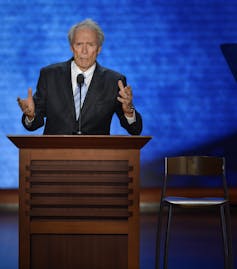
While haranguing an empty chair at the Republican National Convention, Clint Eastwood stumbled upon the central metaphor of the 2012 election. The election has been, on the whole, about people who were not there, the ones who didn’t show up and the ones who were kept away.
Though not present, these people – candidates, voters, and citizens – defined the race. Whether scapegoats or saviours, their absences shaped the field, set the issues, and moved the polls. Collectively they made 2012 an election in absentia.
This empty-chair election began not with Eastwood but with the GOP primaries. As Republicans surveyed the vast but insubstantial field of candidates, many wondered: “where is everyone?” Early 2011 polls had five different Republicans leading the field – Sarah Palin, Chris Christie, Mike Huckabee, Rudy Giuliani, and Donald Trump – none of who entered the race.
The GOP base then cycled through every candidate in the running, from a pizza mogul to a moon-colony enthusiast to a former senator who compared gay people to paper towels. Then they returned their attention to those who weren’t there – the governors and senators and up-and-comers who failed to throw their hats in the ring: the A-team warming the bench.
Pundits and partisans spent the spring pining for a brokered convention, where one of these absent white knights would rescue the party from a Romney-shaped disaster. Once Governor Romney clinched the nomination, however, those fantasies faded. The GOP consolidated around the only viable candidate who had bothered to show up.
Meanwhile, a glaring absence triggered a fight that shaped much of the general election. In mid-February, Republican representatives convened a hearing on the Obama administration’s contraceptive coverage mandate. The GOP was hoping to launch a battle over religious freedom, an attempt to draw evangelical and conservative Catholic voters to the polls in November. But the issue quickly mutated when two Democratic representatives asked: “where are the women?”
Not only had Republicans failed to invite women to a hearing on contraceptive coverage, they turned away the women Democrats had invited. One who had been excluded: Sandra Fluke, a Georgetown law student who would come to symbolize the “war on women” after conservative radio host Rush Limbaugh slurred her as a “slut”. Time and again over the course of the campaign, Republican candidates talked about contraception, abortion, even rape, in ways that made the women involved invisible. By continuing to erase women from these debates, the GOP ensured the “war on women” narrative would prove remarkably durable.
The economic debate also came to be defined by people not in the room: the 47%. In the usually quiet weeks between the conventions and debates, a tape surfaced from a fundraiser Romney held in May. Speaking to well-heeled donors, Romney assailed the sort of Americans who don’t attend $50,000-a-plate dinners: low-income citizens without a federal income tax liability. Over the soft clinking of silverware on china, Romney dismissed these absent Americans as people who would “never take personal responsibility and care for their lives”.
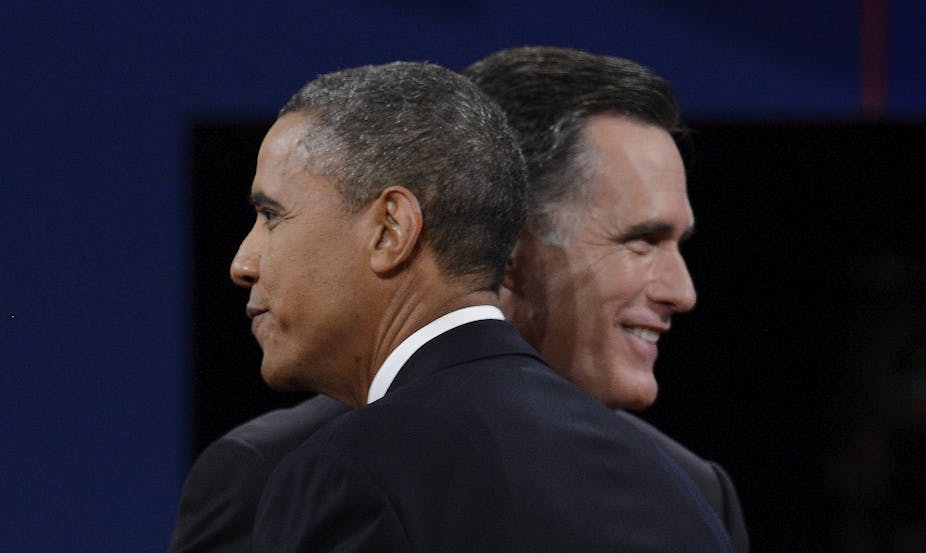
How someone talks about the people who are not there – in this case, vilifying them as parasitic leeches on the body politic – can be revealing. For a time the voting public found it decisively so. Obama’s narrow lead widened to a comfortable five- to six-point margin over Romney.
That was, until Obama decided to use the Clint Eastwood-empty chair debate as a model. While it was entertaining to see an empty chair best the doddering movie actor, the act didn’t translate well to a presidential debate. Mitt Romney brought his A-game to a debate Barack Obama barely attended. Momentum, and the lead, quickly swung to Romney for the first time in the yearlong race. If half of winning is just showing up, Romney met that threshold and Obama didn’t.
The race has since settled to a near-tie, with Obama holding just enough of a lead in just enough of the swing states to be considered the favourite by most observers. But in a race so agonisingly close, the outcome hinges on turnout: who gets their supporters to the polls when it matters. For a campaign that has been defined by those who didn’t show up, it’s fitting that the election will come down to the voters who do.