
The neglected sector: the year that changed TAFE in Australia

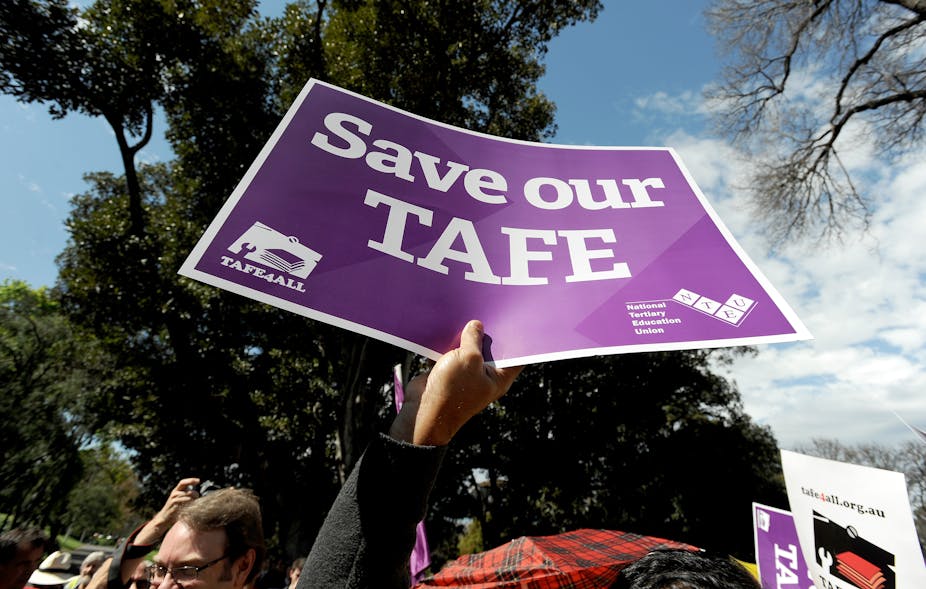
This year, the majority of TAFEs across the country have been threatened by state government changes to the sector. In New South Wales and Victoria, vocational education has seen institutional closures, loss of expertise and reduced opportunities for students. The Queensland government, too, is looking…

N4z8ggwx-1355718002
We won’t realise the impact of state cuts to vocational education for many years. AAP/Joe Castro

This year, the majority of TAFEs across the country have been threatened by state government changes to the sector. In New South Wales and Victoria, vocational education has seen institutional closures, loss of expertise and reduced opportunities for students.

The Queensland government, too, is looking at similar changes to save money on vocational education.

This stands in stark contrast with the debate around government support for higher education. This funding is widely accepted – the discussion mostly looks at why it should be increased not whether it should exist at all.

We justifiably assume that Australia benefits from a well supported higher education sector and from university students who contribute to a higher skilled economy, a more informed political debate, and a richer more well rounded society.

So why is it that cuts to vocational education often fly under the radar?

Who benefits?

With vocational education and training (VET) the same arguments about the benefits of education to our economy and society apply, and are perhaps even stronger than for higher education.

Stronger because the TAFEs and the private vocational colleges that make up the sector, are more accessible to a number of disadvantaged groups.

My recent research on the VET sector shows the role VET plays in both addressing disadvantage as well as the substantial government return on its investment.

Returns on investments have been estimated as more than six to one for NSW TAFEs. And a potential two to one return on investments in the VET sector nationally. Beyond the purely economic arguments, there is an even stronger case that it provides substantial social benefits by giving a forum for those from disadvantaged backgrounds to improve their options.

The following graph uses ABS data that divides the population equally into five levels of socio-economic disadvantage. It shows the percentages of VET and higher education students in each level. The dark line indicates the height the columns would be if students were drawn exactly equally from all levels of disadvantage.

The graph shows that those from less advantaged backgrounds may have difficulty accessing higher education. While the VET sector has a relatively even spread of students from disadvantaged, middle class, and affluent backgrounds.
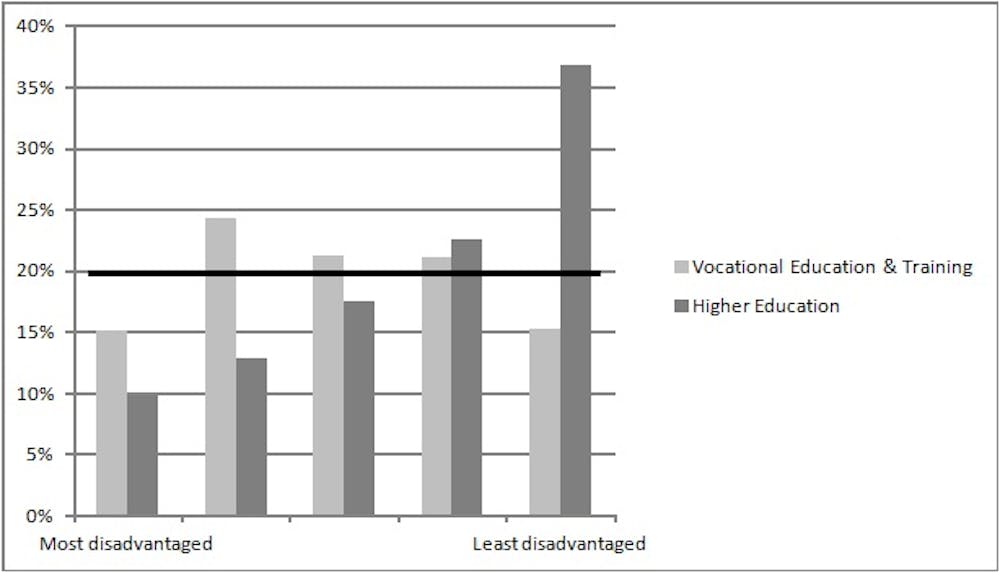
Students by levels of disadvantage. Author

The government money going towards VET is then more evenly spread across different backgrounds, and is making further education available to those who may not normally have access.

This is not an argument for removing government support from universities. Quite the opposite – less funding for universities would only make the problem worse, as the increased costs of university could only be afforded by the wealthy.

However, it does demonstrate the need for other education providers that have greater accessibility.

A helping hand

There are a number of unavoidable reasons why universities are not as accessible as TAFEs. For example, the smaller size of most TAFE campuses and private colleges means they can be more widely distributed.

Shorter travel times make them more accessible to students from rural and remote areas, which are often areas of socio-economic disadvantage.

The lack of access to resources and facilities that can come from living in remote areas is itself a form of disadvantage. And here again TAFEs perform well in providing opportunities.

While the percentage of Australians in rural and remote areas is 11%, the percentage of TAFE students from these areas is 20%. And private vocational colleges also do well with 14% of students from rural and remote areas.

TAFEs play a particularly important role in providing a forum for those with a disability to improve their opportunities, with 7.2% of TAFE students having a disability or long-term medical condition. This is double the proportion of university students with a disability, which is 3.5%.

A question for governments

The evidence shows TAFE’s ability to work for everyone. The role it plays for disadvantaged groups is a challenge to the number of state governments that are implementing or considering large cuts to TAFE funding – which themselves are in a context of long-term funding decline to the VET sector.

The challenge is to explain why cuts are being made to education providers that are clearly using these public funds to provide opportunities to all. So why are our governments choosing not to make this investment when everyone wins?

While there have been some protests, the level of debate around the cuts has been limited. This may be because the damage won’t be realised for many years to come.

It also seems as though VET students as a whole are less politically active than university students. Personally, I think this is because many VET students are working in the industry as they train and worry about endangering their jobs by encouraging media attention.

But whatever the reason, an education sector that benefits all Australians in the long-term should not depend on the activism of its current students. Broader public support is needed. The value of TAFEs and the VET sector, should speak for itself.

In the long term, Australia will come to regret the year we sold out on vocational education.

Articles also by This Author

Sign in to Favourite

Want to follow The Conversation?

Sign up to our free newsletter to get the day's top stories in your inbox each morning, with a special wrap on Saturday.

Spinner
Donate and become a friend of The Conversation

Join the conversation

13 Comments sorted by

  1. George Takacs

    Physicist

    Chris,

    Thanks for this article. It makes me wonder what is driving these short-sighted cuts, and why we are being so acquiescent.

    report
    1. Michael Hay

      retired

      In reply to George Takacs

      George, I think the problem dates back the stupid decision to eliminate technical schools - which were in place specifically to train adolescent youth in the manual trades and to separate those students who sought to achieve an academic qualification.
      The result of this assumption that every person should be encouraged to attend a tertiary educational institute is obvious in our song about the lack of tradesmen (and women) available to ply their trades.
      It will never be too late to reverse this…

      Read more
  2. Geoff Taylor

    Consultant

    So far only NSW and Victoria have shot themselves in the foot. Perhaps more sense will apply in the rest of Australia.
    Although TAFE offers a mix of training, with some easily articulating to university courses, it seems that for hands-on adolescents and also mature age students, your right to appropriate education and training through institutions with rigorous internal standards is now being flouted by the NSW and Victorian governments.

    report
  3. Dale Bloom

    Analyst

    “So why are our governments choosing not to make this investment when everyone wins?”

    The answer could be here.

    “The number of places available in the Migration Program for 2012–13 is 190 000, which is 5000 more than the 2011–12 planning level. Of the 5000 places, 3400 are allocated to the Skilled stream. This is to help meet the demand for skilled migrants.”

    http://www.immi.gov.au/media/fact-sheets/02key.htm

    Various sate government and the Federal Government find it easier to bring in immigrants than train existing Australians. The situation is long term national suicide, as the existing population is not being trained.

    It also means we have to keep increasing the population to maintain a skilled workforce, which means more and more natural resources are extracted and depleted, together with increasing infrastructure costs, and eventually a declining quality of life.

    report
    1. Andrew Smith

      Education Consultant at Australian & International Education Centre

      In reply to Dale Bloom

      The missing part is finding "committed" Australian trainees prepared to make some sacrifices including studying and/or working away from their home (and friends, families or mortgage), plus the aptitude and motivation to stick with an apprenticeship (the drop out rates have improved but still very high).

      In parallel politicians and society tells the young they should participate in "higher education", though unclear if any course or occupational areas have been targeted?

      Fact is that with ageing populations in the first and developing world, there is a need to replace bubble of baby boomers approaching retirement, and will be competing to attract the best and most motivated talent through immigration (similar to 100 of ks of Australians working and living) internationally.

      report
  4. Gil Hardwick

    Anthropologist

    The BIG problem with TAFE is that it relies for its existence on an idea of 'disadvantage', of low expectation and by corollary low outcomes, not to advance its students station in life but to provide permanent, ongoing employment for low level 'teachers', and 'trainers', unable to find a job anywhere else and thus tapping into a captive market.

    So they think.

    TAFE is a lot like regional prisons, where today the third generation of screws guards the third generation of lags, all from the same town whose economy would collapse were anyone to wake up to the reality of what is actually going on.

    Being, significant waste of public money with not only no return on the investment, but ongoing expense.

    I mean, people, get a life finally.

    report
  5. Geoff Taylor

    Consultant

    I recently attended TAFE to learn an Asian language. I also taught at TAFE for some years, and also at university. I can only note that my experience of TAFE is not matched by that of Gil.

    report
  6. Gavin Moodie

    logged in via LinkedIn

    It is true that Tafe enrols a reasonable balance of students from disadvantaged groups, however they are concentrated in lower level programs and in fields of education that have weaker employment and educational outcomes.

    But this is not the point for the governments and their officials cutting Tafe since members of equity groups may equally enrol in private providers, perhaps with community service subsidies. The central question is why Tafe should be supported in preference to private providers…

    Read more
    1. Christopher Stone

      PhD Student at Macquarie University

      In reply to Gavin Moodie

      Gavin, given the experience of Victoria it seems as though the reverse question is being made central "Why should private providers be supported in preference to TAFEs?". I think both questions miss the point that this should not be regarded as an either/or situation or a zero-sum game. Private and public providers have different strengths and are playing somewhat different roles in the sector. VET is better off with both kinds of providers being strong. Both types of providers should be encourage…

      Read more
  7. Jonathan Marshall

    Founder

    As a concept VET education has so much potential - after working in Munich for six months and experiencing first hand the quality of their VET system, the quality of it students and the respect the system has by the broader German society (one that values practical skills) you can see what is possible.

    Unfortunately in Australia as in many countries there is a stigma associated with VET education and those who work in it - yet in nearly all economies, both developed and developing, improving the VET system will have far greater impact than effort spent on improving the higher education sector. There is a lot of low hanging fruit and it is practical skills that are in short supply not theoretical skills.

    I just wish my Economics degree and MBA were vocationally orientated !

    Here is an excellent report from McKinsey released recently - Education to Employment

    http://mckinseyonsociety.com/downloads/reports/Education/Education-to-Employment_FINAL.pdf

    report
  8. Colin Long

    Victorian Division Secretary, National Tertiary Education Union

    Gil Hardwick's comment demonstrates remarkable ignorance of the work of TAFEs and their staff. I have been very directly involved in the campaign against the Victorian Government's cuts and visited pretty much every TAFE in the state, where I met staff doing a brilliant job to educate students from diverse backgrounds to improve their "station in life". The appreciation shown by students completely undermines Mr Hardwick's evidence-free rant.

    report
  9. Gwen Clark

    logged in via Twitter

    @ Gavin. Why TAFE rather than private providers? It comes down to economic priorities. In TAFE the priority is (or was) educating the student to a standard. For private providers it is making a profit. If the private providers were audited and held responsible to delivering the same quality of outcome as a TAFE all would be well but it simply doesn't happen and a significant number of private providers cut corners to the point where their training is worthless. For example fitness training with…

    Read more
  10. Fleur Summers

    logged in via email @rmit.edu.au

    I began my academic life at TAFE. It gave me an opportunity to prove myself in an area that I had little or no background in. I am deeply saddened that those making funding decisions see vocational education of little value. This will actually reduce the standard of students I teach at tertiary level - if they get there.

    report