The sun is setting as I drive home from my work at Charles Darwin University. My route runs between Nightcliff, a funky beach suburb with old-style Darwin elevated houses, and new high-rises springing up to exploit the demands of the most unforgiving housing market in the country.
I drive past mangroves. At high tide, people fish from the side of the road and the water. I always look for crocs, but I haven’t seen one yet. It is my favourite time of day.

Just before the left turn into Douglas Street, there is a bus stop. A dirt track runs off to the right of the busy road to a scatter of houses.
The sky is dramatic above. It is the end of the wet season and there are still large impressive heads of cloud that gather. No subtle colours here. Each day the red skies light up this scene with all the signs of tropical living in Darwin.
But the setting sun lights up another sign of living in Darwin.
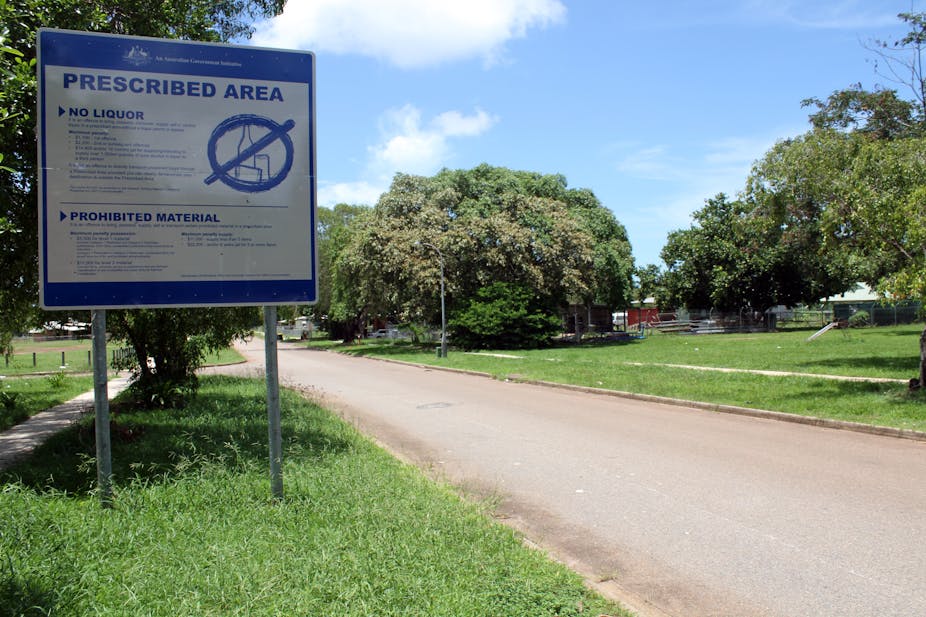
A sign of division, it is very large, white with blue writing, erected to the left of the dirt road entrance to the suburb on my right. The sun bounces off the sign as if to draw attention to this “Australian Government Initiative”. “PRESCRIBED AREA” is written large enough to clearly read from the road.
Underneath in font half that size and still readable from the road it says “NO LIQUOR”. To its right is a large picture of a bottle, can and box circled with a diagonal line through it.
The lower half of the sign says “PROHBITED MATERIAL”. This section used to say “NO PORNOGRAPHY”. Both sections are followed by the small print – yes, I have to get out of my car and walk up to the sign to read the legislation enacted over my neighbouring suburb.

Neighbours twenty metres away are not subject to this legislation. It only applies to particular suburbs, all of which are Indigenous communities.
I try to imagine this sign, replicated next to the entrance of every suburb in Darwin… every suburb in Australia. It is Federal Government policy, implemented with bipartisan agreement.
This agreement perpetuates the Northern Territory Emergency Response (NTER) that erects such signs in our neighbourhoods. Children who live in the number of suburbs designated “Prescribed Areas” around Darwin have grown up passing this sign daily.
Every day, Darwin residents and visitors drive past signs that further entrench every stereotype of Indigenous people I can think of. The public health campaigns to deal with the Territory’s significant drinking levels do not place signs such as these in front of each suburb.
The signs are a dramatic representation of the NTER legislation that should not be imposed on my neighbours. They create artificial segregation from friends, colleagues and family who live there and here.
Indeed, if the legislation responded to statistical evidence the signs would be erected in Canberra, with the highest reported rates of sexual abuse. It is also a territory subject to Federal Government powers.
There is no hiding the signs of racial discrimination. Even if removed from view, the fact remains that the Federal Government required the Racial Discrimination Act 1975 to be lifted and amended in order to affect the NTER.
Each day, driving past the sign, these thoughts spin through my head. Evening spreads over the mangroves and the noisy process of people, birds and animals settling down and waking up.
The sign is invisible in the night. But its implications are harshly clear in the lights of cars and the windows of my neighbours.
Jon Hunt
Medical Practitioner
I've seen these signs around the remote communities. Some of them have "fight racism" scrawled over them, yet no-one seems to be interested in doing this. Society seems to accept it; Gina Rinehart seems to be much more important.
Gil Hardwick
Anthropologist
Bureaucrats work in environments in which direct contact with reality is simply impossible. They don't even use valid statistics beyond what they perceive to be 'public opinion', usually expressed as what you can get away with before anyone objects, and even then some.
One learns the hard way that the only way to get their attention is to stand there and yell at them, though that can go pear-shaped in short order.
What they work on is something they see as 'deterence'.
The public message…
Read moreDiana Rickard
sustainability educator
In all fairness the two governments responsible for this invasion should place these signs around their parliament house precincts. The amount of alcohol and abuse that comes from these places is unreal! Perhaps A4-size stickers for the doors of each electorate office as well wouldn't go astray.
As an aside: the red sunsets currently over Darwin are due to burning the Bush. As well as being the highest abusers of alcohol, we are the biggest emitters of carbon pollution due to our love of setting…
Read moreDavid Tuck
Scientist
They can put those signs anywhere they like as far as I'm concerned, noisey drunk people are incredibly annoying if you ask me. There's that, and the fact that I think that the joys of alcholhol consumption are incredibly over-rated. I haven't drank it at all since learning that alcholhol consumption decreases testosterone levels in males, that's amongst all of the other amazing effects it has on the human body.
Scott Wallace
Technical Analyst
The sign does not necessarily means racially discriminatory policy but a warning for outsider especially to follow safety law, when you drive to the border of SA you will notice the sign to discard all fruits to prevent the spread of flies and disease.
People seem to forget the rights of children and women in troubled communities to grow up and live in a safe environment to have a chance for further development in life. What's the stats for rates of sexual abuse in Canberra and where do you get…
Read moreDavid Tuck
Scientist
That's so true, people are so quick to scream racial discrimination these days whenever a governing body intervenes in a bad situation. The problem with the attitudes of people like the author is that thanks to mass culture and things like Disney children's movies, people are led to believe that childhood is some sort of universal experience for all children. Unfortunately it is not, and in some communities the reality is that children are growing up in appalling conditions with high rates of abuse. The real question here is whether banning alcholhol in these communities is going to help? Maybe it will. Is it worth doing it to try to protect children from abuse? In my opinion, yes.
Fred Pribac
logged in via email @internode.on.net
David Tuck: "That's so true, people are so quick to scream racial discrimination these days whenever a governing body intervenes in a bad situation."
The questions remain - why use an intervention that is guarranteed to not only erode self-respect but publicly further marginalize a troubled community!? Why is this sort of intervention not used in other communities with similar problems but predominantly non-aboriginal populations?
The uncomfortable possibility that suggests itself is that there is some sort of ingrained bias in our governance. That bias would seem to be largely based on racial stereotyping.
Scott Wallace
Technical Analyst
Dave, quite a few dry towns are thankful for such policy, the women are much safer. Drinking law in dry town apply to all races, when people talk about having the privilege to drink on some beach whereas black fellows get picked up by the cops that is racism by the cop which has nothing to do with the intervention. If people see the 7:30 report last night on the terible situation in Toomelah they would want something done about it whether the community is black or white.
The intervention originally…
Read moreDavid Tuck
Scientist
You have a point about that kind of intervention not being used in towns other than ones with predominantly aboriginal populations. But, as I said earlier 'They can put those signs anywhere they like as far as I'm concerned' In fact, I wish they'd have put them in my town when I was growing up, I'm pretty sure that it would have prevented a lot of the alcohol related violence that was going on. That is only one of the many reasons that I don't drink though, alcohol is a poison and the only reason that it is available for public consumption is that making it illegal will probably create a huge black market and a headache for law enforcement. I'm surprised that so many people are so attached to it that they feel as though taking it away is worthy of such an outcry. What are your views on smoking?
David Tuck
Scientist
This excerpt was taken from:
Berk, L. E., (2013), Child Development, 9th ed. Pearson Education Inc., New Jersey
Fetal Alcohol Spectrum Disorder (FASD) is a term that encompasses a range of physical, mental and behavioural outcomes caused by prenatal alcohol exposure. Children with FASD are given one of three diagnoses which vary in severity:
1. Fetal alcohol syndrome (FAS), distinguished by a. slow physical growth, b. a pattern of three facial abnormalities (short eyelid openings; a thin…
Read moreSarah Cefai
logged in via Facebook
I think this conversation is missing an important point that Catherine raises, which is that the urban landscape of Darwin is littered with prohibitory signs that not only symbolise the regulatory power of the federal government (that continues to operate on the individual in ways not possible in Australia's states) but does so in a racialised way. The signs concretise the use of race to delineate Indigenous Australians from everyone else on the grounds that They are in need of greater degrees of…
Read moreDavid Tuck
Scientist
It annoys me when people bring up the civil liberties red herring when talking about health matters. Do you think that it should also be legal to shoot other people with a gun just because you feel like like it? The only difference between shooting someone and feeding them alcohol is that alcohol has a greater effect on that person's children, through growing up in an environment that impacts on the quality of childcare that those people impart to their children, not to mention the impact of prenatal alcohol exposure outlined in my last post. Of course, people arguing for the availability of alcohol may have a conflict of interest that they are unwilling to reveal.
David Tuck
Scientist
The problem is not the signs that are banning alcohol, it is everyone that drinks alcohol. The problem is a culture that equates alcohol consumption with socialising which actually encourages people to drink in order to be accepted. Why do we need alcohol to socialise? It is the socialisation and not the alcohol that is good for lowering stress levels. And even worse, getting drunk and having sex which results in pregnancy leads to gene mutations in offspring and FASD disorders due to prenatal alcohol exposure. How can anyone argue a case for alcohol when science proves that it is not only bad for your physical and mental health, but that your use of alcohol negatively affects the health of others. Alcohol should not be used by anyone at all.
Gil Hardwick
Anthropologist
You may well be right, David Tuck, except that I don't see anyone paying much attention.
The reason, I guess, is not that alcohol is socially important - I do not think myself that it is - but that it is economically important.
Alcohol in its many forms appeared long before money, and I have no doubt it will still be around long after money.
Sit around playing five-card and you will see precisely what I mean.
David Tuck
Scientist
Yes, that's generally what happens when you tell people something that is painfully obvious, but which they don't want to hear. God forbid that anyone should take responsibility for their own actions and actually make an effort to improve their own health. I think that a big part of the reason why people are upset about these signs is because it is confronting to them to think how bad alcohol is for them if they drink it on a regular basis, that would make sense when Darwin has the highest rate of alcohol consumption in the country, and one of the highest in the world.
Gil Hardwick
Anthropologist
Well, sure, except the vast majority of Darwinites are whitefellas, none of whom are sanctioned in this way. The remainder, of most concern, are not ordinary prosperous Larrakia or resident Tiwi or the rest of them, but the residual homeless 'long grassers'.
And again, against the range of options granted in life, with only a blanket to sleep on, when sitting around drinking and playing cards and avoiding fights is the best on offer, something else has to be said seriously about not only civil liberties on the one hand, but the most basic human rights on the other.
David, I am unfollowing this thread the moment I post this.
I am not really very interesting in responding to what is plainly a singular crusade of yours hell bent on refusing to gaze beyond your narrow, blame-casting focus on alcohol alone.
David Tuck
Scientist
Considering that this article is about a government intervention designed to stop the abuse of alcohol, then I'd say that my 'narrow focus' is justified. You as an anthropologist should be especially aware of the bilateral interaction between the health of an individual and the health of the group, so it's surprising that you could be so focused on the negative effects of an intervention instead of the positive ones. Perhaps you really are unaware of just how harmful alcohol actually is.
I don…
Read moreJon Hunt
Medical Practitioner
I think that it is a little harsh for the good anthropologist to get angry and spit the dummy at someone with whom he disagrees, or who disagrees with him because that sort of thing should be expected in a discussion forum such as this.
That aside, I think that Mr Tuck is quite wrong.
The problem with things like the NTER is that it is rubbish. I suppose I now need to explain why it is rubbish. There are the obvious ethical reasons. Perhaps more importantly it does nothing to address the…
Read moreDavid Tuck
Scientist
Hi Jon,
I meant that reference about alcohol and socialising as a reference to broader Australian society, not just to a specific group. Most people in broader society do drink alcohol in social contexts, or at least think that it is good for that purpose.
Read moreMy reference to feotal alcohol syndrome was for the benefit of people who may be reading this thread who do not understand the dangers of drinking alcohol while pregnant. From what I have seen most people think that drinking a little bit of…
Jon Hunt
Medical Practitioner
Hi David,
Whilst it not necessarily a bad thing to mention the teratogenic effects of alcohol, it is a little off-topic I feel. The argument to me is that the NTER is a racist intervention, which I agree with. You ask what else can be done, as though if there are no better ideas it's OK to be racist. It does not really matter if there are no better ideas, you are not going to improve things by being racist.
If you have ever visited a remote Aboriginal community I am sure you will be dismayed…
Read moreDavid Tuck
Scientist
Hi Jon,
That's exactly my point, the government is responsible and should be trying to do something to improve the standard of living for Aboriginal people in Australia. I have visited a couple of remote Aboriginal communities that were like the ones that you described, and yes, it was very confronting to see the conditions they lived in. Again, this only supports my view that the government needs to do something to address this situation. What exactly are the policies of the NTER that are racist…
Read moreJon Hunt
logged in via Facebook
David, well we could argue forever as to whether the NTER is racist or not. Just imagine if these were white communities with the same problems, would the government have gone to so much trouble to enable them to plant these signs? I am sure that there are no white communities in this country that would accept being treated in this manner. It sends a message to everyone that Aboriginal people in communities are winos and paedophiles and is that not racist, or at least does it not have racist undertones? It is simply inappropriate to deal with issues such as this in this manner. And the government thinks it can help people with this sort of attitude.
The problem with racism is that you can't always see that it applies to you. I agree that discrimination according to race is necessary, but it should be in a supportive manner, not the derogatory way these signs represent.
David Tuck
Scientist
Yes, I see your point that it could have the unintended effect of undermining people's dignity with the 'prohibited material' bit. So it is the signs that you have a problem with, not the intervention itself?
Jon Hunt
Medical Practitioner
Oh, dear David, you miss the point entirely. The intervention is what I have a problem with, not the signs!
David Tuck
Scientist
But you said that whatever happens, it should be done in a more supportive manner. Doesn't that imply some sort of action? How is Australia supposed to close the gap between the difference in the standard of living for Aboriginals and non-Aboriginals without some sort of action? The problem isn't just going to fix itself. I think that it's failing because of what you pointed out, that the policy makers weren't sensitive enough to what was needed in order to turn around the cycle of dysfunction. If…
Read moreJon Hunt
Medical Practitioner
David,
Read morethe problem will fix, or at least improve, all it takes is a bit of respect. You don't really need a specific 'action'. There was a recent coronial inquiry in the deaths of several Anangu in Ceduna, all of whom died due to alcohol abuse. There is I believe good evidence that restricting alcohol helps with this, yet the only response is to restrict casks to 2 litres per person per day. That's not a restriction and will not make any difference. The health centre where I had worked asked many…
Jon Hunt
Medical Practitioner
Sorry for the typos...