
Three major floods, four reviews, but still lessons to learn

The last few years provided plenty of data to help us reform our approach to floods. With devastating flooding in Queensland and Victoria in 2011 and 2013, we should have learned a great deal about which approaches to flood mitigation work and which are less effective. A review of four recent Australian…

Ntd7bxns-1363747795
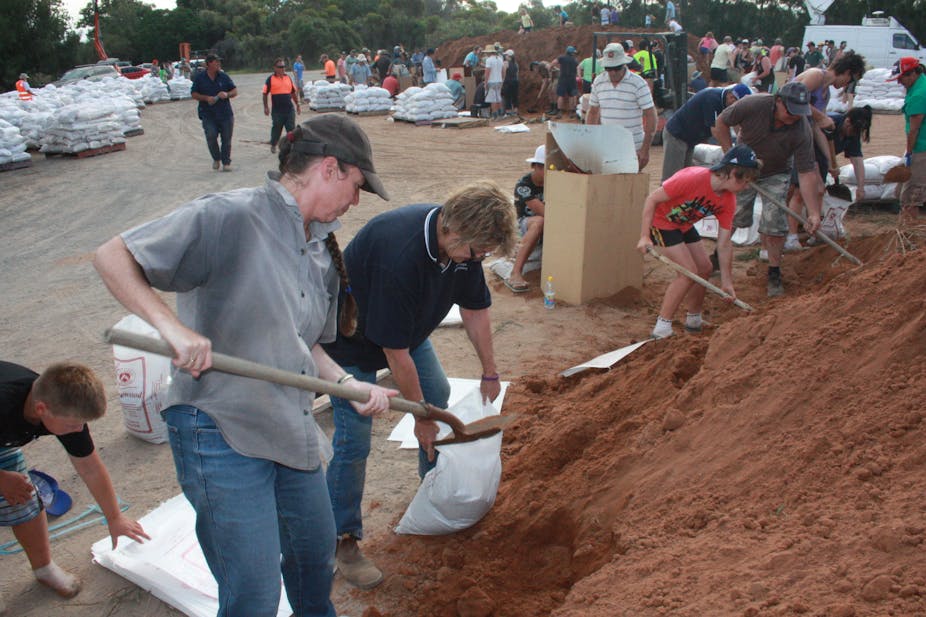
Australia is hanging on to flood mitigation measures that other countries have left behind. AAP Image/Pamela Blackburn

The last few years provided plenty of data to help us reform our approach to floods. With devastating flooding in Queensland and Victoria in 2011 and 2013, we should have learned a great deal about which approaches to flood mitigation work and which are less effective. A review of four recent Australian studies of mitigation and adaptation, and a comparison to overseas recommendations, shows we are lagging behind international practises in a number of important areas.

The Australian approach

We looked at four recent reviews of flood mitigation and adaptation in Australia: the Queensland Floods Commission of Inquiry, Brisbane City Council’s Flood Response Review, the Victorian Parliament’s Inquiry into Flood Mitigation Infrastructure in Victoria and the Victorian Floods Review.

These reviews varied greatly in scope, and all produced a comprehensive list of considered and much-needed recommendations to improve Australia’s resilience to floods in the future. But one surprising fact was none of them dealt with future climate impacts. Some didn’t even mention climate change. Government reviews are expensive, but the cost is justified if they identify reforms which improve society. By not taking into account the risk of future climate change and its exacerbation of flood risk, governments are missing an opportunity to include those risks in the current reform agenda.

Australian governments take the attitude that we can re-make flooded communities exactly as they were before. As soon as a disaster is declared, federal funds are made available to rebuild to “pre-disaster” conditions. There is little or no expectation that infrastructure should be made more resistant to flood damage. In the United States 15% of federal funding is allocated for “betterment”; here there are virtually no resources to plan for, relocate or strengthen flood prone infrastructure to make it more resilient.

The Australian approach to “flood proofing” communities is to build levees. Levees essentially take the same body of water and squeeze it into a smaller space. They don’t encourage evaporation, and they push water to higher levels. They work well in small floods, and under those conditions are very effective at protecting communities. But in recent years we’ve seen bigger floods, and these are likely to get worse. In bigger floods the levees are often overcome, and the potential for serious damage becomes much greater than it would be without them.

“Non-structural” or “ecosystem” approaches to flood mitigation work much better than structural measures like levees. But in Australia, we rarely consider these types of measures.

International ideas

Internationally, the story is very different.

In our research we also looked at flood reforms in the USA, China and the Netherlands. In all three, climate change was a driving force behind their significant recommended reforms.

All of these countries recognise they have reached the limit of what levee banks can usefully achieve. Instead, they have instigated a range of reforms built around the concept of ecosystem management.

The first of these is “making room for the river”. The river channel is widened or deepened to allow more water to flow through while remaining within its bounds. Flooding of surrounding areas is reduced.

Since its devastating floods in the 1990s, China has been restoring flood plains, buying land around river channels and relocating people to higher ground. This has happened most famously as part of the Three Gorges Dam development, which attracted a lot of negative media coverage. But we’re finding that years after relocation, people have shifted to crops that are less prone to flood damage which, combined with being on higher ground, means they’re hit by floods less often, and they’re better prepared to deal with those that come along.

All three countries have changed the way they manage their floodways. Where cities and towns are vulnerable, the government diverts the river into agricultural land around the town. In a flood season the city is protected and agricultural areas are flooded instead. The farming communities are paid by the government to forgo income during floods, but still use the land at all other times. Australian research has shown that for graziers, more frequent flooding can actually improve farm incomes.

What could Australia learn?

Australia has dabbled in ecosystem approaches and relocation, but often in an ad-hoc way.

Critics of ecosystem approaches point out that it’s all very well to deepen a river upstream, but if you don’t deal with the towns downstream, flooding there will be much worse. For ecosystem approaches to work, management and planning have to be undertaken on a much larger scale.

In the southern Murray-Darling Basin, the government proposes removing constraints such as bridges and dams to allow for bigger peak environmental flows (that is, floods). This work is very promising, but what about the rest of the Murray-Darling Basin and, indeed, the rest of the country?

Currently, we don’t have coordination and integration across jurisdictions within and between states. But rivers don’t respect administrative boundaries: when you’re developing ecosystem approaches, you have to use the natural environment as your point of reference.

There have also been a few examples of relocating communities: Grantham and Gundagai being the most notable. This relocation is expensive, but as floods become bigger and more frequent it’s something Australia needs to do more often. The financial and social costs of retaining and rebuilding flood prone towns over and over and over again will soon add up. When the taxpayer is picking up the bill, at some point you must decide whether rebuilding is an economically viable solution, or whether in some situations relocation is the more sensible approach.

And of course we must take account of future climate risks. While none of these reviews seriously studied those risks, change is happening elsewhere. The Australian Rainfall and Runoff Guide is one of the most important national reference guides, and is used by planners and builders to help them allow for floods. It’s currently under review, and future versions will take account of the effects of both natural and anthropogenic climate change. This attitude should spread to all flood reform.

Articles also by These Authors

Sign in to Favourite

Want to follow The Conversation?

Sign up to our free newsletter to get the day's top stories in your inbox each morning, with a special wrap on Saturday.

Spinner
Help us have better conversations — donate

Join the conversation

12 Comments sorted by

  1. Greg North

    Retired Engineer

    It's a bit like horses for courses and terrain and history of climatic conditions may well dictate what might be the best measures to be adopted whilst of course knowing that there have always been climatic changes.

    Australia is not so stagnant in attitudes though that may be hard to believe when it comes to some local government authorities allowing developments to proceed in high flood risk areas and that this still occurs should be a criminal offence.
    Meanwhile, we do build dams and could…

    Read more
  2. william hollingsworth

    student flinders university

    Great article.
    Geography rule 101. Don,t build on flood plains.

    report
    1. Tim Baxter

      Research Assistant at Victorian Centre for Climate Change Adaptation Research - Melbourne Law School

      In reply to william hollingsworth

      While I agree in principle, in Australia this in much more difficult (as is the European idea of allowing "more room for rivers") as most of our best land is flood prone.

      Also in Australia I believe, and anyone feel free to contradict me if I'm wrong, the areal exent of our floods (i.e. the size of the area affected by flood when it does happen) can be quite large due to a number of factors.

      A third factor is that we are a very young nation, with not a particularly large amount of flood information compiled. It is difficult to define what areas are subject to an acceptable risk of inundation from flood when we only have a century of data, much of which is incomplete. Even when it is complete, a lot of it isn't properly incorporated in planning scheme amendments so no-one is properly informed of whether they actually *are* on a floodplain.

      report
  3. Diane Bruhn

    ocassional activist

    Not sure why you would want to widen and deepen waterways. This could significantly increase erosion and move silt into areas where it is not wanted. Are you suggesting removing vegetation from riparian areas and channels in order to widen and deepen? If so, then expect big, big changes downstream during major floods due to the significant hydraulic changes you have introduced into the system. Aren't you worried about bank collapse being an effect of the deepening, worse case scenario think Grand…

    Read more
    1. Edward Fensom

      Coordinator Brisbane Region Environment Council.

      In reply to Diane Bruhn

      Thanks for the information on Lockyer Diane. Severe flood events can expose old paleo river beds like on Oxley creek at Forestdale and Greenbank Military Training Area, but also set in place on going erosion, and bank collapse like at GMTA, Parts of landclearing at Flagstone. Maybe the Redevelopment Authority can fly some more Lidar and SEQ Catchments can be engaged to categorise more erosion and where it dissipated and how much vegetation was lost.
      It appears the reconstruction authorities have…

      Read more
  4. John Browne

    John Browne is a Friend of The Conversation.

    Surveyor

    Revisit the Traveston Crossing Dam on the Mary river maybe? Don't know if anyone is still game.

    As for ARR, regardless of the method used to calculate peak discharge, results will always be based (as they have been in the past) on the variable of observed rainfall intensity and duration. These have generally been revised upward as longer and more intense storms are observed, the realm of the meteorologist.

    report
  5. Colin Creighton

    Chair, Climate adaptation, Marine Biodiversity and Fisheries

    Thanks Jamie and Karen
    Lets not forget about the fish!

    If we restore floodplain functionality the fish, other biodiversity and carbon sequestration will all boom.

    As to improved river channels - bring it on. All our rivers and estuaries have been excessively infilled due to catchment erosion. Strategic dredging done properly will hugely benefit river and estuary ecology, re-establish tidal flow volumes and so on.

    report
    1. Greg North

      Retired Engineer

      In reply to Colin Creighton

      You do mention the two sides to such events Colin and as Diane above mentions the Grand Canyon, likewise the Sahara desert has been formed over an enormous lengthy period, going through much change in thousands of years.

      Improving a river channel may seem fine as a shorter term response but the longer term may not be so rewarding and if you want to restore floodplain functionality, would not dredging river channels be doing the opposite for some.
      It is a known fact that river plains have an alluvial…

      Read more
  6. Geoffrey Harold Sherrington

    Boss

    1. Global Warming has ceased over land and ocean for the last 16 years, as conceded by all major players, up to the end of Jan 2013. Comments at http://wattsupwiththat.com/2013/03/05/has-global-warming-stalled-now-includes-january-data/
    Graph at
    http://www.geoffstuff.com/plateau_global.jpg (Thank you, wood for trees).

    2. Climate models were originally designed for global scale. Complexity removes reliability at continental scale. Think of the storm west of Brisbane that caused floods and the…

    Read more
  7. Tim Baxter

    Research Assistant at Victorian Centre for Climate Change Adaptation Research - Melbourne Law School

    In defence of Neil Comrie, the terms of reference for the Victorian Floods Review did not permit him to discuss climate change impacts (and he explicitly pointed this out in the review). I would argue that his work had future climate change impacts as an underlying assumption.

    Recommendation 86 stated that the Victorian Government should reconsider its decision to remove the requirement that local governments follow the advice of CMAs when approving developments are proposed on floodplains was…

    Read more
  8. Ben Beccari

    Disaster Manager

    I'm not sure that the comparison of inquiries, which tend to be rather reactive affairs and not necessarily reflective of the complete policy spectrum, with international policy and practices is necessarily valid.

    For example the NSW Floodplain Development Manual has sections on both ecological sustainability and climate change. Climate change remains a particular challenge. It could increase, decrease flooding and have different consequences for different areas. A precautionary approach involving…

    Read more