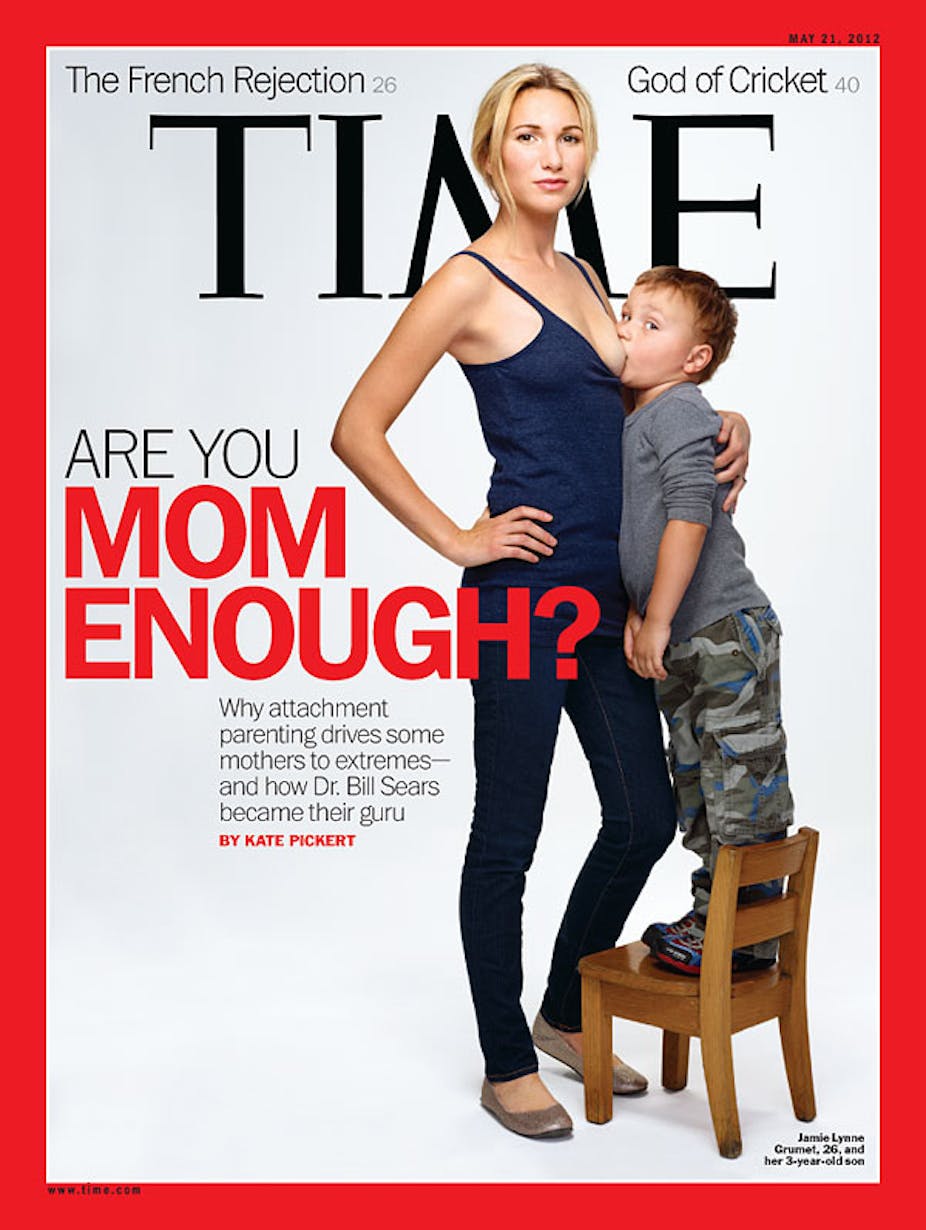
Time #1: what’s wrong with this picture?

Breastfeeding generally falls under the jurisdiction of mothers, so I decided to ask a group of mothers I see regularly on Saturday morning what they thought of the recent Time magazine cover portraying an attractive young woman, hand on hip, staring down the camera while her passive three-year-old dressed…

Z5qtx37x-1337045205
Cover of the latest US edition of Time magazine.

Breastfeeding generally falls under the jurisdiction of mothers, so I decided to ask a group of mothers I see regularly on Saturday morning what they thought of the recent Time magazine cover portraying an attractive young woman, hand on hip, staring down the camera while her passive three-year-old dressed in cargo pants stands on a chair and suckles from her exposed left breast.

What they told me was deeply reassuring.

Is it wrong to breastfeed a three-year-old? “No, I wouldn’t do it, but there’s nothing wrong with it,” said one mother helpfully. “It’s not immoral”.

All agreed in fact; it’s a question of choice, culture, circumstances, needs, and so on.

How about an 11-year-old? (I got daggers for that one.) “Other kids will let you know when it’s gone too far!”

Further prodding revealed a commitment to breastfeeding because of the nutritional benefits it confers on the baby, a sentiment shared by the young woman pictured on the cover of Time magazine, Los Angeles mum Jamie Lynne Grumet, who engages in “attachment parenting”.

Attachment parenting is a popularization of “attachment theory”, a long-standing ethological approach to the study of human relationships. Attachment theory has been dominated by two very big ideas. The first concerns the universality of attachment bonds emerging in infancy and their importance for protection, state regulation, and healthy development.

The second concerns the distinctive ways in which attachment bonds form in individual mother-infant pairs. This latter approach attempts to define optimal or secure attachment in terms of the infant’s capacity to effectively get the mother’s protection and care in times of need, such as when fear or anxiety are experienced, or when frustrations become too great.

It’s no exaggeration to say that hundreds of research studies have been devoted to understanding the underpinnings and consequences of secure attachment. Many researchers working in the field believe the key to security lies in the mother’s prompt and sensitive responses to her infant’s needs. But of course this can mean many things.

For the proponents of attachment parenting, there tends to be an intense focus on physical closeness (including breastfeeding, co-sleeping, and “baby-wearing”) and responsiveness to infant cries.

But let’s be clear, the majority of babies that have ever been studied in psychological research (and there are many thousands) have been securely attached to their mothers. Further, all this has been achieved without attachment parenting philosophies.

In fact, secure attachment is the norm. Most children develop strong affectionate ties to their caregivers that we recognize as loving, and they are able to rely on these relationships throughout development to support them in positive ways.

So what goes wrong? What undermines secure attachment?

The great British pediatrician and psychoanalyst Donald Winnicott argued that infants and children usually get what they need from their mothers. He coined the phrase “good enough mother” to convey his view that perfection doesn’t exist when it comes to parenting. And, even if it did, he added, it would undermine children because it would rob them of their autonomy.

But like many who have followed, Winnicott understood that various factors could prevent a mother from being able to recognise her infant’s needs and appropriately respond to his signals. In particular, ill health (including mental health problems) and environmental stress are prime candidates.

In more recent attachment theory, there’s also some consensus emerging that the mother’s state of mind can undermine her natural capacity to understand and respond to infant signals, such as when she is preoccupied with her own ongoing concerns or is psychologically unavailable.

A final question for the mothers: is there a right time to stop breastfeeding? “You should stop when one or both of the participants is no longer comfortable,” quietly and thoughtfully stated.

This last sentiment carries a lot of wisdom; it reminds us that there’s a relationship between a mother and her infant and the act of breastfeeding is one of the most salient and powerful forums in which the early relationship is played out during the prolonged infancy that humans experience.

It is so tempting to cast breastfeeding in terms of nutritional needs and health, but attachment theory actually presents us with a radical alternative: the biological imperative is not mothers’ milk, nutritional though it may be, it is the relationship itself. When the bonds of affection are in place, the food will come.

So, what is wrong with this picture? For the mothers I spoke to on Saturday morning, it violates precisely what it is that they value about the act of breastfeeding – it is devoid of love, tenderness, warmth or affection. You don’t need to be a developmental psychologist to see this.

My Saturday morning companions hit the nail on the head: this picture is about the mother, her own ongoing issues and preoccupations. No matter how justified these may be, they have no place in the care of infants and children precisely because they prevent us from seeing children for who they are. They prevent us from reading the signals coming from the child and responding to them appropriately and with sensitivity.

That this truth was so obvious to my companions is deeply reassuring, no wonder most children are securely attached.

Read more stories on Time’s controversial cover:

Time #2: Extreme parenting, Time magazine style

Time #3: Why does it hurt to look at a woman breastfeeding?

What do you think of the image and the article? Leave your comments below

Sign in to Favourite

Want to follow The Conversation?

Sign up to our free newsletter to get the day's top stories in your inbox each morning, with a special wrap on Saturday.

Spinner
Become a friend of The Conversation and donate

Join the conversation

21 Comments sorted by

    1. Sue Ieraci

      Public hospital clinician

      In reply to Peter Ormonde

      Extreme atttachment parenting IS all about the mother. The mother can be holier-than-thou and somewhat martyr-ish. The child can be either oblivious to it all (when they are tiny) but risk being smothered as they get older - and the mother still needs their dependence to fulfill her own needs.

      report
    2. Anthony Nolan

      Ruminant

      In reply to Sue Ieraci

      That's right Sue. It starts with misapprehended attachment theory and ends with Lucrezia Borgia. Now there was a mother to reckon with.

      report
  1. Sean Lamb

    Science Denier

    whatever else you might say about the picture it has been a marketing move of sheer genius.

    I am losing count of the number of times I have seen this Time cover reproduced.

    report
  2. Sarah Keenihan

    logged in via Facebook

    A well-written article, thank-you. but surely you don't think this is the position the mother and her son assume for all their breastfeeding encounters? I believe she is posing defiantly to show she has a right to breastfeed her 3-year old and practice attachment parenting. That's all. Most of the time they'd be snuggled in a chair (I assume).

    report
    1. Anthony Nolan

      Ruminant

      In reply to Sarah Keenihan

      Yes, yes, that's right. Assume the position, child o' mine 'cause its my maternal rights that are at issue here, my defiance, your dependence and subordination. Quite literally - suckit up. Your right to privacy in this "tender" moment is as nothing to my right to a defiant, public posture. Motherhood as a rebellious project. Motherhood! Moderns invented motherhood, didn't they? What did women do before Time Magazine needed to boost its sales? Mere breeding. But this is about Militant Motherhood. All bow down.

      report
  3. Jeff Pearce

    Analyst

    Why no mention that this is a salacious image? Whenever I see an adult and child together like this I don't like it. If this was done in a maternal nursing position we wouldn't be talking about it. But it has sexual undertones to it which I find totally unacceptable. Mothers, you would do this to your son? If my mother did this to me I would never forgive her for it.

    report
    1. Lynne Newington

      Lynne Newington is a Friend of The Conversation.

      Researcher

      In reply to Jeff Pearce

      I agree with you Jeff.
      Feeding in this manner is a private thing and no doubt many mothers have done it. I know I have but in saying that, the age is irrelevant. When a child is unwell or in pain there is no better substitute. As an older mother who miraculously was "fully endowed" at 47 there was a bonding I had never really experienced before, not to mention the finanacial element rearing my child alone. Maybe it was the age aspect and having the time to do it.
      Wonderful.

      report
    2. Gil Hardwick

      Anthropologist

      In reply to Jeff Pearce

      Salacious? Sexual Overtones? Tells me an awful lot about the creeping paranoia engulfing us all through these bizarre perversions in the way we view our body, and the massive propaganda that encourages them.

      Apart from the short-lived and very specific Hollywood production code, general concern about public images of the human body is VERY recent, within the past generation or so, fueled especially by the paedophile and 'kiddie porn' hysteria of the late 1990s and early 2000s.

      Even the relevant…

      Read more
    3. Lynne Newington

      Lynne Newington is a Friend of The Conversation.

      Researcher

      In reply to Gil Hardwick

      I have to say, I had never thought of those salacious or sexual overtones, referred too.
      How sad that a perfectly natural life sustaining act can be seen as an opportunity other than what is intended.
      There's an old saying, it's all in the eye of the beholder, and relevant in this instance.

      report
    4. Jeff Pearce

      Analyst

      In reply to Lynne Newington

      I find it more amazing that more women don't find this deplorable, moreso than the image. As you say it's in the eye of the beholder and each to their own. I urge you to rethink it.

      report
  4. Anthony Nolan

    Ruminant

    I feel traumatised by the photograph and may need additional therapy. I'll send the bill to The Conversation. This mother is an uber mutti who clearly has global plans. One world, one breast! Oh please, no! Draw the curtains on the glass ceiling - I don't want to watch; I've been in far too many committee meetings with women who have attitudes like this. The horror, the horror.

    report
  5. Melissa Raine

    logged in via Facebook

    How depressing. A picture of a woman breastfeeding an older than usual child, clearly staged to be provocative (and sell issues), and all that this psychologist sees is self-preoccupation from the mother. Dr de Rosnay might like to read the 2 other contributions to this publication about this picture for some pointers on the huge cultural issues that this image draws our attention to, concerning what I would characterise as the continuing devaluation of motherhood and in particular, of the work done specifically by women's bodies in the process of producing -- people! And if that sounds like yet more self-preoccupation, I'd like to hear his answer to a basic question: how are mothers are supposed to go about the business of meeting their children's needs without broader support from their societies? Seeking this is not a (selfish) preoccupation: I would have thought that anyone working in the discipline of psychology could see that it is virtually the opposite.

    report
    1. Anthony Nolan

      Ruminant

      In reply to Melissa Raine

      "...the continuing devaluation of motherhood and in particular, of the work done specifically by women's bodies in the process of producing..."

      Devaluation of motherhood! Good heavens, in our culture, where Mother's Day reigns supreme as the most comercial celebration of biological affinity. A terrible state of affairs to be sure but you ought to try and see things from a man's perspective in order to understand true victim status. Every day we produce millions of sperm, without fail, and must necessarily spend almost all of our waking hours plotting how to get rid of them. Talk about unacknowledged biological work. I'm exhausted even thinking about it.

      report
  6. Marie Smith

    Researcher

    Breasfeeding too long is often a syndroma of extreme 'spider mum', according to the artist Louise Bourgeois (http://archeologue.over-blog.com/article-18577188.html) , whereby the mum creates or over-play the 'dependency' of the child. The mum suddenly exists because she is A MUM and because someone needs her. She feels needed and she depends on this to feel 'complete'. The more the baby grow, the more the mum fears to loose her grip, the less she knows how to feel good otherwise.
    The 'spider mum…

    Read more
  7. Lisa Ann Kelly

    retired

    What about the other children in the family? I was riding the bus last month and looked across the aisle to see a mother breastfeeding (no "delicacy" shawl or small coverlet involved), her breast exposed.

    The son she was feeding was talking to her, nipple in his mouth. His approximate age: three years. What I found most disturbing was the action of his older, possibly age eight, brother. While "mum" was oblivious to all, her older son was avidly sucking the side of his hand! He looked…

    Read more
    1. Anthony Nolan

      Ruminant

      In reply to Lisa Ann Kelly

      Agreed. The work of adulthood involves getting off the breast. I can't tell you how many young men I know who are not so much firmly attached as being still force fed the breast.

      report
  8. Susan McCosker

    Former school teacher

    Yes, you articulated well my thoughts on this picture. The mother looks like she is just trying to make a point, and the kid looks like he'd rather not be there.

    Yes, I've breastfed two babies, both to 18 months. By the end they were each only have one feed every two or three days. The first I gave it up because I was pregnant and it was becoming painful for me. The second, well, he stopped asking for it. When I had my first, I assumed I'd wean him around 12 months but learnt otherwise.

    Until one or both feel uncomfortable is indeed wise.

    report
  9. Byron Smith

    PhD candidate in Christian Ethics at University of Edinburgh

    I largely agree with the article, though think we should beware jumping to any conclusions about the mother based on this photo alone. A cover image like this is clearly posed and so likely says more about the attitude of the photographer and editor than the bond between mother and infant.

    report