


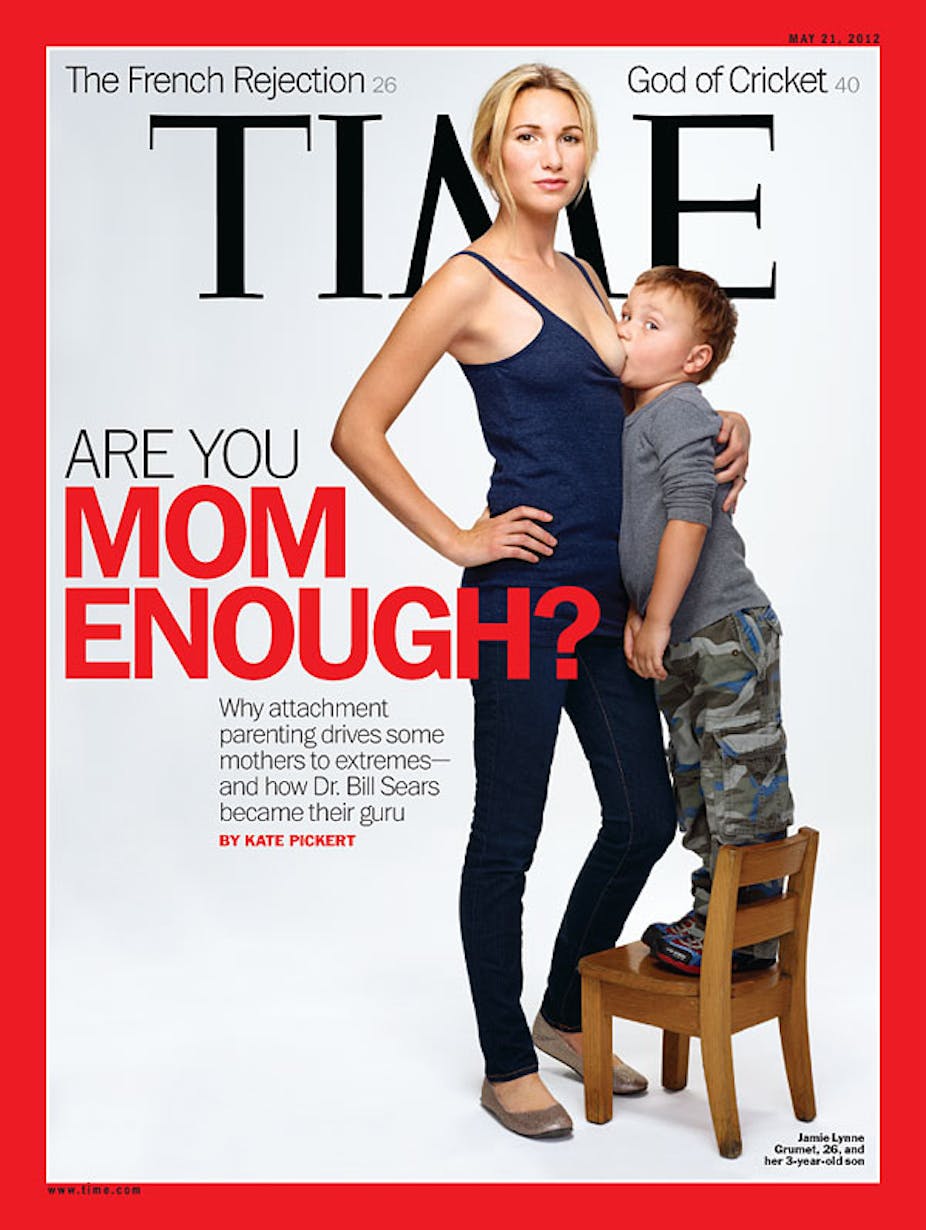
If Time magazine editors had set out to garner a huge amount of free publicity with their latest cover, they’ve achieved their aim. This week’s US edition featuring a photograph of a young, attractive mother breastfeeding a three-year-old child has provoked a high degree of media attention and fervid commentary on the internet, largely from other mothers.
The mother depicted on the cover, Jamie Lynne Grumet, became an instant celebrity, appearing on the US television show Today to defend her parenting practices.
Eroticism and breastfeeding
I trawled through the blogosphere for commentaries and responses to the magazine cover. Two issues were constantly raised. The first was the idea that Grumet was subjecting her son to future embarrassment and humiliation by allowing the image of him suckling at her breast to appear on the cover. People argued that this boy would live to regret his public appearance as a breastfeeding child.
Many of these comments displayed almost revulsion at the idea that a child would be able to remember breastfeeding and being in such regular close proximity to his mother’s breast. It was claimed that once he had grown older, this boy would find the idea that he had breastfed as a three-year-old child disgusting.
There are two major social beliefs underpinning these responses. One is that breastfeeding is appropriate only for tiny infants; for older children, it’s somehow unnatural or abnormal.
The second, related, belief is that breastfeeding older children has a sexual element. The idea that a boy might remember touching, viewing in close-up and suckling from his mother’s breast has erotic, incestuous overtones. So, it’s viewed with suspicion and even horror.
Grumet’s attractiveness, youth and dress contribute to this sexual element of the image. Described on one website as a “hot mom” and another as a “blonde bombshell”, she is wearing a blue singlet and tight black jeans and gazing directly at the camera. She conforms to conventional images of models appearing on magazine covers. The one major difference between the images is the little boy attached to her breast.
One might wonder whether the reaction would’ve been different if the mother shown had been older and less attractive, or if her child had been female rather than male.
“Are you Mom enough?”
The other issue that attracted much debate on online forums was the provocative headline splashed across the cover: “Are you Mom enough?”. This appeared in very bold red and large wording, followed by a subheading in smaller font, “Why attachment parenting drives some mothers to extremes – and how Dr. Bill Sears became their guru”.
If readers look inside the magazine to read the feature article, they find that this well-known American paediatrician and his ideas about attachment parenting is the main focus. There’s some reference to women who have taken up his advice and descriptions of them as perhaps being overly committed to the ideals of attachment parenting.
Some of these mothers are verging on “extreme” according to the article because they’re denying their own needs in favour of those of their children. Nonetheless, there’s reasonably considered discussion of the pros and cons of attachment parenting and the scientific evidence for it.
Despite this, the cover headline is almost a call to arms for mothers who support attachment parenting. It suggests a challenge to other mothers in a contest for who is the best, most devoted mother. By posing the question “Are you Mom enough?” and showing both Grumet and her son defiantly staring into the camera lens, the suggestion is that women who don’t breastfeed their children, or give up the practice while the child is still an infant, don’t measure up as good mothers. There’s an aggressive and competitive tone to these words and imagery.
These aspects of the cover provoked much ire online, as women claimed that whether or not they breastfed or continued to do so for a long time, they were still good mothers. Many commentators pointed out that Time magazine seemed attempting to deliberately be provocative and inflammatory by using both the image and the headline. It was seen as an effort to instigate another skirmish in the so-called “Mommy Wars”.
The commentary demonstrates that many mothers have become tired of being positioned by the media as being in opposition to other mothers, or having to constantly demonstrate their mothering credentials by conforming to one or another expert opinion on the best way to be a mother.
And poor Bill Sears must be frustrated that the main messages of the piece that was supposed to publicise his work on attachment parenting have been somewhat lost in noise of the furore over the cover image and headline.
Read more stories on Time’s controversial cover:
Time #1: What’s wrong with this picture?
Time #3: Why does it hurt to look at a woman breastfeeding?
What do you think of the image and the article? Leave your comments below