


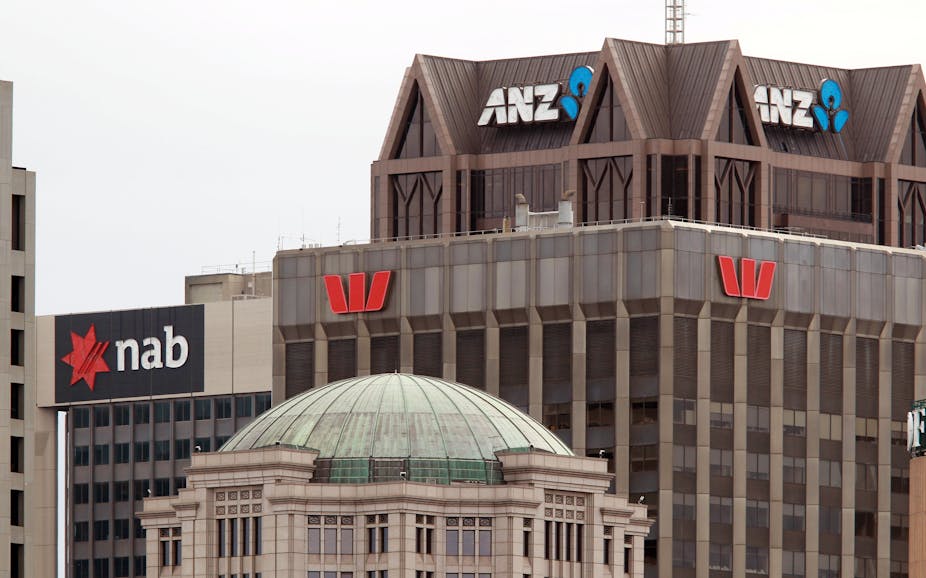
This week, the National Australia Bank published its 2012 annual report, confirming that its net profit for the year had fallen by about 21%, mainly from higher bad and doubtful debt charges.
Buried deep in the annual report on page 75 was an expense line item of $141 million related to “litigation expenses”. This not insubstantial amount had already been announced a few weeks prior as the result of the settlement of a long-running class action by investors, who claimed to have lost money on the bank’s exposure to “toxic” CDOs.
The class action arose from events that occurred at the height of the global financial crisis (GFC) when, in May 2008, NAB announced that they were taking a charge of $181 million against its exposure to CDOs, while assuring the market that their investment in these products was “very conservative”. However, just two months later, the bank announced that it was taking a further charge of $830 million against its CDO exposure as a result of a write-down of similar securities by Merrill Lynch. Investors who had believed NAB’s assurances were justifiably ropeable when NAB’s shares tanked on the day of the announcement.
While NAB struggled back from the GFC abyss, some of the aggrieved investors joined a class action, run by the legal firm of Maurice Blackburn. After two years of litigation, this culminated in this month’s settlement of some $115 million, inclusive of costs and interest.
As has become customary in such settlements, there was no admission of liability by NAB.
Announcing the terms of the settlement, NAB’s company secretary, Michaela Healey stated: “The settlement of the class action is a purely commercial decision made in the interests of our shareholders. We are pleased to put this matter behind us so that we can continue to focus on improving returns for our shareholders without the distraction and significant expense of a lengthy trial”.
But hold on — who is actually paying for the settlement? Shareholders. NAB is slugging one set of shareholders this year for (allegedly) misleading another set of shareholders in the past.
But it is not only shareholders being stiffed. Another line item in the annual report shows that NAB has claimed $40 million income tax benefit against “litigation expense”, which, of course, ends up being picked up by the taxpayer.
The only people in the debacle who appear not to have felt the pain — aside from the lawyers — are the 11 non-executive directors of NAB, who collectively pulled down some $4 million in 2012, up slightly on 2011. Note that most of these directors were in place prior to the events that precipitated the class action and thus would (and should) be expected to bear some of the responsibility for the shareholder (and taxpayer) losses. But “no admission of liability” lets them off the hook, even though in the 2011 annual report the Board restated that the proceeding was being “vigorously defended”.
So what caused the climb down?
In its 2012 performance review, the bank lauded its “reputation-building initiatives, like doing more for our customers, investing in our own people and addressing our broader role in society”. Being found culpable in a class action for “misleading and deceptive conduct and [breaking] continuous disclosure provisions of the Corporations Act” would blow a hole in such fine sentiments. Best to settle and move on — especially if no one takes the blame and someone else is paying for it.
In a similar case, beset by a number of class actions following the failure of Storm Financial, Commonwealth Bank was forced to settle with ASIC for a sum totalling $270 million to its customers who had lost in Storm’s collapse. Again there was no admission of liability by Commbank. Nor, as it turns out, did the Commbank Board take any responsibility. In the mean time, other class actions related to Storm continue for Commbank.
ANZ has also being caught in a similar no-win situation with the collapse of Opes Prime in 2008. Having successfully asserted their rights, in court, to sell securities used as collateral to loans to Opes Prime, ANZ were nonetheless targeted by Opes investors as heartless bankers for selling their nest eggs (which they had foolishly handed over to Opes in the first place) over their heads. A class action, run by Slater & Gordon, resulted in mediation by the corporate regulator ASIC, which eventually involved a settlement in which ANZ and Merrill Lynch paid around $253 million to Opes investors.
To recap: ANZ did nothing wrong in law, but being the last (and largest) man standing when Opes collapsed was fair game for litigation. ANZ settled and ANZ shareholders paid. No action was taken against the ANZ Board or management.
In each case, the banks have fallen foul of what the successful lawyer in the NAB case, Mr Jacob Varghese, called the “mechanism of private enforcement”. In other circumstances, such a mechanism would be called ‘vigilantism’.
Australia is not the only place that NAB is having legal problems. In its annual report, the bank foreshadows a payment of some $168 million for claims against its UK subsidiary, Clydesdale Bank. This provision is part of an industry settlement in the so-called PPI (Payment Protection Insurance) scandal. It is interesting to note that in the last month, some UK banks have increased their estimates of their exposures to PPI, with the overall cost to the industry currently running at over $15 billion dollars.
One of the reasons for the seemingly out-of-control increase in the costs of the PPI debacle is the emergence of so-called claims management companies (CMCs). For a fee, these companies will do all of the paperwork for a PPI claimant and deduct a fee from any claim settled by a bank, before paying the claimant the remainder. Initially seen as white knights fighting the good fight for wronged consumers, these firms have become a self-sustaining industry, using the the internet to trawl for potential claimants.
The genie is out of the bottle. The litigation and claims infrastructure has been built and is just waiting for the next big thing. Having already spent considerable money on building the necessary legal and technical infrastructures, the cost to litigation firms of promoting new scandals is greatly reduced.
The arc of these scandals is as follows: (1) a financial company is perceived to wrong a customer; (2) the customer complains to the company and then to the Financial Ombudsman; (3) when sufficient customers make the same complaint and the issue is not addressed, they approach a specialist litigator; (4) the litigation firm convinces several hundred of the aggrieved to join a class action; (5) if not settled immediately, the action goes to court and the meter is running; (6) as each court appearance is scheduled, the dirty linen is washed in public, getting dirtier by the month; (7) all the while, the defendants in the action make loud noises about vigorously defending the case; (8) at some point, the clamour goes too loud; and (9) the defendant settles, while never admitting liability.
NAB reports just such an action “in relation to the payment of exception fees”, which appears to be at stage six in the arc above. We await the remaining stages, which, if past experience is anything to go by, will take two or three years to play out, all the while racking up costs for shareholders (and probably taxpayers).
While bank bashing can be a very satisfying blood sport, rampant litigation is not a very sensible way to run a financial system. Such legal actions inevitable push up costs for everyone in the industry, as potential legal settlements have to be factored into product prices. Out of court settlements also promote ‘moral hazard’ as bankers feel they can make risky decisions, safe in the knowledge that the shareholder (and/or taxpayer) will pick up the tab if it goes wrong. And such litigation, whether justified or not, also generates uncertainty as to the viability of legal contracts. It is all very well to have a watertight legal contract, but if that contract can be overridden by an out-of-court settlement, its effectiveness is debatable.
Such legal uncertainty, if it were to become prevalent throughout the industry, may even undermine Australia’s hopes to be a regional financial hub in the Asian Century. Perhaps it is time for the peak regulator, the Council of Financial Regulators, to address this potentially significant systemic risk.