Vaccination is one of the most important preventative measures against serious illness, but its very success may be working against it.
With parents no longer having the experience of the devastating diseases it prevents, fear of vaccines has crept in, aided and abetted by groups that exaggerate and distort their possible harms. Vaccination rates are falling, and the scientific and medical communities are alarmed about the growing possibility of devastating epidemics of preventable diseases.
One contributor to the fear of vaccines is the notion that they contain toxins. But “it’s the dose that makes the poison” and it’s distressing that people’s fears are beings stoked by a lack of basic understanding of chemistry and toxicology. So let’s have a close look at some of the “bad boys” the anti-vaxxers love to hate.
Formaldehyde
Formaldehyde has many uses – you may be familiar with its use in biology to preserve tissue. Formaldehyde is used in vaccine preparation to kill viruses or inactivate the proteins used. And traces of it can be found in some vaccines.
Now, while drinking embalming fluid concentrations of formaldehyde is seriously bad for you, the amount present in vaccines never exceed 0.1 milligrams (mg) per dose, and are typically much less than that. To put this in perspective, every time you eat an apple, you are eating between one and six milligram of formaldehyde. Yes, there is formaldehyde in fruit – plants make it as part of their normal metabolism (pears are by far the worst).

You also make formaldehyde as part of your normal metabolism. It’s an essential part of the synthesis of amino acids and some of the components of DNA. At any given time, you have something like 2.5 mg of formaldehyde in every litre of your blood. This formaldehyde is being continuously generated as the enzyme formaldehyde dehydrogenase rapidly breaks it down.
A typical two-month-old child has around 1.1 mg of formaldehyde in its body from normal metabolism, ten times more than the maximum possible dose she could get from vaccines. And less than what she would ingest from mashed apples.
Thiomersal
Thiomersal is the preservative ethylmercurithiosalicylate, which breaks down to produce ethyl mercury. Mercury is famously toxic, we only need to remember the disaster at Minamata (methyl mercury) and Lewis Carroll’s Mad Hatter (mercury vapour) to realise that it’s a potent neurotoxin.
But most of us of a certain age remember Mercurochrome, which was used as an antiseptic on cuts and grazes, turning our knees and elbows red – mercury is also a powerful antibacterial.
Multi-use vials are used during epidemics when there’s a need to produce a lot of vaccine in a hurry and you can’t afford to make it in single-use vials. When this happens, we need some way to prevent bacterial contamination and thiomersal is one such antibacterial.

Most Australian vaccines don’t contain thiomersal because we don’t use multi-use vials as much as other countries. The mumps, measles and rubella vaccine never contained thiomersal, the diphtheria/pertussis/tetanus acelluar vaccine in use since 1997 also doesn’t contain thiomersal. Neither do Australian influenza vaccines.
Indeed, the only thiomersal containing vaccines in Australia are for Japanese encephalitis and Q-fever. The amount of mercury you would get from one of these vaccines is less than what you would get from eating a can of tuna (around 85 micrograms of mercury for a standard serve). And the can of tuna would have the mercury in the form of methyl mercury, which is expelled from our bodies much more slowly (half-life of about 50 days) than the ethyl mercury from thiomersal (half-life of about seven days).
Aluminium
Most vaccines contain materials to enhance the immune response to them and aluminium salts are one such material. Aluminium is the third most common element in the earth’s crust, and it can be toxic. People on dialysis who have been exposed to higher than normal aluminium levels in their dialysis fluid over a long period of time show a range of adverse effects, including damage to the brain and nervous system.
But these levels (and how long people are exposed to them) are considerably larger than the levels we’re exposed to in vaccines. Indeed, the amount of aluminium we are exposed to in our food and drink normally is much larger than any vaccine dose.

You may be surprised to know that human breast milk has 40 micrograms of aluminium per litre, and infant formulas contain around 225 micrograms of aluminium per litre. Aluminium is also rapidly excreted – half of any dose of aluminium will be expelled from the body within 24 hours.
Guidelines for aluminium exposure (with a 30-fold safety factor built in) are for aluminium exposure to be less than two milligrams per kilogram of body weight per day. That means someone who weighs 80 kilograms could ingest 100 milligrams of aluminium in a day and remain safe.
All vaccines have less than one milligram of aluminium per dose, and most are below half of that. So exposure to aluminium through vaccines is negligible, and well below the already low risk threshold.
Antibiotics
Many vaccines are produced in tissue culture, which requires antibiotics to keep them sterile. The purification process used to produce the final vaccine can’t remove 100% of all the antibiotics, so there’s a residue.
There’s quite a lot of hyperventilating about antibiotics in vaccines. Some antibiotics (such as penicillin) can produce hypersensitivity reactions, but such antibiotics are not used in vaccine production. Those typically used include neomycin, streptomycin and polymyxin B. Of these, only neomycin is present in detectable quantities, typically less than 0.025 mg per dose.

Neomycin can cause adverse events at doses of three grams per day or more. This is over 2,000 times the amount in a typical vaccine dose, which is clearly well below the threshold for adverse events in humans. Antibiotic resistance also worries some people, but for bacteria to become resistant to an antibiotic, the antibiotic has to kill off some bacteria and let some resistant bacteria survive. The dose of neomycin in a standard shot is also well below that required to produce resistance, and we are generally not giving these vaccines to people with bacterial infections in the first place.
Don’t panic
This is not an exhaustive list but it covers most of the toxins that anti-vaxxers are most concerned about. The remainder of the so-called toxins in vaccines bring up exactly the same issues as highlighted here. The presence of low levels of one of the most common amino acids in our body is apparently now a worry, and I will pass lightly over claims that sodium chloride (common salt) is a toxin in vaccines. There’s really no reason that these compounds should keep people from getting vaccinated.
Vaccination has been enormously successful in reducing or banishing diseases that used to plague us and our children. It would be sad if these diseases came back because people didn’t understand the role of dose in the adverse effects of chemicals.
[The author has made a PDF version of this article available for download]
Sue Ieraci
Public hospital clinician
Great article, thanks Ian.
It's important to understand the difference between an element and a compound as well as the difference that concentration makes.
Water contains both hydrogen and oxygen, but it is neither hydrogen not oxygen. Similarly, ethylmercury is not the same as elemental mercury. Even the form matters - mercury in a thermometer is not absorbed - it passes through the gut.
In terms of concentration, we know that potassium is essential to life, and has a higher concentration inside cells than in the serum. A very high potassium level, however, is toxic. Should we say that bananas are toxic because they contain potassium?
There is no conspiracy to poison children. Paediatricians, early childhood nurses and neonatal ICU clinicians promote vaccination - why would they be motivated to cause harm to the very children they dedicate their lives to helping?
Joel Rudd
HR Consultant
Agree about the article Sue, well written by Ian.
If I can answer your last sentence, it would be predict that the likely response would involve the big pharma throw away lines, etc. Preferably the alternatives should contain words such as natural, organic, holistic or even quantum. It is nonetheless a good question to ask because whilst it won't change entrenched views, genuine, but poorly informed but people are not likely to go down conspiracy routes after any kind of thoughtful consideration.
Also, if the doses of these concerning ingredients are so low as to be imperceptible, surely Homeopaths will be falling over themselves to point out how powerful their effects must be...? Clearly I have poisoned my own daughter by taking her along to our local vaccination dates!
Sean Lamb
Science Denier
I am sure Dr Musgrave is correct, but aluminum is added for a specific reason, to stimulate the immune system, so at very least is must produce significant local elevations of aluminum levels, otherwise the immune system would not be stimulated. I immunised a rabbit once and because the protein wouldn't fold properly the post-doc I was working with just told me to cut out a band from a polyacrylamide gel - don't worry about the polyacrylamide, he said, it will act as a good adjuvant! Poor bunny.
As anyone looked specifically for any long-term effects on immune system function through such adjuvants in repeated immunisations?
Craig Morton
Biomedical Research Scientist
Yes Sean they have - there is even evidence that a very small population of individuals with a particular MHC complex genotype (HLA-DRB1*01) are susceptible to an aluminium adjuvant-triggered immune reaction called Macrophagic myofaciitis.
http://www.ncbi.nlm.nih.gov/pubmed/20882368
For the vast majority of us, however, aluminium-based adjuvants are so well established as cheap, safe and effective that getting new adjuvants approved is very, very difficult. See: http://www.ncbi.nlm.nih.gov/pubmed/21506649 for example.
Sue Ieraci
Public hospital clinician
The real advantage of the use of a tiny quantity of aluminium is that it minimises the amount of bacterial or viral antigen that is required, thereby minimising the inflammatory reaction. Aluminium adjuvants have been used for almost ninety years, and have been refined over time.
Of course, the vaccine already has a much smaller dose of the antigen than having an actual infection from that micro-organism.
Here is a paper that outlines the role and safety of aluminium adjuvants:
Read morehttp://www…
Ian Musgrave
Senior lecturer in Pharmacology at University of Adelaide
Err, the effect of aluminium is complex, and related to how it interacts with the immune cells and the proteins in the vaccine. Aluminium oxide is not generally, as Craig points out, associated with immune reactions of itself. This is well studied (and it's not what the anti-vaccinationists are talking about generally anyway)
Sean Lamb
Science Denier
Actually the review that Dr Ieraci linked to suggests you are wrong:
Read more"Although traditionally thought to function primarily
by forming a long-lasting depot for antigen and by promoting
their uptake by antigen-presenting cells (APCs), it is now clear
that innate immune stimulation plays a primary role in the
adjuvant activity of alum (Lambrecht et al., 2009; Marrack
et al., 2009)."
Although, it is not the exactly the potential issue I had in mind, I would feel that using commonly occurring ligands…
Ian Musgrave
Senior lecturer in Pharmacology at University of Adelaide
Err, Sean, those reviews cover the concept that I was summarising, I wan't talking about the depot effect at all.
For more information about the (non) association between aluminium and Alzheimer's, see my forthcoming article for the Conversation.
And pattern recognition receptors are useless for adaptive immunity.
Sean Lamb
Science Denier
Errr, Dr Musgrave, I will give you the benefit of the doubt and assume you didn't mean to say that aluminum plays no role in the immune response - in point of fact the comment in reply was scientific gibberish so you could have meant anything or, more likely, nothing.
Read moreBut just for the record, I will point out that most people would take this: "Aluminium oxide is not generally, as Craig points out, associated with immune reactions of itself. "
and this: " it is now clear that innate immune stimulation…
Ian Musgrave
Senior lecturer in Pharmacology at University of Adelaide
Sean, don't presume to tell an Alzhemier's researcher what is or is not a matter of debate amongst Alzheimer's specialists (roll on DANDIS 2014!!)
Sean Lamb
Science Denier
I wouldn't presume at all. I would just refer you to the Journal of Alzheimer's Disease, Volume 29, Number 2 / 2012, pages 255-273. Look, it isn't hard to look up your publication record.
And it is not hard to plug Alzheimer's and aluminum into pubmed. You are welcome to give your view and your assessment of where the preponderance of the evidence points. But I can find half a dozen papers published this year alone which argue the opposite.
http://www.ncbi.nlm.nih.gov/pubmed/23103708
"CONCLUSIONS:
The specific aluminum content of ferritin seems to be related to different disease stages of Alzheimer's disease. This result confirms the hypothesis of aluminum as a possible factor inducing the Alzheimer's disease and opens the ways to possible new diagnostic tests."
Believe me, if you want to suggest that in the medical literature these days any old rubbish can get published, you won't get any argument from me. All I am saying is it is still an active hypothesis.
Ian Musgrave
Senior lecturer in Pharmacology at University of Adelaide
Sean, it's not hard to plug in amyloid, tau, oxidative stress, and metabolic syndrome into pub med and tell the difference between active and productive research areas and moribund ones.
To bring this back to the topic of the article, one of the issues with topics such as vaccination is the "university of Google" effect, where people can bring up lots of results in searches, but lack the context or background to interpret them (aluminium in dialysis fluid vs aluminium in vaccines being an example…
Read moreSue Ieraci
Public hospital clinician
Sean Lamb - I don't know how familiar you are with critical review of the medical or scientific literature, but the way to evaluate the significance of an article is to obtain the full text, and analyse it systematically.
You have cited a review paper from the Journal of Alzheimers Disease. Can you talk us through what they did and what they found?
Sean Lamb
Science Denier
I have to say I was a bit shocked by what I have learned here and thought a rebuke to Professor Walton might be in order
j.walton@unsw.edu.au
Dear Prof Walton,
There is an Alzheimer Researcher by the name of Dr Musgrave of the University of Adelaide who appears to be suggesting that your Alzheimer research is derived from the University of Google.
See his comments on this article:
[link]
I would like to remind you that your salary is largely derived from the taxpayers of this great nation and ask you to desist from pushing moribund areas of research that you lack the context and background to interpret.
Thanking you in advance for your co-operation in this matter
Sean.
Ian Musgrave
Senior lecturer in Pharmacology at University of Adelaide
Sean said: "... thought a rebuke to Professor Walton might be in order"
Sean, learn to read please. If you think a comment about people who uncritically utilise the internet for their health information in the absence of of critical context applies to Professor Walton, then you have a serious problem with understanding the written word.
Sean Lamb
Science Denier
Oh, well this really confuses the matter.
I have already said I don't have an opinion on a link between Alzheimer's and aluminum, but simply observed that it was still an active hypothesis.
It is true, I don't have the depth or context to determine whether Professor Walton is a nutter or not. Initially I thought that as a member of the UNSW medical faculty and publishing in the Journal of Alzheimer's Disease she must be presenting a hypothesis that still was seen as having some merit in parts of the research community. Then I simply assumed from your assurances - as an Alzheimer researcher - that it didn't, that she must be a nutter.
Obviously, as Dr Ieraci gently hints, I am not familiar with critical reviews of the medical or scientific literature, nor how to evaluate the significance of an article by obtaining the full text, and analyzing it systematically.
Ian Musgrave
Senior lecturer in Pharmacology at University of Adelaide
Sean wrote: "Then I simply assumed from your assurances - as an Alzheimer researcher - that it didn't, that she must be a nutter."
No Sean, Dr. Walton is not the nutter here.
Sean Lamb
Science Denier
Just anyone who takes her seriously?
Craig Morton
Biomedical Research Scientist
Surely Ian the most abundant element in the earth's crust is Oxygen, followed by Silicon?
Aluminium is the most abundant *metallic* element...
OK, so I'm a pedant. :)
Otherwise, great article!
Ian Musgrave
Senior lecturer in Pharmacology at University of Adelaide
[puzzled expression] I'm sure I wrote "third" in there. You're right, it's the third most abundant element in the crust after silicon and oxygen, and the most abundant metal.
Mark Amey
logged in via Facebook
I thought that iron was the most abundant, but most of that is in the earth's interior, being protected by our reptilian overlords.
Edward John Fearn
Edward John Fearn is a Friend of The Conversation.
Hypnotherapist and Naturopath
One of the clearest and most readable explanations I have seen on the topic, (and I love the bar graphs simple and straight to the point). Now if we can only get this article on the first page of Google…….
Mark Amey
logged in via Facebook
"Not another bloody immunisation article'.
Only joking, succinct, easy to understand, some folk just need to read it (but would rather have it chewed up and spat into their mouths!).
Kate Rowan-Robinson
Kate Rowan-Robinson is a Friend of The Conversation.
Registered Nurse/Sexology Student
Great succinct article. Definitely one to print off and keep around the clinic. Thank you.
Sivan Elishav
PhD student- anatomy and developmental biology
Fantastic article! very well written. Thank you
Judy Nicol
logged in via Facebook
Interesting article and might reassure some of those families with children with autism who are very convinced that vaccines have harmed their children as I read in many of the Facebook autism support groups. One interesting paper I saw recently was that in Cuba there is very low autism rates compared to many other countries. When researchers studied the vaccination rates they found them to be very high 95% , but they do not have access to paracetamol because of the embargo from the USA , and since most parents use that either before or after vaccines there is now some thought that may be the problem. Autism has increased hugely since the 1970's, at the same time as the number of multiple vaccinations so it is no wonder parents are concerned that there is a link. More research needs to be done rather than dismissing parents who say it was after their child had a vaccination that they started to regress, researchers and provaccinating doctors need to listen to their concerns.
Ian Musgrave
Senior lecturer in Pharmacology at University of Adelaide
The "autism epidemic" is largely (but not entirely) one of diagnostic substitution see below for a reasonably straightforward account
http://www.sciencebasedmedicine.org/index.php/autism-prevalence-now-estimated-to-be-one-in-88-and-the-antivaccine-movement-goes-wild/
Sue Ieraci
Public hospital clinician
Judy Nichol - I don't think autism researchers have been ignoring the concerns of parents. On the contrary, the now-discredited Wakefield paper, which only examined twelve children (who were referred because their parents had contacted lawyers about suing), led to a huge diversion of time and resources looking for a relationship between vaccination and autism. It wasn't found.
Now, the issue is about anti-vaxers accepting the evidence and allowing researchers, doctors and parents to collaborate in other ways to help children with autism.
Autistic children and their parents have been used by the anti-vaccination movement to promote a misguided cause. So many environmental things have changed since the 1970's - from the use of technology to older parenthood. There appear to be also both genetic and pre-natal factors. It's the anti-vaxers who need to listen, and move on.
Mike Mayfield
Avid Science Nut
Yes Ian, we have formaldehyde naturally in our blood at all times, and it's present in many foods, and it's always present in the air we breath, and what's already in our blood is there in greater concentrations than you can get from a vaccine, and we have an enzyme whose sole purpose in life is to break it down.
But no matter how many times I explain this to an anti-vaxer, nor how many ways I re-explain it and simplify it, I still get:
1) Stone cold silence, followed by
2) "Well formaldehyde is TOXIC didn't you know?"
The common trait among hard-core anti-vaxers like Meryl Dorey and her followers is that they refuse to even *attempt* to understand basic logic. What to do?
Mark Amey
logged in via Facebook
I've had similar conversations ( I work in a Neonatal Intensive Care Unit). Don't get me started on Mercury, I even get the vials, and manufacturer's pamphlets out to read, but, no, 'there's a whole lotta Big Pharma stuff added'.
Having said that, i think Ian's article would be terrific to print out to give to parents.
Linda Tock
logged in via Facebook
I've had the same problem, Mike.
Usually the AV line I get is:
1) There's a difference between the 'natural' formaldehyde we make, and the 'synthetic' or 'chemical' formaldehyde in a vaccine.
or
2) "Just because I make it doesn't mean I need more of it!"
Even after mentioning that the average half-life of formaldehyde in the body is somewhere around 2 minutes.
/facepalm
Megan Barnes
logged in via Facebook
Ian, this is an exceptionally useful and clear article, Thank-you.
jerry sprom
logged in via email @gmail.com
Well written and informative. Thanks Ian
Neville Mattick
Grazier: Biodiversity is the key.
Great article, I enjoyed learning from it entirely - thank you!
Colin Jenkins
Software
Hi Ian. Very clear article and I will be using it when chatting to anti-vaxers. But I can predict their respopnse: we dont inject tuna etc etc. Is there any chance you could address that as a footnote or a comment - i.e. that the same/similar immune responses are still involved...?
Ian Musgrave
Senior lecturer in Pharmacology at University of Adelaide
That's a very good idea, the main article is overlong as it is (I routinely get in trouble for being too long), but a supplement is a good idea. I'm at a conference at the moment, but I'll write something as soon as possible.
Sue Ieraci
Public hospital clinician
Good point, Colin.
Some of the old anti-vaxer canards include:
- "Injected straight into the blood stream" (they aren't)
- Bypass the mucosal defense system (so do infections - that's how they get established)
Some facts on Ian's common-sense style would be good. Won't convert the nutters, but will help other readers understand the errors in their arguments.
Colin Jenkins
Software
Awesome. I look forward to reading it. Thanks for your clear articles. This is a great platform..
Joli Bastin
logged in via Facebook
Can I be notified somehow of when that next article will be posted? Because that was exactly the point I was going to make that anti-vaxxers continuously make.
Thanks.
Sue Ieraci
Public hospital clinician
Many anti-vaxers like to argue that "a lot" of mainstream medical people are concerned about vaccine constituents as well.
If that's the case, where are they?
If there are any of you reading, could you come in and explain why you disagree with Ian Musgrave's assessment?
Amanda Murray
Mum
The discussion of the adjuvant (aluminium) and the reactions of those with a particular genotype got me thinking that perhaps gene sequencing could be done at the same time as Guthrie tests (if they are still done – I’m a long way from breeding). This could be linked to our medicare numbers, so that those with a particular genotype that is known to react with aluminium can be easily identified, together with the minute percentage of people who may react adversely to vaccines, surely this would promote…
Read moreMark Amey
logged in via Facebook
Yes, Amanda, the Newborn Screening Test is still done in Australia. The set of disorders screened has been expanded considerably.
Two problems with gene sequencing. One is. who's going to pay for it? I NSW we are struggling to try to get Congenital Adrenal Hyperplasia added to the screen. This, I believe, will be five to ten dollars per card. No one wants to pay this small amount (100,00 deliveries per year in NSW, adds half to one million to the health budget). Gene sequencing will cost a hell of a lot more...for what, something that is not a disease,i.e. sensitivity to vaccines?
The other problem is the tinfoil hat brigade who believe that the NBST card goes to a database owned by the police, AFP or CIA...you really think that gene sequencing will allay their fears?
Amanda Murray
Mum
Hello Mark, thanks for the reply... I know as a mum I would be willing to pay anything to ensure the best opportunity healthwise for my children. It seems a small amount of money to be denied access to a fuller picture of neonatal health knowledge..
I personally paid for additional vaccinations (for hepatitis) when my kids were growing up, that are now available as part of the schedule. Perhaps we should hit up mums at antenatal classes.. What is even $20 out of a baby bonus? I'd pay that for peace of mind, and I'm sure many soon to be mums would too!
There is not much you can do about the tin-foil hat brigade unfortunately, apart from continued education, but why should a few nutters stop the rest of us from moving forward?
P.S. To Ian, thanks very much for a fantasic article, I have passed a link to the article on to my daughters to do all those magical things they can do with their computers to spread the word.
Mark Amey
logged in via Facebook
You're welcome, Amanda. I know that many would be happy to pay a one-off fee to screen for all sorts of things, but the bottom line for screening tests for inborn errors of metabolism, is that they are detectable by day three, that they are treatable, and that non-treatment will result in significant morbidity, and/or mortality in the sufferer. The test also should be cheap!
Unfortunately gene sequencing doesn't (yet) meet these criteria.
Amanda Murray
Mum
Oh well, I am daydreaming then, bugger!!
Perhaps when my grandies are having children the kinks will be ironed out and the costs won't be prohibitive and comprehensive screening will be run of the mill.. The earlier the detection of possible problems and their treatment would surely be cheaper than after symptoms present - emotionally and finacially!
Thanks again, Happy Saturday.
Ian Musgrave
Senior lecturer in Pharmacology at University of Adelaide
The issue is we don't know what genes are associated with these kinds of adverse reactions. If we knew this we wouldn't lose as much money developing drugs (this is an area of significant research with very slow progress unfortunately, biology is complex).
Unlike many drugs, the adverse reactions to vaccines (few that they are), are not linked to mutations in metabolic enzymes. There's a whole slew of reasons why these reactions occur, and the genetic basis of many of these are unclear.
Amanda Murray
Mum
Thanks Ian, for your explanation.
I shared the article and comments with my beloved (hubby) his reply was as always a joke, maybe not worth sharing, but I will anyway!
What do mums and researchers have in common? - Their work is never done!
I didn't say it was a good one! At least mums get one celebratory day a year.. So here's to all those hard working unsung heros, who work so diligently to improve all our lives!
Thank you and Huzzah.
Sean Lamb
Science Denier
Not stupid at all, Amanda, a little bit futuristic, but maybe less than 20 years in the future. A full genome scan of major variations is less than $300, while a whole genome sequencing is supposed to be coming down to $1000.
I have come to the opinion that aluminum adjuvants do potentially represent a problem and I haven't seen any appropriate studies that have addressed these issues.
Read moreDr Musgrave suggests that there can't be a problem because the amount introduced is similar to the levels…
Amanda Murray
Mum
Thank you Sean, it certainly is a complex issue. Unfortunately I don’t have any sort of qualification that permits me to have an understanding of the peculiarities of all manner of scientific matters. I am in the same boat as the majority, dependant upon the ‘boffins’ interpretations of the data, it is probably possible that I could gain an understanding of all manner of exciting advances in our ever accumulating knowledge if I had a spare decade or two and no children. It is an unreal expectation…
Read moreLisa Hodgson
Director
Hi Professor Ian,
You also said “it’s the dose that makes the poison” in a conversation about fluoridation of our water and how that dose was determined. You never got back to me on my argument that F dosage was, at best haphazard and unscientific?
On topic, after having read lots of “anti-vaxxer” articles, you make the *toxins in vaccines sound positively pleasant! I don’t pretend to be a chemist but as someone wanting to correct any errors in my thinking I am still not convinced these *toxins…
Read moreSue Ieraci
Public hospital clinician
"As someone allergic to bee stings, Formic acid seems to be equally (un)pleasant?"
Tip to Ms Hodgson: if you don't know the difference between bees and ants, it might be better to resist arguing toxicology with a pharmacologist.
Ian Musgrave
Senior lecturer in Pharmacology at University of Adelaide
[delurks from organising timetables]
Lets pretend you are allergic to formic acid, rather than bee venom (which has no formic acid). At any given moment your body has 2.5 mg of formaldehyde in every litre of your blood, due to **normal** metabolism. This is converted to formic acid. You are still alive, discuss.
[relurks to continue timetable organisation]
Lisa Hodgson
Director
Well thanks very much guys for engaging so pleasantly with me. I'll consider myself bullied away and not grace your positions on high ever again.
All the best.
Mark Amey
logged in via Facebook
Lisa, I'm sorry that you felt that you were 'bullied away', but, unfortunately, your arguments were not based on science, and failed to follow any logic. If this is bullying, then society is doomed!
John Cunningham
Orthopaedic spinal surgeon
Lisa I think you need to accept several things. Firstly, Wiki is not perfect. The statement, for example, "Formaldehyde, as well as its oligomers and hydrates, are rarely encountered in living organisms." is "sort of" correct. Maybe they mean it is metabolised so quickly, so it's rarely found in large quantities. It is definitely detectable though in human plasma.
Wiki also does not cover topics in as much detail as say, a textbook of human physiology. Many topics are "dumbed down" in Wiki and that's why there are sometimes peculiar and contradictory statements.
Sue Ieraci
Public hospital clinician
Having read the tone of Ms Hodgson's post, where she disagrees with Ian's article on the basis of her own reading of wikipedia, I suspect the "bullying" comment is a bit disingenuous. That comment above is dripping with derision for the expert author.
Having been caught out, it is preferable to accept information gracefully than to exit with a flounce.
Mark Amey
logged in via Facebook
I agree, Sue, there seem to be many drawn to TC who either, don't read the articles, or don't understand them, so seek information from lesser sources. I will be using this article as a resource for parents in my clinical practice, and will make it available for my students, as well.
Again, a very well written article.
Lisa Hodgson
Director
Ms Ieraci,
You couldn’t be more wrong. Your assessment of my *tone and that my comment was “dripping with derision” is completely unwarranted. I have asked several genuine questions - your interpretation is extremely unpleasant.
My previous unanswered questions to both you and Professor Ian were also a genuine attempt at conversation around the Fluoridation conversation. My comment about bullying was (IMHO) absolutely valid, but I wouldn’t expect you to recognize that. On several previous…
Read moreMark Amey
logged in via Facebook
Ms Hodgson, I'm not sure how this animal study relates to humans. In the study, mice, weighing 17 to 20 grams were given 20 micrograms of Hepatitis Vaccine, with an undisclosed amount of Aluminium Hydroxide (which is a bit sloppy, given that the researchers allege that the adjuvant may be responsible for the side effects). In other words it is around one microgram per gram of bodyweight. An adult receiving the Hep B Vax receives 10 micrograms per injection. Even if the adult weighed only 40 Kgs…
Read morePera Lozac
Heat management assistant
You start you article with the following claim:
"Vaccination is one of the most important preventative measures against serious illness..."
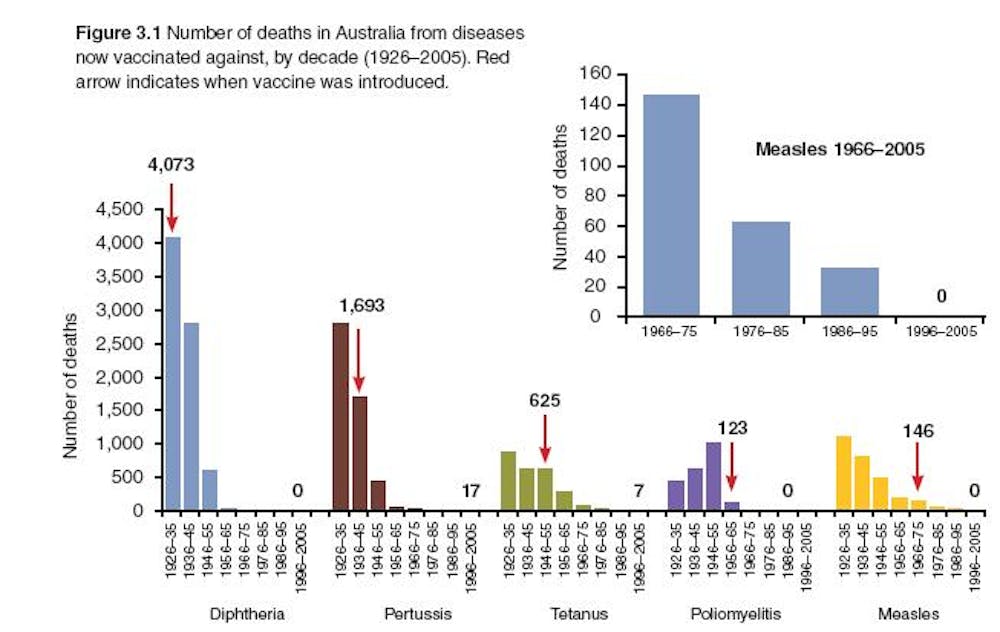
You also use the death number decline as the metrics to support this claim. It the vast majority of infectious diseases the decline in the number of deaths was naturally occurring years before the vaccination was introduced. The reasons being twofold: improvement of living conditions (clean water and food) and build up of natural immunity to these diseases. How can you prove that vaccination has any effect on the death numbers that? Your statistics is flawed because there are numerous examples where countries stopped with mandatory vaccination and the number of deaths continued to decline.
Can you comment on financial interests of pharmaceutical companies to maintain mandatory vaccination since it is bringing a stable and safe profit?
Mark Amey
logged in via Facebook
The decrease in death numbers, on the graphs in Dr Musgrove's article, particularly in tetanus, diphtheria and pertussis may well be linked to the use of penicillin for tetanus and erythromycin for diphtheria and pertussis. The graph for polio shows a steady increase prior to the introduction of polio vaccines. Deaths attributable to measles may be the only disease that was already on the decrease. It would be interesting to have some statistics available on the morbidity of these diseases during the last century, given that most of these illnesses have quite disabling sequellae for many of the survivors.
John Cunningham
Orthopaedic spinal surgeon
Pera,
You've merely repeated the same mantra that many anti-vax proponents recite at times like this, like it's the magic bullet to take down vaccination. Unfortunately, it fails on several levels. Firstly, it does not acknowledge that mortality rates are a poor measure of effectiveness on one intervention. As you allude to yourself, there are confounders to consider as well. However, to claim that you know of the two confounders that explain the death rate changes is spurious. Only two…
Read moreTrevor S
Jack of all Trades
Well done Sir, one of the better articles I have read here.
Michael Specter had an interesting TED Talk touching on this some time ago (Feb. 2010), I see his thread on TED is still attracting discussion :)
http://www.ted.com/talks/michael_specter_the_danger_of_science_denial.html
Mo Kendall
logged in via email @heartshapedhands.co.uk
Thank you for writing this article - and particularly for doing so in such an accessible way. My husband and I have found it really useful in making our decisions around our son's vaccinations. It is very important to us to make our own informed decisions about what goes into our and his bodies; some recommended medical and pharmaceutical interventions we have gratefully accepted, some we have declined.
Read moreA lot of what we have found written about vaccinations seems either very biased and poorly evidenced…
Sue Ieraci
Public hospital clinician
Mo Kendall - my comment using the term "nutters" refers to those who do not change their views despite the evidence - not to those who are thoughtful and are genuinely seeking information.
If you spend any time reading on dedicated anti-vaccination sites, you will find astounding conspiracy theories and allegations that no vaccine has ever prevented any disease, even that
"germ theory" is not valid. Perhaps I could have used a more eloquent term, but these people are "nutters".
You are right - most people who have not studied human physiology will not know about the concentration and effects of formaldehyde, and its natural presence. It makes sense to want to know more about why it is used.
What does not make sense, however, is to assume that the developers, regulators and prescribers of vaccines have somehow overlooked the safety concerns.
Elizabeth Hart
Independent Vaccine Investigator
Ian, it’s interesting to compare your cavalier attitude to vaccination with that of more thoughtful and cautious experts on vaccination in veterinary medicine.
Read moreFor many years there have been calls to reduce vaccination of companion animals because it may be harmful. For example, during a roundtable discussion between veterinary academics and a veterinary specialist regarding titre testing and vaccination(1) (report published in 2002), Professor Richard Ford said: “I believe that repeated injections…
Mike Mayfield
Avid Science Nut
My goodness Elizabeth! What juicy, succulent cherries you've picked there!
The whole roundtable discussion you cite is irrelevant to humans. The discussion centres on whether animals need annual vaccinations, and this is a very valid debate. There is absolutely no need to have this debate in relation to humans because they don't get annual vaccinations for multiple diseases. And why didn't you cite Ford's earlier statement that "all of the vaccines you've mentioned are excellent"? I think we all…
Read moreElizabeth Hart
Independent Vaccine Investigator
Mike Mayfield – are you characterising me as ‘anti-vaccination’? On what basis?
I’ll give Mike ‘a big red “F”’ for reading comprehension, like many of his ilk. Perhaps it’s a forlorn hope on my part, but it’s possible there may be some more astute people reading these discussion threads who understand where I’m coming from: http://theconversation.edu.au/profiles/elizabeth-hart-6978
Also on vaccination, I have recently forwarded an email to Sir Gus Nossal, Chair of the Australian Academy of Science’s Oversight Committee for “The Science of Immunisation: Questions and Answers” publication, enquiring if disclosure statements for members of The Science of Immunisation Working group, i.e. detailing any possible conflicts of interest, are publicly available on the Australian Academy of Science website. My email to Sir Gus Nossal can be accessed via this link: http://bit.ly/U3ygHo
Mike Mayfield
Avid Science Nut
You can colour yourself whatever shade you like, Elizabeth.
You cherry-picked certain selected quotes.
The cherry-picking gave a misleading impression that the views being presented in the discussion on canine vaccines were very vaccination-negative. A read of your references shows this is in fact not the case at all.
Why did you do this? Any particular reason?
Elizabeth Hart
Independent Vaccine Investigator
Mike, for more background on my position on human and companion animal vaccination, refer to my website “Over-vaccination – Challenging Big Pharma’s lucrative over-vaccination of people and animals”: http://over-vaccination.net/
Read moreMy website includes webpages on:
- Over-vaccination – a multi-billion dollar market;
- controversial Human Papillomavirus (HPV) vaccination;
- the arbitrary Measles/Mumps/Rubella (MMR) second ‘booster’ dose;
- annual flu vaccination and the flu industry;
- pertussis…
Kate Squires
logged in via Facebook
Your website would strongly indicate that you are anti vaccine.
There is a strong rationale for the second MMR dose, mainly that one dose was not enough to confer strong herd immunity. A second dose has resulted in nearly two decades of lowered rates of measles, to the point where Australia was declared endemic measles free in 2005, due to a total of 10 cases of measles. This is down from 10,000 cases of measles in 1993/1994, shortly before the second dose was recommended.