


Some natural phenomena are so familiar to us that they feature in our lives and culture, yet we know precious little about them. Sometimes we don’t even know how little we know.
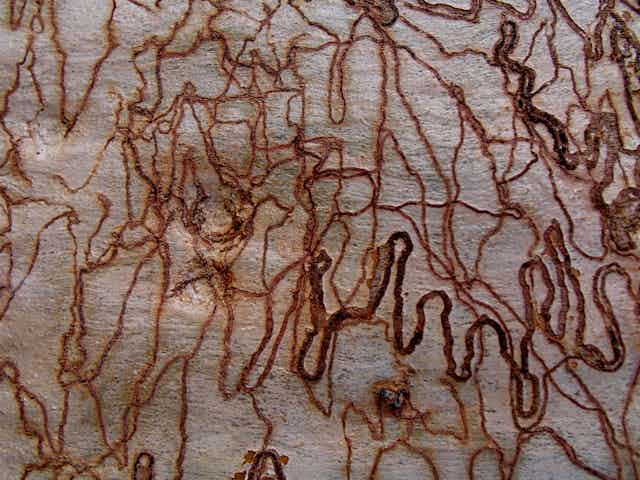
Take the subject of our most recent research: scribbly gum moths. The “scribbles” on the scribbly gums are not just a well known feature of smooth-barked eucalypt trees in southeastern Australia, they are considered an Australian icon.
The author of the Snugglepot and Cuddlepie books, May Gibbs, made them a feature of the gumnut babies’ world, and the great Australian poet Judith Wright cemented their place in literary culture with her 1955 poem Scribbly-Gum. Max Whitten has detailed the contribution of eucalypt scribbles to Australian culture in his article in the journal Meanjin.
But for all the inspiration they have provided, we had no idea of the biology behind the complex scribbles.
Originally thought to be the work of beetle larvae, it was recognized in 1934 that a moth larva was responsible when the scribbly gum moth from a snow gum, Ogmograptis scribula, was described.

Ogmograptis did not seem to fit into any Lepidoptera family and its position remained so enigmatic that it was left out of the authoritative 1990 book Moths of Australia.
Our study, published in Invertebrate Systematics, was intended to resolve the life history behind the scribbles, but it revealed much more. It showed that Ogmograptis comprises many species in three groups, with the biology known only for those making scribbles on smooth-barked eucalypts. We described 11 new species.
Second, we discovered a hitherto unknown insect/plant interaction. Third, the larva of Ogmograptis provided unique characters to assign it to the Bucculatricidae and to expand and redefine this enigmatic family. Fourth, we demonstrated that Ogmograptis is part of a southern group of Bucculatricidae once living on the supercontinent Gondwana and feeding on southern plant families.
So how are the scribbles made? Moth larvae bore a meandering tunnel through the eucalypt tree’s bark at the level of the future cork cambium, a growth layer within the bark. First it burrows in long irregular loops and later in a more regular zigzag which is doubled up after a narrow turning loop.
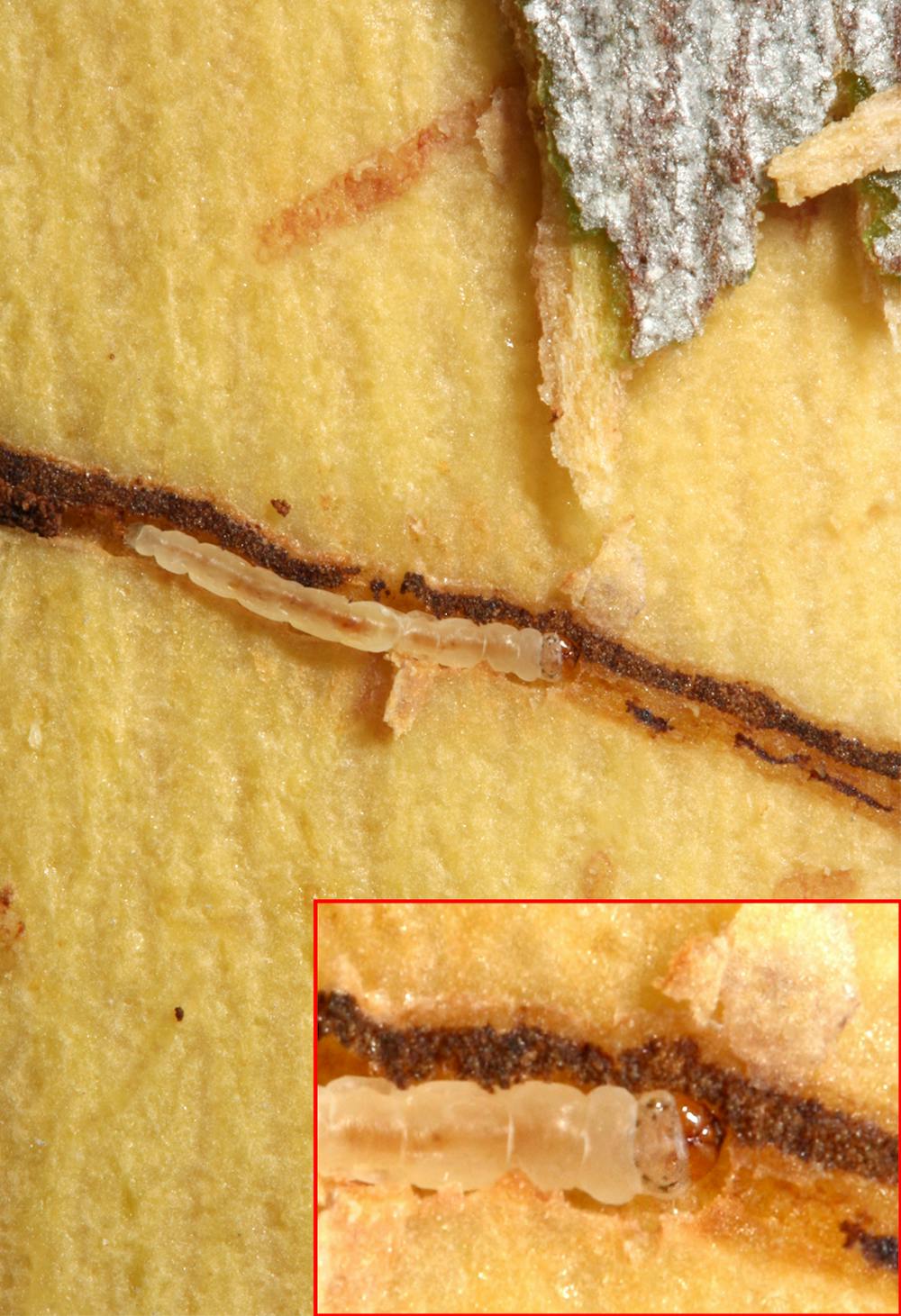
When the cork cambium starts to produce cork to shed the outer bark it produces scar tissue in response to the feeding of the caterpillar, filling the doubled part of the larval tunnel with highly nutritious, thin-walled cells. These replacement cells are ideal food for the caterpillar which moults into the final larval stage with legs, turns around and eats its way back along the way it has come.
It now grows rapidly to maturity, leaving the tree to spin a cocoon at its base where it pupates. Not long after, the bark cracks off, exposing the iconic scribbles beneath.
DNA analysis, as well as two unique larval structures revealed by scanning electron microscopy, clearly assign Ogmograptis to the family Bucculatricidae. Also in the family are the Australian genus Tritymba, which produces the “ghost scribbles” on eucalypts, and a genus from South Africa. These three southern genera are the sister group of the world-wide genus Bucculatrix.
These are very exciting discoveries. Gerry Cassis’ recent explainer should give you a sense of the difficulties involved in classifying insects.
At this point I should point out that I, like the other main contributors to this research, am retired. Under the guidance of 96-year-old entomology legend Max Day AO, Ted Edwards AM and I undertook this work at the Australian National Insect Collection (ANIC) in CSIRO — all of us as Honorary Fellows. The botanical nous came from another retired but active Honorary Fellow, Celia Barlow, who devoted both her time and access to the trees on her property for the investigation.

None of us expected to make big discoveries while trying to understand the biology of a common insect. The results are a stunning example of how little we still know about the insects in this country, even the ones we can see signs of everyday. For example, only about half the species of Australian moths have been described and named and we understand the biology of only a small fraction of them. This is a tantalising prospect for budding young scientists.
To the next generation of entomologists, a treasure trove of wonder and discovery awaits you.