
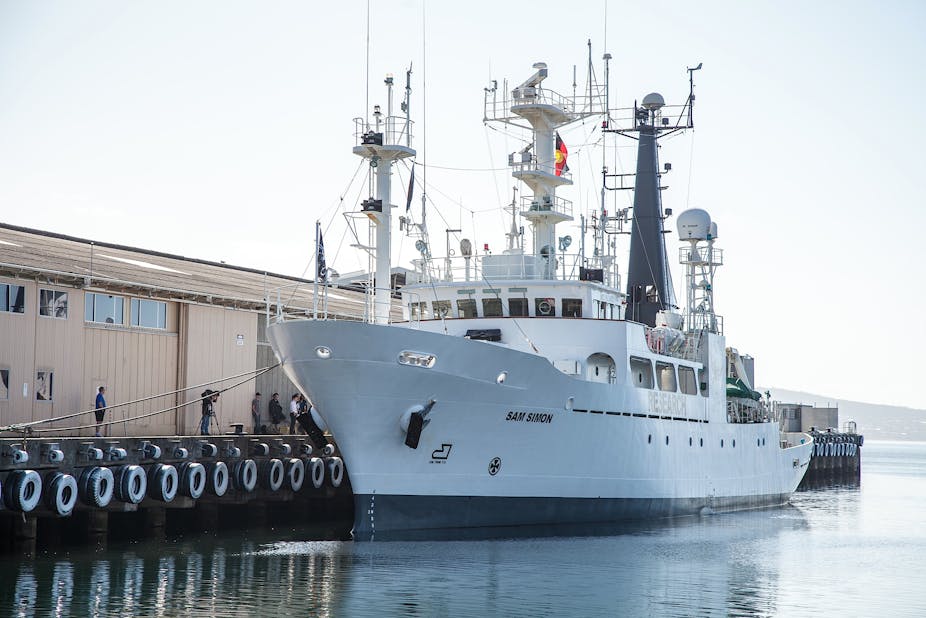
On Monday a US federal appeals court granted an injunction requiring the Sea Shepherd Conservation Society to stay at least “500 yards” (457 metres) away from Japanese whaling vessels.
It is a significant victory for the Japanese whaling industry. If complied with (and it should be as the US-based Sea Shepherd and its flamboyant Captain Paul Watson both accepted the US court’s jurisdiction) the decision will allow Japan to engage in whaling in the Southern Ocean essentially unhindered for the first time in a decade.
The Sea Shepherd Case was brought by the Japanese Institute of Cetacean Research and the company that conducts Japanese research whaling, Kyodo Senpaku Kaisha Ltd.
The Sea Shepherd Case was initially filed by the Japanese plaintiffs in the US District Court for the Western District of Washington. The case was dismissed by the court, and for a fascinating reason – that “international comity” demanded that it respect an earlier decision of an Australian court.
The District Court referred to a case in the Federal Court of Australia decided in 2008, in which it was found that Kyodo Senpaku Kaisha broke Australian law by engaging in whaling near the Australian Antarctic Territory, which is within the Australian Whale Sanctuary (AWS).
The US District Court explained its reasons for refusing the whalers’ motion for a preliminary injunction as follows:
[Australia’s] legislature has declared whaling unlawful in the AWS, and whose courts have enjoined the whalers from hunting there. The whalers decline to recognize either Australia’s law or the injunction because they dispute Australia’s sovereignty in the AWS. Indeed, the whalers refused to participate in the Australian court proceedings. But whether the whalers respect Australian law, international comity demands respect for the judgments of foreign courts….Regardless of the whalers' view of the Australian injunction, the Australian judiciary has imposed it and expects the whalers to adhere to it. What penalties, if any, the whalers face for violating the Australian injunction is not this court’s concern. This court’s concern is that the whalers ask a United States court to issue an injunction that would help them engage in the very conduct that an Australian court has enjoined. The court will not grant that request. At a bare minimum, the court will not issue an injunction (or any affirmative relief) as to the whalers' conduct in the AWS.
The AWS is given legal force by the Environment Protection and Biodiversity Conservation Act 1999 (Cth) (EPBC Act), and applies throughout Australia’s 200-mile (320km) Exclusive Economic Zone, around Australia’s mainland and its external territories.
The Australian government has not taken any steps to enforce the Federal Court of Australia’s 2008 order against the Japanese whalers, for the good reason that it would create a major diplomatic incident. Japan does not recognise Australia’s claim to Antarctica (only four countries do: France, New Zealand, Norway and the United Kingdom, and they are also Antarctic claimants). Moreover the 1959 Antarctic Treaty rules out enforcement action against foreign nationals.
Despite this, the Federal Court of Australia’s decision was clearly given some practical effect when considered by the US District Court in the Sea Shepherd Case. That may now have changed with the decision on appeal by the US Court of Appeals, which has granted the injunction against Sea Shepherd. However we will not know for certain until the court issues its opinion on the merits of the appeal from the lower court ruling.
The Japanese government has been a mostly passive player in the cases that have been brought in various national and international jurisdictions arising out of whaling in the Southern Ocean and the protest activities of Sea Shepherd.
That has now changed decisively with the Sea Shepherd Case brought in the US Courts. Whether this is an opening salvo in a new aggressive litigation strategy by Japan remains to be seen. But it is an interesting development given that many commentators anticipated that Japan’s financial troubles would see it quietly roll back its financially (and diplomatically) costly whaling activities.
To many the injunction against Sea Shepherd granted by the US Court will come as a vindication for common sense, as Sea Shepherd repeatedly flouts accepted rules for safe navigation set out in the International Maritime Organization’s Regulations for Preventing Collisions at Sea.
Other environmental groups such as Greenpeace abandoned a confrontational approach some time ago in part because of safety concerns, but also because while it may frustrate the Japanese whaling industry, it has no effect on hearts and minds in Japan, which will need to change for their to be a permanent end to whaling in the Southern Ocean.
Whatever happens in the Southern Ocean this summer, and in courtrooms in the United States, Australia or elsewhere, the main arena for contesting the legality of Japanese whaling in 2013 will be the International Court of Justice (ICJ). The ICJ will hold hearings in the long-awaited case, commenced by the Rudd government in 2010. It squarely raises the question that needs an answer – whether Japanese whaling is truly research whaling consistent with the 1946 International Convention for the Regulation of Whaling, or whether instead it is commercial whaling in disguise.
Ieyasu Tokugawa
Daimyo
Tim, you describe the granting of the injunction as "a significant victory for the Japanese whaling industry". This is disingenuous. There is at present no such things as a "Japanese whaling industry" - there is only a legally sanctioned Japanese cetacean research program.
Further, it is an injunction that was granted to protect the safety and lives of Japanese mariners who have come under repeated and sustained violent assault from anti-whaling extremists. This violence is well documented and…
Read moreChris Owens
Professional
"There is at present no such things as a "Japanese whaling industry" - there is only a legally sanctioned Japanese cetacean research program". Hilarious and love the deadpan delivery.
Do you want fries with that?
Colin Vine
Miscellaneous Public Servant.
"Tim, you describe the granting of the injunction as "a significant victory for the Japanese whaling industry". This is disingenuous. There is at present no such things as a "Japanese whaling industry" - there is only a legally sanctioned Japanese cetacean research program."
I wonder sometimes at the amount of time, money and energy which is spent on "whaling research" by Japan. Especially when compared to research into any other species.
The Japanese must really love whales.
Peter Fox
Peter Fox is a Friend of The Conversation.
Medical doctor
Ieyasu, are you really a 16th century shogun?
http://en.wikipedia.org/wiki/Tokugawa_Ieyasu
http://en.wikipedia.org/wiki/Daimyo
What are your thoughts about surplus dolphin meat ending up in school lunches?
http://www.guardian.co.uk/world/2007/sep/05/japan.justinmccurry
Bruce Tabor
Research Scientist at CSIRO
If international law is to mean anything and to be accorded any respect, it must begin with the truth. And describing the Japanese whaling industry as a "legally sanctioned cetacean research program" is such obvious doublespeak as to make the rest of Tokugawa's argument, based as it is on this premise, completely invalid.
Ieyasu Tokugawa
Daimyo
Bruce, the truth of the matter is that Japan's cetacean research program is conducted in accordance with all relevant international laws. Just because you do not like it does not make it invalid.
Australia is currently challenging the legality of the research program in the ICJ, but the case is generally expected to fail (except perhaps by those academics who promoted the idea of the legal action).
Please follow the outcome of that case closely so that you may receive judicial confirmation of the legality of the research programs.
Chris McGrath
Senior Lecturer at University of Queensland
Ieyasu, you have very dogmatic views on something that is not as clear-cut as you suggest.
I agree that Japan has a good argument based on the text of Article VIII of the International Whaling Convention that whatever it chooses to call "research whaling" is lawful. The article is written very broadly.
On the other hand, the lack of any credible research being produced from killing the whales undermines the validity of Japan's position considerably.
Japan could continue its research using…
Read moreIeyasu Tokugawa
Daimyo
If I may beg to differ, I believe the legal issues are in fact relatively clear cut, despite the efforts of ideologically-motivated anti-whaling advocates to cloud the issue and reinterpret laws to suit their agendas.
However, I am glad that we can agree on the strength of the Japanese.
Your claim, though, that there exists a “lack of any credible research being produced” by the Japanese research program is unfounded. There are numerous peer reviewed papers produced based upon the research…
Read moreChris McGrath
Senior Lecturer at University of Queensland
Ieyasu, you make false arguments.
I said that "the lack of any credible research being produced from killing the whales undermines the validity of Japan's position considerably."
I presume you have looked at the JARPA cruise reports (or perhaps you are involved in writing them) so you know that there is nothing new coming from the lethal research methods. You can read one at http://www.envlaw.com.au/whale17.pdf
There is simply no need for lethal research methods to be used.
I disagree that the validity of Australian law to stop Japanese nationals whaling in its Antarctic waters is tenuous. Recognition is not the test of sovereignty under international law, effective occupation is.
If you wish to, you can read my analysis of the legal basis for Australia being able to lawfully stop Japan's whaling in its Antartic waters at http://www.envlaw.com.au/whale24.pdf
Anthony Nolan
Ruminant
All due respects to your academic position, legal credentials and participation in animal welfare politics, Tim, but this sort of article exemplifies what happens when the middle classes attempt to get a stranglehold on ideological leadership of a movement.
Greenpeace gave up a confrontational approach over whaling because Greenpeace is the plaything of private school chaps, too readily unnerved by lack of spine, and, in any event, it is deeply politically compromised by the absence of anything…
Read moreComment removed by moderator.
Chris McGrath
Senior Lecturer at University of Queensland
Thanks for your article Tim. Nice to see a range of comments coming in.
I have read some of the things you're written on Antarctica in the past but I can't recall your views on Australian sovereignty.
Do you agree with Gillian Triggs that "Australia has valid title to those parts of the Australian Antarctic Territory which have been effectively occupied by it. Such areas are the coastal mainland bases of Davis, Casey and Mawson and their surrounding territory and the continental shelves adjacent…
Read moreIeyasu Tokugawa
Daimyo
Mr McGrath, I realise the question was not directed at me so I hope you don't object to my interjection.
But with regards to Australia enforcing its laws and claiming sovereignty over the EEZ around its so-called "Australian Antarctic Territory", is this not a violation of the Antarctic Treaty's prohibition of the making of new claims? After all, I understand that the concept of an EEZ came into being some 20 years after the signing of the treaty. Therefore, any Australian claim to an EEZ around Antarctica would classify as a new claim, which would constitute a violation of the Treaty.
Perhaps Tim will clarify.
Chris McGrath
Senior Lecturer at University of Queensland
That is a good question Ieyasu and there has been academic debate on this point. Several countries, such as the USA, objected to Australia asserting some of its rights to the continental shelf adjacent to its Antarctic territory so they presumably also object to the assertion of the EEZ.
My opinion is that the better view is that, interpreted in good faith, the ordinary meaning of Article IV suggests that Australia is not restricted from claiming an EEZ adjacent to the Australian Antarctic Territory…
Read moreChris McGrath
Senior Lecturer at University of Queensland
Just to add Ieyasu: countries often take political positions based on their own economic interests in sovereignty disputes that do not reflect the principles of international law.
In my view that is what Japan, the USA and other countries do in refusing to recognise Australia's sovereignty in Antarctica. Their aim is to try to keep the resources available for their nationals to exploit in the future.
Another example of political positions that do not reflect the principles of international…
Read moreIeyasu Tokugawa
Daimyo
Mr McGrath, having briskly read through the paper to which you kindly provided a link, I would like to raise the following points.
Firstly, it would appear your personal views on whaling may have overcome more rational considerations in your analysis. It is remarkable you would advocate that Australia physically enforce its domestic laws upon Japanese government vessels operating in Antarctic waters (read: the high seas), thereby risking not only armed confrontation with Australia’s closest Asian…
Read moreTim Stephens
Associate Professor and Co-Director, Sydney Centre for International Law at University of Sydney
Thanks for your helpful comments Chris.
I don't have a firm view on the sovereignty issue, but I do accept that if Australia has a valid territorial claim then it follows that Australia can assert claims to maritime zones adjacent to the AAT. I don't see these as new claims, contrary to the Antarctic Treaty. They are pre-existing entitlements under the law of the sea.
In relation to the enforcement issue, Ben Boer and I explored it in some detail in Looking South: Australia's Antarctic Agenda…
Read moreChris McGrath
Senior Lecturer at University of Queensland
Thanks Tim, I did like Looking South but I disagree with your analysis on the enforcement issue. Still, we can agree to disagree. You view on non-enforcement is certainly the accepted dogma at present.
Chris McGrath
Senior Lecturer at University of Queensland
Ieyasu, thanks for making me laugh with your points about my "profound ignorance of geopolitical reality" and "Australia’s imperialistic territorial claims in Antarctica".
You might have a think about the role of sovereignty as the foundation for the international legal system. Why is it so "imperialistic" for Australia to assert its rights in accordance with that system?
Certainly Australia has economic and resource motives for maintaining its Antarctic territory and asserting an EEZ around…
Read moreIeyasu Tokugawa
Daimyo
Mr McGrath, perhaps you are again succumbing to your various biases in allowing yourself to believe that international legal norms somehow apply to Antarctica.
You also claim that Australia's position is not a fiction, yet you are fully aware that it does not exist beyond the imaginations of 1.97% of all people.
"Effective occupation" is a concept familiar to all Japanese as it was once the foundation for our own campaign of unilateral territorial expansion. The fruits of that expansion did…
Read moreChris McGrath
Senior Lecturer at University of Queensland
Ieyasu, I am not sure about your reference to Japan's actions. Are you referring to conquest of territories using armed force? Conquest of territory by the use of armed force is now outlawed by Art 2(4) of the UN Charter.
Regarding the principles for effective occupation and establishing sovereignty in Antarctica, the Legal Status of Eastern Greenland gives the leading international decision on sovereignty over remote, sparcely populated and ice-clad land masses such as Antarctica. See: http…
Read moreJohn Coochey
Mr
Glad you believe in the rule of law, how about prosecuting Paul Watson for the illegal possession and importation of a bullet proof jacket? He made great play of having a bullet stopped by his bullet proof jacket, stage managed hockum but is illegal to possess or import bullet resistant jackets without ministerial permission so when do we see a prosecution?
David Poynter
Medical Scientist
Bravo Ieyasu Tokugawa,
I can see application for such an injunction, if such were possible on mainland Australia, as a means to protect mining, forestry and other land use industries that are continually subject to face to face activist confrontation, so called 'non-violent' protests, but which never the less put staff and protestors alike at great personal risk; not to mention the economic threat to the viability of said industries.
The enviro-media always side with the activists and tacitly approves of their violent and illegal activities. The ABC for instance is little more than the PR arm of the Sea Shepherd organization. 'The Age' for years has run a campaign to destroy the native forest timber industry. Their campaigns have effected public opinion to the extent that whaling and logging are widely regarded as indefensible pursuits.
Nick Kermode
logged in via email @hotmail.com
"raises the question that needs an answer – whether Japanese whaling is truly research whaling consistent with the 1946 International Convention for the Regulation of Whaling, or whether instead it is commercial whaling in disguise."
With all due respect, are you serious? "Research whaling" is an embarrassment to Japans scientists conducting meritorious work and is the most transparent BS imaginable.
I hope Paul Watson and Sea Shepherd refuse to sit up the back of the bus, so to speak. Sea Shepherds motto is "Conservation In Action" while Governments and other groups that should be protecting these species motto seems to be "Conservation Inaction". Their MO is straight out of The Peoples Front Of Judea playbook. I know who gets my support.
David Poynter
Medical Scientist
A wise shogun once said : "Find fault with thyself rather than with others."
Ieyasu Tokugawa
Daimyo
Wise words indeed.
As a starting point, could I suggest the minor fault of Australia's 44% catch of the global harvest of the critically endangered Southern Bluefin Tuna?
Chris McGrath
Senior Lecturer at University of Queensland
Good point Ieyasu. We can certainly agree on all nations, including Australia and Japan, reducing or halting the take of SBT to allow the stocks to recover.
Vincent Burke
Violinmaker
@Ieyasu...could not agree more...Australia plunders its ocean for profit...I accept that Sea Shepherd NEVER target legal & licensed operations, but many people in Aus are working to close down over fishing here.
Ieyasu Tokugawa
Daimyo
Vincent, you claim that Sea Shepherd never target legal and licensed operations, but that is factually incorrect. For instance, the Japanese cetacean research program is entirely legal and licensed under all relevant international laws and yet it has come under repeated and sustained violent assault from Sea Shepherd.
Another example would be Sea Shepherd's attack upon a legal and licensed fishing operation in Malta last year. The Steve Irwin was impounded in Europe as a result and only released when £520,000 of donated money was paid up for its release. See:
http://www.timesofmalta.com/articles/view/20110821/local/would-sea-shepherd-reimburse-donations-if-they-lose-case-fish-fish-asks.381232
Paul McCarthy
lawyer
People should check out the research papers the IWC claims to have sponsored, at http://www.icrwhale.org/JARPA91paper.html. This list is very interesting.
The only paper I saw that would have required killing a significant number of whales was a 2008 paper entitled "Ishikawa, H. and Shigemune, H. 2008. Comparative Experiment of Whaling Grenades in the Japanese Whale Research Program under Special Permit (JARPA and JARPN). Jpn. J. Zoo Wildl. Med. 13(1): 21-28." I suppose this is a test of different…
Read moreChris McGrath
Senior Lecturer at University of Queensland
Sadly Peter, there are many detailed reviews of the Japanese whaling program coming to the same conclusion as you reached that the killing of whales has negligible scientific value.
See, for example, Peter Sands (2008) "Japan's ‘Research Whaling’ in the Antarctic Southern Ocean and the North Pacific Ocean in the Face of the Endangered Species Convention (CITES)" Review of European Community & International Environmental Law, Volume 17, Issue 1, pages 56–71, available at http://onlinelibrary.wiley…
Read moreIeyasu Tokugawa
Daimyo
Paul, the veracity of the anti-whalers' claims regarding the validity of the research will be decided soon enough in the ICJ.
But until that time, I would suggest the issue that ought to be considered is why the moratorium remains in place despite undisputed scientific acknowledgment that many species of whale - such as the minke and humpback - are available in such abundance as to easily allow for a sustainable commercial harvest.
After all, the moratorium was only ever intended as a temporary…
Read moreJamie McCroskey
logged in via Facebook
I am a bit confused when you say the case was "dismissed", the prelim injunction was not granted and the ICR/KSK appealed that decision, in October they had a hearing on the appeal, no decision has been given yet so the ICR/KSK asked for the court to expedite that decision, this temporary injunction has been given pending that decision which is where things stand right now. The case was never ''dismissed''.
Ieyasu Tokugawa
Daimyo
Jamie, I too was confused by this point in the article and I believe you are correct in pointing out that the case itself was never dismissed.
Terry Bull
logged in via Facebook
Japan ,illegally or legally depending on your homeland , under the pretence of research travels and kills a designated quota of various species of whale , sending the Nisshin Maru , a processing factory ship , a ship which receives the whale ,primary butchers set to work , waste products rejected from ship , the whale produce in carefully packed in wholesale packaging and palleted and shrink wrapped , why on earth do people find this an issue for debate , it is a commercial business ...
Vincent Burke
Violinmaker
"To many the injunction against Sea Shepherd granted by the US Court will come as a vindication for common sense, as Sea Shepherd repeatedly flouts accepted rules for safe navigation set out in the International Maritime Organization’s Regulations for Preventing Collisions at Sea."........Prof. Tim Stevens.
Tim may not be aware of the deliberate ramming of the Ady Gil in 2010 by the Shonan Maru, 6 crew on that small vessel luckily survived but the SM captain could not have truly believed that he was NOT likely to kill or injure crew by his deliberate lining up, ramming and destroying the AG.....Hear this Tim, SSCS will be in the Southern Ocean this summer and whales WILL be protected...at all cost!...Zero Tolerance.
Ieyasu Tokugawa
Daimyo
Vincent, your claims regarding the sinking of the Ady Gil are totally unfounded. Investigations by Australian maritime authorities did not find that the Ady Gil was deliberately rammed as you claim. In fact, an observation of the available footage of the incident clearly shows the Ady Gil accelerating into the path of the Shonan Maru 2. Subsequent information released by members of Sea Shepherd has revealed that a decision was taken by members of Sea Shepherd to scuttle the Ady Gil for dramatic effect…
Read more