

Warning: your journalism may contain deception, inaccuracies and a hidden agenda

MEDIA & DEMOCRACY – Stephan Lewandowsky and Ullrich Ecker have some tips on how avoid being fooled by the media. Bad media can do considerable harm. Professor Stephen Kull has been keeping track of key beliefs among the American public for many years, and his data are as stunning as they are concerning…

Newspaper_deeknow
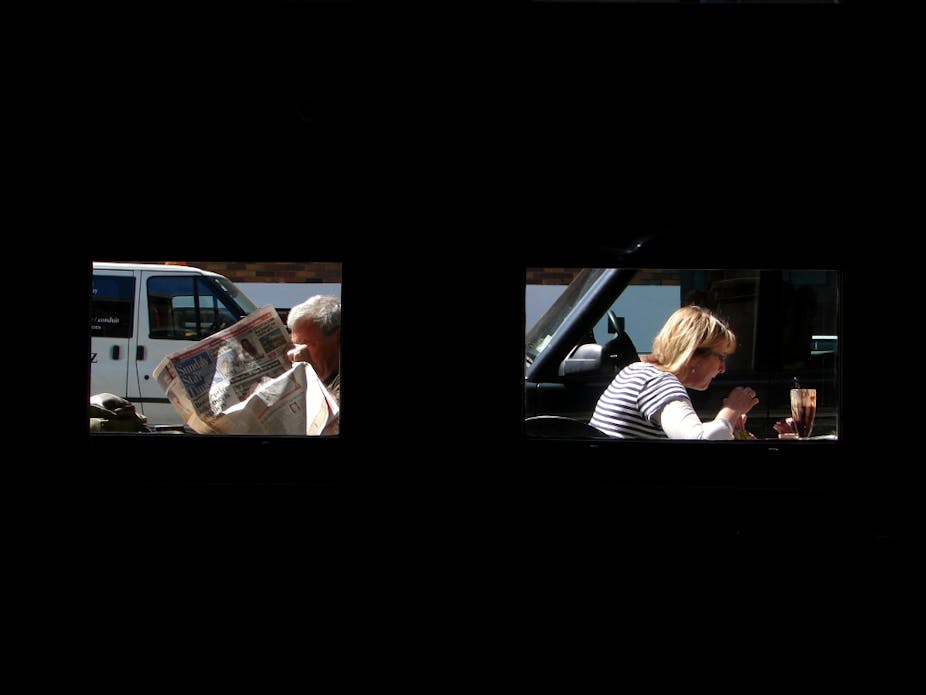
Your media may not be giving you the full picture. DeeKnow/Flickr

MEDIA & DEMOCRACY – Stephan Lewandowsky and Ullrich Ecker have some tips on how avoid being fooled by the media.

Bad media can do considerable harm.

Professor Stephen Kull has been keeping track of key beliefs among the American public for many years, and his data are as stunning as they are concerning.

After the invasion of Iraq in 2003, the US began its search for the “weapons of mass destruction” (WMD) it had used to justify the invasion. The search proved futile, but large segments of the US public continued to believe in their existence. Indeed, in 2004, some 20% believed that WMDs had been used by Iraqi troops during the conflict.

And in 2010, almost 45% of the American public erroneously believed that scientists are evenly divided on whether or not climate change is occurring.

In fact, an overwhelming majority of scientists supports the consensus view, labelled a “settled fact” by the US National Academy, that the Earth is warming due to human activities.

Are all media bad all the time?

Do these data imply that the media in general misreports important issues?

No.

Further inspection of Kull’s work reveals that the extent of mistaken belief varies dramatically with people’s preferred news source. Consumers of Murdoch-owned Fox News were most likely to be misinformed on a range of issues, whereas those who primarily listened to National Public Radio (roughly comparable to our ABC) were most likely to be attuned to reality.

Moreover, the extent to which Fox consumers were misinformed increased with how much they were glued to their preferred channel. Those who entered the Fox “matrix” every day were least likely to be connected to reality. Those who watched Fox “rarely” or “only once a week” escaped nearly unscathed and resembled occasional listeners of public radio.

(In contrast, increased consumption of Public Radio increased people’s understanding of reality, and daily listeners were typically the best-informed people across a number of studies spanning nearly a decade.)

We are not aware of any corresponding data involving the Australian media. But as the preceding articles in this series have shown, it can be very challenging for the Australian public to consume the major Murdoch-owned papers and still retain a grip on the scientific reality of our changing climate.

It is particularly concerning that this judgment applies not only to the low-rent tabloids, but also to the national broadsheet that, nominally at least, engages in actual journalism.

As Dr Tim Lambert of UNSW has meticulously documented, The Australian is surprisingly incapable of accurate reporting when it comes to climate change.

We say “surprising” because of the vast and motivated mendacity that is required to serially ignore a mountain of scientific data in favour of quotes from Farmer Fred or Swimmer Sam or an academic with no climate expertise but a background in the oil industry.

Ignoring the complexity of scientific data is, however, not without merit, as revealed by the fact that The Australian’s Editor-in-Chief, Chris Mitchell, received the “JN Pierce Award for Media Excellence for leading the newspaper’s coverage of climate change policy” in 2009.

The award is presented each year by the Australian Petroleum Production and Exploration Association.

Getting your head above the spin

A functioning media is a crucial element of a functioning democracy.

But those in the media who cast aside accurate reporting in favour of ideological drivel and spin are dysfunctional and must themselves be held accountable.

The continued calls for an enquiry into the Australian media appear amply justified by the evidence revealed here during the past few days — the media matter and bad media can do considerable harm.

But until bad media are held accountable by shining a bright light onto their practices, what can a member of the Australian public do to avoid being misinformed?

As we saw at the beginning of this piece, an obvious response is to choose one’s source of news wisely.

Another response, based on research in cognitive science, is to be highly sceptical of the media and to accept that some organs may be pursuing an agenda other than to objectively inform the public.

We know that people are more likely to discount information that later turns out to be false if they are warned ahead of time of the possibility that they are being misled. In an ideal world, warning labels on mendacious media products, akin to those on tobacco products, would be a solution: “We frequently mislead — disbelief of content is advisable.” And we’re not the only ones who have thought of this.

In the absence of such labels, this series of articles on the media and climate change has provided ample warning that some Australian media organs simply cannot be trusted to report the science accurately.

Know whom to trust

We also know from research that raising suspicion about the source of potential misinformation helps alleviate its effects. We found that people who were suspicious about the official reasons for the 2003 Iraq invasion — namely the search for weapons of mass destruction — were better at distinguishing between truthful news reports concerning war events on the one hand, and false and later-retracted reports of events on the other.

In a nutshell, people who believed the WMD story also continued to believe in other war-related information which they knew had been retracted. People who thought Iraq was invaded for reasons other than WMDs, appropriately disbelieved information they knew to be wrong.

Hence, general suspicion surrounding an event and its architects can help us discount information that turns out to be false. Without this suspicion, that information otherwise lingers in people’s memories.

By extension, learning that some prominent climate change deniers, such as outgoing Australian Senator Nick Minchin, also long denied the adverse health effects of tobacco smoke may make one justifiably more suspicious of their claims involving scientific issues.

Likewise, entertaining the possibility that some media organs are pursuing a propagandistic agenda may induce healthy suspicion about what those organs are likely to print or broadcast.

When science meets agenda

Recent research at the University of Queensland found that among Australian politicians, the percentage whose views on climate are influenced by scientists — as opposed to, say, the local publican or barber — ranges from 44% to 98% across parties.

The party at the bottom, which in its majority rejects science, is the Liberal party. The party that nearly exclusively prefers peer-reviewed science to gossip is the Greens.

In this context, it is worth recalling that The Australian — taking a stand against radical activism and flying the banner of journalistic impartiality — has recently vowed to help destroy the Greens at the ballot box.

This is what most people would call an agenda.

This is the final part of our Media and Democracy series. To read the other instalments, follow the links here:.

This article is about the media’s representation of climate change – we’d love to hear your opinions on that topic. If you would rather discuss the existence of climate change, there are many other articles on the site covering that issue: please take your comments to one of those discussions.

Join the conversation

22 Comments sorted by

    1. Michael J. I. Brown

      ARC Future Fellow and Senior Lecturer at Monash University

      In reply to Mark Duffett

      Perhaps an even better example of bad media coverage having a direct effect of people's health is the MMR vaccine autism scare. The effects of this scare persist to this day, despite there being no credible evidence for a link between the MMR vaccine and autism.

      A good starting point for a discussion of this is Ben Goldacre's Bad Science (http://www.badscience.net/2008/08/the-medias-mmr-hoax/).

      report
  1. Andrew Hack

    IT Project Manager

    Meanwhile, theconversation.edu.au has vowed to help destroy any opposition or criticisms to the watermelon political movement, or so it would seem.

    Liberal Party rejects science?

    Greens prefer peer-reviewed science over gossip?

    "Ideological drivel" indeed...

    report
    1. Andrew Hack

      IT Project Manager

      In reply to Andrew Hack

      Glad this article came with a warning; in the article topic.

      report
    2. Mark Duffett

      logged in via Facebook

      In reply to Andrew Hack

      Once outside the realms of climate, the Greens' so-called preference for peer-reviewed science goes missing. Whether it's genetic engineering, energy options, forestry, coal seam gas, nuclear radiation safety and risk assessment...in all of these areas mainstream peer-reviewed scientific expertise takes a back seat to Green ideology.

      report
    3. Sherry Mayo

      logged in via Facebook

      In reply to Mark Duffett

      More generally, politicians of any stripe will believe science to the extent that it fits in with either their general world view (whatever that may be), or that of the voters they are trying to attract. Sadly not many are prepared to take a principled stand on things that go against these political instincts.

      report
    4. Michael J. I. Brown

      ARC Future Fellow and Senior Lecturer at Monash University

      In reply to Mark Duffett

      It should be noted that there are large differences between the opinions expressed by The Conversation and "The Greens" political agenda. A good example is The Conversation's articles on GM crops (http://theconversation.edu.au/scientists-appalled-by-whippersnipper-attack-on-csiro-gm-wheat-trial-2334).

      It is a disappointing (albeit predictable) tactic of those opposed to the science to suggest that the scientific opinion is politicised.

      Concern about climate change can be completely consistent with a conservative agenda, as highlighted by David Cameron's policies in the UK.

      report
  2. Daryl Deal

    retired

    I believe, the correct phrase for this prodigious nonsense from all private corporate mass print and TV media propaganda garbage, post 2000, in the age of the Internet, is called "Churnalism"

    Urban dictionary definition:-

    "Term coined by author Nick Davies to describe poor practices of modern day journalists who "churn" or recycle news stories off the wire or internet without appropriate critical investigation.

    Where once journalists were seen travelling out and about in the search for facts, a large majority are now, literally, chained to their desks waiting for the next major scoop; eager to be the first to report on the topic and thus draw traffic to their news sites... this is churnalism."

    http://www.urbandictionary.com/define.php?term=churnalism

    "It is difficult for a man to understand something, when his job depends upon him not understanding it." : Upton Sinclair

    report
  3. Christopher Hayward

    Self Employed

    Well written and absolutely spot on about the how the various parties veiw science.

    report
  4. Marc Hendrickx

    Geologist

    Great piece by Brendon O'Neill in Today's Australian...

    "Climate sceptics called every name in the book"
    The green movement is not content with arguing that its opponents are wrong. It wants to brand them as twisted, sinister and pernicious, spouting words that actually harm other people and society itself. In their determination to denude climate-change scepticism of any decency, greens ape every arch censor throughout history, from Torquemada to Joseph McCarthy, who likewise depicted certain people's ideas as a mortal threat to the social fabric.
    http://www.theaustralian.com.au/national-affairs/opinion/climate-sceptics-called-every-name-in-the-book/story-e6frgd0x-1226128390401

    report
    1. Nick Kermode

      logged in via email @hotmail.com

      In reply to Marc Hendrickx

      "HAS any intellectual current ever been so disparaged and demonised, so ferociously harangued by the chattering classes, as climate-change scepticism? "

      Ah, actually yes......global warming advocation!

      Marc, this sort of thing happens on both sides. They are at least as bad as eachother. I would have thought with your interest in balance you may have mentioned that. Unless of course you think guys like Mann, Hansen, Trenberth, Cook, Steffan, Flannery, Lambert, Santer etc etc dont cop the same? Actually I think Mann probably holds the dubious record of most harangued on either side, though it would be close.

      report
  5. wilma western

    logged in via email @bigpond.com

    At least this article didn't get drowned in item by item ,toe to toe duelling over various scientific( and less scientific) research papers . Comments are actually on the topic of the quality of the journalism not the quality of the science ! Comments by M Brown and M Duffet are to the point and of course most people pick and choose which viewpoints they trust . For long-term credibility ,advocates for change in public policy need to respect the evidence , and present their case in a way that can be understood by their various audiences without unjustified scare or denigration tactics .

    report
  6. Jane Salmon

    The first Keith Winschuttle who wrote "Fixing the News" before he was captured by self interest, was indeed correct. The media's agenda is dominated by its board, its corporate advertisers and political vested interests.

    However, the solution is imply public media in all its random glory.

    Let every blog add to the concert of public opinion, experience and whistleblasting that is freedom of expression ... and long may search engines shine light on pertinent comment of every type.

    report
  7. Mark Harrigan

    Dr

    Thanks - great article- concise and to the point.

    Confirmation Bias on Steroids it would appear.

    I presume Kull's work has been scientifically validated and is based on some well grounded data? If so are you able please to provide the references (the link to kulls Work" seemed a little general).

    I suppose I should not be surprised about the Fox Media - but I confess I was. Are people really that gullible?

    I am a regular reader of the Weekend Australian although is a far cry from my only source…

    Read more
    1. Stephan Lewandowsky

      Australian Professorial Fellow, Cognitive Science Laboratories at University of Western Australia

      In reply to Mark Harrigan

      Sorry for the delay in replying to your query about the Kull references. I hope you are still monitoring the thread.

      Here they are:

      Kull, S., Ramsay, C., & Lewis, E. (2003). Misperceptions, the media, and the Iraq war. Political Science Quarterly, 118, 569-598.

      PROGRAM ON INTERNATIONAL POLICY ATTITUDES (PIPA). (August, 2004). U.S. Public Beliefs and Attitudes About Iraq. Unpublished manuscript (available at http://www.pipa.org/OnlineReports/Iraq/Report08_20_04.pdf).

      PROGRAM ON INTERNATIONAL…

      Read more
  8. Brett Twentythree

    Typer

    Gee Marc Hendrickx, an article from The Australian sceptical of climate change and playing the victim to those nasty greenies who abuse them - who saw that coming?
    No, wait, that's exactly the kind of stuff they print on a daily basis, as the above article points out.
    Here's a challenge for you: find an article or two in The Australian that shows the other side, that even hints that climate change might actually be real, and it's not a global conspiracy perpetrated by lefty loonies like NASA and The American Association of Petroleum Geologists, and every single national or international scientific body on Earth.

    "In this context, it is worth recalling that The Australian — taking a stand against radical activism and flying the banner of journalistic impartiality — has recently vowed to help destroy the Greens at the ballot box.
    This is what most people would call an agenda."

    report
  9. Grant Kennedy

    Astronomer

    What would happen if by some miracle the whole world (or those don't listen to NPR say) gained the ability to think critically? or were perhaps able to do a little common sense style statistics when they read some non-story? (I think this covers what it termed 'suspicion')

    Would this send FOX bankrupt through an inability to sell advertising due lack of subscription? Probably not, but my point is that their goal is to make money, and just like anyone else they are ultimately selling a product that we choose to purchase. It's not their fault that we've been gullible enough to buy their stuff and make them successful.

    This argument doesn't give a solution, but whenever there's a clear ambulance at the bottom of a cliff (i.e. legislation/regulation) there's probably a deeper problem that's way harder to solve but bears thinking about (i.e. education).

    report
    1. Stephan Lewandowsky

      Australian Professorial Fellow, Cognitive Science Laboratories at University of Western Australia

      In reply to Grant Kennedy

      Based purely on economics, your analysis has much merit. Except that i balk at the notion that truth (or lack thereof) are "products." I don't think broadcasters are absolved from the requirement to tell the truth, simply because their audience (ostensibly) wants to live in a dream world.

      report
  10. Tim Benham

    Student

    "The Australian has recently vowed to help destroy the Greens at the ballot box".

    The linked article doesn't appear to support the claim. The author affirms that The Australian means to wreck the Greens-ALP alliance and that the Greens <i>should</i> be destroyed at the ballot box. He does not, however, state that the The Australian intends to help destroy the Greens at the ballot box.

    report