
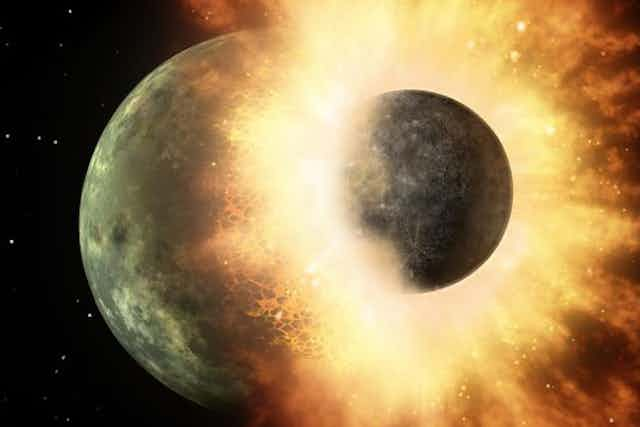


New research published in the planetary science journal Icarus, shows the moon may have been formed by a glancing collision with an “impactor” in the violent days of the early solar system.
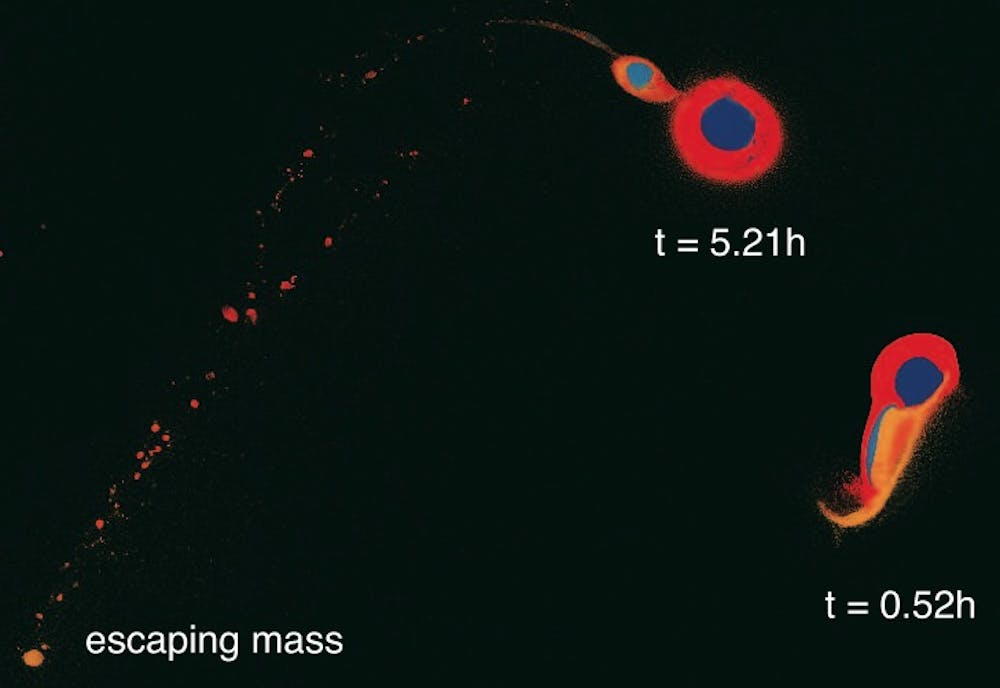
Contrary to previous research, which showed the impactor more or less stopped dead when it hit Earth, the new model describes a ricochet, where part of the impactor escaped Earth’s gravity after the collision.
To understand why this matters, we first need to understand some key mysteries about the moon, and the wild explanation for its formation that is currently favoured.
The solar system is full of differences. Venus has a surface that is permanently shifting and not far from molten. Earth has wonderfully complex system known as plate tectonics. Mars has a static surface with a northern hemisphere that is 6km lower than the southern hemisphere, not to mention a giant volcano that’s three times as tall as Mt. Everest.
Along with cosmetic differences, there are chemical differences between each set of rocks that share a common origin. These differences are most easily seen by analysing the isotopic abundances of oxygen.
But the Earth and the Moon, despite their obvious cosmetic differences, share the same isotopic signature, suggesting they are essentially the same object.
This appears to be at odds with the generally accepted formation theory of the Moon, where an impactor (often called Theia) impacts with the proto-Earth, spinning up the proto-Earth and slowing the impactor down so the later is captured in a tight orbit around the former.
In this “giant impact hypothesis”, severe tides on Earth deform the molten rock which gradually slows down Earth’s rotation as the Moon drifts outwards. Naively, this scenario would result in the Moon being mostly made of impactor material, and Earth being made mostly of the material that originally formed the proto-Earth.
For at least five years, the similarity in composition between the Earth and the moon has been explained by Theia mixing with the proto-earth after impact. Mixing is only possible if Theia melts (or even vapourises) after impact, forming a spinning disk of liquid and gas around the proto-Earth.
This molten disk becomes a sphere under the influence of its own gravity, and gradually cools to become the modern-day moon.
This theory of a well-mixed proto-lunar disk was put forward by David Stevenson at Caltech with his PhD student (now Bateman Postdoctoral Fellow at Yale) Kaveh Pahlevan.
(Dave is known for his unusual ideas, including his proposed mission to the earth’s core.)
It takes quite an imagination to think up a century-long storm in a 2,000ºC disk, complete with droplets of magma that fall on to a turbulent Saturn-shaped Earth-moon system. It also takes quite a theoretical pair of minds to feel comfortable using physics equations for concepts such as eddy diffusion in such an unusual environment.
One problem with this model is that it can only work if the proto-lunar disk and the upper layers of the proto-Earth are really hot and turbulent.
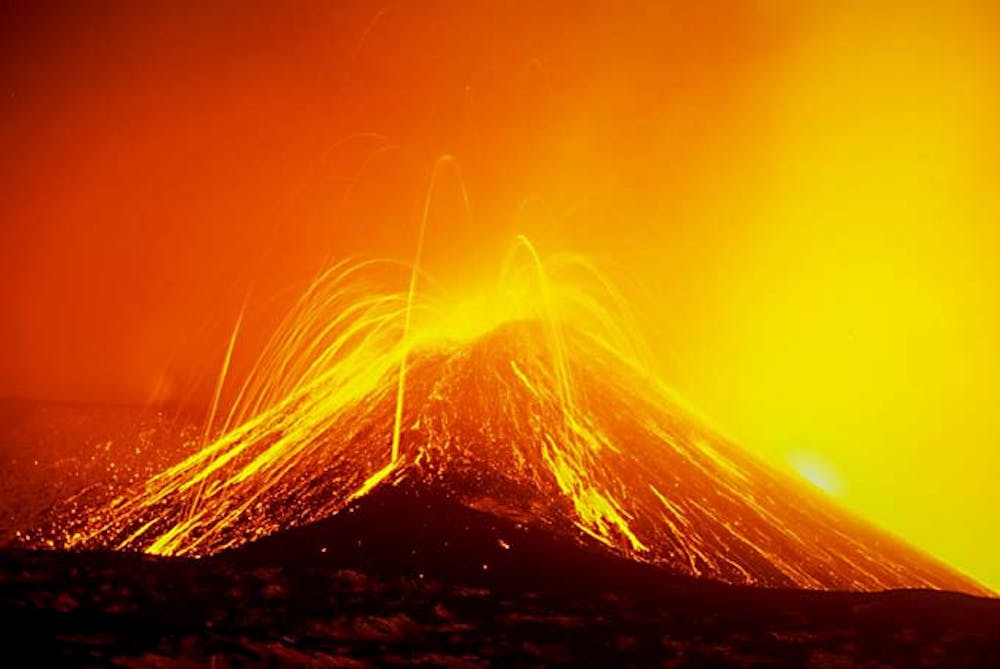
The new “hit-and-run” moon formation model from Andreas Reufer and collaborators makes it easier to believe there was enough heat after the collision. The kinetic energy of the impactor is turned into heat via highly supersonic shocks - so the higher the impact velocity, the more heat generated.
This model also means it is possible for the impactor to have come from more distant orbits - even as far away as Mars.
If their theory is correct, it’s possible the leftover pieces of Theia are still floating around in the solar system somewhere … unless they went on to collide with another planet, or if they were thrown out of the solar system by multiple slingshots.
A beautifully frustrating part of the early solar system’s history is that, in the chaos, both information and material is lost, leaving unanswerable questions. The challenge of planetary science is to find which questions might be answered.