


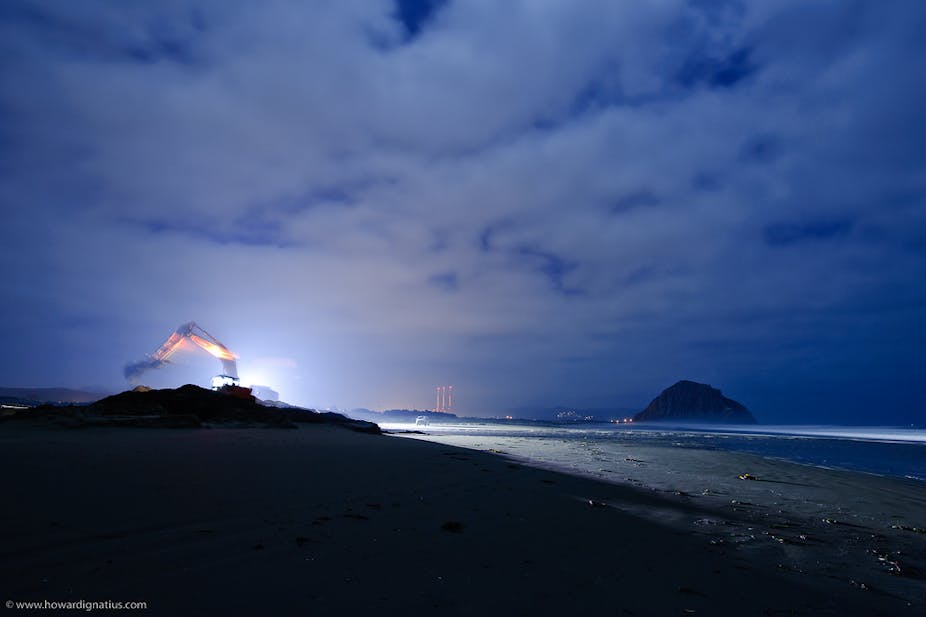
The Queensland port city of Gladstone has been in the news for all the wrong reasons lately.
Fish and other marine life have been infected by a strange parasite that seemed to make the leap to humans. The outbreak led to a local fishing ban which was recently overturned, despite lingering concerns about water quality and the health of fish.
Some commentators have suggested liquified natural gas (LNG) developments on nearby Curtis Island could be responsible for the ill health of marine life and the flow-on effects.
So what sort of assessments were done to predict the environmental effects of LNG developments? Was enough done? And what will be the long-term effects for the local environment and the people of Gladstone?
Fundamentally flawed
Quite simply, the Gladstone case highlights the flaws in the environmental impact assessment and approvals processes overseen by state and federal governments.
In order to start a project such as the one on Curtis Island, LNG companies are required to carry out environmental impacts assessments (EISs). These assessments must be approved by the state government and by the Commonwealth, if the type of environmental damage is covered under Commonwealth legislation – in the case of biodiversity impacts, for example.
Notably, these EISs are done by private companies hired by the businesses backing the project.
In the case of LNG, there are separate EISs covering the extraction and piping of coal seam gas to Gladstone by four companies: GLNG, QCLNG, Australia Pacific LNG and Gladstone LNG. Shell LNG is currently at the proposal stage.

In addition to these assessments, EISs were required for the development of Gladstone harbour by Gladstone Ports Corporation (GPC); a development necessary for the processing and shipping of LNG.
The Queensland Coordinator General and the Commonwealth’s Minister for the Environment have approved the four gas company proposals and the development of the harbour by GPC.
However, it is apparent from reading the EISs that there is great uncertainty about the environmental effects of coal seam gas extraction. These include:
- the effect of drawing excessive water from the artesian basin
- the chance of polluting groundwater by gas extraction
- the risks of watershed damage associated with disposal of highly saline groundwater that comes to the surface.
The Queensland Coordinator General has been forced to apply a great number of conditions to his approval of coal seam gas extraction.
One condition is that: “There shall be no release of contaminants to groundwater”. Given chemicals are used in the hydraulic fracturing process (known as “fracking”) that forces gas to the surface, this seems to be a condition that cannot possibly be met.
The Coordinator General has had the task of adding up the cumulative impacts of the LNG projects. In examining the cumulative level of greenhouse gas emissions from coal seam gas extraction and processing he came to a rather startling conclusion: the LNG projects will contribute greatly to Australia’s total emissions.

The EISs suggest there will be some 39 million tonnes of CO₂-equivalent emitted from the five Gladstone projects, per year, once fully operating after 2014. This will amount to:
- more than 10% of Australia’s 2020 emission target of a 25% cut on 2000 levels of greenhouse emissions
- 8% of its 2020 emissions target of a 5% cut, and
- 19% of the 2050 target, which is 60% below 2000 levels.
This finding leaves the Commonwealth embarrassed, having omitted this large source from its latest assessment of Australia’s future greenhouse gas emissions. Quite simply, LNG was wrongly seen as a benign activity.
Dredging the Gladstone Harbour
The massive development of Gladstone Harbour – including dredging to allow large LNG vessels through – will cause many environmental and social problems, the extent of which has not been settled in EISs.
The Commonwealth will undoubtedly have to answer some questions from the UNESCO committee that monitors the management of world heritage areas.
The dredging of the harbour and the LNG plants being built on nearby Curtis Island all fall within the Great Barrier Reef World Heritage Area.
Moreover, the Commonwealth has approved the disposal of large amounts of dredge spoil at a site in the harbour mouth, which is situated only about one kilometre from the Great Barrier Reef Marine Park boundary.
Gladstone is noted for its very big tides, so dispersal of spoil from the dumping ground into the Park is a legitimate concern.
Fishy business
Fish habitats in Gladstone harbour will also be diminished by the project. New wharves are being created on top of sea grass beds. The dredging stirs up silt which remains in suspension in harbour waters, affecting the ability of fish to extract oxygen from the water, before settling out on sea grasses and wetlands.
The quantity of food available for both commercial and recreational targeted fishes is thus diminished.
The environmental effects will be long term. Dredging will continue to at least 2015, and the sea grass beds that are smothered will take some years to recover after dredging stops.
Another impediment to fishing is vessel traffic in the harbour. Hundreds of workers and materials need to be ferried to Curtis Island daily, and LNG vessels and their wharves have large exclusion zones around them.
The economic future of commercial fishermen using the harbour is not nearly as emotive an issue as damage to the Great Barrier Reef. But it is another cost of the development that has often been minimised in EISs and by the Coordinator General.

Social impacts assessments in the EISs suggest only a handful of fishing businesses will be adversely affected. But it is obvious that harbour-wide impacts affect – and will continue to affect – the livelihoods of a considerable number of fishing families.
Furthermore, local wholesaling, processing and exporting businesses will find it difficult to survive the reduction in supply of local fish.
An issue avoided in social impact assessments is the serious economic impact of the scarcity of skilled and unskilled labour on fishing and wholesaling businesses. These cannot compete with the high levels of remuneration offered by the transport, dredging and building companies operating in the harbour.
It’s time for change
Given the massive economic and tax benefits to both state and Commonwealth governments of LNG developments, there is a conflict of interest when these same governments make environmental assessments.
Moreover, the chances of these judgements being biased are exacerbated when the EISs are put together by the project developers themselves.
Something needs to change to mitigate the inevitable damage done under the present assessment system by large projects such as LNG.
Under a more rigorous process, the choice of Gladstone Port (which has shallow waters that need a significant amount of dredging) and Curtis Island (which lies in the World Heritage Area) for LNG development would be subject to much greater scrutiny.
It would be costly to mandate that independent bodies carry out environmental and social assessments and reviews of projects. Nevertheless it is a solution that should be considered.