
Fisheries Minister Joe Ludwig and Environment Minister Tony Burke are seeking advice on whether to allow the Abel Tasman super trawler to act as a factory ship. Seafish Tasmania aims to skirt the fishing ban on the super trawler by contracting smaller Australian-licensed trawlers to bring the small pelagic fish, caught under quota, to it for processing.
Before a decision is made on whether or not to allow transhipment at sea in the Small Pelagic Fishery, the fisheries management authority is seeking comment from interested stakeholders.
While there is some dispute over the sustainability of the quota in the Small Pelagic Fishery, the quota was approved by scientists. The real issue that led to disallowing the Abel Tasman from fishing was the death of protected Australian fur seals (Arctocephalus pusillus doriferus) in the trawler’s nets.
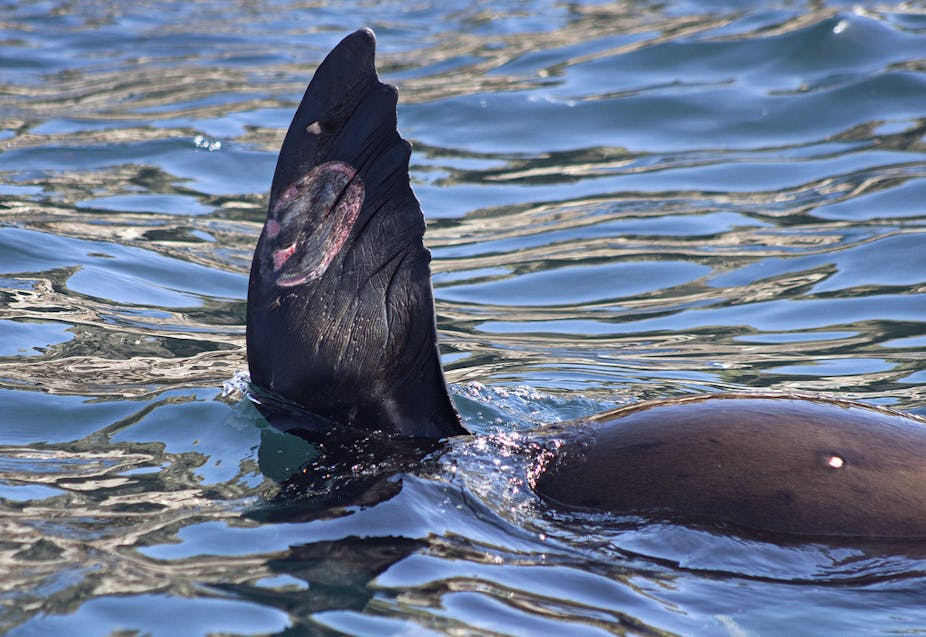
Seals are attracted to an easy feed: trawler nets provide this. While seal exclusion devices (SEDs) are fitted to nets, some seals inevitably fail to escape and drown.
However, the small trawlers will likely kill more seals – for the same tonnage of small pelagics – than the large Abel Tasman would have. While the super trawler’s net would have trapped seals, it would have been more effective at reducing seal deaths because of design improvements made to it compared with the devices fitted on the smaller trawlers.
Underwater cameras have shown that more seals meet their demise in mid-water trawl nets of the small trawlers than was previously thought. This is because the dead ones roll out of the net unseen during hauling. There is considerable scope to further refine the orientation, size and scope of seal exclusion devices. But crucial trials to find optimum devices have not taken place, due to lack of funding.
Bycatch is not a plausible reason for selectively banning the Abel Tasman. The Commonwealth’s South East Trawl Sector, with many more vessels, is already far more destructive than the Small Pelagic Fishery.
The South East Trawl Fishery interacts strongly with – that is, kills – the protected Australian fur seal and, to a lesser extent, the Australian sea lion (Neophoca cinera). This species is listed as vulnerable under the EPBC Act.
Between 1993 and 2000, the Scientific Monitoring Program suggested that an average of 720 fur seals are caught incidentally by the small trawl vessels in the South East Trawl Fishery each year. (The Abel Tasman, had it been allowed to fish, would have had its activity suspended any time it caught three fur seals.)
Compared with large vessel operators, who are well resourced, the operators of the smaller vessels or “wet-boats”, are constrained in applying mitigation methods such as seal exclusion devices. Recent trials of a flexible SED design have been relatively successful, but reliably estimating and reducing the level of interactions between seals and wet-boats remains an issue.
Conservation groups have been slow to grasp the South East Trawl nettle. Perhaps they are worried about the consumer backlash if flathead supplies to Sydney and Melbourne were diminished. There was no such risk in calling for a ban on the super trawler catching sardines for export.
The factory ship operation will be economically efficient in allowing the small feeder vessels to continuously fish. Moreover, it will be sustainable in the sense that the quota is very conservative, compared with other Commonwealth fisheries, representing only a small fraction of the biomass of the small pelagics.
If the factory ship is banned, consistency demands a moratorium in mid-water trawling elsewhere.
If there is no ban then there will be seal deaths. But this would be more acceptable if it was accompanied by the announcement of a major effort by the Commonwealth to seriously address the issue of bycatch in its trawl fisheries.
David Clerke
Teacher
I think it naive to think the issue will be decided on its merits, Getup and the like will want to excercise its muscle again and we have an election year. Labor will have to face the electorate and this may seal (no pun intended) their fate.
John Newton
Author Journalist
Here's what line fisherman Mark Eather thinks of trawling - any sort, large or small (from an article i wrote for the SMH):
And don’t get him started on demersal trawling, a method of fishing which drags a net along the bottom of the ocean, catching any fish that get in its way.
“There’s a big gorgeous mountain at the back of Hobart, Mount Wellington. If someone was to put a big steel rope up the face of that mountain from one end to the other and put a team of bulldozers at the bottom, and…
Read moreWhyn Carnie
Retired Engineer
This super trawler or one like it was recently used in South Africa by Chinese interests to completely wreck the annual massive pilchard runs. The destruction was caused, not by the trawler itself, but by the Government in its licence conditions. They permitted the catch while the pilchards were on the outward Easterly run, thereby taking the ready to spawn fish in the wrong part of the cycle. Simple stupidity or greed?
Anyway, I would not expect our Government to stand up any better in negotiations for issuing a licence for its operation in our waters. Best to ban it rather than try it.
Thomas Cobban
BSc. MEnvMan.
The fact is that the Australian government doesnt make fisheries management decisions lightly. A hell of a lot of scientific research goes in to fishery management plans before quotas are agreed upon. The science is all on the AFMA website for public review.
http://www.afma.gov.au/managing-our-fisheries/fisheries-a-to-z-index/small-pelagic-fishery/publications/
Wade Macdonald
Technician
While I still see this operation as risky territory for Australian fisheries, I will be much happier seeing small local operators keeping their jobs (as in this situation) than seeing a monopoly develop where Seafish Tasmania buy out everyone else.
I guess we will just have to trust AFMA to police and regulate this venture well despite the fact Gerry Geen is on the AFMA board and owner of the vessel.
Super trawlers have a bad reputation so AFMA have their work cut out for them in ensuring sustainability and hence an absence of public backlash if localised stock depletion occurs.
Andy Saunders
Consultant
Oh boy, here we go.
Wade, Gerry Geen is not on the AFMA board. See http://www.afma.com.au/structure/directors.html
Sustainability comes from the fisheries management processes, not the size of the vessel that refrigerates the catch...
Wade Macdonald
Technician
My apologies Andy if that was incorrect or old information?
Quote...."Sustainability comes from the fisheries management processes, not the size of the vessel that refrigerates the catch..."
My concern is that the capability is there and AFMA have to be on the ball in managing these processes as my last sentence alluded to in my initial post.
Wide gaps in stock assessments etc are often the cause of unsustainability especially when offshore extraction/freezing capacity is fast and quotas are not adjusted soon enough.
I am prepared/interested to sit back and see if AFMA can maintain effective control of this venture, as too many times elsewhere on earth this sort of offshore factory fishing has been far from sustainable.
Best of luck with it if you are involved.
Wade
Nev Norton
Farmer
Yes exactly Andy, and if this venture goes ahead it will be perverse in that seal mortalities will be significantly higher than if the Abel Tasman did the job on it's own. No doubt the Co2 emmissions will also be higher.
It would really be yet another case of a slow handclap for the Engo's.
However given that Burke who seems to be led around by the ear at the hand of the engo's and does their bidding it will quite likely be banned.
Andy Saunders
Consultant
I'm pretty sure Gerry Geen has never been on the AFMA board.
Given there would have been (and presumably might still be) 100% observer on-board coverage, I think AFMA would react remarkably quickly if there was a problem.
The extraction capacity hasn't been changed at all - same nets as available now/previously. Sure, more freezing capacity, but that's really just to enable a high added-value - human food rather than bait.
David Arthur
n/a
The centuries-long history of fishery collapse in the North Atlantic does not engender confidence in fishing equipment the Europeans devise, especially if it is designed to be "bigger and better"; "bigger" is easily observed, but "better" requires decades of assessment.
Andy Saunders
Consultant
Non-quota fisheries in the North Atlantic are a very far cry from the Australian ITQ systems.
Besides, the proposal as per the article is for the big boat to not fish at all, just be a refrigerator.
Can't see how your comment is relevant.
David Arthur
n/a
My comment is relevant because if they want to bring a refrigeration vessel here, they'd bring a refrigeration vessel, not a super trawler.
That they are now conniving to bring a super-trawler here, under cover of some other use, speaks volumes.
Nev Norton
Farmer
David, the Abel Tasman is sitting idle at dock, In Australia. The Abel Tasman is a multi function vessel. thats why it's the size it is. Why would anyone in their right mind want to bring in another vessel, when they have one that is sitting idle and can fullfill that role. I would call it smart business, in that it seeks to utilize a legal quota and they can at least get some return on that asset that is currently idle.
Andy Saunders
Consultant
They did bring in a refrigeration vessel. It just happens to have some relatively modest trawl gear on the back. They have trawl equipment already in use (and have had for some years) that is larger than the Margiris/Abel Tasman.
Far from conniving, it seems they followed the absolute letter and spirit of the law. The deliberations seem to be quite public and transparent (they are on the AFMA website). And for a definite, stated, lawful use. That is, until a new law had to be introduced. Speaks volumes... of predilections for conspiracy theories.
Thomas Cobban
BSc. MEnvMan.
In regards to fishery sustainability, It's not the super trawler that matters here. What matters is the; 1) quota size in comparison to biomass, 2) the effectiveness of enforcement of quotas and 3) the effectiveness of establishing the state of the fishery. If the fishery can be exploited economically and sustainably, as well as regulated tight and transparently - then it doesnt matter if its a fleet of small trawlers or a single super trawler, the outcome is the same.
Their are many other Australian fisheries under imminent threat - the Southern Bluefin Tuna for one (depleted to something like 5% of its original biomass), even if regulated through international treaties, it does not mean Australian lobby groups cant market the issue to push for stronger public and government action.
Wade Macdonald
Technician
Hi Thomas,
As Brian Jefferies pointed out on here a few days back under the endangered species series for SBT, the models were 28% below the actual biomass increase at last assessment.
Industry, scientists and government are all still deciding what to do about this new stock level and all are treading carefully.
Garry Baker
researcher
Yet another blow at driving in the thin edge of the wedge - Indeed, they are at it again
Doubtless the government may have discovered the real ownership of this so-called local fishing operation - "Seafish Tasmania" - and found it's almost an entirely foreign owned venture. Two New Zealanders own three quarters of Seafish Tasmania , and their CEO Gerry Geen, 10%, at best. However, the company - Seafish Tasmania, is really just a front office serving more important players. A Dutch company wholly…
Read moreNev Norton
Farmer
Garry, given that Australia imports ~70% of our seafood requirements some of that desertification is attributable to us.
We can"t shut down our own fisheries and say look how good we are. All we are doing is shifting the problem and putting increased pressure on the rest of the worlds fisheries.
Garry Baker
researcher
Granted Nev, our own demands may be contributing to desertification, however there's never been a suggestion about shutting down our local fisheries. More to the point, manage them for a long term haul - Albeit, perhaps in an inefficient manner compared to the owners of these factory ships who actively search the world for large scale harvesting in a business that's doomed to extinction. Indeed, a cursory glance at the worlds remaining fisheries indicates their business model now belongs to a past…
Read moreAndy Saunders
Consultant
Doubt Seafish Tasmania is a front - it's been based in and employing people in Triabunna for years - maybe decades - catching and processing pelagic fish...
Deserts? The DEPM survey showed far from that.
Nev Norton
Farmer
Garry, I remain far from convinced that there is any truth to the statement " however there's never been a suggestion about shutting down our local fisheries." I believe thats exactly where the Engo's are taking us. I also believe it's happening right now, little by little, piece by piece. I've read sufficient of what I could only describe as propaganda and heard enough anecdotal evidence to have little doubt.
Read moreTake ex Greenpeace co founder Patrick Moore who said "The truth is Greenpeace and I had…
Garry Baker
researcher
Ah, the doom and gloom report from an independent - a paper co-authored by Bob Kearney, who was a director of AFMA for more than five years, and for the first three he served with Stuart Richey, Chairman of AFMA.-. The same Stuart Richey who went to join the board of Seafish Tasmania.
Nev Norton
Farmer
Garry, I'm not understanding your reasoning here. You are sounding like an activist, of the type Patrick Moore would describe as Anti-science, Anti-business, Anti-human. AFMA is a commonwealth government statutory authority. So what if someone (Richey) who also served on the board moved on to a paid position in private industry, hardly an uncommon thing to do, nor did Richey write the paper.
Andy Saunders
Consultant
Garry, I guess Stuart Richey is a foreigner then, seeing that you believe Seafish Tasmania to be a foreign front? (not that being a foreign front is illegal...). Besides, are Kiwis really that "foreign"? They are possibly Australians - have you read the Australian constitution?
Wasn't aware that Stuart Richey was on the Seafish Tasmania board - where did you get that from?
AFMA has five legislative objectives (see http://www.afma.gov.au/about-us/functions-and-powers/), all of which would benefit from having board members with fishing industry experience. Actually, now it has transformed into a commission, it doesn't have board members any more, and the commissioners no longer have commercial fishing experience (but most do have extensive fisheries academic/management experience). I think AFMA would actually benefit by having some commercial expertise...
Garry Baker
researcher
As of July 2012
Stuart Richey
Independent Chairman: Past Chairman and Board member of AFMA. Current Board member of the Fisheries Research and Development Corporation, successful Australian fishing company owner.
Though he's not the only Richey connected to the business - it's more of a family affair... others are involved
His nexus to the supposedly independent Bob Kearney is the problem, not the issue that he changed occupations. Kearney/Richey, and the old boys network, if you like…
Read moreAndy Saunders
Consultant
Yes, Stuart Richey is well connected in the fishing world. You'd hope an AFMA board member would be well connected. There is indeed a bit of an old-boys network in the commercial fishing world, as there is in any small industry I guess.
But where did you get that Stuart was on the Seafish Tasmania board? I wasn't aware that he had any interest in Seafish, please enlighten me.
In a typical Australian quota fishery like the SPF, you need two vital things to catch fish - the vessel/gear, and the…
Read moreAndrew Caddle
logged in via email @netbay.com.au
Immediately prior to the vigorous debate surrounding the proposed use of the Margiris within the small pelagic fishery, Seafish Tasmania had a website which, amongst other things, listed the 'credentials' of its Board Of Directors. Mr Garry Baker's information ... "Stuart Richey
Independent Chairman: Past Chairman and Board member of AFMA. Current Board member of the Fisheries Research and Development Corporation, successful Australian fishing company owner. " .... appears to be directly quoting that website.
I hope this is enlightening enough!
Interestingly, the Seafish Tasmania website disappeared at about the time when the public debate began to heat up.
Michael Kennedy
Campaign Director at Humane Society International/Wildlife Land Trust
The deaths of so many fur seals is if course completely unacceptable, and conservation organisations have made their case to Government for disallowing the new proposal from the owners of Abel Tasman. The EPBC permits the Minister to enact a prohibition where he or she sees fit. AFMA itself can also take action, and while it took an HSI application to the Commonwealth Administrative Appeals Tribunal, a drawn out mediation process, and even longer post negotiations, HSI was able to convince AFMA to close fisheries taking Australian sea lions. The Coalition Government subsequently removed the public's right to make "merit" challenges in the courts (a position that the Labor Government now supports) but there is enough public and political moment to finally stop such appalling bycatch - one way or another.
Andy Saunders
Consultant
Michael;
Whilst your comment sounds good, it is misguided. Banning the Abel Tasman means that less efficient pelagic fishers will likely do more of the fishing and kill more seals/sea lions. The Abel Tasman (as originally proposed prior to the law change) would have had extensive Seal Exclusion Device trials and 100% SED coverage, with 100% AFMA observer coverage.
Changing the law means that more, smaller, unsupervised mid-water trawlers will be used, with predictably more pinniped bycatch.
Law of unintended consequences...
Colin Hunt
Honorary Fellow in Economics at University of Queensland
Michael, The point of my article is that there is far more mammal destruction going on in the South East Trawl than in the Small Pelagic Fishery. While trawlers in the the SPF don't interact much with sea lions the SET trawl does, and also causes the deaths of far more seals. This situation surely has policy implications with respect to the mid-water trawl generally.
Andrew Caddle
logged in via email @netbay.com.au
Can somebody please enlighten me?
It was my impression that the previously existing Total Allowable Catch quota within the Small Pelagic Fishery was actually significantly under-utilised, due to the limited value of the catch (something like 2,500 tons total actual catch). The effect of AFMA issuing an 18,000 ton per annum INCREASE in the total quota, coupled with the liklihood that Seafish Tasmania would then buy up all those other under-utilised quotas, means that the actual annual take within…
Read moreAndy Saunders
Consultant
TAC setting is (properly...) set by scientific measures rather than anecdotes. The fish are there... the DEPM is pretty robust.
Almost by definition, a highly migratory species has an ability to resist localised depletion. Normally (and I think this is the case with the SPF) zones are based on distinct stocks, in turn these days decided by genetic differences. That's a pretty robust method also.
What perhaps some people don't realise is that any fishing operator doesn't want localised depletion, especially if they have a very mobile (large...) vessel - they'd rather go where the fish aren't depleted rather than overfish a small area...
Garry Baker
researcher
Andrew Caddle said -- "" that leaves people like me gravely suspicious of the competence of our 'experts'."
Experts" may not be the right term - "Faciltators" maybe. Perhaps akin to various State Forestry Services, where in the past there's been an assumption their role is to care for, and manage native forests - when in truth they serve as commercial arm of government in order to keep the coffers topped up. Anyone who has seen a clear-felled area in an old forest will leave with an impression…
Read moreAndrew Caddle
logged in via email @netbay.com.au
Mr Saunders, with respect, your assertion that the "TAC setting is (properly ...) set by scientific measures rather than by anecdotes' ...... is a statement of your opinion. Personally, I would rather decide for myself, what is 'proper'. I'd like to think that any scientific research would at least consider ANY evidence or data that was possibly relevant to its enquiry.
Are you saying that the 'evidence' of observation by local fishermen over an extended period should be ignored? We should…
Read moreAndy Saunders
Consultant
Mr Caddle,
Whilst anecdote has its place, I doubt it should have much weight placed on it during TAC-setting processes. After all, we know (anecdotally) that fishermen tend to exaggerate. If you relied on the anecdotes of commercial fishermen operating in the fishery, then you would probably set the TAC too high, if you relied on rec fishermen then probably too low (I'm speaking in general). Your point about self-interest is correct - it also applies to fishers. Science is generally the better…
Read more