
This week’s hoax email from an anti-coal activist, Jonathan Moylan, highlights an emerging issue in land-use conflicts both in Australia and internationally. Activists, and in many instances, communities, feel increasingly compelled to engage in extreme actions to have their voices heard.
Within a regulatory regime that prioritises development interests, and provides limited opportunity for independent arbitration of development decisions, this is hardly surprising.
The mining boom has created unprecedented land use conflicts, particularly in rural and regional Australia. Agricultural communities and environmentalists are engaged in disputes with mining and gas companies over the use and management of natural resources. In many cases, these conflicts have eluded resolution.
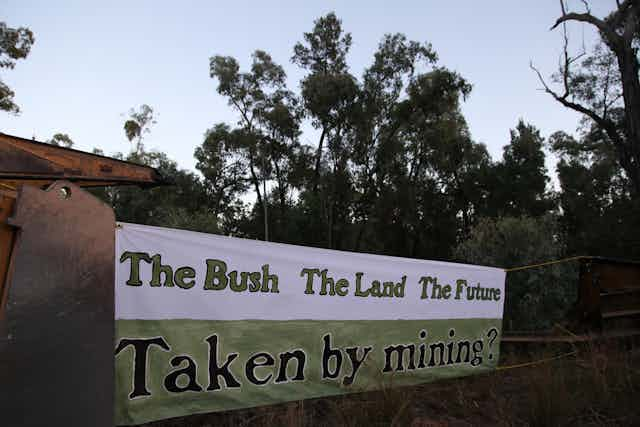
The Maules Creek mine, near Narrabri in the north-west of New South Wales (and the subject of the aforementioned hoax email), is one such conflict. The proposed 2,000 hectare greenfield open-cut coal mine project sought to clear more than 1,300 hectares of the Leard State Forest. The forest is a high conservation wildlife habitat, and is home to such threatened species as the Masked Owl, as well as 1,500 hectares of critically endangered Box Gum woodland (some 700 hectares of which would be cleared for the proposed mine project).
Leard State Forest was previously mapped in the NSW Government’s draft Strategic Regional Land Use Plan as high conservation value land to be protected from further biodiversity loss. But this was not reflected in the final plan.
As the constitution does not list minerals as an area of federal government jurisdiction, the states and territories regulate mine development consent. In New South Wales, mining leases are granted under the Mining Act 1992, and development consent for mining activities is granted under the Environmental Planning and Assessment Act 1979 (EP&A Act).
Under the Mining Act, any person can lodge an objection to a mining lease. However, this entitlement is lost where development consent is required under the EP&A Act and objectors have already had the opportunity to raise concerns during the development application process. Most mining activities are considered large-scale, state-significant developments for which development consent is required. So public opposition to mine development is usually raised under the EP&A Act.
Following public notice of a development application, there is an exhibition period in which any person may lodge a written objection to the project. It is critical that objectors raise their concerns during this time, as rights to appeal decisions to the Land and Environment Court are only available to those with objector “status”.
The Planning Assessment Commission (PAC) usually determines more contentious applications from private developers. The EP&A Act requires that the decision maker take into account environmental and social impacts of the development, any public submissions, and the public interest.
The public has different appeal rights against determinations than development applicants have. Objectors can only seek to have the decision reconsidered if they have made a written submission during the public exhibition period. They have 28 days in which to lodge their appeal. However, where the PAC conducts a review of an application that includes a public hearing, this avenue of appeal is extinguished.
Under request from the minister, the PAC conducted a review of the Maules Creek mine project, including a public hearing in November 2011. Objectors raised many concerns about the environmental impacts of the project, including the clearing of significant endangered woodland and resulting biodiversity losses. The PAC acknowledged these in their final decision, but determined that the project could nonetheless proceed with certain conditions in place to offset biodiversity loss.
Adding insult to injury for already angered community and environmental groups was a ministerial request that the PAC hold a public hearing as a part of their review that closed off any opportunity to lodge a merits appeal with the Land and Environment Court. Some felt that the right to appeal to the independent umpire was deliberately circumvented.
In their deliberations, PAC were careful to note the concerns raised by community and environmental groups. But ultimately the project was approved with conditions many feel are inadequate to protect both environmental and community welfare. With no right to appeal the decision, other avenues to voice discontent with the determination have been sought.
Despite recent reforms, the planning regime in New South Wales still attracts much criticism.
It is accused of being a top-down framework that facilitates development and delivers royalties to government at the expense of environmental and social concerns. The Environmental Defender’s Office has previously argued that the regulatory framework for mining must enshrine guaranteed rights of community consultation through increased legislative requirements for public input, and greater access to merits appeals and judicial review.
Such reforms would give members of the public more ability to raise their concerns over development projects. Reforms would arguably reduce the need to resort to civil disobedience (or worse) to make concerns heard.
The regulatory framework for mining development fails to meet the expectations of the public, increasingly driving some to take alternative direct actions. This week’s hoax email case demonstrates that when we rely on legal arrangements that simplistically consider the role of communities and the nature of land use conflict, we create the potential for adverse consequences. We need to think more creatively about how communities and resource users resolve disputes, as land use demands will only increase in intensity and complexity.
James Jenkin
EFL Teacher Trainer
One person doesn't like the system, and breaks the law, and this shows we have to change the system?
Neil Gibson
Retired Electronics Design Engineer
The planning system can't cope because it doesn't give the right decision? Whose right decision ? People under a democratic government feel inclined to EXTREME protests when the decision goes against them and to the writer this is hardly surprising. Terrorists also feel inclined to extreme protests when they disagree with a government and it is hardly surprising when they start planting bombs.
"The regulatory framework fails to meet the expectations of the public" says the writer as if Moylan is representative of the Australian public which maybe he is to the left-wing " intelligentsia" but to mainstream Australia who knows our wealth comes from mining he is a fool. He disagrees with a democratic government elected in a landslide and breaks the law to prove his point so the government should make a point and jail him for ten years to make their point and he should make restitution for money lost due to his fraud.
Chris Owens
Professional
So to summarise, the deck is stacked so extractive industies can and will do whatever they want and the rest of us can suck it up.
Grant Burfield
Dr
Something of a disappointment in the hoax stakes. Not very subtle, completely lacking in humour, too short a time frame and the potential for prosecution. These youngsters could have learnt a thing or two from the late, lamented Alene Composta.
http://www.abc.net.au/unleashed/45638.html
Robert McDougall
Small Business Owner
Australia wide, the legislation governing the whole approval process for resource projects was essentially written by.. you guesssed it... the resource industry and its lobby groups happily supported by politicians who, when they leave/are booted out, hope to get well paid cushy jobs with.. resource companies (look at the whos who of nsw and qld politicians now working for csg/coal companies).
I've personally thought that there is a massive conflict of interest when the state is the approver…
Read moreNeil Gibson
Retired Electronics Design Engineer
Robert
You talk about the State as if it has nothing to do with it's citizens but in a democracy it actually represents them. You cannot make an omelette without breaking eggs unfortunately and every new road ,bridge ,power station, power line, mine or factory is going to disadvantage someone. The nimby principle is alive and well in this country and that is normal but governments are not there to just make easy decisions. That said I believe that CSG and similar operations should pay some royalties to the landowners which would go a long way to defusing the issues. That seems common sense to me.
Robert McDougall
Small Business Owner
Neil,
I think you may be aware that anyone that actually believes the State represents its citizens could be accused of being naive, and what we have could not actually be called a democracy, if it was, then the systems would be set up to take greater account of what the citizens themselves are asking for.
I understand that any kind of development is going to have pros and cons, but when the decision making process is set up to highlight the pros and hide or externalise the cons, than that…
Read morePeter Brennan
Academic Director
Neil Gibson, you claim that the state represents its citizens in a "democracy". How then do you explain the fact that 87% of Lismore residents voted against CSG exploration and mining at a plebiscite at the last local government elections and yet all the local members of state parliament still support CSG? The answer is clear: the state represents the corporate interests that fund the politicians of both major parties and that threaten politicians with massive campaigns of disinformation if they…
Read moreMeanwhile .....
logged in via Twitter
Neil, shouldn't you be publicly acknowledging your links to the mining industry lobby?
Neil Gibson
Retired Electronics Design Engineer
I would not like to have mining next door so nimby is alive and well with me. Unfortunately our country's manufacturing base is declining to zero and mining is the only thing keeping the country afloat .
Read moreTytler cynically said "A democracy is always temporary in nature; it simply cannot exist as a permanent form of government. A democracy will continue to exist up until the time that voters discover that they can vote themselves generous gifts from the public treasury. From that moment on, the majority…
Suzy Gneist
logged in via Facebook
Neil, I urge you to look a little closer at what is considered a "democracy" currently in the western world. As a system it actually works from the top down, when it should work from the bottom up. Having a vote once every 4-5 years to choose between a group of hierarchically structured 'parties' (supported by a hierarchically structured bureaucracy) with little chance for participatory say and action is a far cry from what democracy ideally stands for. Many who do not vote or live in this democracy…
Read moreNeil Gibson
Retired Electronics Design Engineer
I wish- I would be able to augment my retirement income then :).
Neil Gibson
Retired Electronics Design Engineer
At the end of the day each of these parties have to eventually face the people in an election. I agree that is a flawed system mainly because people actually get what they want which is more of everything and that is unsustainable financially. You say that business has a great say in government which is proper because it is only business that provides productive jobs in a sense of generating wealth which pays for the welfare of our citizens. The past models you refer to are actually working and sustainable but not according to your political philosophy. If you want to study doom-sayers start with Paul Ehrlich and his predictions all the way to the present global warming catastrophists . According to Ehrlich today's world shouldn't exist and his modern AGW Cassandras are flailing around to explain a 16 year hiatus in their calendar of doom. Prophets should not make prophesies which can be disproved in their lifetimes.
Suzy Gneist
logged in via Facebook
I disagree with your statement that "people... get what they want" because the preferential voting system makes sure that whatever they want will only ever go to the large parties - so even if each 10% of the population voted for 1 out of 10 minor parties/groups, these votes would be transferred to parties they did not vote for due to the two/three major party system available. The dialectic in government plays out through opposition and division, not in deliberation between many varied groups (as…
Read moreBernie Masters
environmental consultant at FIA Technology Pty Ltd, B K Masters and Associates
Robert, you state: "Australia wide, the legislation governing the whole approval process for resource projects was essentially written by.. you guesssed it... the resource industry and its lobby groups happily supported by politicians". Bollocks! In WA, the state that exports more minerals than virtually all the other states combined, the Mining Act gives an absolute power of veto to landowners of productive land. The Mining industry has opposed this for decades but politicians have always retained it in legislation so, in WA at least, your claims are patently incorrect.
If people concerned about the spread of new mines in the eastern states really wanted to balance up the power between miners and the community, they should be pushing for just one legislative change: to give the owners of productive land the same power of veto that exists in the west.
Robert McDougall
Small Business Owner
We have heard about an agricultural veto, but it's more mythological than a unicorn. In practice, the veto you mention has no teeth. The only real avenue for input provided to the public is through the environmental process and recent changes introduced to the EPA act in 2010 tried to limit that input by limiting comments to one paragraph on the EPA website.
Our area has been this process recently iincluding appeals and the wardens court, where we were told our arguments (I.e. social, economic and amenity) were 99% irrelevant at law.
So your assertion that this "veto" is an absolute, is laughable, as never once during the whole process including a major law firms legal advice was it ever brought up as a realistic option.
Is this a case of theory vs the real experience?
Bernie Masters
environmental consultant at FIA Technology Pty Ltd, B K Masters and Associates
Robert McDougall, I think you need to find better lawyers. Section 29 (2) of the Mining Act states:
Except with the consent in writing of the owner and the occupier of the private land concerned, a mining tenement shall not be granted in respect of private land —
Read more(a) which is in bona fide and regular use as a yard, stockyard, garden, orchard, vineyard, plant nursery or plantation or is land under cultivation; or
(b) which is the site of a cemetery or burial ground; or
(c) which is the site…
Robert McDougall
Small Business Owner
Exactly Bernie, the top 30m of land.
However typically the mining companies aren't that interested in the top 30m of land, they want what's deeper down. The mining act also guarantees miners access to that land to explore and mine and the land holder has the right to negotiate a land access agreement or get taken to court to impose such. The landholders neighbor who may not have the mine surface footprint on their land has no say, although also potentially impacted.
So in summation yes there is a veto, for the productive use for the top 30 meters, but the landowner is required by law to provide access to mining companies to explore, construct facilities and mine on the surface of their properties.
Something you obviously were aware of when you replied, so when dealing with a coal mine at greater than 30 m depth, the veto is irrelevant.
Bernie Masters
environmental consultant at FIA Technology Pty Ltd, B K Masters and Associates
Robert, can you please advise which section of the Mining Act requires landowners to provide access to a mining company against their will? I'm not aware of such a provision in the Act and, as Section 29(2) states, no mining activity can take place except with the explicit permission of the owner and occupier. And I've never heard of a landowner being taken to court to have mining company access imposed upon their private land if they have objected to the grant of a mining tenement as it applies…
Read moreRobert McDougall
Small Business Owner
Ok Bernie, I think we need to clarify something. I am referring to Mining activities below th 30m level. While I dig up the section of the Mining act that requires land holders to provide access to the surface re leases below the 30m level, can you outline the rights of the lease holder to gain access to the surface for the purposes of exploration below the 30m mark and the rights to construct facilities to access such resource?
To be clear, the rights of access for a tenement below 30m to the surface land.
Bernie Masters
environmental consultant at FIA Technology Pty Ltd, B K Masters and Associates
Robert, If a landowner allows a tenement application to be granted over his or her property's surface and subsurface (above and below 30 meters), then by law they must allow access to the mining or exploration company so that exploration or mining can take place.
Read moreIf however the landowner has objected to the grant of surface rights above 30 metres and been successful for any of the reasons listed in section 29(2) of the Mining Act, then my understanding is that there is no legal ability of a mining…
Robert McDougall
Small Business Owner
on a second note, i wonder why the legislation is rigged the way it is? If you factor in all the externalised costs, would they still be considered worthwhile?
Robert Crocker
logged in via LinkedIn
Thanks Amanda, for a balanced account of a typical Aussie-style planning fiasco. You could have been describing our (urban) planning regime in South Australia, where I am sure others will sooner or later be tempted to mount such a media hoax. Our system also has a complex chain of state-based authorities, and much of the system is similarly manipulated by the minister in response to the economist-ic 'urgency' of the development's supposed benefits. Where these benefits prove illusory or come at a…
Read moreAnthony Nolan
Ruminant
Thanks Amanda that's a comprehensive review of the state of play around this stuff in NSW.
NB editors: more articles like this, please. With good, factual reviews that detail the specifics of the individual battles it is much easier to stay in touch with developments.
Philip Dowling
IT teacher
A few points concern me.
"The public" is a term freely bandied around in this article. It is noted that "the electors" would appear to be a completely different group.
It would appear that some consider the law is only to be followed when they agree with it.
The slowing down of all kinds of developments has opportunity costs for the community, in terms of lessened state and federal revenue.
This particular issue is presented with no broader context. The proportion of the state which is now national park for example is not mentioned.
"The regulatory framework for mining development fails to meet the expectations of the public, increasingly driving some to take alternative direct actions" includes dangerous logic, which could lead to all sorts of illegal actions.
Amanda Kennedy may have forgotten about a similarly driven person, Anders Brievik.
http://en.wikipedia.org/wiki/Anders_Behring_Breivik
Thomas Brookes
Founder of the Australian Independents Movement
Philip Dowling, you cant be serious to compare what Jonathan Moylan did to what Anders Brievik did.
Meanwhile .....
logged in via Twitter
Godwin's Law needs updating.
Philip Dowling
IT teacher
Thomas, I was not comparing actions but logic. The notion that a personal exemption from the law applies if one is motivated by a perceived higher morality can lead to the justification of all sorts of actions. To encourage those actions because one personally agrees with the aim is also questionable.
I chose Breivik as an extreme example of where such a path might lead.
One can find many others across the poitical spectrum. 9/11 bombing, the Unabomber, the Brigate Rosse, Aaron Swartz, Symbionese Liberation Army, Holsworthy Army Base conspirators.
None of these were motivated by greed but by beliefs.
Robert McDougall
Small Business Owner
as far as I know there are no personal exemptions from the law. Moylan still has to face the court over his actions.
My point was that when people are desperate and backed into a perceived corner, they can do unexpected and desperate things.
This can play out in a wide number of ways, from stealing a loaf of bread to feed your children to the actions you highlight.
Ken Fabian
Mr
Doing the least possible about the climate and emissions problem will remain the primary policy motivation of Liberals, Nationals and Labor too. So if the greatest environmental problem of all time isn't enough to bring them to restrict the expansion of mining of fossil fuels it's no surprise community concerns have so little impact.
At best climate and emissions are something to give lip service to whilst taking care not to impact the mining and energy industries in any significant way. At worst…
Read moreAndrew Duffy
logged in via Twitter
"Activists, and in many instances, communities, feel increasingly compelled to engage in extreme actions to have their voices heard."
This is hardly an "emerging issue". It has always been the case for some activists to act this way. Christine Milne said herself that Moylan's actions were part of a long line of similar civil disobedience.
I agree with some of the other comments here in that Moylan and his cohort are hardly speaking on behalf of the majority of Australia. Perhaps we can take a look at the approvals process in QLD and NSW, but surely let's keep Moylan + the out of control emotion out of it.
Suzy Gneist
logged in via Facebook
"I agree with some of the other comments here in that Moylan and his cohort are hardly speaking on behalf of the majority of Australia." < the reason may be that the majority is largely ignorant about the issues and traditionally all change is initiated by an initial minority or individual - one cannot have an educated opinion on something one doesn't know anything about. In effect, environmentalists are speaking on behalf of all species, incl. humans, even if these do not realise it ... yet.
Suzy Gneist
logged in via Facebook
take out doubled 'initial', sorry can't edit post ;)
Philip Dowling
IT teacher
Karl Marx might accuse you of plagiarism, if he were still around. Eerily similar to his thoughts. At least he was prescient and self-aware enough to realise that he was part of the dialectic.
Unfortunately, these thoughts seem to echo the ideas of Pol Pot rather than Karl Marx.
The great unwashed ... the proletariat .. the uneducated .. the self=proclaimed environalmentalists.
Luke Weston
Physicist / electronic engineer
"Community concern" is OK, as long as activists stay within the law (which is not the case here) and elucidate their concerns in a civil, rational, peaceful, law-abiding fashion without vandalism economic or otherwise.
Also, note that you can't replace science-based, evidence-based assessment (for example of environmental assessments) with low-quality science, pseudoscience or antiscience and get away with that in the name of "community concern" and activism either.
wilma western
logged in via email @bigpond.com
Good to read an article dealing with the planning and approval maze tackled by opponents of coal mining and CSG exploration licences. Victorian communities have only recently become involved when the gas rush under way in Queensland and NSW spread south.
The Senate 4-party committee dealing with CSG mining and exploration , also including Tony Windsor seems to be in furious agreement that exploration companies have treated landowners shabbily , that the environmental impacts of CSG exploration…
Read more