Who pays for conservation in the world’s biggest tuna fishery?

The world catches too many tuna. Thanks to our high levels of fishing, some tuna species are under threat. Everyone involved in the fishing industry agrees that fishing effort needs to be reduced. But no one can decide who should bear the burden of cutting back their fishery. This week the Scientific…

Zgrtfzz5-1344216708
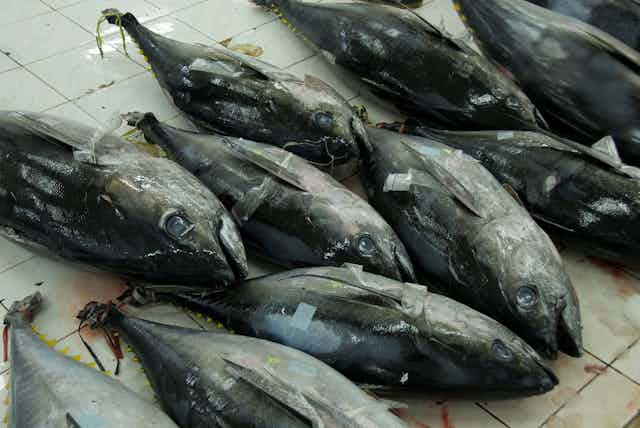
Tuna fishers agree that too many tuna are caught. But there is no good system to decide who should catch less. Justin Woolford

The world catches too many tuna. Thanks to our high levels of fishing, some tuna species are under threat. Everyone involved in the fishing industry agrees that fishing effort needs to be reduced. But no one can decide who should bear the burden of cutting back their fishery. This week the Scientific Committee to the Western and Central Pacific Fisheries Commission (WCPFC) meets in Busan, Korea to try once more to reduce over-fishing.

The WCPFC is the globally mandated regional fisheries management organisation for these tuna fisheries. It is required to adopt conservation measures that ensure the long-term conservation of the region’s tuna fisheries. These measures are then legally binding on the WCPFC’s member States (including Australia).

The WCPFC faces a complex conservation and management challenge. Previous scientific assessments found that we need urgent action to address overfishing for some species of tuna. We must also develop precautionary limits for others. Otherwise, the world’s largest tuna fishery will decline in productivity and value, wasting a critically important resource and leading to key species becoming overfished. Such a management failure would first impact on the vulnerable bigeye tuna, then yellowfin and albacore, and lastly skipjack. Even the highly productive and resilient skipjack has sustainability limits.

The conservation challenge is complicated by the multi-gear, multi-species and trans-boundary characteristics of these tuna fisheries. Each species of tropical tuna is caught by each gear in a tightly inter-meshed manner that is difficult, if not impossible, to separate. It’s no one fishery’s problem; everyone has to work together.

Tuna fishing is a tangled web, but tuna conservation relies on figuring it out. Quentin Hanich

The WCPFC has struggled to address this challenge since its was established in 2004. Every single session of the Scientific Committee has advised the WCPFC to reduce overfishing, and every meeting of the WCPFC has responded with measures that are insufficient to implement the scientific recommendations.

The key obstacle to adopting a sufficiently strong conservation measure is the difficult negotiation over how the burden of conservation is distributed. Given current levels of overfishing, some or all WCPFC member states must necessarily compromise their interests and carry some share of the conservation burden.

If serious conservation measures are introduced, it will affect some of the developing small-island states that depend significantly on tuna fisheries. Many of these states have strong aspirations to further develop fisheries' benefits. Some of these states may have few other development and resource options: conservation could give them a relatively higher economic and social burden compared to other states with diverse resources, large institutions and substantial revenue streams from multiple economic activities.

Many small island states have planned their future around fishing. Quentin Hanich

Under international law, the WCPFC has to make sure that conservation measures do not transfer a disproportionate burden of conservation action on to developing states. But the WCPFC does not transparently study how each of its potential management options would distribute the conservation burden.

Instead, the WCPFC addresses deeply political and economic arguments using a scientific framework. This framework then becomes politicised: members favour scientific assessments for measures that best protect their own interests, and refute scientific assessments when they compromise their interests.

Ultimately, the lack of a framework to address political and equity considerations undermines the fisheries science, while still leaving the political and economic questions unanswered.

The WCPFC should adopt a new approach to distributing the conservation. It should transparently answer the important equity questions that are fundamental to conservation negotiations. This new system would provide concrete steps that explicitly determine what conservation burden each state would carry depending on their national characteristics. This would modernise fisheries management, making it more consistent with broader developments in common resource management. We can see this approach now in climate change negotiations, where there are principles of differentiated responsibilities between developed and developing states.

Let’s look at an example: how do we decide how to reduce catches? Should a historically high level of catch and fishing activity be prioritised? Or should it be penalised, if it is considered more equitable to share benefits in turn? Should the WCPFC incorporate the principle of “polluter pays” into fisheries measures, and focus the conservation burden on those states who are historically responsible for overfishing?

If you’ve historically fished a lot, should you get to fish more, or less, in the future? Quentin Hanich

The new approach would address such questions. The WPCFC would identify the key fields of interest (say, rights to fishing grounds) that may be impacted by conservation measures. It would then develop a methodology to distribute the conservation burden, based on specific values for each field of interest. This would then measure the impact of these alternative management options against the identified fields and their agreed values, and determine which of the management options generated the least impact.

This approach would separate the scientific advice from the distribution of the conservation burden, de-politicising the scientific assessments and advice to a significant degree. Members could feel sure their interests would be transparently and equitably considered in accordance with the agreed framework. They would be able to see how decisions were made.

Similar discussions have occured in climate change negotiations with support for transparent application of conservation measures and differentiated responsibilities for conservation between developed and developing States. As is the case in climate change negotiations, it is likely that such concepts will prove contentious in fisheries management. But until something changes, the current status quo will continue: fisheries will become overfished, industries will decline, our oceans will become poorer and developing states will lose a rare opportunity to develop economic independence.

Articles also by This Author

Sign in to Favourite

Want to follow The Conversation?

Sign up to our free newsletter to get the day's top stories in your inbox each morning, with a special wrap on Saturday.

Spinner
Become a friend of The Conversation and donate

Join the conversation

7 Comments sorted by

  1. Wade Macdonald

    Technician

    No disrespect to the author but this article is funded by the PEW Environmental Group. This group have an anti fishing agenda and couldn't be impartial on the state of fisheries management regimes of today.

    Most declining catch rates today are from a reduced commercial fishing effort not from overfishing. Recreational anglers have seen an increase in wild tuna stocks off Australia's southern coastline over the last few years due to our sound management practices.

    Management regimes globally have limited overfishing for many years now and it is not as widespread as 20-30 years ago.

    These sorts of reports have been flogged to death and are not reflective of current times on said topic.

    report
    1. Gil Hardwick

      Anthropologist

      In reply to Wade Macdonald

      That's unfair, Wade. Quentin's source of research funding is openly declared. I have no doubt that he would be just as interested in declaring the terms.

      I doubt anybody in his position would risk his reputation and career just to get funding. It simply doesn't work like that. Anyone who does so would quickly become a laughing stock.

      Sorry, but we are not all politicians, activists, party apparatchiks and camp followers who'll do anything for a few votes, as we have seen all sorts of things, anything at all.

      By comparison the academy is a glass bowl in which all things are subjected specifically to open review and critique, definitive of the place.

      report
  2. Quentin Hanich

    Senior Fellow, Australian National Centre for Ocean Resources & Security at University of Wollongong

    Hi - thanks for the response. Just three points.

    First, your statement that overfishing is not as widespread as 20-30 years ago is incorrect. In 2012 the Food and Agriculture Organisation of the United Nations (FAO) reported that global marine catches were in decline, with increased percentages of global fish stocks identified as over-exploited. The FAO found that the state of world marine fisheries was worsening and this has had a negative impact on fisheries production.

    I wish your statement…

    Read more
    1. Wade Macdonald

      Technician

      In reply to Quentin Hanich

      Sorry Quentin but I disagree with the state of Australian tuna fisheries management and this article.

      While our OZ tuna fishers are being locked out of our EEZ, USA has just signed a deal with our pacific neighbours to take millions of tuna from the same migratory stocks.

      PNG are also increasing extraction rates far above Australian fishing quotas as well.

      To save the world's tuna stocks American conservation groups like PEW should look at other countries including thier own.

      I believe the US groups funding the campaign to create massive no take zones in OZ have no intention of saving biodiversity. They seek only to advance their own national take of the worlds natural resources by inflicting unsound public policy on the rest of us.

      PEW wouldn't do it in their own backyard as they have stated publicly.

      http://www.fishingworld.com.au/news/pew-admits-it-targeted-australia-for-lockouts-left-us-alone

      report
    2. Quentin Hanich

      Senior Fellow, Australian National Centre for Ocean Resources & Security at University of Wollongong

      In reply to Wade Macdonald

      Hi Wade,

      The article is not about Australian tuna fisheries, but the entire Pacific fisheries and the 40 odd countries that have interests in it. Australia is actually a very small fishery compared to PNG or the USA which have far larger fleets and fishing grounds. I haven't said anything about the Australian tuna fisheries, which as you correctly note are pretty well managed and regulated.

      My point is that the entire western and central pacific fishery also needs to be managed to reduce fishing mortality to sustainable levels and remove the overcapacity that is undermining the sustainability and profitability of the fishery. In order to do so, difficult decisions needs to be made on how to distribute the conservation burden. This does not currently occur in a particularly transparent or effective manner.

      In regard to Pew, you'll have to take up your concerns with them. This article is not about Pew but about the fishery.

      report
    3. Wade Macdonald

      Technician

      In reply to Quentin Hanich

      Have a read..

      http://blog.nature.org/2010/11/fisheries-apocalypse-ocean-fish-stock-peter-kareiva-ray-hilborn/

      Quentin, I feel that you are misunderstanding my point. Millions of people around the world are aware of the actions of PEW and hence it automatically denigrates the validity of your article in the eyes of many including other conservation groups.

      I believe you when you say these are your own views...but many wouldn't and that is a harsh fact.

      http://www.marianasconservation.org/2008campaign.htm

      I am only trying to help all academics realise this and to understand that their credibility is already gone despite declaring independence.

      I only wish to see our academics funded by socially moral institutions for their own benefit and is the reason I responded here.

      report
  3. Ian Donald Lowe

    Seeker of Truth

    Who pays for it?
    That's pretty easy to answer I think.
    Anyone who eats tuna as a regular part of their normal, healthy diet will pay for it through increased prices at the fish monger or the supermarket. Yes, we have farmed tuna but there are problems with them like pollution, disease and general lack of fitness or vitality compared to the wild-caught fish. So if we rely on farmed tuna for our tuna source, then we all pay through an inferior product which is not as healthy as the real deal.

    Then there are the skippers with vessels designed to fish for tuna and their crews, and their families and the shop-owners in the fishing port towns and all the subsidiary industries related to the fishing industry affected by closures of fisheries.

    report