



In a recent thought-provoking article in The Conversation, Kate Murphy posed the question: “Is there a limit to athletic performance?”. The answer, mathematically speaking, is yes.
Kate considered the issues of physiology, the impact of new technology, and also controversial augmentations such as performance-enhancing drugs and gene therapy. Her conclusion was that a ceiling to human performance still seems a long way off.
The contention of limits to athletic performance is likely to engender robust debate at a dinner party discussion with strong arguments on both sides. But the answer to the question of whether performance in any particular athletic endeavour has a limit must be yes, in a strict mathematical sense.
Take high jump records over time. Since breaking a record means a higher jump than the previous one, the sequence of records is known as a monotonic non-decreasing sequence. It is mathematically trivial to prove that a monotonically non-decreasing sequence of real numbers with an upper boundary has a limit less than that upper boundary. Hence, if an upper boundary can be identified for any sequence of athletic records, then that sequence has some limit.
Obviously, every athletic record has a hypothetical upper boundary – the 100m sprint cannot be faster than zero seconds and the javelin throw is limited by Earth’s escape velocity (you can’t throw faster than 11.19km/s on Earth). So by induction, all athletic performances have a limit.
This intuitively makes sense. We know there are limits to what can be achieved by the physics of our universe, if not the limitations of our physiology.
A more vexing question is when (if ever) we will see an end to improvements in athletic performance. In other words, will records be set that will never be broken? And, for specific sports, what might we expect those records to be?
First let’s distinguish between sports in which there’s the potential for open-ended improvement and those sports that are limited by the rules of the game. The latter category includes gymnastics, where a perfect 10 cannot be bested, or ten pin bowling where a perfect 900 in a single three-game league session is the maximum attainable score.
Sports in this grouping are all about performance on the day and records normally take the form of lifetime achievements rather than single one-off performances. In this category there are long-standing records that are highly unlikely to ever be broken: Margaret Court’s 62 Grand Slam wins, Byron Nelson’s 11 consecutive PGA tour victories in 1945, or Sir Donald Bradman’s 99.94 test batting average.
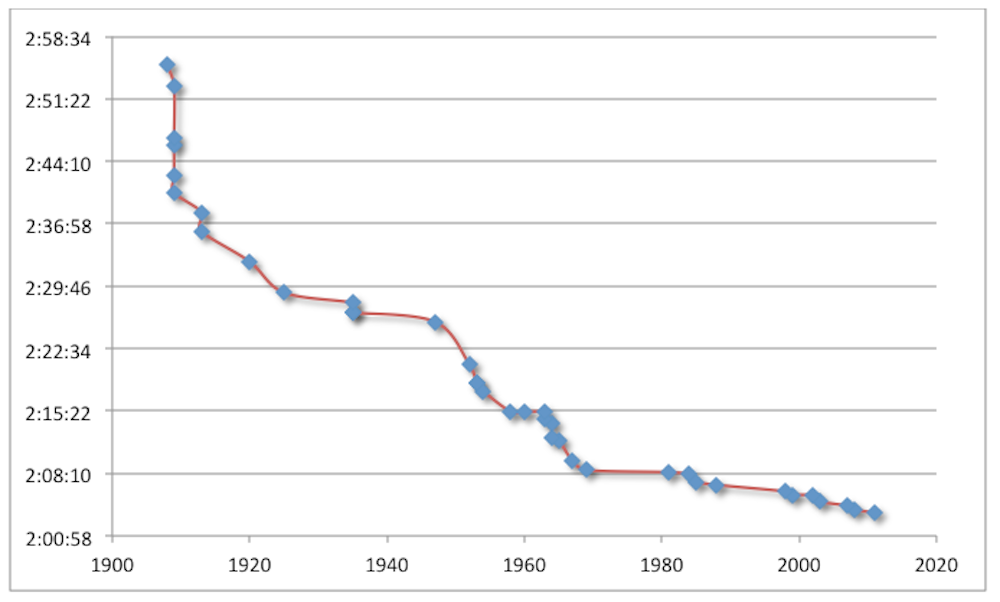
For sports in which achievements are constrained only by performance, such as marathon running and discus, the progressions of world records generally follow a curve that seems to approach an asymptote - that is, they get closer and closer to some finite limit in ever decreasing increments.
For example, the men’s marathon record was just under three hours in 1908, and today stands at just over two hours. The trend line appears destined to level out at around two hours, and the world record has only been improved by six minutes in the Last 45 years (see figure). Note however that this is not a smooth progression but is rather characterised by several sudden drops followed by periods of somewhat linear incremental improvements.
This phenomenon is in fact rather common across most sporting record trends and it often reflects innovations in training, nutrition, equipment, and technology. Examples such as carbon fibre bicycles, waveless swimming pools and frictionless suits, the klapskate in endurance speed skating, and the Fosbury flop in high jump all contributed to sudden changes in world record trends.
Even in sports where technological improvements play little part, sudden jumps in the record trends can be witnessed. Possibly one of the most highly analysed record trends in athletics is the men’s 100m sprint. For the past 20 years there has been a slight linear downward trend from 9.93 to 9.74 followed by a sharp drop with Usain Bolt’s astonishing new record of 9.58 seconds set in 2009.
Men’s sprint records have been modelled using extreme-value theory, logistic models, actuarial calculations, statistical analysis, and biomechanical analysis.
Estimates of the ultimate time for the 100 metre sprint using these methods vary between 9.0 and 9.5 seconds. But all are agreed that even with the occasional outliers like Usain Bolt, the ultimate 100 metre sprint record would eventually be reached.
Of course, it is outliers such as Usain Bolt that will hasten the time of the unbreakable record. Unusually large improvements in records are often followed by long periods of the record being unbroken.
A good example is Bob Beamon’s amazing long jump of 8.90 metres in 1968, a full half a metre longer than the previous world record. Beamont’s record stood for 23 years until 1991 when Mike Powell leapt 8.95 metres for a record that has now stood 21 years.
This is perhaps an example of where most record trends are heading – small improvements by once-in-a-generation athletes, setting records that stand for many decades.
While logically there must be a limit to human performance it is ultimately impossible to know if a given record is unbreakable. So if you are asked at a dinner party if you think Usain Bolt’s sprint record, Mike Powell’s long jump record, or even Don Bradman’s batting average will ever be beaten, your safest answer is: “yes, but we may not live to see it”.