


It seems science reporting in Australia has taken hits left, right and centre this year – a shame at any time, but especially when “big science” and “big tech” are coming so obviously to the fore.
In May we had the long-awaited announcement about the future home of the Square Kilometre Array. The slug fest playing out between the South African bid team and the Australia/New Zealand consortium came to an end when both were called to the centre of the ring and declared winners.
A couple of months later, scientists at the Large Hadron Collider confirmed what everyone hoped they were going to confirm: they’d detected a “Higgs boson candidate”. Party poppers were pulled, champagne corks popped; babies – one has to assume – were created.
No-one doubted a major breakthrough had been made in particle physics, even though many of us were left scratching our heads.
In August, we teared up with the rest of the world to see NASA engineers reacting like NASA engineers react in Hollywood. As the Mars Curiosity rover neared, then landed, on the red planet, a room full of tension gave way to fist pumps, shouts, bear hugs – giving us a glimpse at (surely) the best moment in those people’s careers, and (surely) one of the best in the history of space exploration.
Eyes still trained upwards, we watched SpaceX’s launch of the first-ever commercial space venture to the International Space Station, the twice-in-a-century Transit of Venus; and, eh, the falling of a global star in the shape of Lance Armstrong.
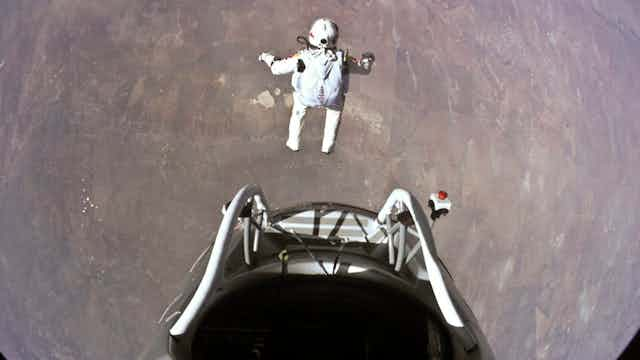
In October, Felix Baumgartner became another falling star, showing it takes more than a cool name to jump from a tin can at 120,000 feet.
Our Science + Technology and Environment + Energy teams showed they had the legs for multidisciplinary sport in coordinating The Conversation’s extensive coverage of the Olympics and Paralympics in London – culminating in laps of honour around the office and/or our own work stations depending on who else was around.
One of the focuses for Science + Technology since our launch has been to get experts to explain things to readers, and us, in a way that (a) doesn’t fry our brains and (b) doesn’t make us feel condescended to. We’ve continued down this road this year, bouyed by readership figures for “explainers” on, among others, dreaming, 4G, the colour of the sky and gravity.
Highlights on the technology front included the (slightly terrifying) exploration of whether we are living in a computer simulation; an analysis of America’s latest military robots; a look at the DayZ zombie videogame, and the seemingly endless debate over whether violent videogames breed real-world violence.
Not to mention Tupac Shakur coming back to life, but not as a hologram; a sober look at cracks in aeroplane wings; the end of Kodak memories; and artificial intelligence coming out of its box.
We also introduced columnists to the Science + Technology pages, charged with the weighty task of entertaining and informing you on topics as diverse as evolutionary biology, science and motherhood, planetary science and crystallography, and future technology. We’ve loved having them on board, and seeing their audiences grow has been testament to the quality of the ideas and writing.
So, yes, it’s been a good year for us, and hopefully for you. If we had one Christmas wish it’d be to hear more from you. Get in touch, let us know what you like, don’t like or would like to see more of in the section. We’re here to serve you and your wish – to a degree, and bound by common laws of decency – is our command.
Have a wonderful break and a great new year!
Paul Dalgarno, Section Editor, Science + Technology
Matt de Neef, Deputy Section Editor, Science + Technology
Top five Science + Technology stories in 2012, by readership:
- Snapping an atom’s shadow? Now that’s a first by Erik Streed
- Fast and furious: intensity is the key to health and fitness by Nigel Stepto & Chris Shaw
- Frank Schleck, the Tour de France and doping: so what’s xipamide? by James Heathers
- Pay-TV smartcard hacking – how easy is it? by James H. Hamlyn-Harris
- Artificial intelligence – can we keep it in the box? by Huw Price & Jaan Tallinn