
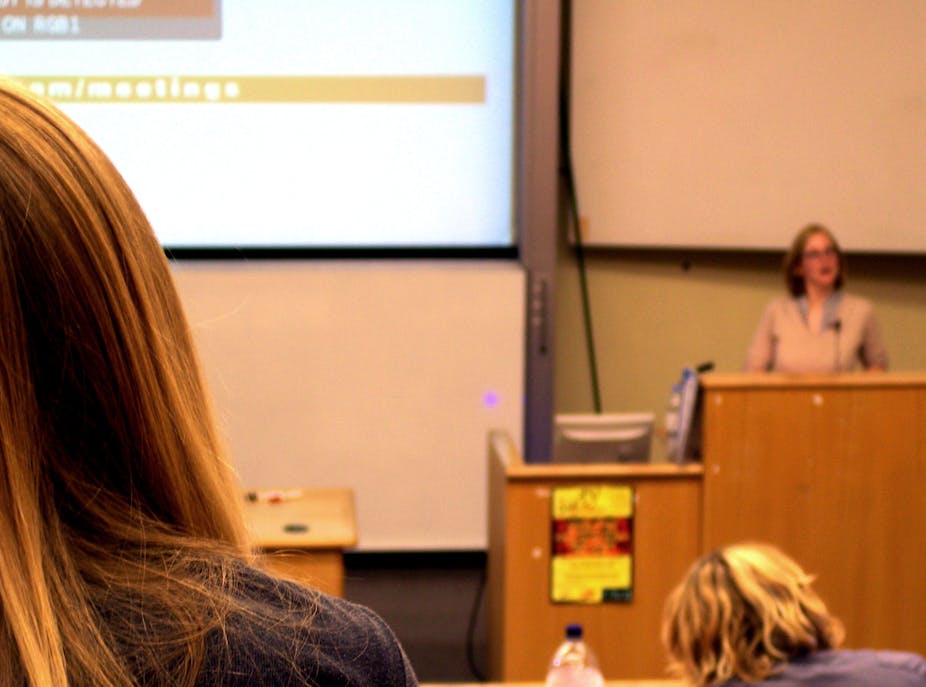
A lecture on the art of lecturing: A how-to guide to teaching young people

Narcissistic, lazy, and overly confident – this is the way some see the new generation of young people starting to go to our universities. According to teacher Lynn Van Der Wagan, who sparked an online debate recently with this article, members of “Generation I” form strong opinions without enough knowledge…

38xb2kw4-1341453789
Students from the next generation are heading to university, how should we teach them? Flickr/iwouldstay

Narcissistic, lazy, and overly confident – this is the way some see the new generation of young people starting to go to our universities.

According to teacher Lynn Van Der Wagan, who sparked an online debate recently with this article, members of “Generation I” form strong opinions without enough knowledge and are reluctant to work. Reactions to her article – mostly in agreement – came in thick and fast.

As I take an interest in who will be next in my class, Van Der Wagan’s provocation has prompted a few thoughts of my own on how to approach teaching this new generation.

A new breed

Be assured, I do not see the current crop of Australian tertiary students through rose-tinted glasses. But I am certain that “young people these days” do make their teachers better.

While some students may expect effusive praise, they usually get prompt feedback. While some may wish to give their opinion unchallenged, they do get corrective engagement which all the class can learn from. In expecting respect and responsiveness “young people these days” have put the onus on their lecturers to do a half-decent job.

I would hope that tertiary students are not shamed or discouraged by their lecturers during their studies. But that they do not always feel happy as learners is not necessarily cause for concern; this is often a sign that learning is happening.

Shameful learning

Everyone seems to remember the 1990s as the time when political correctness reached its zenith in universities. But the shaming of students that used to go on in those days seems unbelievable to me now.

When I was an undergraduate student in the early 1990s, I was in a tutorial where after five minutes of silence a student summoned courage to make a point. The lecturer instead of encouraging the student or making a constructive comment, just told the student that what he had said was “absolute rubbish.”

Not everyone’s a fan of lectures. Flickr/Tadeeej

On another occasion, in a lecture where the students were clearly unprepared, the lecturer launched off with: “This isn’t kindergarten you know; we aren’t here to run around in circles all day”.

Who should speak?

Van Der Wagen argues that education experts have been misguided in empowering students in Australia to develop an “unwavering self-belief,” contrasting this with her experience in China.

Like Van Der Wagan I have been in the teaching game for a fair while and I have had stints of teaching in China. I agree with her comment that mainland Chinese students expect direction and are bemused by lecturers who ask them questions.

I found that my students may not have been ready to say what they thought, but were ready to hear a four hour monologue.

Some Australian students seem to prefer the monologue too. In one evaluation of my teaching a student wrote “I am paying to hear what you think, not what the bloke sitting next to me thinks”. In another year one asked: “Can you just LECTURE us?”

Fair enough points, you might venture. But these are not the opinions of the majority or necessarily reflecting the best way for most students in the social sciences to learn.

It occurs to me, however, that the question of who speaks in class and why is as important now as it has ever been. This is because the quality of our interactions with students in class is coming into question.

Bringing something to the table

One legacy of students expecting better from lecturers is the interactive teaching style which is now so common. But tertiary students can’t very well demand interaction and then not bring anything to class. When they do not take the opportunity to interact, it is unfair to criticise their lecturer for falling back on the monologue.

Students have to bring some level of knowledge in order to be stimulated. A student who opens the textbook before the lecture can bring even the most dreary topic to life. Such a student arrives at class with a stake in the discussion. Even an understandable misapprehension arising from the reading gives us some place to start.

Teaching my Chinese students, I found that if there was a single line in my Powerpoint slides that seemed out of context, then they would beset me at the end of the session with very specific questions about it, for there was confusion to put right. So there may not have been in-class dialogue between us at every moment but they were engaged and interacting with material in class.

As long students can engage and a few lightbulbs get turned on, then that’s all that matters, I don’t care how. But if it does not happen, in any form, in China or Australia I will choose a monologue over 100 minutes of silence because, unless I start teaching mime, something has to be said.

Sign in to Favourite

Want to follow The Conversation?

Sign up to our free newsletter to get the day's top stories in your inbox each morning, with a special wrap on Saturday.

Spinner
Help us have better conversations — donate

Join the conversation

56 Comments sorted by

  1. Sean Lamb

    Science Denier

    "Narcissistic, lazy, and overly confident" - sounds like me 20 years ago, wait a minute, it sounds like me today.

    I can't help noticing that many of the things people say about young people and many of the things young people say about themselves are exactly the same as 20 years ago.

    My favourite is: "People of today's generation won't have a job for life any more, but will change career 5 or 6 times."
    Remember that myself in Year 10.

    report
  2. Fred Pribac

    logged in via email @internode.on.net

    The author writes about the 1990's as a decade where students were shamed: 'The lecturer instead of encouraging the student or making a constructive comment, just told the student that what he had said was “absolute rubbish.”'

    It goes back further than that and I can give several examples from my own times. Here is one.

    In the early 1980's three of my year and I were studying a notoriously difficult subject at the honors level at the ANU. We had a 3 hour exam which was so difficult it stunned…

    Read more
    1. Sean Lamb

      Science Denier

      In reply to Fred Pribac

      "Two of the class went on to become professors of physics at highly regarded universities"

      Where they probably grouch about the terrible standards of undergraduates these days.

      report
  3. James Jenkin

    EFL Teacher Trainer

    When I was at uni in the 80s, we all expected lectures to be boring. One of my lecturers actually fell asleep in his own class - that's saying something!

    However, the quote 'I am paying to hear what you think, not what the bloke sitting next to me thinks' is interesting. Interaction in class is not always appropriate - it depends on the content.

    If we're exploring ideas, or developing a skill (like a language), interaction is important. If we're learning new information, it may be more efficient and engaging if the teacher presents it.

    report
    1. Seamus Gardiner

      Citizen

      In reply to James Jenkin

      Hi James,
      That is interesting. I've found students sometimes quite resistant to engaging in dialogue in team based learning. Nevertheless, I am convincd of the efficacy of this approach (when it works it works well).
      Some students love to sit back and be spoon fed in a lecture but I do agree with you in that sometimes extremely complex concepts are best broken down and demonstrated by a lecturer in a didactic format. The old 2 hour talkfest lecture is now a construct that should be dead and buried, however, no one learns well in that format. The work of Eric mazur (look on YouTube) illustrates this very well.

      report
  4. Patrick Moffat-Stokes

    logged in via Facebook

    I'm sorry but I am struggling to understand the point you are trying to make in this article. Everything that was presented that could be construed possible solutions or ideas didn't really seem very innovative or new.

    From my own experience, whether people want to just have a monologue read to them depends on how much content needs to be delivered and how difficult it is to understand (generally the case in my law subjects). Whereas with politics subjects, the opportunity for dialogue with the…

    Read more
    1. Mister A

      Mental Health Advocate

      In reply to Patrick Moffat-Stokes

      Exactly. Has anyone sat in on a university lecture lately? I've been doing some teaching recently at uni and quite loving it. But I've also been sitting in on random lectures across various disciplines. Oh.......my.....goodness.......every single one has been a total snooze fest. What's happened to all the good lecturers?

      I had some amazingly good ones as a student (and bad) but most of them were pretty darn good. All of the ones I've sat in on recently have been just so incredibly, mind…

      Read more
    2. Seamus Gardiner

      Citizen

      In reply to Mister A

      Mister Ahoon,
      I believe so yes. I used to work in the VET sector and there was a minimum teaching qualification (Cert IV/Diploma) before you could instruct. You don't necessarily have to have a background in education to be a lecturer. The uni's that I have experience with all have a compulsory professional development program that articulates with a Grad Cert. But in essence you are right, you don't need to have sound pedagogical experience or knowledge to lecture... crying shame, I say but I believe that this has always been the case in Australian unis, as they are so research focused. Was this a surprise to you?

      report
  5. Mat Hardy

    Lecturer in Middle East Studies at Deakin University

    I remember my first or second week of my first semester as a journalism student. My first news writing assignment comes back. At the bottom, scrawled in red pen is the evaluation: "What a load of fucking shit!"

    And look, here I am. Still writing shit. Just now it's on The Conversation.

    report
    1. Dale Bloom

      Analyst

      In reply to Mat Hardy

      I ignore the profanity, but there is an issue of whether or not a student should always agree entirely with the lecturer, or even ask the lecturer a question. If the student has doubts regards what the lecturer or teacher has said, then it may not be worthwhile saying anything, or the student could be failed or punished in some way.

      I have a relative who had a teacher who was feminist. One day the teacher held up a photo of teeth marks in a chocolate bar, and said “This represent men’s violence against women”.

      The relative asked “How do teeth marks in a chocolate bar represent men’s violence against women?” The feminist did not answer, but when the relative handed in their next assignment, the teacher returned it and said the assignment had to be done again. This took the relative over a week to do the assignment again.

      So in that context, disagreeing with a lecturer, or even asking a lecturer or teacher a question is not worth the possibility of punishment.

      report
    2. Seamus Gardiner

      Citizen

      In reply to Dale Bloom

      Another explanation is that The assignment could have been a piece of crap, Dale. I have sat with many students who are oblivious of the flaws in their work ( or the strengths) until its pointed out to them.
      I expect that a student should not agree with me all of the time, I'd be disappointed if they did not criticizes outright everything they hear and read. In my experience students are quick to challenge orthodoxy and lecturer's pronouncements, as it should be.

      report
    3. Dale Bloom

      Analyst

      In reply to Seamus Gardiner

      Sean Parker,
      It was the first time the relative was ever asked to repeat an assignment, and their marks were in the top 10% of students state-wide.

      There are teachers who are unapproachable, and students cannot ask them questions, and must repeat back to them everything they say, no matter how stupid it is. If the student does not do that, then the student might be failed or punished in some way.

      Certainly in my education, students quickly learnt which teachers were approachable, and could be asked questions of, and which teachers were never spoken to, and never asked any questions.

      report
    4. John Coochey

      Mr

      In reply to Seamus Gardiner

      Throughout this dialogue there is the assumption that the lecturers actually know their job and try and do it. I had one with which we used to write random phrases such as "the white rabbit" in the middle of essays to see if he picked them up and he never did meaning he had not read them. Another case I had a friend married to someone who was a lecturer in international trade and for some reason did an undergraduate course in it, his highest grade was a credit, much to his wife's amusement. On another occasion I was at a lecture where the presenter put up a formula to prove something and I asked him what K was, he did not know,

      report
    5. Seamus Gardiner

      Citizen

      In reply to John Coochey

      I had an occasion where my lecturers knew exactly what they were teaching and did a great job... Whose anecdote wins?

      report
    6. Dale Bloom

      Analyst

      In reply to Seamus Gardiner

      Sean Parker,
      The teacher in question was an arts teacher in a high school, but I have heard similar about certain lecturers in universities. Some subjects are now so PC, it is best to say nothing to the teacher, but agree entirely during class with the teacher, never ask the teacher any questions, and only give the answers the teacher wants during exams.

      Outside of the school or university, the student can of course make their own decisions and form their own opinions.

      report
    7. Seamus Gardiner

      Citizen

      In reply to Dale Bloom

      Well, that's a different uni than I work at. Which universities are you talking about? I'd be interested to know which uni's are so PC that dissenting opinions are suppressed. Can you give examples?

      report
    8. Dale Bloom

      Analyst

      In reply to Seamus Gardiner

      A similar organisation much needed in Australia would be this.

      http://www.studentsforacademicfreedom.org/

      It is well established that US universities are highly left wing, and Australian universities are much the same.

      It leads to this situation.

      “These figures suggest that most students probably graduate without ever having a class taught by a professor with a conservative viewpoint.”

      http://www.studentsforacademicfreedom.org/news/1898/lackdiversity.html

      But you could try it for yourself. Just make a positive comment about the male gender, or about religion or even about the Liberal party, and see what reaction occurs amongst fellow academics. Or, question feminism, immigration policy, or multiculturism and see what reaction occurs.

      Then ask yourself how much intellectual diversity is allowed in your university.

      report
    9. Seamus Gardiner

      Citizen

      In reply to Dale Bloom

      They are interesting American citations, dale. What studies are you basing your assertion that Australian uni lecturers are left wing? Is it 'well established... That Australian uni's are left wing'? I haven't seen that anywhere, can you please quote your evidence? In the interim I'll pose a non left wing assertion to my colleagues, which one would you suggest I try?

      report
    10. Dale Bloom

      Analyst

      In reply to Seamus Gardiner

      Sean Parker,
      As an experiment, try saying Australia should quickly reduce its immigration numbers so as to acheive a sustainable population.

      (PS. Increasing the population through immigration seems to be well supported by various academics, because they make money from foregin students who often want to stay in the country)

      Or if you haven't the courage to say that, try saying something positive about the male gender, or 50% of the population that funds universities.

      (PS. Within a university, saying something positive about the male gender is a health hazard, and could significantly reduce your life expectancy as an academic.)

      report
    11. Seamus Gardiner

      Citizen

      In reply to Dale Bloom

      Ok i will state this at the lunch table today, I'll get back to you with the result, I'll use the immigration question because I don't think the second question has a lot of meaning.
      I assume that in the intervening time you will draw up a list of those 'certain lecturers' that you know of that expect students to always agree with them and I expect you will be able to provide me 'well established' evidence that universities are left wing. Which academics support increasing population through immigration, by the way... you wrote that in your previous post. I'd like you to name them, that way if my lunchtime conversation goes well I'll be able to research these 'various academics'' papers and establish their basis for their beliefs.
      Shall we meet again at around 1400 EST. I will have my not vary large sample of academics' beliefs surrounding immigration and you shall have a sound evidence basis for your 3 opinions, sound fair?

      report
    12. Dale Bloom

      Analyst

      In reply to Seamus Gardiner

      Sean Parker
      “Which academics support increasing population through immigration”

      Basically all the main universities it seems.

      http://www.abc.net.au/news/2010-07-26/immigration-cuts-could-cripple-industry/920040

      This does bring into question the attention academics have been giving recently to sustainability and overpopulation,(but best not mention that).

      You also have elected not to mention anything positive about the male gender to fellow academics. I think you may be too concerned about self-preservation, or do not wish to carry out career suicide, (but best not to mention that).

      report
    13. Seamus Gardiner

      Citizen

      In reply to Dale Bloom

      I see your reference but it doesn't support your contention that unis are left wing at all... it just infers (rightly) that unis and TAFEs are self interested in their bottom line and consumer base. It says nothing about the politics of immigration from an ideological perspective. Can you provide some evidence that supports your assertion that Australian Unis are left wing? That's what you wrote, so obviously you can substantiate it.

      As to the gender question: Well, to be honest i would find…

      Read more
    14. Mat Hardy

      Lecturer in Middle East Studies at Deakin University

      In reply to Dale Bloom

      At the risk of agreeing with Dale, I would say that lecturers are just like any other set of humanity. There are good ones and bad ones, vain ones and humble ones, jolly ones and spiteful ones... Two legs good, four legs bad on both sides of this debate is a silly generalization to make.

      Sometimes the teacher's vanity is assumed on the part of the student (or the conspiracy theorist). I have students who go out of their way to include references to my material in their work. But I just see that…

      Read more
    15. Mat Hardy

      Lecturer in Middle East Studies at Deakin University

      In reply to Dale Bloom

      And Students for Academic Freedom mainly stands for "Students for Teaching a Set Conservative Orthodoxy With Oversight From Approved Conservative Pundits".

      I used to love their rants years ago about how college professors were doing unspeakable things like challenging that Saddam had WMD or saying that a link between Saddam and al-Qaeda would be a nonsense.

      report
    16. John Coochey

      Mr

      In reply to Seamus Gardiner

      What only one anecdote? That is like saying you knew a pilot who once landed a plane. With internal assessment there is no real way of judging the standard of lecturers. Some years ago I gave a lift to a couple of Asians who were facing poor bus services and one had very very basic English and the other could say Thankyou very much. Both were students at the University of Canberra. They could no more have benefited from a course in English than I could one in Slovak but I bet both passed

      report
    17. Seamus Gardiner

      Citizen

      In reply to Dale Bloom

      Dale,
      These are opinion pieces, not reliable data the only data is from US universities. US universities are not Australian universities. The difference is US universities are in the US and Australian Universities are in Australia. That's two different countries.
      Believe me I do not have a cognitive bias here,I am fully able to accept if universities in Australia have a left wing bias, but apart from opinion I don't see evidence. This is a vexatious issue, I really wish that you had hard evidence…

      Read more
    18. Seamus Gardiner

      Citizen

      In reply to John Coochey

      wow,
      that's another great anecdote.
      I saw some students that failed last year. Some of them spoke english and some spoke other languages. That's just amazing. It's like we have two different anecdotes or something... but we both must be correct because we both have anecdotes, i wonder if there is a way out of this conundrum?

      report
    19. Dale Bloom

      Analyst

      In reply to Seamus Gardiner

      Sean Parker,
      There are some universities now giving students the ability to rate their lecturers.

      That is an improvement on the past.

      Perhaps universities should also be running a course during student inductions in propaganda techniques, so that students can identify if a lecturer is biased and carrying out propaganda, or is objective and non-biased.

      http://library.thinkquest.org/C0111500/proptech.htm

      report
    20. Seamus Gardiner

      Citizen

      In reply to Dale Bloom

      Universities have evaluations of their lecturers. Now back to you contention that australian universities are left wing... found anything yet?

      report
    21. Seamus Gardiner

      Citizen

      In reply to Seamus Gardiner

      Dale,
      Right - results of the experiment as requested:
      The staff room consisted of 3 males 4 females, I started with a jocular:
      'so what is it with males in academia, how good are we!'
      There was a stoney silence, the men all looked down at their lunch or the newspaper (Pravda - or at least the Monthly, I think... possibly just the Age) the female Prof reared up and with a hideous expression of distaste said: 'Your brand of gender fascism is no longer to be tolerated, get out!...' boxes were gathered, desk was emptied...it sems like i have been ejected from the uni...

      it seems like you were right all along Dale, how blind I've been....

      report
    22. Dale Bloom

      Analyst

      In reply to Seamus Gardiner

      Sean Parker
      Well I did try to warn you about asking non-PC questions to fellow academics during lunch?

      You can never determine what their reactions are likely to be, so best remain silent, or talk about the weather, or talk about how evil males are. Something everyone is likely to agree on, and bond.

      report
    23. John Coochey

      Mr

      In reply to Mat Hardy

      Yep but that is a bit like saying police officers, judges and other people in power fall into all categories. The issue is that academics are largely a law unto themselves and have few restrictions on carrying out vendettas or favoratisms

      report
    24. Dale Bloom

      Analyst

      In reply to Mat Hardy

      Mat Hardy,
      So if a university was equitable, and had equal numbers of left wing and right wing lecturers, how does a student determine who is left wing and who is right wing?

      Very difficult, which could be the reason why some students don’t say anything, or simply regurgitate what each lecturer has told them.

      Much less painless.

      report
    25. Seamus Gardiner

      Citizen

      In reply to Dale Bloom

      Yes, what an intolerant bunch. I can see now that uni is just a ruse for an evil hegemony of left wing man-haters.... Wait, how does that explain the business faculty?

      report
    26. Seamus Gardiner

      Citizen

      In reply to John Coochey

      John,
      I award you 4 Blooms for that comment....

      You clearly have no idea of the accountability that teachers and lecturers have. Just have a look at any uni policy on student rights of appeal and complaint.
      Whilst its fun to make flippant inaccurate comments it doesn't advance your argument in the slightest.

      http://www.ombudsman.monash.edu.au/

      report
    27. John Coochey

      Mr

      In reply to Seamus Gardiner

      It is the literal truth, the lecturer was John Gagg who later changed his name to John Gauge and the subject was Russian Economic History at the ANU

      report
    28. John Coochey

      Mr

      In reply to Seamus Gardiner

      I think you are proving my point about the inadequacies of some academics! The issue was people were being admitted to courses that they could not possibly pass if there was any kind of realistic assessment. There have been two scandals that I know about at UC involving Asian students. One was when there was an attempt to allow asian fee payers to have a subsequent exam after a large number had been failed, the public outcry prevented this. The more recent involved a journalism course where a staff member claimed she had been directed to pass students on the ground they would not practice in Australia.

      report
    29. Seamus Gardiner

      Citizen

      In reply to Mat Hardy

      The Bloom score is a measure of misenterpretation of a 'theconversation' article. The SI unit is the 'bloom' and It's a scale from 0-10. 1 is slight misogyny, paranoia and misinterpretation and 10 might be interpreting an article on particle physics as a left-wing, man-hating academic diatribe.

      report
  6. John Coochey

    Mr

    I had some appalling lecturers at both universities I attended and am always amused when the boot is on the other foot. One occasion was when a lecturer who would not have given Jesus Christ a grade higher than credit made a submission to the RAC Inquiry into Kakadu which I would not have accepted from a base grade clerk. Another was when one, now deceased, had an ambitious second wife and set up ANCLAS but did not speak Spanish whereas I do and knew many of the diplomats personally at the initial…

    Read more
  7. Seamus Gardiner

    Citizen

    I've recently started 'lecturing' at uni and found that the curriculum is quite different to what I expected. The lectures are still available and predominately online but most of the contact time is taken up by workshops, 'tutes' in the oldspeak. The work by mazur and others has really put some nails in the coffin of the lecture and the format has changed radically to include new ways of delivery. Is it better? Don't know yet. But so feweople seemed to learn well from the old didactic lecture that it's probably worth a try.

    report
  8. Gavin Moodie

    Principal Policy Adviser

    This piece would have been better had it reflected on the prior question: why have lectures?

    report
    1. John Coochey

      Mr

      In reply to Gavin Moodie

      Could it be to employ lecturers? I wonder how many academics reading this would be happy about outside auditing of their marking?

      report
    2. Seamus Gardiner

      Citizen

      In reply to John Coochey

      I'd be rapt. Quality control is moderated by peers, in my experience. I don't know this (auditing independantly) could happen unless an outside auditor had specific curricular knowledge and took a few random samples. Can't say it'd bother me at all. It's surprising how close most markers get to the norm when comparing papers upon moderation, actually.

      report
    3. Gaye Swinn

      Retired academic

      In reply to John Coochey

      John Coochey, Phillip Ebrail and others.

      In nearly twenty years as an academic or TAFE teacher I did have a very few colleagues who were "narcissistic, lazy, and overly confident ..." and some students who fell into that category also, I don’t think it’s more true now than in the ‘90s. What is true though is that students have become clients and universities are eager to keep them well pleased. The fact is that it simply isn’t possible to please all students all of the time and some can turn very…

      Read more
    4. John Coochey

      Mr

      In reply to Seamus Gardiner

      In Pakistan all assessment is done by two assessor who do not know the candidate and if there is more than a certain discrepancy it goes to a third whose decision is final. I remember one lecture where the academic, now deceased had not prepared a lecture so spent the entire time telling us about his misadventures on a motor cycle in the 60's. I also remember an accountancy tutor who was encouraged to do Honors which he did not have and failed. When you have the answer book in front of you it is easy to seem wise

      report
    5. Phillip Ebrall

      Professor of Chiropractic at Central Queensland University

      In reply to Gaye Swinn

      Gaye - you are spot on! The only way forward is to guide the student learning at the level you set and then deal with the second problem, that of actually failing students, as indeed a second problem.

      The underlying issue has been identified many times in this wave of responses, and that is the attitude of the institution and the role of the student as an economic unit. Perhaps it is not the academics who are the polarised wankers, perhaps it is is the admin people. I recall at one institution…

      Read more
    6. John Coochey

      Mr

      In reply to Seamus Gardiner

      There was a bad comedy screened in the UK in the sixties called "The Importance of Being Hairy" which was supposed to lampoon the importance of being anti establishment to get a posting in it the lead character later boasts that he will make his subject as hard and irrelevant as possible to deter student numbers and minimize his teaching load. A friend of mine got a job lecturing a specific course at the UC and told me over a drink he had no knowledge of that subject so he was going to teach the subject of his Phd instead. He is now a professor at the ANU so he must have got away with it!

      report
  9. Gil Hardwick

    Anthropologist

    Sorry, Rohan, I disagree with you in substance and in principle.

    First, and I admit to being unsure about the 1990s because on extended fielde research, but certainly during the late 1980s and again currently, I have found undergraduates conscientious and hardworking. Of course you get a lot of filtering out in 1st and 2nd year especially, but that's not because students are lazy or arrogant but because they are still feeling their way. The test of that is to note that once on track they simply…

    Read more
  10. Phillip Ebrall

    Professor of Chiropractic at Central Queensland University

    "Narcissistic, lazy, and overly confident ..." sounds more like a description of quite a few of my contemporary academics. How many reading this have students in their class this week who are actually smarter than you?

    report
    1. Gaye Swinn

      Retired academic

      In reply to Phillip Ebrall

      Yes, Phillip, I'm sure that anxiety about smartness underlies a great deal of poor teaching in any mode at tertiary level. Fact is that both the academy and the public expect academics to be smart but, in reality, many academics aren't particularly smart - or funny or entertaining or well-dressed. I've known one or two who clearly couldn't negotiate the workings of a lift! They may, however, be world experts in their field and it's alarming that it sometimes is not enough for some undergrads. Such…

      Read more