
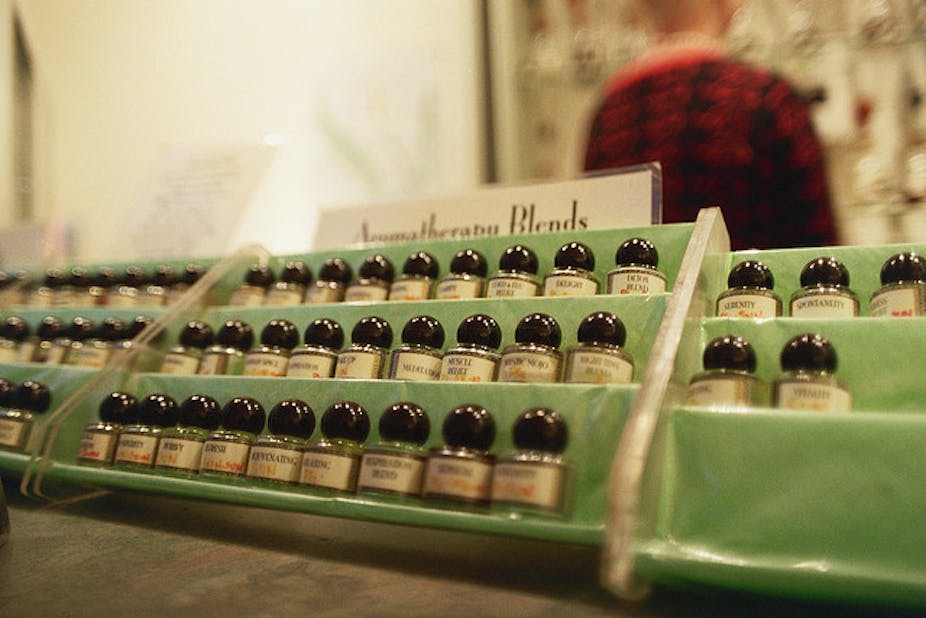
PANACEA OR PLACEBO – A weekly series assessing the evidence behind complementary and alternative medicines.
Aromatherapy is based on the idea that aromatic substances, usually the essential oils of plants, can change how people feel or have an effect on the symptoms of various conditions. Aromatic substances can be delivered through massage, direct inhalation, or diffusion into the air.
People have used essential oils for medicinal purposes for centuries: Chinese traditional medicine uses aromatic plants; the ancient Romans used aromatic plants in their baths; and there are records of Greek doctors using them as far back as the first century.
But the modern practice of aromatherapy as we know it now is only about a hundred years old and probably began with a French chemist, Gattefosse, who published a study about his use of lavender oil to treat his burnt hand.
Different oils are claimed to have different effects on anxiety, agitation, nausea, pain, hair loss, dementia, hypertension, concentration, sleep, depression and infant colic, among others. But much of the research in this area is of poor quality and contradictory.
Often, the recommendations found in aromatherapy texts are based on anecdote or clinical experience rather than strong evidence.
How does aromatherapy “work”?
The best known and most investigated uses of aromatherapy are for conditions such as anxiety, agitation, stress and nausea. But the mechanism, if any, by which these actions occur remains controversial.
One idea is that scent activates the olfactory system (responsible for our sense of smell) which triggers the brain’s limbic system. This in turn may produce emotional responses and enhance the retrieval of learnt memories connected with the scent.
Research has shown that our response to scent is cultural, in that people of particular cultures often perceive different scents as being pleasant or unpleasant. Our response to scent is also able to be influenced by the prompting of researchers, and is dependent on the participant’s perception of the scent, which of course makes assessing cause and effect more difficult.

When participants of one study were exposed to certain scents and had their responses recorded through functional MRI brain imaging, researchers saw activation in the areas of the brain responsible for emotions. Although this is interesting and could point to evidence of an effect, this study was small and did not report its methods well, so it’s hard to know how much weight to put on it.
Supporting evidence
There are a few well-conducted studies that show aromatherapy may be effective. Laboratory studies using animals have shown that some aromatherapy preparations cause observable changes in biochemistry.
In humans, a small pre-clinical study of aromatherapy using healthy volunteers showed a measurable reduction in stress hormones in saliva samples when lavender and peppermint aromatherapy were given following a stressful event.
But these results have yet to be reflected in strong clinical studies and, more importantly, in systematic reviews, the highest level of clinical evidence. Statistical pooling, or meta-analysis, of study results can help us to understand the overall effectiveness of an intervention much more clearly than a single study alone.
Some systematic reviews have found weak evidence of an effect for aromatherapy for some conditions such as the behavioural and psychological symptoms of dementia, and post-operative nausea and vomiting (although this was with a non-traditional aromatherapy product).
One systematic review found convincing evidence of an effect for the use of massage with lemon balm (Melissa officionalis) oil for agitation associated with dementia, however this was based only on one randomised controlled trial.
The verdict
When studies of aromatherapy are subjected to close scrutiny, and the results combined, there is no convincing evidence that the therapy works.
But this may come down to a shortfall of well-designed randomised controlled trials, which provide the best experimental evidence when studying a therapy.
It’s difficult to know just how effective aromatherapy is, and it may be that while there are some products that are effective for some conditions, there are many other products on the market that have no effectiveness at all. Either way, it’s important consumers know what they’re using and are alert to the possibility of adverse effects. Just because a product is “natural” does not automatically mean it is “safe”.
This is the fifth article in our series Panacea or Placebo. Click on the links below to read the other instalments:
Tim Scanlon
Debunker
There is only one conclusion that can be made about aromatherapy and that is that it doesn't work. I don't know why the idea is even entertained. http://rationalwiki.org/wiki/Aromatherapy http://www.skepdic.com/aroma.html
Russell Hamilton
Librarian
If a smell can make people nauseous ... actually vomit, might not other smells have beneficial effects?
Tim Scanlon
Debunker
You didn't bother to read the articles I linked, otherwise you would have seen the explanations and the linked science studies.
Vomiting is driven by nausea, not smell. This is why not everyone vomits every time they smell something displeasing and why you "get used to" bad smells.
Russell Hamilton
Librarian
Tim, the url didn't look too interesting, but I have read it now, and it isn't very convincing. Of the references at the end of the article, the only 'quality' one has a link that doesn't work.
I thought I would find some articles in PubMed to support my claim that smells could cause nausea, but I can't be bothered going past the first one that came up which has in the abstract:
"Our laboratory has been asked to elucidate the origin of a strong "toxic smell" present in a prominent politician's office, private house and motorcar. This stinky and pungent atmosphere has caused serious nausea and vomiting to several individuals ...Detailed examination of the spectra as well as GC/MS analysis of commercially available skunk secret allowed us to relate the identified compounds to those present in the defence spray of skunks."
Tim Scanlon
Debunker
Are you not capable of following the links and searching the linked sites for the referred article? Because I found them easily enough. Unlike you, I cited evidence, which you didn't even bother to read, this is not the way a proper discussion is held.
I also found the some really simple articles on what drives vomiting. http://en.wikipedia.org/wiki/Vomiting Even easier to find science articles on the topic. Your quoted part is a joke and actually supports my statements.
Russell Hamilton
Librarian
Following the link didn't get me far, however, yes, you can google up an author's draft, which ends with:
"We found clear and consistent evidence that lemon oil inhalation enhances positive mood and also boosts norepinephrine release (in line with its activating properties), but no other obvious physiological or health-related benefits from either lemon or lavender; ..."
Tim, are you actually saying that odours don't produce a physical effect in our bodies? That you've never salivated when the scent of something delicious has wafted over you? Or gagged at a particularly disgusting smell?
Tim Scanlon
Debunker
What is it with CAM supporters and strawmen? I never said that odours can't or don't have an effect on the body. The olfactory senses are tied into the limbic centre of the brain, which is tied to memory, so that is bound to illicit memories.
But that doesn't change the fact that aromatherapy can't be used to treat anything.
Russell Hamilton
Librarian
Tim, you wrote, of aromatherapy: "I don't know why the idea is even entertained."
I offered the opinion that the idea could be entertained: "If a smell can make people nauseous ... actually vomit, might not other smells have beneficial effects?" A speculation.
You responded "Vomiting is driven by nausea, not smell" which seemed to me an odd response to the suggestion that an odour could cause nausea!
Then finally you write that: "I never said that odours can't or don't have an effect on the body"
So we seem to agree that odours can have an effect on the body. I think that's worth investigating and, although I've never considered trying aromatherapy, I wouldn't dismiss the claims of people who say that it works for them. Not everything is known yet.
Tim Scanlon
Debunker
Show me the evidence. There has been plenty of research, none of it concluding anything solid or tangible. Weaseling meaning out of my statements that were not intended nor implied is also not evidence, nor are presumptive statements, show me your evidence.
To say that we don't know everything is to try and create a red herring, to imply that we haven't investigated aromatherapy. The fact that this modality has been around passing itself off as a medical treatment means it has had plenty of time to provide evidence of how it works and what it can actually be used for. The fact that it hasn't done either shows that there is either nothing of interest to be found or that the practitioners have deliberately avoided testing for fear that their house of cards would fall.
So, show me the evidence. I've shown my tangible proofs of aromatherapy being rubbish as a medical treatment, time to show me yours.
Russell Hamilton
Librarian
Tim, have a look at Dr Geiger's presentation ... loads of 'evidence'.
Tim Scanlon
Debunker
Oh you have to be kidding. 10mins into his presentation and he still hasn't presented anything of any value.
First he starts with completely unrelated statements like "Look at this study, it shows drug companies are using plants as sources of drugs." Really? I never!
Then he moves in for a killing blow with "Look at this study that shows peppermint aromatherapy is no different from a placebo, so exciting." So the aromatherapy did nothing? This is meant to convince me? http://europepmc.org/abstract/MED/14770380/reload=0;jsessionid=NpaBP4ZIIaiAuFPEapHe.0
At the 26min mark he cites another study about lavender oils that has no adequate control measures (no placebo). These are just the couple of papers I've bothered to look up, as most of what he cites is unrelated to aromatherapy at all (e.g. dogs smelling cancer, unrelated and not yet proven, yet cited as evidence, WTF?).
James Tad Geiger
logged in via Facebook
Tim
Anesth Analg. 2012 Mar 5.
Aromatherapy as Treatment for Postoperative Nausea: A Randomized Trial.
Hunt R, Dienemann J, Norton HJ, Hartley W, Hudgens A, Stern T, Divine G.
Source
From the *Department of Anesthesia, Carolinas Medical Center University, Charlotte, NC;
Abstract
Background:Postoperative nausea (PON) is a common complication of anesthesia and surgery. Antiemetic medication for higher-risk patients may reduce but does not reliably prevent PON. We examined aromatherapy as…
Read moreTim Scanlon
Debunker
There are a lot of issues with that paper. The first is that the controls are not suitably blind, you would expect the patients to not know which treatment they are getting, but the two actual treatments would have been obviously different. This can be seen directly in the change in distribution of the pain scores: the reaction to isopropyl alcohol was the same as the ginger and barely significantly less than the blend. The stats themselves show that the nausea is not improved relative to the alcohol.
So unless you are telling me that alcohol is also an essential oil or aromatherapy oil, then the paper doesn't show anything.
Sue Ieraci
Public hospital clinician
Another issue with this trial - the participants only took three (3) breaths of the substance. This makes it unlikely that there was any effect at all, but that the results are spurious.
It's also interesting that the blend oils had the same effect as ginger - so it doesn't seem to matter what the oil is - just that it smells nice.
Maybe it comes down to this: there's nothing wrong with a quick trial of some nice-smelling agent if you have nausea, with a back-up way of treating it, if it doesn't work.
It can only be a good thing to make health care settings more pleasant and humane - using music, colour, massage, clowns, games, television, fragrances - so long as these dont interfere with, or substitute for, effective therapies.
Tim Scanlon
Debunker
But I loved the smell of bleach in hospitals (/sarcasm).
James Tad Geiger
logged in via Facebook
Tim and Sue.
I am fairly certain you are aware that essential oils from plants are rich in various chemical constituents, including alcohols. I have used one drop of essential oils of ginger on the palm of very many high risk for post op nausea anesthesia patients to smell ad lib. It works. The article substantiates the hypothesis. Picking it apart with your desperate Cochran like review does not change the results of the study. Inhalation of ginger vapors aka aromatherapy, works in the recovery room for many people. The diatribe voiced here does not serve people. Rather it cheats people of something simple and cheap that both prevents and TREATS nausea and is devoid of the cost and side effects of the various multi-modal patches, pills and intravenous drugs.
Tim Scanlon
Debunker
All I've done is apply basic principles of science. If you want to make a claim you have to produce evidence that stands up to scrutiny. Scientific scrutiny seeks to ascertain that what was measured is applicable and repeatable, essentially trying to understand if what you measured was actually what you measured.
If you don't understand this very basic nature of science then you are just deluding yourself with personal bias. You are trying to claim something works without presenting valid evidence. If I presented you with a stick and told you it was a calculator, you wouldn't just blindly accept that as fact, you'd want rational proof. If you want to cherry pick data to support your inherent bias then you should expect to be challenged. Don't then try to pass blame on others for pointing out the Emperor isn't wearing any clothes.
Sue Ieraci
Public hospital clinician
James - what you are doing is something relatively simple and pleasant that may help people feel better. I have no problem with that - I do the same with chocolate.
The difference, though, is that when you claim a therapeutic benefit, you need to back it up with good evidence. If you are indeed a practising clinician, you must know about critical review of the literature - how well was the study conducted? What did they do? How many subjects were there? Were the groups well-matched? What were…
Read moreSue Ieraci
Public hospital clinician
Thank you for a clear and well-written article.
In my view, aroma"therapy" should sit alongside massage as a service for those who feel that it helps them relax - not as a therapy for illness or injury. (I would distinguish manipulative therapy or therapeutic massage). It could also accompany music "therapy".
These are elements of TLC that can help people relax and feel better, without doing harm. They should not be considered remedies or "health care".
So long as people are sold an honest product (eg a soothing massage with pleasant fragrances in the air may help you relax), I don't have a problem. My only issue is with the implication of the word "therapy" - it should be made perfectly clear that these are not remedies or treatments for health conditions.
Tim Scanlon
Debunker
I can agree with that. Nothing wrong with relaxing.
Russell Hamilton
Librarian
But if stress or anxiety can be relieved with music or scent, why isn't this a therapy? Or are they not significant medical conditions?
alfred venison
records manager (public sector)
i think the problem is that the effects of aroma and music on sick people can't be quantified - they are subjective & cultural and can't be easily generalised & extrapolated to other sick people's situations with the same results.
having said that, when i was recovering from an operation 5 years ago, i flooded my flat with music of beethoven for 12 hours a day. not the big symphonic stuff, but the string quartets, trios, piano sonatas, violin & cello sonatas. i'd swear on a stack of darwins…
Read moreRussell Hamilton
Librarian
Hi Alfred - (Nice to hear from old acquaintainces from LP)
Agree. I guess that, while we know that listening to music can change the rate of your heartbeat, and odours can make you salivate, the effects of music and aromas can also be subtle and different for every person. If I got a bad sore throat I would like antibiotics to get rid of it, I wouldn't try aromatherapy. But our conventional medicine seems to have some difficulty in anything other than the 'big guns' approach to fighting disease. The wellness movement seems to be more about creating an ongoing positive, preventive state of health, in many small ways. State of mind has an effect on health, so I wouldn't dismiss music, aromas, 'affirmations' or anything else people use that works for them.
alfred venison
records manager (public sector)
Hi Russell
thanks for the comment. for some reason you got a down-thumb for it - i remedied that, for now. its obvious to me tha,t as you say, state of mind has an effect on health, and, as i say, music has an effect on state of mind. i wouldn't use music for my sore throat either but for post operation recovery i couldn't recommend it enough. here's looking at you! -a.v.
Sue Ieraci
Public hospital clinician
Russell - I don't think too many people would disagree with that approach.
I do disagree, however, with your assertion "But our conventional medicine seems to have some difficulty in anything other than the 'big guns' approach to fighting disease."
As you said yourself, aromatherapy is not about "fighting disease". The point of this article, and many of the comments, is that aromatherapy is not a treatment for disease, though it is perfectly acceptable - and likely safe - as an aid to feeling better, or more relaxed, or in a better state of mind.
Many major medical institutions encourage the use of music, relaxing massage, clown doctors etc. These modalities are not rejected by medicine - they are recognised as modalities to help people feel better - but not as treatment for disease.
Russell Hamilton
Librarian
Hi Alfred,
I was thinking about your use of music for alleviating sadness, and wondering, do you think that one of the reasons it works is because listening to good music isn't just a passive activity, but a creative one? There's something about the energy of creativity in you, ignited by the music, that recharges you?
alfred venison
records manager (public sector)
hi Russell
this thread is fast disappearing into the archives below the fold so i'll keep it short(ish).
i'm biased but i think music is indeed special. in essence its an acoustic communication that's non-verbal (when its instrumental). i like mendelssohn's response to the critique that music is too indefinite to express anything like significant thoughts:- "what the music I love expresses to me, is not thought too *indefinite* to put into words, but on the contrary, too *definite*" (mendelssohn…
Read morealfred venison
records manager (public sector)
from a philosopher:-
for schopenhauer, music expresses universal human emotions and strivings shorn of any particular context in the phenomenal world. like first-personal volitional insight – the basis on which schopenhauer identifies the world in itself with “will”– absolute music is experienced only in time, without the mediation of other forms of cognitive conditioning such as space and causality. it thus affords, for schopenhauer, the closest access we can have into the nature of the in itself of the world. and this itself is a source of the most “profound pleasure”– a pleasure from seeing the “deepest recesses of our nature find expression” (the world as will & representation", I:256) .
sandra shapshay, "schopenhauer’s aesthetics and philosophy of art", http://onlinelibrary.wiley.com/doi/10.1111/j.1747-9991.2011.00453.x/full#b29
Ian Donald Lowe
Seeker of Truth
The pharmecutical companies thank you, from the bottom of their bank accounts.
Tim Scanlon
Debunker
What a red herring.
You do realise that the alternative therapy industry in Australia is worth at least $4 billion and profits over $1.6 billion? http://www.ibisworld.com.au/industry/default.aspx?indid=1914 These figures are likely higher as most of the CAMS are private companies and don't publically report their earnings.
My point being to redress your statement as a distraction, as alternative therapies are also big business.
James Tad Geiger
logged in via Facebook
Hello
Read moreI am an anesthesiologist in the USA. Things are different here. I did research on this field of aromatherapy and arrived at a much different conclusion.
Watch my video on medical aromatherapy.
http://vimeo.com/33176990
I present the old and new medical references and discuss them in this webinar presented to doctors and nurses. Here are two examples of definitive positive effects of aromatherapy. The newest articles published in anesthesia journals show that oils like ginger prevent and…
Sue Ieraci
Public hospital clinician
"things are different here" In funding and billing, perhaps, but the evidence should be the same.
James Geiger - can you post the references to those newer trials?
Sue Ieraci
Public hospital clinician
Let's see:
There are lots of references for INGESTION of ginger for nausea - but I don't see any for SMELLING ginger.
James Geiger's assertion that "Lavender oil decreases the need for narcotics needed post op in the PACU after lap band surgery." is directly copied from the title of this paper:
http://link.springer.com/article/10.1007%2Fs11695-007-9170-7?LI=true#page-1
If you look at the table on page 922, you will see that the group randomised to receive lavender oil on their oxygen mask STARTED with higher pain scores, which reduced to the same level as the control group after the intervention (pain score 2.7 ini placebo group vs 4.1 in the intervention group).
This is a small study with odd results - not the type of cutting edge stuff that James Geiger suggests.
Aromatherapy can make you feel better and probably won't do any harm, unless it replaces more effective treatment.
Tim Scanlon
Debunker
James, I've watched your video and I've found it to be largely devoid of actual information on the topic of aromatherapy science. The actual studies you cite on aromatherapy fall into two categories: those that say it isn't better than a placebo, and those that didn't use adequate controls (no placebo included). E.g. http://europepmc.org/abstract/MED/14770380/reload=0;jsessionid=NpaBP4ZIIaiAuFPEapHe.0
I'd also take issue with your nutrogenomics video. Not only does it lack any actual science, it also lacks any actual rationale and research backing it. http://www.sciencebasedmedicine.org/?s=Nutrigenomics
Edward John Fearn
Edward John Fearn is a Friend of The Conversation.
Hypnotherapist and Naturopath
While small anxiolytic effects have been demonstrated it would be generally unwise to rely on aromatherapy as a stand-alone treatment. Aromatherapy is commonly combined with massage and music/art therapy as part of diversional therapy programmes in aged care centres.
Importantly the use of aromatherapy is already widespread in dementia care, where even slight reductions in the need for chemical restraints could be considered a vastly positive outcome.
http://www.ncbi.nlm.nih.gov/pubmed/15860944
http://www.ncbi.nlm.nih.gov/pubmed/11994882
http://www.ncbi.nlm.nih.gov/pubmed/17342790
Tom Hennessy
Retired
"Fourteen premature infants born at 24-28 postconceptional weeks and
presenting apneas resistant to classical treatments were exposed during the second week after birth to the odor of vanilla diffused during 24h in the incubator.
The day before and the day after odorization were used as control for
each subject.
A significant diminution (44%) of the number of apneas longer than 20
sec (or less if associated with immediate hypoxia) was observed during
odorization and this diminution was seen in all the subjects."
Lane Simonian
History Instructor
Aromatherapy does indeed work for Alzheimer's disease and perhaps for other forms of dementia as well. Jimbo and colleagues used rosemary and lemon essential oils in the morning (for cognition) and orange and lavender essential oils in the evenings (for relaxation) for 29 days via a diffuser. After this, all patients with dementia and especially those with Alzheimer's disease experienced a substantial improvement in personal orientation in regards to cognitive function.
http://onlinelibrary…
Read more