







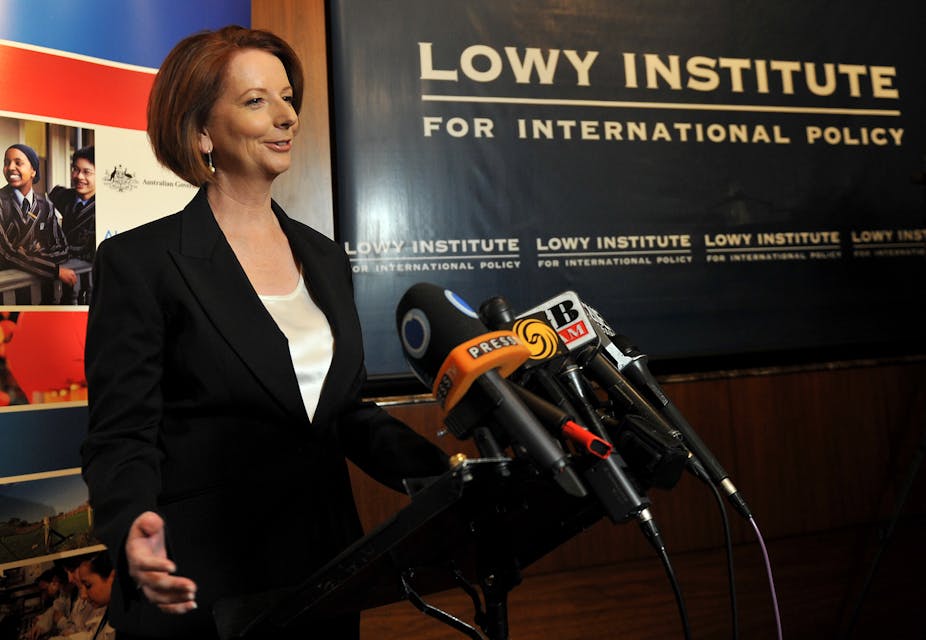
Prime minister Julia Gillard released the Australia in the Asian Century White Paper in an address to the Lowy Institute on Sunday.
The paper sets out 25 “national objectives” to prepare Australia for the rise of Asia in the 21st Century. These include boosting productivity, encouraging Asian language teaching in schools, strengthening the credentials of Australia’s universities and increasing diplomatic presence in the region.
Earlier this year, The Conversation assembled a panel of experts from Australia’s academic community to provide their advice to the Asian Century taskforce. Members of the panel met with taskforce leader Ken Henry at an event in Canberra to discuss their proposals.
Representatives of this team provide their view on the paper below.
Northeast Asia - Associate Professor Craig Mark, Kwansei Gakuin University, Japan
Regarding the democracies of Northeast Asia, there are no major surprises in the Government’s White Paper.
The white paper encourages Japan’s continuing involvement in regional and international institutions, such as APEC and the East Asia Summit. It refers to the previous cooperation between Australia and Japan on the International Committee on Nuclear Nonproliferation and Disarmament. So there are no real policy changes regarding Japan.
Deeper defence cooperation and joint military exercises are also set to continue with South Korea, including a regular “2+2” defence and foreign ministers’ meeting, as well as increasing cooperation on climate change and non-proliferation. The white paper mentions that negotiations towards bilateral Free Trade Agreements are ongoing with Japan and South Korea, but there is no acknowledgement that both these rounds also face considerable domestic political resistance.
Beyond a commitment to expanding the recently opened consulate in Ulaan Bataar to a full embassy, there is practically no other mention of Mongolia. This is a disappointing omission, given the high level of Australian investment in its mining industry.
The white paper does refer to the tensions over maritime disputes in the South China Sea and North Asia, without explicitly specifying the Senkaku/Diaoyu Islands, or any other disputed territories. It maintains that Australia takes no position on these disputed claims, urging their peaceful settlement via international law. This is an implicit criticism of China, which refuses to recognise the United Nations Convention on the Law of the Sea.
Culture - Dr John Lenarcic, RMIT
A melange of bland rhetoric and generic management-speak, leavened with policy points as mantra. That pretty much sums up the Asia Century White Paper on the whole. Where are the grand initiatives of a specific nature that display radical novelty under this banner heading? “Culture” as a term is bandied about in the paper without offering any head-turning ideas worth debating.
For example, how about dedicated schemes to address the diversity in philosophical outlooks that may exist in Asian communities as opposed to Australian norms? Learning the mechanics of languages is one thing but learning to think in another culture is another matter entirely.
The refrain of the National Broadband Network as a universal high-tech fix was also evident in the report. Apparently, the NBN will facilitate closer ties with Asia. Closer in comparison to what? Systems analysis 101 will tell you that one has to understand the real world in a deep sense before developing and applying a technological solution.
Points for pop culture inclusion must be awarded, though, to the mention of the Fruit Ninja game-app (on page 270) which is highlighted as a sterling example of the crossover potential of culture, technology and design in Australian-Asian business ventures. If only there was more emphasis on the fun aspects that could be afforded by the Asian Century. I guess it would have been too much to ask to have a K-pop reference in the document, though.
Asian languages – Yuko Kinoshita, University of Canberra
The White paper identifies education in Asian language and culture as a key part of capacity building for Australia’s future. It proposes some clear strategies: all Australian students to have continuous access to high quality language studies in Chinese, Hindi, Indonesian, or Japanese; all schools to collaborate with a school from one of the priority countries; and utilising multilingual people to enhance education.
At the tertiary level, it proposes to support increases in the numbers of Australian students studying in Asia, and the growth of Asian studies. The paper also proposes a target of one third of the nation’s leadership roles in business and government to be carried by individuals with Asian expertise. This would encourage students to study an Asian language and parents to encourage their children to do so.
The White paper recognises the importance of “people-to-people” relationships with Asia for our future prosperity, and identifies our current shortfalls in the language and cultural skills needed for this.
If funding, bipartisan support, and long-term commitment to achievable actions follow, we are looking at a bright future on the edge of Asia. Otherwise this inspiring vision will remain mere aspiration, and others will take our place.
Food security - Professor Peter Batt, Curtin University
Competitive advantage comes from having a strong domestic industry and constant innovation. This approach seems central to the government’s recent position statement on Australia’s role as a supplier of food to Asia.
Innovation is required at all stages of the value chain to meet consumers’ changing demands for more healthy and nutritious food that has been produced in a way that minimises the adverse impact on the environment. Supporting more sustainable production is both a public and a private good, yet most of the responsibility seems to fall only on the producer. Policies to support co-investment in new technology and more efficient use of natural resources are desperately required. Over many years, government investment in agricultural research and development has progressively declined.
Consumers, too, must recognise that role that they have to play in supporting a more sustainable food industry. With as much as 40% of the food that we produce being wasted, the costs are enormous. If reducing waste and maximising value is to become the central tenet, the key argument here is whether Australia can and should support an internationally competitive food processing industry. I fear Australia is likely to remain a net exporter of agricultural commodities and minimally processed food.
Science and research - Sally Gras, University of Melbourne
More research occurs in Asia now than ever before. Today, the prime minister’s launch of the Asian Century White Paper highlighted the increasing number of research links between Australia and Asia.
Opportunities for collaboration will increase in the Asian century but so too will the competition to work with the region’s best in the areas of basic, applied or commercial research. Research and technology partnerships will therefore be crucial to access ideas and build our national competitiveness.
Scientific collaboration will benefit from four new Asian embassies that will assist in the negotiation of science and technology agreements. Research collaborators will also find it easier to obtain Australia visas. The importance of diplomatic networks between universities, dialogues between young leaders and the flow of people and ideas between academic and research organisations have been identified as essential to Australia’s strategic position.
The report provides a commitment to science and innovation but leaves policy details such as links with industry and strategic priorities to the upcoming Industry and Innovation Statement and the National Research Investment Plan. While much needs to be done to better position Australia’s researchers, this report provides an important first step. These ideas will require commitment both in the short and long term to make a significant regional impact.
Climate change – Tim Stephens, University of Sydney
The White Paper does a good job of highlighting the challenge that climate change poses to food, water, infrastructure and energy. It notes that “projected sea-level rise, more intense tropical storms and higher wind speeds could inundate low-lying port cities, threaten coastal areas, exacerbate flooding and increase the salinity of rivers and bays across the region.”
The authors argue that “not only is action on climate change in the region’s interests … it is critical to a global climate change solution,” noting that Asia is already a major contributor to global emissions.
But despite this, overall the White Paper’s authors assume that business as usual can and will continue into the Asian Century. However, it is a blithe assumption that climate change will only add to, rather than fundamentally change, the character and severity of the challenges faced by many Asian states and, as a consequence, by Australia.
The reality is that climate change will threaten Asia’s food and water security, and have transformative effects on security and stability in the region.
More to come