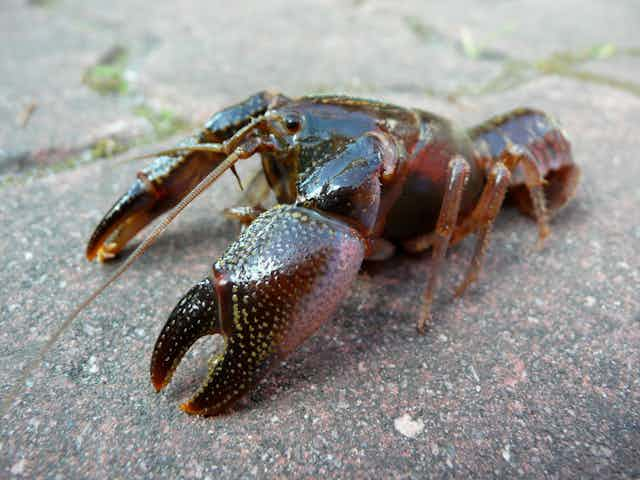

The buttongrass plains, swamps and heathy slopes of western Tasmania support a suite of burrowing crayfish species in the endemic genera Ombrastacoides and Spinastacoides.
These nutrient-poor, acid peatlands are an unusual habitat for crayfish, and there are few other places in the world where peatlands are so extensively burrowed by them. In fact it is likely that they play a significant role as ecosystem engineers, aerating and draining the soils, improving conditions for the growth of plants and providing habitat for an assemblage of other species.
A recent review of these peatland crayfish revealed a number of new species, several of which have restricted ranges. Although the ranges of many of the Ombrastacoides species are protected within the Tasmanian Wilderness World Heritage Area, some are threatened.
Status
The Denison Rain Crayfish is only found in the upper reaches of the Little Denison River catchment and two small tributaries of the Weld River. Its range lies outside the World Heritage Area, in the contentious tall wet forest belt that lies adjacent to its eastern boundary. Its total range is well under 100 km2, and within that its actual area of occurrence is very much less. It requires access to the water table in its burrows for all but very short periods, so it is confined to swampy areas, seepages and roadside ditches. It is difficult to estimate the area of these habitats, but it is very unlikely to exceed 30% of the whole range.
The Short-tailed Rain Crayfish has a known range of less than 10 km2 to the south east of the West Coast Range, in the valley of the King River. Its area of occupancy is not known, but it is a burrower in peaty soils and suitable habitat is abundant (or was, before flooding, see below).
Threats
Much of the distribution of the Denison Rain Crayfish is in wet eucalypt forest of high commercial value and 10-15% of its range has either been cleared for agriculture or recently clear-felled and regenerated. However, forestry coupes are only likely to have less suitable habitat where they include drainage depressions or unrecognized Class 4 streams, or where roads have had an impact on watercourses.
Lake Burbury was created for hydro-electric power generation in the 1990s before the Short-tailed Rain Crayfish was discovered. The dam flooded most of the known localities for this species and no survey work has yet been done to establish how much of its population remains. It is very unlikely that the crayfish has persisted in the new lake. Soon after Lake Pedder was flooded crayfish were commonly found in the guts of trout caught in the new lake, but they are very rarely found now.
In general, burrowing crayfish are threatened by processes that affect water, soil structure and food. These include roads or clearing, burning or conversion to plantations. While natural fire has little effect on burrowing crayfish, too-frequent hazard reduction burning or repeated high intensity fires can permanently reduce vegetation cover, thus changing the microclimate and reducing the availability of food. In peatlands, intense fires can remove the soil itself.
Climate change overlies all of these factors and it is likely that species at the eastern edges of the range of the genus, such as the Denison Rain Crayfish, will have their ranges reduced by the drying climate in the near future.
Strategy
Burrowing crayfish present both unusual opportunities and unusual difficulties in establishing their geographical range and status. On the one hand, as effectively sedentary animals, their locations can be mapped with great accuracy and population size can easily be assessed by counting burrows.
On the other hand, discovering what species inhabits a burrow inevitably involves the burrow’s destruction. DNA-based methods may soon provide a non-destructive alternative.
The Denison Rain Crayfish has already been recognized as a Priority Species by the Forest Practices Authority, which approves logging plans in Tasmanian forests. This means that the needs of this species must be taken into account in the preparation of the mandatory Forest Practices Plans that are drawn up for any substantial forestry activity in Tasmania.
The priority for the conservation of the Short-Tailed Rain Crayfish is simply to find out how much (if any) of its population remains. When that has been established any on-going threats can be considered.
Conclusion
The peat burrowing crayfish of Tasmania appear to be more closely related to the crayfish of New Zealand and Madagascar than to the rest of the Australian crayfish fauna. This makes the conservation of the full diversity of this group globally important.
The Conversation is running a series on Australian endangered species. See it here
Mike Swinbourne
logged in via Facebook
Thank you Alastair - and to the other authors in this series - for raising the issue of these threatened species to the wider public.
Of course, it is not just the charismatic megafauna and cute and cuddlies that are in danger, nor are they necessarily the most important components of the ecosystem.
Keep up the good work.
Alastair Richardson
Honorary Research Associate, School of Zoology at University of Tasmania
Crayfish are not cute and cuddly, they're feisty! But I'm always pleased with the positive response from people who haven't met one before; they are good flagship invertebrates.
John Newlands
tree changer
I wonder what is happening to the burrowing crayfish on a day like today with warm dry winds. If the peat is on bedrock they cannot burrow deeper. For example on the return trip from Lake Pedder we have buttongrass plains leading to the high Sentinel Range then tall wet forest. I imagine the drying plains will become shrubby and the forest will become box woodland with few ferns or other 'wet' plants.
Some evidence for this transition strangely comes from the whiskey makers who dig up peat in the central highlands. I presume the surface layer of that peat hosted bc's in wetter times. The irony is that burning ancient compacted peat, namely coal, is causing the drying. As always the answer is tokenism... preserve a couple of swampy areas but keep burning coal.
Alastair Richardson
Honorary Research Associate, School of Zoology at University of Tasmania
They can survive a week or two in a dry burrow (and some burrows on those mountains in the south west are very shallow), but of course they are very vulnerable to reduced rainfall and increased evapotranspiration.
John Holmes
Agronomist - semi retired consultant
With respect to the ecology of these peat lands, how much is threatened by grazing? That could also affect the hydrology of the sites as reported where reduced water yields are noted with reduce shrub height and density. In addition, are these animals tolerant of repeated trampling of their burrow entrances? Sure, some would be in areas not normally grazed - too wet, but in dry spells.
Alastair Richardson
Honorary Research Associate, School of Zoology at University of Tasmania
No grazing within the range of these species (apart from wombats and wallabies). But trampling is certainly an issue for some other burrowing crayfish in Tasmania, particularly Engaeus species.
Jeremy Tager
Extispicist
Alastair, you note that at least to some extent the survival of the crayfish depends on the Forest Practices Authority. I have been reading the submissions to the Federal Senate's Inquiry into Threatened Species (http://www.aph.gov.au/Parliamentary_Business/Committees/Senate_Committees?url=ec_ctte/threatened_species/submissions.htm) and without doubt the most damning submissions are regarding forest practices and the RFAs. 'Taking into account' the crayfish is not a requirement to protect - I'm wondering how much faith you have in the priority listing?
Alastair Richardson
Honorary Research Associate, School of Zoology at University of Tasmania
I'm quite confident about the will of FPA to protect this species, as evidenced by making it a Priority Species when it is not yet formally Listed. I know that the species is taken into account when preparing Forest Practices Plans. Perhaps the weakest link is when contractors are actually at work on the ground, but there are people looking over their shoulders, so to speak.
Susan Lawler
Head of Department, Department of Environmental Management & Ecology at La Trobe University
Hi Alistair, thanks for this great article. Rob McCormack gave a presentation at our Taxonomic workshop just a few days ago, and he has a neat trick for collecting Engaeus without digging up the burrow. It works best if you are camping nearby and can wait overnight. He pushes some dirt into the opening, knowing that the crayfish will come to clean it up, and then inserts a loop of wire attached to a tube of bird netting. When he withdraws the netting the next morning, the crayfish is often tangled in it but unharmed, and the burrow remains intact. I wonder if this would work for Ombrastacoides.
Alastair Richardson
Honorary Research Associate, School of Zoology at University of Tasmania
Thanks for the tip, Sue. As I get older and creakier I'm even more willing to try an alternative to burrow digging!
Patsy Harmsen
logged in via Facebook
Alistair, the name Nelson rings an awful bell. How close is the habitat of the crayfish to one of the open-cut exploration licences recently given to mining companies ?
Alastair Richardson
Honorary Research Associate, School of Zoology at University of Tasmania
Neither of these species is anywhere near the Tarkine, and the only rain crayfish up that way is very widely distributed. Engaeus species of burrowing crayfish may be an issue, but the distributional information is a bit sparse.