Support for smoke-free laws is near universal in Australia. In the late 1980s and 90s, these laws were primarily advocated and adopted on the premise that employees shouldn’t be continuously exposed to a known carcinogen as they go about their work. It’s now commonplace to ban smoking outside around the doorways, windows and air conditioner intakes of workplaces.
Even among smokers you would be hard pressed to find a longing to return to the days when pubs and restaurants were choking with smoke. Clear air is good for business, good for employees and welcomed by the public.
It’s unsurprising then that a call for a total smoking ban in the City of Melbourne, including all outdoor areas, appears to have widespread support. Councillor Richard Foster’s proposal calls for a complete ban on smoking in any outdoor dining areas, footpaths, city squares – essentially any area that is not deemed to be private land. It’s unclear how or if such polices would be enforced.
But should this be the next frontier in tobacco control?
Existing outdoor smoking bans
Outdoor smoking bans are not a particularly new or novel idea. School, university and hospital grounds across Australia and internationally have adopted complete smoking bans based on the idea that these institutions should serve as role models to the rest of community when to comes to healthy living.
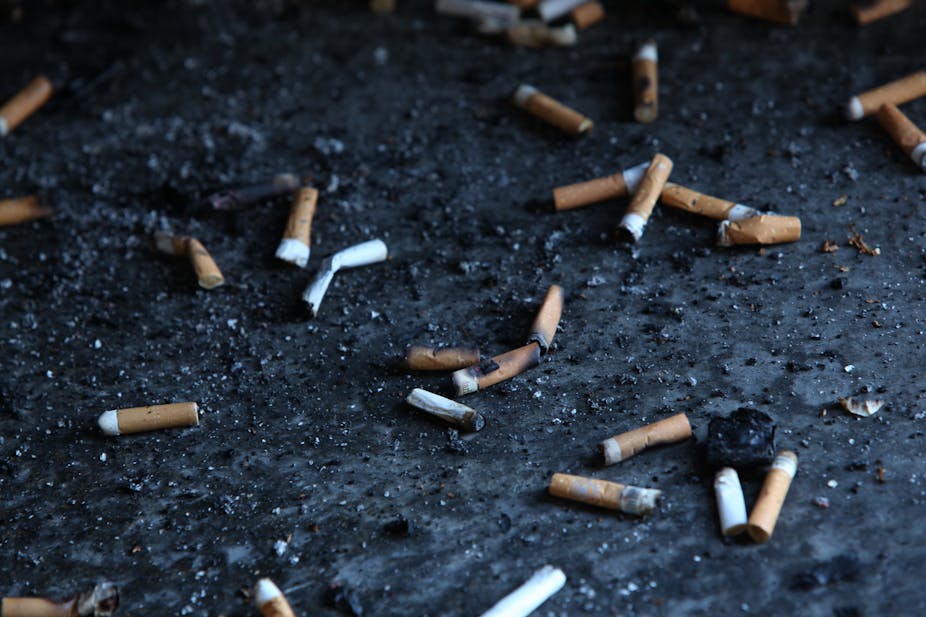
Playgrounds, parks, sports fields, beaches and other child-focused venues are also increasingly being made smoke free in recognition that adult behaviour strongly influences children. Cigarette butts are also potentially poisonous if swallowed by small children. There is little argument that these sorts of outdoor areas should be smoke free.
The potential for hospitality staff and diners to be exposed to secondhand smoke has led to smoking bans for al fresco dining areas in several Australian states including Queensland, the ACT, and Western Australia with New South Wales to follow in 2015.
No Australian state has completely banned smoking in outdoor drinking areas, but in Queensland, all outdoor smoking areas prohibit patrons from being served and no food or entertainment is permitted.

Assessing the evidence
There’s no doubt that exposure to secondhand smoke in enclosed places is harmful – the evidence base is rock solid. The evidence that secondhand smoke exposure in outdoor dining areas could occasionally exceed safe levels, particularly for wait staff, may also be sufficient to warrant an outdoor dining ban.
But when it comes to fleeting exposure in wide open outdoor spaces, there is little evidence to support that this type of second hand smoke exposure is a public health issue. Completely banning smoking in all outdoor areas cannot be justified on the grounds that the exposure to the resulting secondhand smoke is of significant harm.
Very few public health organisations have actively lobbied for a complete outdoor smoking ban. Contrary to what the tobacco industry lobby would have you believe, tobacco control advocates – myself being one of them – know where the evidence stops.
Next steps in tobacco reform
So does this mean that smoking in outdoor areas should not be banned? Communities ban all sorts of things that they dislike or that annoy them, but do not cause any real health issue. Running into a cloud of smoke on an attractive city square ruins the look of the place and annoys some people.
Essentially it is up to the community to decide if a total outdoor smoking ban is something it supports and feels is necessary to fully enjoy their public spaces.
As a tobacco control and public health advocate, it is my responsibility to ensure that good evidence guides policy implementation. And when it comes to reducing smoking rates and protecting health, nothing beats a tobacco tax increase.
Comments on this article are now closed.
Stephen Mugford
Sociologist
Maybe (not entirely tongue in cheek) we should just ban tobacco? Most of the arguments about why bans are failures (there are many, I know) sort of falter here. For example, the classic one that the black market version springs up and is more poisonous can hardly be true for this one, can it? In addition while there would be a black market (Cf Prohibition in the US) i suspect enforcement would be far easier than (say) cannabis, cociane, etc. These bans are somewhaat contested, but many people loathe smoking and would dob illegal smokers in. Hmm. Well, I guess not but it is not automatically a bad idea as it is for more drugs! :)
Judith Olney
Ms
What I find particularly disturbing about this ongoing demonisation of smokers, is the complete lack of acknowledgement of the reality of tobacco use in Australia.
The measures taken in education, and laws banning advertising of tobacco products, as well as the anti-smoking laws, (which BTW have a greater than 95% compliance rate from smokers), are all working well in decreasing the percentage of people smoking or taking up smoking. Less than 18% of our population smoke, and that is declining…
Read moreColin MacGillivray
Retired architect
Banning tobacco might cost tax payers. In the UK the cost to the NHS of treating diseases caused by smoking is approximately £2.7 billion a year. The Treasury earned £9.5 billion in revenue from tobacco duties in the financial year 2011-2012 (excluding VAT). taken from an ASH website. So smokers subsidize UK taxation by £7 billion a year.
What are the figures for Australia?
Matthew Thredgold
Software Engineer/Secondary Teacher
"I sure don't want to live in a world where people feel the need or desire to dob in smokers, when they are not harming others."
Yes, but they are continuing to harm others. That's why we need a ban on smoking in public places.
Passing me on a footpath with a cigarette in their hand, is going to cause me nuisance and annoyance, and is going to prevent me from walking on the same footpath, and it is exposing me to harmful chemicals I don't want to be exposed to.
I want to have a say in all of that, and it is "don't do that to me". I have tried asking people not to politely, but you should see how far that gets you. We need a legislative response to prevent what is ultimately their rude and selfish behaviour.
If that is demonising them, then I make no apology. They need to learn some manners.
Judith Olney
Ms
What nonsense, if someone is walking past you with a cigarette in their hand, there is no evidence at all that you are being harmed. This is what the author pointed out in this article.
Annoyance is not harm. I am annoyed by people who sneeze or cough while walking past, and I am far more likely to be harmed by catching whatever disease they have, than you are by someone walking past with a cigarette.
I totally disagree that we need legislation to prevent what you view as rude and selfish behaviour. You cannot legislate for good manners.
Matthew Thredgold
Software Engineer/Secondary Teacher
Judith you are obviously not an asthmatic. Cigarette smoke has a physiological effect on me. And it is doing me harm. There is also no safe exposure level to some of the chemicals and the particulates.
Annoyance is reason enough to ban it. Littering is reason enough to ban it. And then it is harmful. People who claim it isn't harmful are being willfully ignorant.
Matthew Thredgold
Software Engineer/Secondary Teacher
I get a bit sick of people, including Dr Freeman, discounting my experience. There is physiological harm from outdoor tobacco smoke. The shortness or breath, the coughing, the nausea. Maybe that isn't cancer of the mouth, oesophagus or lungs, and maybe the risk of those isn't high, like they are from the exposure to indoor smoke, but I would classify the shortness of breath, the coughing and the nausea as harm.
Judith Olney
Ms
And yet you walk along city footpaths breathing in all manner of petro-chemical pollution, and seem quite happy to do so. I see you are not calling for a ban on motor vehicles.
I am not asthmatic, but I do have an extreme sensitivity to petro-chemical pollution, but I am also a realist, I moved to a country town where the pollution level is very low, rather than go on a crusade against people who drive motor vehicles.
I don't agree that annoyance is reason enough to ban anything, and if littering is enough to ban something, than we should be banning fast food and alcohol, soft drinks and plastic bags, disposable nappies, and any number of other items commonly littered around our cities, towns and roads.
Nobody is claiming that tobacco is not harmful, but there are levels of harm to others, as with everything that produces pollution. People who overstate the harm caused to suit their own agenda, are wilfully ignorant of the actual research done.
Matthew Thredgold
Software Engineer/Secondary Teacher
Oh this is a tired, worn out argument "I see you are not calling for a ban on motor vehicles."- yeah it would be in a different thread and you are making assumptions that just aren't true.
I would advocate restrictions on vehicular traffic. Starting with 2 strokes and diesels, and then in the city I would greatly limit where the remaining traffic can go and make most streets only for pedestrians, trams and cyclists.
I would also ban motorcycles because of their noise or the noisy ones at least.
And no I generally avoid city footpaths now, and have negotiated telecommuting most days, and on other days the route I take between the station and my current workplace is not direct, because I avoid the smell of traffic, the noise of traffic, and the density of crowds, because of the tobacco smoke.
Are you saying I am overstating the effect tobacco smoke has on me? Are you calling me a liar?
Judith Olney
Ms
I suffer the same symptoms from exposure to petro-chemical pollution, as well as suffering hives, and eczema from contact exposure. I moved to a country town to minimize this exposure, and if I need to go to the city, I take measures to minimize my exposure there. The shortness of breath, coughing, and nausea I suffer from, is temporary, and as far as my doctor can tell me, causes no harm.
I do not expect the government to ban all motor vehicles because I suffer from this sensitivity, I do not expect other people to stop driving their cars, because I suffer from this sensitivity. I take responsibility for myself.
The evidence does not support your claims Matthew, however you may view it.
Judith Olney
Ms
Good luck with advocating for restrictions on motor vehicles, that is something I would support. Good to see you are taking responsibility for your health problems, I too have to do this.
I think you are over reacting to my comments, and trying to find a reason to be offended, I have not call you a liar at all, and have not suggested that you are not effected by tobacco smoke. I have suggested that the evidence does not support your call for a ban on smoking in all public spaces.
Colin MacGillivray
Retired architect
Matthew
In the mid 1970's, in the days when everyone smoked everywhere, I was playing squash and smelt cigarette smoke and after the rally turned to the gallery and said to the offender- bugger off. It turned out he was a friend and afterwards told me he couldn't believe how quickly I smelt his smoke. It was a matter of seconds after he entered the gallery and he was about 6 metres away, and above, me.
Evert Rauwendaal
logged in via Facebook
Hi Stephen
If you goal is deter people from using tobacco, tobacco control is likely to be more effective than tobacco prohibition. For example, compare tobacco (controlled) to cannabis (prohibited/uncontrolled) in Australia and the USA.
“Adolescents aged 14-19 years are now more likely to have ever tried cannabis (25.5%) than tobacco (16.2%)”. http://www.health.gov.au/internet/drugstrategy/publishing.nsf/content/mono63
"Current marijuana use among high school students was more common than…
Read moreVladimir Breskin
logged in via Facebook
We have to remember;
Read morePre-humans lost their tails and developed to homo sapience due to extensive use of fire.
Smoke in environment for 2 million years was instrumental for many evolutionary changes in human biology as well as created brand new conditions to advance our specie in personal hygiene.
Our immune system is product of inhaled smoke of fire. We have to keep in focus its impact. Tar? One of the normal functions of our lungs developed is to clean themselves from pollutants, by kilos…
Henry Verberne
Former IT Professional
Vladimir: Please provide some evidence for your assertions.
Vladimir Breskin
logged in via Facebook
Some links:
http://www.abc.net.au/science/articles/2012/08/21/3570223.htm
http://www.livescience.com/19425-earliest-human-fire.html
http://www.sciencedaily.com/releases/2012/04/120402162548.htm
http://www.bbc.co.uk/news/science-environment-17598738
and 100s more
Vladimir Breskin
logged in via Facebook
Check refs here
http://www.beyondveg.com/nicholson-w/hb/hb-interview2c.shtml
Sue Ieraci
Public hospital clinician
What a load of nonsense, with no support from your links.
1. ABC - Dr Carl "Way back then, the ability to control fire gave us our tools and metals. It also gave us warmth, food and light, helped bond us together around the campfire, and helped protect us from predators. Even today, we talk of 'firepower' as a measure of our ability to outgun those with less 'firepower'." NOT about inhaling smoke
2nd ref "human ancestors may have used fire a million years ago, " Nothing about inhaling smoke or immune systems
3rd ref "Evidence That Human Ancestors Used Fire One Million Years Ago"
4th ref BBC - same as 2.
Sue Ieraci
Public hospital clinician
The beyondveg one is about ancient use of fire and the introduction of cooked food - again, not about inhaling smoke.
Vladimir Breskin
logged in via Facebook
"the new findings fit with an idea that Homo erectus began to cook food nearly 2 million years ago, the scientists propose."
http://www.sciencenews.org/view/generic/id/339600/description/From_the_ashes_the_oldest_controlled_fire
Tell them, please, to stop their nonsenses.
Did you try to cook on open fire or warm yourself without inhaling any smoke? For 2 million years?...
Or fumigate your cave without killing germs and parasites?
Come on...:)
Matthew Thredgold
Software Engineer/Secondary Teacher
Vladimir,
Where to begin with such nonsense?
WHO - 1.5 million people die each year, mostly women, from indoor wood smoke particulates. US CDC - Tobacco kills 5 million people per year.
There's 6.5 million people each year not participating in human evolution.
Vladimir Breskin
logged in via Facebook
Matthew,
Did you see any postmortem report where smocking or inhalation of “wood smoke particulates” is stated as a cause of death?
Or yours "6,5 million" is a speculation and part of propaganda?
Matthew Thredgold
Software Engineer/Secondary Teacher
You'd have to ask the World Health Organisation and the Center for Disease Control.
I for one am prepared to trust the scientists that work for those organisations without glibly calling it propaganda to make some dumb point or to make excuses for poor behaviour.
Smoke such as woodsmoke and tobacco smoke are toxic. They are not benign. They kill people in their millions. It makes sense to reduce our exposure to them to lessen the risk. To ignore the evidence is dangerous and dumb.
Vladimir Breskin
logged in via Facebook
"To ignore the evidence is dangerous and dumb."
I am on your side here, Matthew.
Matthew Thredgold
Software Engineer/Secondary Teacher
5 years ago I got a plum job in the Melbourne CBD. It was only a short walk from either Southern Cross or Flinders St stations, yet I could find no route to work where I would not be exposed to a dozen or so cigarettes between the station and the office door. Not wanting to start each day being forced to breathe cigarette smoke I quit the job. It took 2 weeks after starting to make that decision, and a few weeks to find another job. My Melbourne employer was of course annoyed when I quit so soon…
Read morePeter Fox
Peter Fox is a Friend of The Conversation.
Medical doctor
Matthew, completely agree with all your comments including statements above about assault and need for harsh enforcement. I develop wheeze when forced to inhale second-hand smoke. I avoided pubs in the bad-old-bads, but it remains difficult to avoid this assault in many public spaces, especially congregations around building entrances (including hospitals!).
As suggested in other comments, enforcement is very difficult, especially since many marginalised smokers react aggressively to polite requests. I have received verbal threats in the past when politely asking people not to smoke on hospital campuses. When smoking bans were recently instituted on all Sydney train stations, a station worker told me he was threatened "I'll punch you in the head" when asking a passenger to put his cigarette out. As a result, he no longer is willing to enforce the new rule.
Vladimir Breskin
logged in via Facebook
I hope, you can get an adequate cure for your condition.
Paul Richards
strategic foresight
Becky Freeman said "....... up to the community to decide if a total outdoor smoking ban is something it supports and feels is necessary to fully enjoy their public spaces." Great point and the real issue.
It is inevitable our community will take back their public spaces and further humanise our cities. This will be more of a response to multinational corporations and their profit regimes than an attack on smokers. These corporations have modified the structure of our society and we have started rejecting their version of reality.
Theo van den Berg
IT Consultant
Our newest and biggest wave of tourism comes from Asia. Most of our student income is from there as well. In Asia, smoking is still very popular and it would be very silly indeed, if they tried to ban smoking in Beijing.
If Melbourne wants to attract any tourists, it would be much better if they finally followed-through and banned all cars from the inner city. Less noise, less danger and definitely less polution.
When they banned smoking in the G, I stopped going there. When they banned it at other entertainment ventures and did not provide an out, I stopped going there as well.
I now live in the bush. I still smoke, but my lungs are likely to be in much better health than if I was still walking around dirty Melbourne.
Sue Ieraci
Public hospital clinician
Theo Van Den Berg - no way are your smokers lungs better off than a city non-smoker.
Here's just one paper showing the difference: http://radiology.rsna.org/content/251/2/566.full.pdf+html (you need to read the data in the tables - the detail is not in the abstract).
I love going to smoke-free music venues - I can enjoy the night out and come how without smoky clothes and hair.
I understand the need to justify when you have a strong addiction, but that doesn;t negate the harm.
Theo van den Berg
IT Consultant
Thanks for that Sue, but I have also seen plenty of studies the other way, like smoking farmers versus citydwellers at the end of their lives having their lungs disected.
Read moreAnd yes, I agree that unfortunately after 50 years of smoking, I still enjoy a few cigarettes. I also agree, that it is much nicer to be in a public venue without smoke, but just as we have toilet facilities and cater for the disabled, surely we can look after those poor disabled smokers as well ?
And yes, I also agree with Rob…
Paul Richards
strategic foresight
Theo van den Berg said; "...... also seen plenty of studies the other way..."
Read moreHave you verified these are not the same think tanks who put out studies rejecting climate science? These neoliberal 'think tanks' are financed by well known corporations like the tobacco and the energy industries. Consulting and working as lobbyists for corporate vested interestes. Just what kind of value system is in play in the background around these 'studies'? Have you actually researched this? [rhetorical]
Theo…
Rob Buttrose
University of Melbourne
Butt litter is just as big an issue
Although the focus of this article is the health impact of smoking in outdoor areas, I think the litter problem is equally important. Around 7 billion butts are littered in Australia each year (http://www.buttlitteringtrust.org/) , ending up in the soil, waterways and the ocean and posing a threat to the environment and wildlife. Discarded butts also impact on the amenity of many public spaces, particularly in our cities, and are an expensive challenge for…
Read moreSue Ieraci
Public hospital clinician
Good point, Rob.
Why is it that smokers feel free to drop butts on the ground? Why not just carry them to the nearest bin, like we expect people to do with other rubbish? (Not perfect compliance, I know, but cigarettes seem to be in come special category here. Why?)
Vladimir Breskin
logged in via Facebook
=="Smokers really are second-class citizens"==
What job position are you currently holding at Melbourne Uni, Rob?
Gary Cassidy
Interesting article - thanks.
There are two main consequences of second hand smoke exposure, reduced health and reduced amenity. Arguing for reduced second hand smoke exposure on health outcomes can be quantified (in terms of health and dollars), and as you point out fleeting exposure has little evidence of being a public health issue. Reduced amenity, however, is difficult to quantify and it would most likely not be able to be attached to any dollar costs.
For me the reduced amenity that…
Read moreTheo van den Berg
IT Consultant
and to be as silly as Mr Foster and hopefully still politically correct, I personally am not too keen on overweight people, specially on planes, trains and busses, where they often take more than their allotted space. Should they ban certain sizes from using public transport ?
Where does it end ? Some of our poorest people are renting in places like Fitzroy. The landlord does not allow smoking inside and the council has banned smoking outside. Will there be riots ?
Someone like Mr foster should be voted out on a special emergency meeting of the council today. Tollerance of diversity in Australia, good and bad, must feature high on the agenda of any of our politicians.
Leo Kerr
Consultant
What is the point of this proposed ban? Is it concerned with health issues, air quality? If so a draconian measure like this will have negligible if any effect. I don't smoke and am in complete agreement with all of the restrictions so far in place throughout most of Australia - but I can't quite fathom the purpose of this proposal. It smacks to me of righteous indignation by non-smokers to those addicts still unable to quit. If we want to improve the air quality in cities then we should be banning petrol/diesel vehicles from the city environment.
Matthew Thredgold
Software Engineer/Secondary Teacher
Again - vehicle exhausts are a different issue, and restrictions on them are probably a good thing too.
It is not righteous indignation. At the moment a large number of people are excluded from participating in normal life, because cigarette smoke dominates the area around the smoker, both inside or outside. So large numbers of people have to avoid anywhere where cigarette smoke is likely to be. We are excluded from outdoor seating areas, city streets, public transport stops, and we have restricted entertainment, education and employment opportunities. In effect we are being discriminated against.
Public smoking bans end the apartheid against the smoke sensitive.
Paul Richards
strategic foresight
Leo Kerr said : "If we want to improve the air quality in cities then we should be banning petrol/diesel vehicles from the city environment."
You have a good point, both are an issue in a civilised evolving society. Which corporate entities are easier to tackle first? The tobacco industry or the petrochemical / vehicle industries? Seriously, the tobacco industry is a good first choice, make no mistake the other two are on notice and will make a good precedent. This is not about an attack on smokers, it is more about who structures our society. Humanising cities is a worldwide movement and gaining momentum as human value systems evolve.
Leo Kerr
Consultant
Matthew I really don't see that vehicle exhausts are a different issue - it's about health and air quality. The only study I'm aware of was conducted by NSW Dept. of Health into costs attributable to air quality issues and the results are staggering. $4.7 billion dollars a year spent on health issues related to air quality in the greater Sydney Metro area. 70-80% of air quality issues are due to vehicle exhaust. Diesel has been declared to cause cancer by the WHO yet the diesel fleet continues…
Read moreLeo Kerr
Consultant
You might be right Paul in that the tobacco industry is an easier target - the bigger issue is air pollution due to vehicle exhaust imho.
Vladimir Breskin
logged in via Facebook
"the tobacco industry is a good first choice, make no mistake the other two are on notice" (the petrochemical / vehicle industries)
How can you substantiate your promises? Are you member of some sort of campaign group and aware of the future agenda?
Paul Richards
strategic foresight
Vladimir Breskin said; "How can you substantiate your promises?
No promise was made about the future. It is unwritten, but the direction of probability is self evident to an evolved value system.
Vladimir Breskin said; "Are you member of some sort of campaign group and aware of the future agenda?"
Yes, as a member of a evolving civilised society, whose field of study is strategic foresight. If you like labels pick anything you like, your choice. If you see the carbon energy industry as a viable future that is also your choice, but world opinion is changing.
[my value system is generally on SDi turquoise if you grok stages of human development]