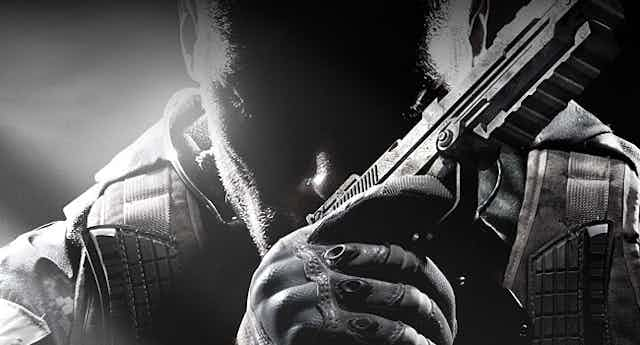
Call of Duty: Black Ops II – why the series hits the target every time

Last week, the first-person military shooter game Call of Duty: Black Ops II hit the shelves. The release marks the fourth year in a row that a game in the Call of Duty series has had the “biggest entertainment launch of the year”, grossing more than US$500 million in its first 24 hours on sale. Its…

Hjbdp52j-1353387079
Black Ops II was one of the most-anticipated games of 2012, and it’s had the sales figures to match. Activision

Last week, the first-person military shooter game Call of Duty: Black Ops II hit the shelves. The release marks the fourth year in a row that a game in the Call of Duty series has had the “biggest entertainment launch of the year”, grossing more than US$500 million in its first 24 hours on sale.

Its predecessor, Call of Duty: Modern Warfare 3, grossed US$1 billion worldwide within 16 days, beating James Cameron’s Avatar, the highest grossing film of all time, by a day. Black Ops II is poised to potentially break that record again.

For many who aren’t familiar with these games, though, their popularity can seem somewhat alarming. Are they simply a disturbingly popular product of the military-entertainment complex, or is there more to their popularity?

Although it was always a popular series, Call of Duty didn’t rocket into ubiquity until November 2007, when Call of Duty 4: Modern Warfare was released.

Call of Duty 4: Modern Warfare helped make the Call of Duty series one of the biggest in gaming history.

Modern Warfare was the videogame equivalent of the first Pirates of the Caribbean film, or the early Harry Potter books – a game that did extremely well critically, that caught on with consumers in a big way, and that ultimately assured the success of future instalments in the franchise.

There have been five Call of Duty games on consoles and PC since Modern Warfare, all of them smash-hits.

The game launched at a time when the term “military shooter” normally meant a game which was set during World War II – a setting that gamers had long since grown tired of.

The solo campaign in Modern Warfare saw the player switching between six different playable characters, but focusing primarily on Seargent John “Soap” MacTavish, a new member of the British Special Air Service.

The game was set in the “near future” of 2011, following a fictionialised conflict that echoed real-world events in numerous ways.

Call of Duty: Modern Warfare’s plot was hailed as a critical success.

But while the solo campaign was lauded as excellent, Call of Duty’s popularity has never been tied to its qualities as a single-player game. In fact, some 30% of people who played Call of Duty 4: Modern Warfare on Xbox 360 while connected to the internet never even completed the first mission in the solo campaign.

In 2007, online multiplayer gaming was still a novel concept for many. Although the Xbox and Playstation 2 consoles had both allowed online play, the next generation of consoles (including the Xbox 360 and the Playstation 3) had launched with a much greater focus on online multiplayer, and ultimately provided much better experiences for consumers who were now far more likely to have broadband internet connections.

Modern Warfare was launched just when many console owners were ready to be wowed by online gaming.

To explain the appeal of Call of Duty’s incredibly popular multiplayer to an audience that has never played it is a difficult task. Indeed, to non-gamers, the idea that a game can achieve such popularity by making the act of killing friends and strangers extremely fun may seem somewhat vulgar.

But Call of Duty has always had two major things going for it: the snappy responsiveness at the heart of its ultimately rather simple combat, and a fun reward structure.

bigdigo/Flickr

Many of the game’s detractors – and there really are a great many of them – have written Call of Duty off for its lack of complication, its singular focus on sprinting around maps, hurling grenades and gunning people down without needing to be strategic.

This is a rather reductive way of looking at what the games achieve, but it’s accurate … to a point. The simplicity of the systems that govern Call of Duty’s action means it’s easy for a player to jump in and start enjoying the game immediately.

The system for connecting to an online game couldn’t be easier, and allowing players to pick and choose their own weapons and “perks” (which make your character better at certain tasks such as reloading, sprinting, or surviving being shot) can make for a highly personalised experience.

It’s an incredibly responsive game – tapping the left trigger on the controller zooms your gun into iron sights, while at the same time subtly shifting it immediately towards your nearest opponent. This makes the combat, on a moment-by-moment basis, incredibly satisfying … when you’re playing well.

Weapon proficiencies are one of the reward systems that allow players to customise their gaming experience.

The reward structure, which has been copied repeatedly by most online shooters that have followed, is a genius idea.

Using a gun in any of the online modes unlocks, essentially, better versions of that gun – your first ten kills with a weapon may net you a new scope for it, or you may “level up” after a game and unlock a new “perk”.

You’re constantly being given things while you play Call of Duty, and each new good action you perform – whether it’s a kill, completing an objective, or assisting someone else – awards you with experience points.

It’s the same model that many of the most popular mobile games operate on. Angry Birds, for instance, works because it constantly rewards you with new levels.

Call of Duty’s popularity is due partially to the responsiveness of its rather simple combat system.

Since Modern Warfare, publisher Activision has made a concerted effort to make sure gamers have the option of upgrading to a new Call of Duty every single year, a model that has always worked well for sports franchises such as EA Sports’ FIFA (soccer), Madden (NFL) and PGA Tour (golf) games.

By splitting the efforts between multiple studios – games produced on odd years are headed up by Infinity Ward, while games on an even year, including Black Ops II, are developed primarily by Treyarch – Activision has been able to maintain a strict annual release schedule.

As of right now, Activision has ten developers dedicated to Call of Duty, whether leading their own games, assisting with others, or developing downloadable content maps that are sold after release.

It would be fair to suggest this development model has turned many off the games – which some argue have failed to evolve – but it’s a strategy that keeps working.

The popularity of Call of Duty, then, comes down to a combination of smart design, a somewhat cynical (but incredibly effective) publishing cycle, good grace, and the fact Call of Duty 4: Modern Warfare appeared at just the right time to capitalise on the new online multiplayer market.

The success of that game has allowed for a huge marketing budget – one that allows for advertisements filled with celebrities (see video above), lavish review events at Californian resorts, numerous marketing stunts and utter saturation of the Call of Duty brand.

Whether or not this strategy will last indefinitely is questionable – oversaturation eventually forced Activision’s Guitar Hero brand into hiatus – but the sales figures for Black Ops II suggest Call of Duty is likely to remain the most popular and powerful franchise in videogames for a while yet.

Sign in to Favourite

Want to follow The Conversation?

Sign up to our free newsletter to get the day's top stories in your inbox each morning, with a special wrap on Saturday.

Spinner
Help evidence based journalism become the norm and donate

Join the conversation

11 Comments sorted by

  1. Jason Bryce

    logged in via Twitter

    I hate this whole franchise. How has this become a socially acceptable toy for young children? The MA rating is widely ignored yet these games are disgusting, bloody and brainless.
    But try keeping your boy away from it and they will find anyway possible to get their mates house or borrow someone's disc and get online.
    Its like they need a hit of their crack -Don't get in between a boy and his Call of Duty. This is a parent's nightmare.

    report
    1. Zhixi Jim Zhou

      logged in via LinkedIn

      In reply to Jason Bryce

      @Jason Bryce, but the point is that these games are not just specifically marketed at "young children". A significant proportion of players are young adults and those well into their 30s. The notion that video games are made only for boys with much time on their hands is wildly outdated. And many would disagree that games such as Call of Duty are "brainless".

      report
    2. Stuart H

      logged in via Twitter

      In reply to Jason Bryce

      The fact that the MA rating is ignored is more a reflection on the parents than on the children.

      Once the R18 rating is introduced, I imagine that this game will be put under that. Ultimately the responsibility- as with any form of entertainment- lies with parents to moderate and contextualise the violent acts that children are exposed to.

      report
    3. Tim Scanlon

      Debunker

      In reply to Jason Bryce

      So bad parenting is a parent's worst nightmare? Wow, who'd have thunk!

      Average age of gamers is 32 and they have been playing for a dozen years. 75% of gamers are over 18 and both sexes play them relatively equally. Trying to say that this is a kids game when it has an MA rating is fallacious, this game is aimed at adults. Calling the game bloody and brainless is contrary to the challenge that games have to impose to be interesting and popular, and being as how it is not real, the blood is a non-issue. If an adult can't separate fantasy from reality then that adult has more problems than playing computer games.

      Just because you don't like it doesn't make it wrong. http://www.igea.net/wp-content/uploads/2011/10/DA12FinalLinkVideo.pdf

      report
  2. steven kouts

    teacher

    My 10 year old son gathers his mates on the phone and play minecraft 'hunger games mode". He loves the online interaction. I cant help but feel that Call of Duty and other such games are the next logical step for them as they mature. Not something that I as a parent is really happy about. Hopefully other online games will evolve that dont use violence as entertainment.

    report
  3. Martin Male

    logged in via Facebook

    For me the great concern that is not address in this article, which seemed quite biased in my view, is how come people and children are being conditioned to accepting this as a "good" form of entertainment i.e. mindless slaughtering.
    I am not a conspiracy follower, I just observe patterns of behaviour.Does anyone else see the connection between these games and the increasing similarities to how "war" is now played out. Drones are the classic example of this, the "operator" doesn't even have to leave his home town. The American defence machine heavily invests in war game development as a recruitment tool.
    For me as a psychotherapist it is a concern that we are normalising this behaviour as acceptable and suitable for malleable minds. How have we come to accept that this is all ok? Behaviourists have a term for this systematic desensitisation!

    report
    1. Tim Scanlon

      Debunker

      In reply to Martin Male

      How can you equate fiction with reality? If that were the case then just about every form of entertainment is mindless violence of one sort or another.

      If military styled games are meant to be a recruiting tool then it has failed miserably. The only positive for military recruits in the US was the economic downturn. Generally recruiting has been flat or declining. So not much evidence to support your supposition.

      Drones are not similar to games. Games are fun, drone pilots are exhibiting high levels of stress and emotional burnout. Plus, drones still require ground crews in most instances.

      report
  4. Pete Mulherin

    Student

    Not sure why the Conversation is publishing this 'article'...hardly a thoughtful insight into anything other than why the game is 'good'.

    All I read is an advertisement for a game which glorifies war. Why is killing people fun? Would gamers find a paintball game (no dying) similarly enjoyable? I think not.

    Obviously suggestions like banning the game are out of the question, but I am interested why gamers find this kind of inane 'entertainment' fun?

    report
  5. Robert Tony Brklje

    retired

    The difference between a winning game and a losing game is often not the qualities of the winning game but the qualities of it's competition.
    The Call of Duty franchise is not that good it's competition is simply worse and in the multi-player environment it has momentum, more players accessible to play a multi-player game. Gamers are looking to play a game both single player and multi-player and call of duty is closest to the target for that market.
    For high initial sales, it's marketing is obviously…

    Read more
  6. aligatorhardt

    logged in via Twitter

    I see the same nonsense every time an article about video games appears. That is the claim that it is violence, and we are shooting our friends and neighbors. We are shooting CARTOONS of people. Everyone is fully aware that it is a game of fantasy. The religious types who complain about games are the ones who cannot separate fantasy from reality. The next big myth is the effects on children. These are M rated games that are not sold to children under 17. If a child has the game, and the parent does not like it, it is their responsibility to take it away. Real violence in society has existed since the beginning of time, and banning games will not remove it.

    report