


Is Tasmania at a tipping point? Over the past two weeks The Conversation, in conjunction with Griffith REVIEW and the University of Tasmania, has published a series of provocations. Our authors ask where does Tasmania’s future lie? Has it reached a “tipping point”, politically, economically and culturally? Thinkers, writers and doers from Tasmania and beyond, including members of its extensive diaspora, challenged how Tasmania is seen by outsiders and illuminated how Tasmanians see themselves, down home and in the wider world. This is the final part of the series.
Prejudice, ignorance and shallowness characterise the current national debate on Tasmania and its future. On the political right the island is portrayed as the kind of poor, tree-hugging, gay-loving, welfare-dependent, enterprise-free society Green-dominated Labor governments inevitably create. These images fit a narrative established in colonial times when Tasmania was thought of as a government-subsidised prison society where laziness, pauperism and depravity were rife, and self-discipline and self-help unknown.
Whether West Australian Premier Colin Barnett realises it or not, his attacks on Tasmania’s “mendicancy” draw as much strength from ancient fears and stereotypes of Tasmania as a flawed and failed place as from contemporary concerns about the distribution of GST revenues.
The anti-Tasmanian myths perpetuated by progressive intellectuals are less obvious but just as self-serving. Debate on Tasmania is framed in terms of a unique “moment”, “watershed” or “tipping point” where the island faces the choice between embracing the creativity and innovation of the elite few or being held back by “local resistance to change” and “stuck in the mud of the past”.
As with the right’s story about Tasmania’s poverty and weakness, the cultural left’s wipe-the-slate-clean-and-start-again story about Tasmania’s future is based on the assumption that mainstream Tasmanian politics and society is fundamentally flawed, destined to failure and in need of rescue. It also has a very long pedigree. We were told we were on the cusp of a radical rupture with the past when transportation ended, when the colonies federated, when the first Labor/Green Accord was forged in 1989 and when the “New Tasmania” was suddenly born from, among other things, the decriminalisation of homosexuality in 1997.
Each time the reality was far more complex.
It is an understandable and sometimes charming peculiarity of immigrant societies that we see the past as wholly grim and gone and the future as holding nothing but promise, with an unbridgeable chasm between the two.
But it is also a curse.
By pretending a historically important event is a repudiation of what has gone before, rather than its outgrowth, we’re destined not to understand or gain from these events. As in a nightmare, the faster we try to run from the past the slower our real progress becomes.
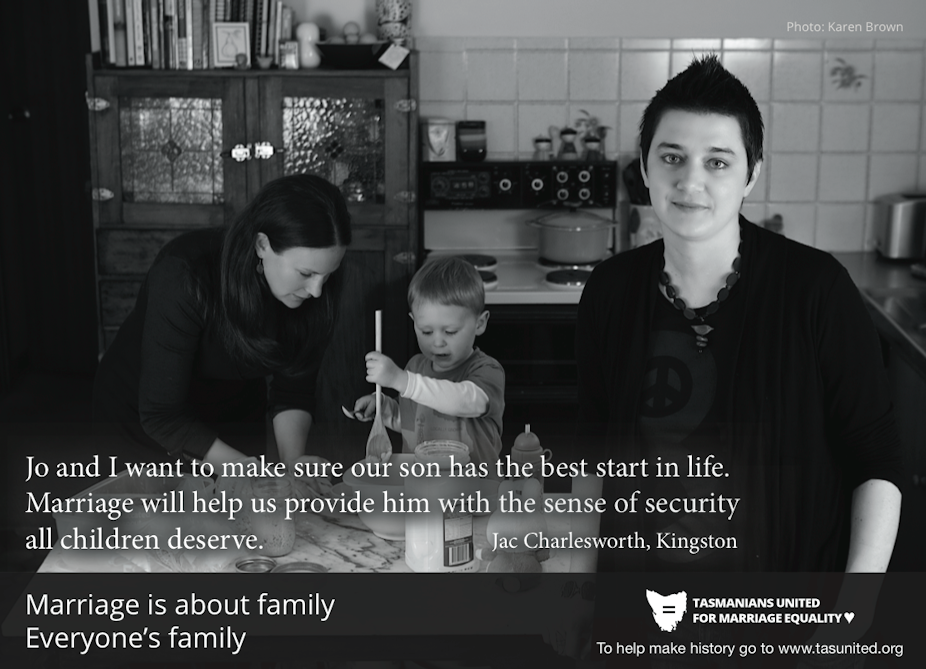
Tasmania’s leadership on marriage equality is a good example of how distorted preconceptions about Tasmania obscure reality. In August 2012, Premier Lara Giddings announced her government would pass legislation allowing same-sex couples to marry. Continental opinion was bemused. Some commentators labelled it “unlikely” and “ironic” that the last state to decriminalise homosexuality was the first to move on same-sex marriage.
People on both sides of the marriage equality debate thought Tasmania was stepping out of type (with the exception of opinion and arts writer Helen Razer, who opposes same-sex marriage as co-option of gay people into an archaic institution, and for whom Tasmania’s leadership confirmed her pre-existing stereotype of the island as a “creepy” monstrosity).
The reason the nation was surprised was because Tasmania has always been a convenient screen upon which it can project everything it doesn’t like about itself, including its homophobia. The thought goes something like: “however uncomfortable we are with gays, we’re not as bad as those Tasmanians”.
For centuries, islands have unwillingly served the psychological role of allowing continental people to exonerate themselves of their own faults. But now Tasmania was defying its set place in the national psyche. It was inevitable continental commentators would try to portray Tasmania’s leadership on marriage equality as an exception to the proper order of things.
Such commentary was all nonsense. Tasmania has been on the path to marriage equality for many years. In 2005, it was the first state to see same-sex marriage legislation introduced to parliament and publicly debated, with the bill re-introduced in 2008 and 2010. In 2003, Tasmania became the first state to have a scheme for formally recognising same-sex relationships and was the first state to officially recognise overseas same-sex marriages in 2010.
The year before, the Tasmanian state branch of the Australian Labor Party was the first to endorse marriage equality at its state conference – and in 2011 Tasmania’s lower house of parliament, the House of Assembly, was the first Australian legislative chamber to pass a motion in support of marriage equality.
Far from being an unlikely first-mover on marriage equality, Tasmania has been on a trajectory to lead the nation on the issue since the mid 2000s. To confirm this, we only need to look at reforms more broadly. Tasmania’s anti-discrimination laws enacted in 1999 are the strongest in the nation, with no exemptions allowing religious organisations to disadvantage gay and lesbian people. These laws have been effectively utilised to launch globally unprecedented challenges to everything from the gay blood donation ban to the use of lesbian, gay, bisexual, transgender and intersex human rights as wedge issues during elections.
Tasmania’s recognition of same-sex parenting, the state school system’s concerted efforts to challenge classroom homophobia, and the government’s funding of LGBTI support organisations, have all led where other states have since followed. Beyond these legislative and policy initiatives there is a solid foundation of public support. Polls consistently show support for gay equality is higher in Tasmania than nationally.
But that still leaves unexplained how the last state to decriminalise homosexuality has moved so far so quickly. To understand the depth of Tasmania’s transformation it is important to understand how repressive Tasmania once was for homosexuals.
Former laws against gay sex carried the harshest penalties in the western world – twenty-one years in gaol. They persisted thanks to public support, with polls in the late 1980s showing opposition to decriminalisation to be 15 per cent higher than the national average. Through the twentieth century our old anti-gay laws were enforced more often than in the other states, with their repressive impact magnified by laws unique to Tasmania, such as those criminalising male cross dressing.
In the nineteenth century, unprecedented steps were taken to eliminate same-sex relationships among convicts. These included the separate and silent prison at Port Arthur and the continuation of capital punishment for sodomy until 1867, long after it had been abandoned elsewhere in the British Empire.
When I came out in 1987 I was immediately made aware of this repressive legacy. At the first gay community meetings I attended I was warned about the police practice of taking down the car registration numbers of those attending such meetings to add to a list of known homosexuals. Not long after that I was horrified to hear the then Liberal premier, Robin Gray, declare that homosexuals were not welcome in Tasmania.
Only a few months after that the gay rights stall I helped set up at Salamanca Market to gather gay law reform petition signatures was shut down by the Hobart City Council because homosexuals were ‘not welcome in Hobart’s family market’. When we defied the ban the police were brought in and over seven successive Saturdays a hundred and thirty people were arrested in what became the largest act of gay rights civil disobedience in Australian history.
The arrests at Salamanca Market bring us back to the question of Tasmania’s profound change: the Hobart City Council used the twentieth anniversary of these arrests to apologise and fund a public art work commemorating the event. Both were the first of their kind in Australia. How did this transformation occur? How did Tasmania go from having the worst laws and attitudes on homosexuality to having the best? How, in the words of one American journalist, did Tasmania shift in just a few short years from being Australia’s Alabama to its Massachusetts?
The answer lies in the Tasmanian debate over decriminalising homosexuality during the 1990s. It was the most high-profile, bitter and protracted of its kind in Australia. The gay law reform question divided families and communities. The laws themselves drew condemnation from the United Nations Human Rights Committee, Amnesty International, the Federal Government and the Australian High Court. Angry resistance to reform in the state’s upper house of parliament, the Legislative Council, and at hateful anti-gay rallies saw Tasmania dubbed “Bigots Island” in the British press and sparked a boycott of Tasmanian produce.
The campaigns for and against reform mobilised thousands of people to rally, march, leaflet, write and lobby. Gay law reform became a stage upon which the state played out its many tensions and frustrations. Homosexual decriminalisation was rarely out of the news for almost a decade.
One feature of the debate that accounts for its profound effect was the widespread face-to-face community education not previously undertaken in Australia. For almost a decade ordinary lesbian, gay, bisexual, transgender and intersex Tasmanians travelled around the state addressing church groups, Rotary Clubs and party branch meetings about their everyday experiences and how the law affected them.
The change which this kind of community education fosters is magnified in an interconnected community such as Tasmania. When historians come to ask how it was that Tasmanians embraced ground-breaking gay law reforms, they will conclude that it was often the quietest voices which spoke the loudest.
High-profile actions also played a role. In early 1994, the United Nations Human Rights Committee’s condemnation of the Tasmanian laws sparked a national debate that quickly turned to the question of whether the Federal Government had the power to override the offending Tasmanian statutes.
To bring attention back to the core issue of gay equality, several gay men – including me and my then partner – turned ourselves into the police with statutory declarations detailing our illegal sexual activity. I still recall the odd questions the police asked me in my interview – how often had this occurred with the co-accused and at what addresses, how did I get from position A to position B, and what was I wearing at the time?
Only later did I realise these were questions typically asked of anyone who had confessed to a serious crime, be it armed robbery, rape, murder or homosexuality. At that moment I realised what a tragedy our old laws really were. As it happened the police did not arrest us despite having the evidence they needed. Their decision, as much as any other, destroyed the credibility of our discriminatory old laws and those who continued to defend them.
Another important legacy of the decriminalisation debate was the decision by many LGBTI people to stay in or move to Tasmania. The demographic shift of LGBTI people out of inner-city ghettoes and towards suburban and regional areas, drawn by growing tolerance in these areas, is an accelerating trend across the western world.
But in Tasmania this change was sudden and dramatic. Before the decriminalisation debate it was common for LGBTI people to leave the state if they wished to lead an open life. After decriminalisation that trend was reversed, with successive censuses recording unparalleled growth in the number of same-sex couples living in Tasmania.
The significance of this demographic shift lies in the fact that nothing changes attitudes towards same-sex relationships as quickly or as profoundly as familiarity. When heterosexual people can see that same-sex partners conduct their lives and relationships the same as everyone else, it becomes much harder to justify legal discrimination against these relationships.
But if there was one legacy of the decriminalisation debate which has contributed more than any other to the situation today it is this: in the course of that debate, Tasmanians witnessed some of the worst anti-gay bigotry seen in modern Australian history. We saw first-hand the damage caused by prejudice and discrimination. We experienced how hate divides and cripples entire communities. And having seen all this we opted instead for a society based on tolerance and inclusion.
Taking all this into account it becomes clear that Tasmania’s progress towards marriage equality is not despite our history, but because of it. Far from resisting change, the mass of ordinary Tasmanians has been at its cutting edge. The mud of Tasmania’s past is not something to be shaken from our boots. Our capacity for reform springs from that mud, just as we have done. And it is all the more precious for that.
There are other reasons Tasmania is now leading the way on marriage equality. Just as Tasmania’s leadership on the issue has been the logical outcome of a long narrative about the place of sexual minorities in Tasmanian society, so it is also the result of a long narrative about our place in the federation. Tasmania’s leading federalist Andrew Inglis Clark, like his hero Giuseppe Mazzini, was a romantic nationalist who hoped Tasmania would be elevated by federalism.
Today it feels the opposite. It feels like Tasmania is badly governed from Canberra. State revenue has been hit by the global financial crisis, and our exports and tourism are down, thanks to the over-valuation of the dollar by the mining boom. Our agricultural products are under threat from cheap foreign imports and the diseases they carry. National decisions about key social issues like marriage equality are being determined by a handful of socially conservative seats in western Sydney. Meanwhile, initiatives like the globally acclaimed Museum of Old and New Art are fostering an image of Tasmania as creative and innovative.
There is a sense in Tasmania that we need to assert ourselves more within the federal system, and blaze our own trail to economic and cultural development. Taking the lead on marriage equality, in defiance of Canberra, sits well in this narrative of greater Tasmanian autonomy.
Apart from marriage equality, there are many other cases of real change arising from within Tasmania’s past and its people, rather than from outside them. The island’s world-leading environment movement is the obvious example. The dauntless Aboriginal movement is another. The island’s rich artistic and literary scene is yet another.
What these political and cultural phenomena share with the island’s campaign for LGBTI equality is that the determination and risk-taking that has led to their success was forged by the strident adversity and repression they have too often faced. In turn, that adversity has grown stronger because of the challenge presented by those seeking change, and so around it goes.
Tasmania is a fractured and polarised society with a weak middle ground. It moves forward by the grinding of fault lines against each other. Unfortunately this sometimes produces great heat and instability, but it offers far more to the world as a result. Tasmania is neither entirely conservative nor predictably progressive. If it were, it could not have made its great and original contribution to the nation and the world.
Tasmania is both the abominable Fatal Shore and the felicitous Apple Isle, together at the same time. The fact that such a paradox can exist in the heart of a single people and place is not easy to grasp. But without at least attempting to grapple with Tasmania’s contradictions, the island remains impossible to explain.
So it is to marriage equality we return. In September 2012, after the triumphant passage of the Same-Sex Marriage Bill through the House of Assembly, followed by weeks of hard-fought marriage equality campaigning of an intensity never before seen in Australia, the Tasmanian Legislative Council narrowly voted marriage equality down by just two votes.
Before the vote, momentum was strong, with support emerging from all sections of the community. With pro-equality endorsements coming from prominent legal academics, economists, mental health experts and celebrities, and with a tide of popular support that saw members of the Legislative Council deluged by thousands of pro-equality emails and petitioners, it really seemed like reform was achievable.
But in the end Legislative Council support melted away. Those members whose votes were needed to pass the Bill justified their failure to support it with concerns about the risk and cost of a potential challenge to the validity of the laws in the High Court of Australia. These concerns were wildly exaggerated, leading some people to see them as camouflage for homophobic prejudice.
I’m not so sure that’s the explanation. I heard in the voices of the faltering parliamentarians a loss of nerve. They talked about how often Tasmania had lost in the High Court in the past but they were expressing something much deeper and more insidious – the belief that Tasmania is flawed at its core and that Tasmanians are born to fail.
A desperate desire to prove to ourselves we can succeed, and a fatal fear that we never will – these two contradictory and interdependent impulses drove, and sank, Tasmania’s bid to become the first place in Australia to allow same-sex marriages.
Other jurisdictions now have the opportunity to take a lead on marriage equality. The new ACT government is committed to reform, and with a single, government-dominated house of parliament and a self-confident citizenry, faces none of the barriers that inhibit Tasmania. Relevant legislation also has a chance of passing in South Australia and New South Wales thanks to the Liberals in both states allowing party members to vote according to conscience.
But the Tasmanian campaign is far from over. In typical fashion, the polarised nature of the Tasmanian debate, with its see-sawing hopes and disappointments, has hardened the resolve of those campaigning for and against reform. Those against are determined the issue will not be re-visited. Those for are just as determined the legislation will be re-introduced sooner rather than later, and passed.
Our battle will be one for same-sex equality and dignity. But it will also be a battle for Tasmania’s soul, as all our battles have always been. The world may watch with interest, as it sometimes does – or it may ignore us, as is more often the case. But we shall churn the Tasmanian mud regardless, until something truly remarkable again springs forth.
You can read the whole series here.