
Coal seam gas mining is rapidly expanding beyond the eastern basin states. The Inquiry into Greenfields Mineral Exploration and Project Development in Victoria recommends the Victorian Government establish a process to consult stakeholders about the future development of goal seam gas. But Victoria’s laws simply aren’t ready for this new form of mining.
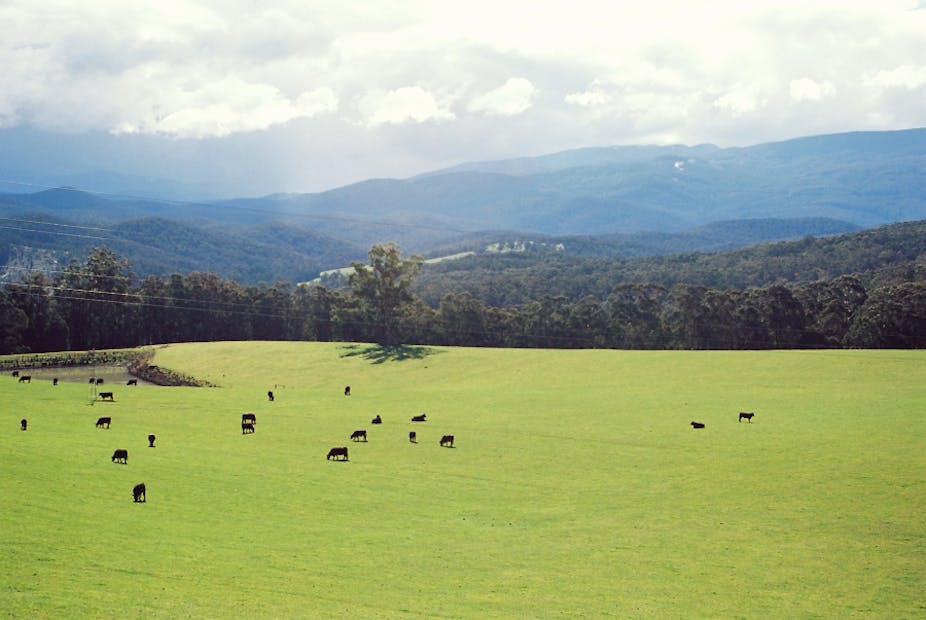
Mining is a relatively small component of the Victorian economy. In 2009-2010 this sector contributed $5.9 billion (2%) of Victoria’s gross state product. The primary focus of the Victorian economy is agriculture, which covers approximately 60% of Victoria. Coal seam gas expansion is likely to have a significant impact on this sector in Victoria. Striking a balance between farming and coal seam gas mining will, however, be difficult. The intersection between mining and agriculture, and in particular the impact that coal seam gas mining will have upon food security, is a major concern.
The Minerals Council of Australia has previously noted that “mining and agriculture” have co-existed for 150 years and that “mining operations' water consumption by volume could be largely offset by minor efficiency gains in the agricultural sector”. The Victorian division of the Minerals Council has largely rejected the impact of mining on food security, saying it’s “not a real concern for Australia”.
These conclusions do not, however, have any real cogency for coal seam gas mining, a new form of mining for Victoria. Any mining activity which diverts and degrades large quantities of water will inevitably have a significant impact upon the agricultural sector in Victoria.
Coal seam gas mining involves extracting methane gas from the coal seam. The extraction process involves the use of vast quantities of water, which is diverted from sub-surface aquifers. This diversion will inevitably affect farmers' and others' pre-existing entitlements to aquifers.
Coal seam gas mining also generates vast quantities of highly saline water. This water needs to be properly disposed or it could contaminate fresh water and cause further environmental degradation. The practice of hydraulic fracturing also has the potential to create connection between sub-surface aquifers, thereby generating cross-contamination.
The existing legislative framework in Victoria is patently inadequate. The current law in Victoria is the Mineral Resources (Sustainable Development) Act 1990 (Vic) (MRSD). The MRSD vests ownership of all minerals, defined to include hydro-carbons contained within coal (and therefore including coal seam gas) in the Crown. The MRSD does not mandate notification or consent from the landowner before mining operations start, but an applicant must get Ministerial approval before commencing work within 100 metres of an existing dwelling.
The MRSD allows licencees to enter into compensation agreements with landowners. However, these agreements relate to loss or damage that has already occurred and, significantly, have no connection to the value of the mineral which is extracted.
The MRSD does require mining applicants to obtain a “statement of economic significance” in circumstances where their application covers agricultural land. The Minister can decide to exempt agricultural land from the application of a mining licence. But this only happens when the Minister decides that there would be greater “economic benefit to Victoria” in continuing the use of the land as agricultural as opposed to developing it for mining.
The MRSD does not clearly delineate how an exemption determination should be assessed. It appears, though, that the decision has an “economic” focus and “employment” and “revenue” considerations are highly relevant. The Greenfields Report has a strong focus on “direct and indirect” financial benefits associated with expanding the resources sector in Victoria. So it’s likely that agricultural exemptions will become increasingly difficult to obtain under the MRSD in the future.
The Greenfields report recommends development of a state-wide integrated, strategic land use policy framework to better manage “competing land uses” in Victoria. This recommendation is best implemented, as has occurred in New South Wales, with a Strategic Regional Land Use Policy. Under the policy, Strategic Regional Land Use Plans (SRLUPs) coordinate water management, water-use conflict and land-management.
This initiative should be reinforced by a code of conduct for coal seam gas mining, mandating land-access arrangements between mining applicants and land-owners and requiring proper and adequate disclosure of the nature and volume of any chemical additives which have been used.
These policies should then be supplemented by comprehensive changes to the MRSD as well as the Environment Protection Act 1970 (Vic) and the Water Act 1989 (Vic). These would ensure coal seam gas expansion is subjected to appropriate environmental and water licencing regulation.
The government should take the opportunity to engage the public in strategic choices concerning the co-ordination of Victorian resources. It must develop a policy framework capable of properly evaluating the consequences of coal seam gas development. In so doing, it should adopt a precautionary approach, commensurate with public expectations, that takes account of the risk of irreversible harm being inflicted upon Victorian land and the industries and livelihoods dependent on that land.
Mark Duffett
logged in via Twitter
Instant distrust is engendered when phrases like "large quantities", "significant impact" and "vast quantities" are deployed liberally, with no attempt to attach hard numbers to them. It's a hallmark of scare campaigns.
Blair Donaldson
logged in via Facebook
Unless the proponents of coal seam gas can clearly demonstrates aquifers, waterways and productive farmland won't be adversely affected long-term, it should be kept out of the state.
Paul Dawkins
logged in via Twitter
You just have to look at what is happening in Queensland and NSW to know that there are real concerns. The industry even admits to the large volumes of water they use. Prefer it to be used for food. It even admits to generating vast quantities of highly saline water. You do realise that when the salt hits perfectly good agricultural land that it is gone forever. The Ipswich Mayor, Paul Pisasale doesn't want this contaminated saline being dumped at Swan Bank. The industry doesn't treat the water…
Read morePeter Ralph
Share trader
Ah Mark Duffet you have not been following events in Queensland and New South Wales. Anything that goes wrong be it THPS in an aquifer in Dalby or methane in the Condamine River or the releasing of wastewater directly into paddocks in the Hunter Valley is described by the industry (no matter how bad) as insignificant, negligible, minor, not harmful, easily remedied, slight, unimpotrant, small and harmless. Right now in Tara there are 19 households where adults and children are suffering bleeding noses and ears, dizzy spells and respiratory problems......the identical symtoms experienced by those in Garfield County, Colorado and Bradford County, Pennsylvania but the industry has totally denied liability. You're right, words and phrases indiscriminately used can create a false impression but not in the context you have suggested.
Joseph Bernard
Director
Hi Peter,
going by the negative score, seems like there are more reader here that wish to vote for killing the little kiddies and poisoning the earth, than not .. pretty ugly position to be in when the "educated" amoungst us choose to totally ignore the smoke and pretend that there is nothing wrong!
I suspect the only way to get any attention is to start a class action for attempted murder or industrial man slaughter.. send a few CEO and Directors to jail.. fines mean nothing, human means nothing.. maybe soap on a rope for these souless corporates is the answer.. Come on there must be some lawyers that smell a buck in amoungst that methane!
Bernie Masters
environmental consultant at FIA Technology Pty Ltd, B K Masters and Associates
The author states: "Mining is a relatively small component of the Victorian economy. In 2009-2010 this sector contributed $5.9 billion (2%) of Victoria’s gross state product. The primary focus of the Victorian economy is agriculture, which covers approximately 60% of Victoria." Why does she compare chalk with cheese? If the mining industry is worth $5.9 billion annually, what is agriculture's financial contribution (my guess is several times more than mining)? Conversely, if agriculture covers 60…
Read moreMatthew Currell
Lecturer in Hydrogeology, School of Environmental Engineering at RMIT University
An important environmental impact which is touched upon in the article, but perhaps warrants more attention, is that it appears the CSG industry is still yet to come up with clear and comprehensive waste management strategies for the large quantities of saline and/or contaminated water produced in the extraction process. There may need to be a careful review of the Environmental Protection Act of 1970 to ensure it can adequately ensure management of waste water from CSG, to prevent environmental harm. If we now have the awareness that Coal Seam Gas is coming to Victoria, then surely this presents the time and opportunity to review and prepare our regulatory framework for challenges such as this.
wilma western
logged in via email @bigpond.com
An application by Leichardt Resources in Bass Coast and South Gippsland Shires has prompted a campaign spearheaded by Bass Coast groups, AND their local MLA Ken Smith ,speaker of the Leg Assembly and long-standing Liberal. The Victorian Farmers Federation adopted the policy that landowners be given the right of veto when mining and exploration co's ask for access to their land. This was refused by Premier Baillieu. Leichardt was forced to readvertise its application for EL 5416 twice due to inadequate…
Read moreMark Duffett
logged in via Twitter
Thanks to all the commenters who continue to illustrate my point, however it's getting a bit tedious. 'Large quantities'? Really? In the context of the basin?
A bit of quantitative perspective is all I'm arguing for; like Tom Keen I'm no fan of CSG. But calling the exploration licence conditions 'deceptive' is a bit harsh. How is the company supposed to identify the resource without test drilling to see if they can get it out or not? If you really think activity on that scale is going to have a significant system impact...well, it comes back to that 'quantitative perspective' thing.
Tom Keen
BSc
I'm certainly not an advocate for coal-seam gas, but I don't buy the argument that it's a significant threat to food security. You really need to attach some numbers if you're going to make that argument.
I'd argue that a much greater threat to food security is shown in the lead image of this article. Agriculture covers 60% of Victoria? I wonder where all the biodiversity went? I wonder what portion of that 60% has been cleared for grazing? Clearing land for grazing and feed for cattle is probably…
Read more