
The report, Status of Key Australian Fish Stocks 2012 is the first official report combining assessments of major Commonwealth and state-managed fisheries into one document. The report paints a rosy picture. Of the 150 fish stocks assessed only two are found to be overfished.
The two overfished stocks are southern bluefin tuna and school shark.
How should consumers respond to this finding? In the case of southern bluefin, the fattened fish are sent to Japan, so the Australian consumer is not faced with a decision. The inference is that only school shark, whose stock is fished to a very low level, is of concern. When we go to the market, they’re suggesting, we really don’t need to worry – all the other Aussie fresh fish on offer is sustainable.
Analysis reveals anomalies
A deeper reading of the report throws up some concerns. There are underlying issues with 52 of the 150 stocks assessed.
The descriptions of stock status have become very sophisticated in the report. For example “transitional depleting stock” is code for a stock subject to overfishing, and this affects three stocks. “Transitional recovery stocks” is actually an overfished stock, affecting eight stocks. There are also 25 stocks “undefined”, on which the report fails to express an informed opinion that would help the buyer.
Pink snapper (Pagrus auratus) is a rather worrying classification in point. This is a very popular fish with consumers and with recreational fishers, who take the bulk of the catch. Heavily fished virtually everywhere it occurs and vulnerable to over-exploitation, snapper stocks are generally recognised as precarious. In fact, in state assessments in Queensland, NSW and WA (Shark Bay and West Coast) the stock of pink snapper has been officially classified as overfished. In Victoria, stocks are officially in decline and in SA uncertain.
However, the report asserts that snapper in Queensland, New South Wales and Victoria is “undefined”, while in WA it is in “transitional recovery”.
The treatment of the popular southern crayfish (SA, Victoria and Tasmania) is also debatable. The report’s assessment is “sustainable”. But catch rates in the fishery have been in steep decline and stocks have been depleted to a quarter of the previous levels, as acknowledged by the report itself.
The report says the cuts in catch quotas appear to have been successful in generating greater abundance of stock (author’s emphasis). However, lobster egg production as a percentage of virgin egg production suggests extreme caution (see chart).
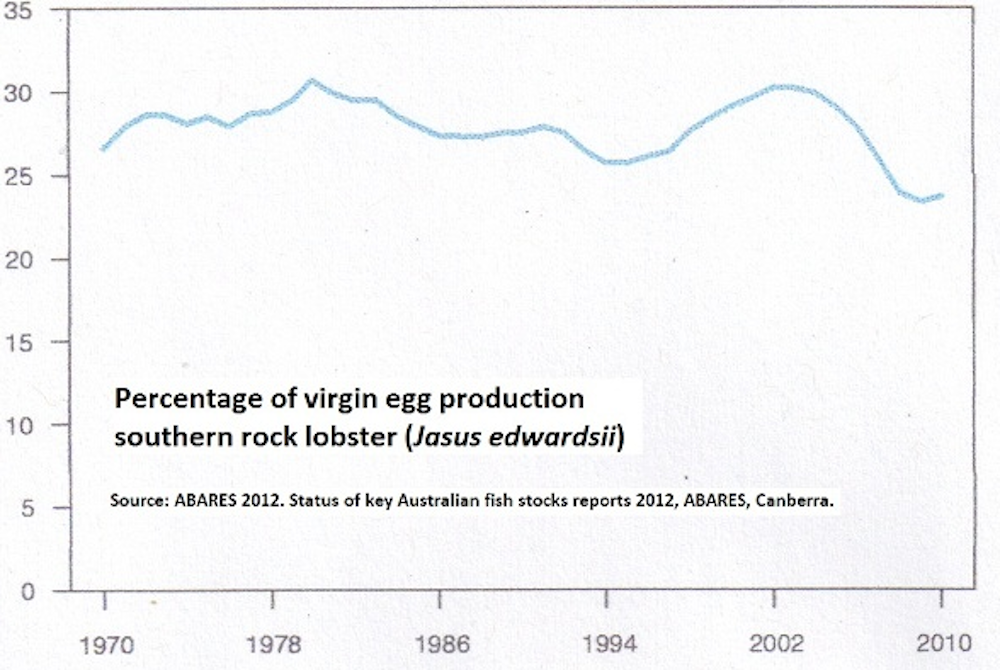
An objective assessment should surely conclude that the fishery will need a long recovery period before it can be confidently classified as sustainable.
Consumers’ needs for information
While the report assesses Australian fish stocks with the greatest value and volume there are some notable absences. For example, not included are popular east coast fish jackass morwong, officially overfished; gemfish, subject to overfishing, and blue warehou, officially overfished and subject to overfishing in ABARES’ Fishery Status Reports of 2011. The same applies to the popular garfish in SA and Victoria: both were overfished in state assessments.
The consumer is helped to a limited extent by the classification of major Australian wild fisheries. At a local level, retail outlets carry many fish not covered in the report. Some of these would be locally caught and some raised in ponds or pens. But most of the fish on offer is imported – we now consume more cheap imports than we do domestic fish. Moreover, sales of canned fish are high – take a look at the overwhelming choice in the supermarket. But again the report is no help.
Apart from the sustainability of fish per se, consumers are becoming more aware of the bycatch and environmental problems associated with fishing. The recent banning of the super trawler Abel Tasman, largely because of seal mortality, is an example of the importance the public attaches to bycatch issues once it is informed.
The South East Trawl Fishery, responsible for much of the nation’s “sustainable” fish – blue grenadier, flathead and silver warehou – is notorious for its bycatch. Many more seals die in the nets of the 35 small trawlers than would have been killed by the Abel Tasman.
Again, prawns are listed as “sustainable”, but the level of bycatch is an issue. In Australian prawn fisheries between 300 and 500 other species are commonly trawled along with the prawns; and most bycatch is returned to the ocean dead.
On visiting the fish and chip shop this Friday, differentiating between the overfished school shark and other “sustainable” shark sold as flake will be a challenge. I am sure consumers would be interested to know that in the Great Barrier Reef World Heritage Area many thousands of 40 species of these top predators, which are in serious decline globally, are caught in nets every year.
The sanctioned shark catch includes some 2000 scalloped hammerhead, which is listed as endangered world-wide by the International Union for the Conservation of Nature.
Many consumers would also have qualms about buying Atlantic salmon if appraised of its problems. Fish pens are taking up a large proportion of some formerly pristine Tasmanian estuaries. Furthermore, there are ethical considerations – that some take seriously – over confining such predators at high concentrations.
An ecological assessment of key fisheries by the report’s authors is said to be two years away. Meanwhile, consumers would do well to consult the guides available from non-government organisations before they go shopping or, while they are shopping, using the apps available for smart phones. These cover the sustainability of imports, aquaculture and canned fish, while providing information on bycatch and the environmental effects of fishing.

Susan Lawler
Head of Department, Department of Environmental Management & Ecology at La Trobe University
Thanks so much for this article Colin. As soon as I heard about the report I wondered how much real information we could glean from it.
Now I am left wondering if the "fish and chop shop" was a typo or a clever, subversive statement about the sustatinability of our favourite Friday feed.
Colin Hunt
Honorary Fellow in Economics at University of Queensland
Susan,
Thanks for your favourable comment.
Could claim to be clever about the chop shop but I think that would be just too clever.
Jane Rawson
Editor, Energy & Environment at The Conversation
I'll take the credit for that! Or the blame... Either way, it is now a fish and chip shop once more.
Nick Kermode
logged in via email @hotmail.com
Thanks very much for this Colin. I am always very sceptical when I see reports that involve industry groups and 'regulators' in their report. Your article has collated some very useful information and links that would have taken quite some time to find. To have them here in one spot is very convenient and valuable to people who want to understand this issue better but have little time to 'trawl' the interweb looking for the relevant information. Cheers.
Colin Hunt
Honorary Fellow in Economics at University of Queensland
Nick,
By the way, ABARES' comprehensive assessment Fishery Status Reports 2012 is due very shortly and will be available online. This is a very well done and covers all commonwealth fisheries as well as those fisheries under regional agreements like southern bluefin tuna and the Western and Central Pacific Tuna Fishery.
It's plain talking about 'overfishing' and 'overfished' stocks and usually makes some pointed remarks about management and bycatch issues.
Nick Kermode
logged in via email @hotmail.com
Thanks very much Colin, will keep my eye out for that...and another useful evaluation :)
Ib Svane
Marine scientist
Thank you for your critique of the report. Not that many brave people out there! As you mention, the key issue is not necessary what is hidden behind the data it is also what is not mentioned. In trawl fisheries environmental degradation is a major problem. All evidence shows that habit change brought about by fishing will eventually finish off the fishery. To claim that any fishery is "sustainable" is really nonsense.
Nick Kermode
logged in via email @hotmail.com
Excellent point lb, I was worried when I read, "these issues are not considered in the stock status classifications" when talking about the "effects of fishing on the marine environment". Leaving that issue out speaks volumes for what the report was trying to achieve to me.
Colin Hunt
Honorary Fellow in Economics at University of Queensland
Ib,
Yes, you put your finger on the trawling problem. While trawling is being gradually wound back it still causes many problems for wildlife and destroys the benthic ecosystem.
Luc Brien
logged in via Facebook
Thanks , for this, Colin.
Here's a radical idea: how about we stop eating fish? We surely don't have any need to, and the level of suffering involved - fish are sentient - in both target and bycatch species, coupled with the ecological and environmental impacts of fishing, seems to me to make consuming these creatures an ethically untenable practice.
Colin Hunt
Honorary Fellow in Economics at University of Queensland
Luc,
I think more and more people will come to that decision, especially for wild fish. But then some aquaculture can be very cruel, so differentiating there is important.
John Clark
Manager
Luc,
Given the extractive nature of the fishing industry, your wish will be granted, but by economic rather than moral grounds
Jane Lovell
EO
Colin, just check the years of the Fishery Status Reports you are referring to....the only one available at the moment is 2010 and 2011 will be available shortly.
Colin Hunt
Honorary Fellow in Economics at University of Queensland
Jane,
Good point. I am referring to the publiication dates. The 2012 version will be to 2011.
Fred Pribac
logged in via email @internode.on.net
Reading the press releases I got the notion that there was a good deal of spin and that the authors were patting themselves on the back because at least we are not the complete fisheries basket case that some of our neighbours seem to be. To have one-third of our fisheries stocks still in a compromised or indeterminate state and with very poorly characterised ecosystem and bycatch impacts the message really is - could do better.
"An ecological assessment of key fisheries by the report’s authors is said to be two years away."
I'll be very interested to see what transpires, which stocks are tackled and how seriously it's actually being taken as evidenced by how many resources are allocated to the ecological assessments and over what time frames.
Colin Hunt
Honorary Fellow in Economics at University of Queensland
Fred,
You ask some pointed questions.
The difficulty of making assessments of fish or fisheries on ecological or bycatch criteria is that it always comes down to a subjective or, at best, a group subjective basis. When assessing stocks, one has a benchmark: below such and such a biomass the stock is overfished. However, what is the level of bycatch that is tolerable. One seal? Some would say even one seal is too many.
Fred Pribac
logged in via email @internode.on.net
Colin - you've hit the nub here!
"However, what is the level of bycatch that is tolerable. One seal? Some would say even one seal is too many."
There is a common argument from advocates of the current fisheries management that we have best scientific practise and that it is insulting to the scientists involved to question their work which is often proclaimed to be based on modern fisheries best practise. If it is ... it'll stand up to extra scrutiny ... and a little argy-bargy is a small price…
Read moreFred Pribac
logged in via email @internode.on.net
One interesting report would be if somebody were to undertake a complete history and analysis of the school shark fishery from go to woe.
This fishery presents a fascinating story from Olson's earliest reports (was it 1957) when it was the principally targetted species in the essentially artisinal early shark fishery, the mercury bans and subsequent black markets, the earliest warnings in the 1970's of depletions, the rapid downward slide of the 90's and the issues that arose through industry obfuscation, legal challenges and managerial delays up to the current situation where the stock remains managed as a bycatch at historically low levels with little if any data pointing to a re-building.
There are probably many more cogent lessons in taking a good retrospective look at this one failed fishery than in the dozens of fisheries that just hover around the lower management trigger limits.
Colin Hunt
Honorary Fellow in Economics at University of Queensland
Fred.
A very apt suggestion.
I think, as an economist, that looking at the opportunity costs of overfishing would be very relealing. Tom Kompass et al have done some great work looking at how much more money could be made by fishing less. A wider study would reveal the millions if not by now billions of dollars worth of ongoing sustainable production lost over the years because of overfishing and lack of recovery of stocks such as orange roughy and toothfish, to name just two.
Fred Pribac
logged in via email @internode.on.net
Oops - forgot to mention the war years when school shark was fished to supply oils.
Patrick Filmer-Sankey
logged in via Facebook
Thank you Colin for this rapid and skillfully applied bucket of cold water on some dangerous and rather self-congratulatory spin. It is at least comforting that the fishing industry feels it has become necessary to mount such justifications, a clear sign that they recognise not all is well, probably both in the marine and consumer worlds.
The recent rash of state and federal action on marine parks shows a similar discomfort, but alas also a similar imbalance of form over function.
Of the nearly…
Read morePatrick Hone
CEO Fisheries Research and Development Corporation
The key Stock Status Reports has been developed by 80 fisheries scientists across universities, CSIRO, ABARES and state research institutes.
Read moreThe report clearly focuses on the stock status. This is made very clear throughout the report. The report does not assess broader environmental considerations that are either caused by fishing or caused by other abiotic environmental processes.
The report does provide a qualitative description of environmental effects. The report is fully referenced…
Colin Hunt
Honorary Fellow in Economics at University of Queensland
The Foreword to the report, by Ian Curnow Chair, Australian Fisheries Management Forum and The Hon. Harry Woods Chair of the Fisheries Research and Development Corporation Board of Directors states the following:
The Status of key Australian fish stocks reports do not aim to be an eco-labelling guide, but rather a scientifically robust, simple tool to inform fishers, seafood consumers, managers, policy makers and the broader community, and allow ready comparisons between the status of the key wild-caught fish stocks around Australia.
My article comments on the claim of the report to be useful as a tool to inform seafood consumers.
John Clark
Manager
The short answer is NO. While the comprehensive and detailed study is an important determinant of sustainability, it is of little comfort to consumers.
Rather than being viewed as a vital part of the Australian diet, fish (and other marine products) are seen as a source of income. The result is that we import and export roughly the same amount, but export world class premium fish, and import low quality product. Consumers therefore cannot afford locally caught fish, since they are priced to meet the demands of overseas buyers whose local sources have long since been exploited to extinction. Even those of us who were brought up with fish meals now have to become reconciled with doing without.
Patrick Hone
CEO Fisheries Research and Development Corporation
John, can you please provide the scientific evidence for which marine species you refer to have been fished to extinction? As a scientist I know of no species that has been fished to extinction. The closest is the Caspian Sea sturgeon that I know about. In this debate it would be good to use facts based on science.
Just to clarify your comment “import and export roughly the same amount” this is by value not by volume. Australia only exports about 41,000 tonnes from a production of 171,000 for the period covered by this report. You make a claim about exporting premium fish - but this is really only the case for rock lobster, abalone and SBT. Some 80% of Australia's prawn catch is sold domestically. Do not confuse premium with high value.
Colin Hunt
Honorary Fellow in Economics at University of Queensland
John,
We can't ban the trade in fish.
But, as you say the escalating price of wild caught Australian fish has meant that it has become a luxury rather than a staple.
Even more worrying is what escalating exports of fish from south east Asia is doing to the environment. I have personally witnessed the massive destruction of the coast that shrimp farming for export has caused in Thailand; it is also bad in Indonesia, the Philippines and China.
John Clark
Manager
Patrick,
The topic is asks the question of consumers. The scientific evidence is not my field, though the North Atlantic cod fishery, and the West Americas coast sardines come to mind. A bit closer to home, the live trout industry targets "plate sized ( undersized)" immature fish. Empirical evidence is available from any fisherman 70 years or over. Fish were so plentiful that we fished for food, not sport. My grandchildren will never experience the joy of catching a n edible fish. The best they can do is to have a day out dangling a line in the water. Sustainability is taken to mean maintaining a level of already diminished stocks.
Comment removed by moderator.
Caleb Gardner
Program Leader (Fisheries), Institute for Marine and Antarctic Studies at University of Tasmania
This article contains some opinions and errors that are worth noting. It’s helpful that Colin declares his vested interest through his work on an alternate guide.
On the example of southern rock lobsters (crayfish), yes, catch rates went through a period of decline and the stock was reduced by fishing. But the stock remains above benchmarks that are accepted to prevent recruitment overfishing. Colin claims the data presented suggests extreme caution, but on what basis? His opinion as an economist…
Read moreColin Hunt
Honorary Fellow in Economics at University of Queensland
Dear Caleb,
Read moreI am also a scientist and have worked in fisheries management at the cutting edge, including with the southern rock lobster.
My claim on southern rock lobster is that it is alarming that the stock is down to a third of its original biomass, as reflected in egg production. This is of concern to consumers. The stock should be built up and not be subject to catch quotas that simply sustain the stock at a fraction of what it was. See the steep decline in catches over the last 4 years in…
Caleb Gardner
Program Leader (Fisheries), Institute for Marine and Antarctic Studies at University of Tasmania
Dear Colin,
Harvesting deletes biomass so I'm afraid catch quotas >0 will always sustain the stock at a fraction of what it was. The issue is what fraction is of concern. You can assert that stock depleted to 30% of the unfished state is of concern to consumers but the challenge for a forum like this is explain why.
In the case of the SRL fishery you discuss, benchmarks were followed, based on science, that provide high confidence that recruitment will not be affected by fishing.
I'm concerned…
Read moreColin Hunt
Honorary Fellow in Economics at University of Queensland
Dear Caleb, In response to your second comment, below, I provide the following excerpts from the latest state assessments of their Southern Rock Lobster fisheries. These suggest that catches have been set too high for years.
Read moreSA Northern Zone Southern Rock Lobster Fishery:
“Estimates …indicate a general decline in lobster biomass over the last three decades.”
SA Southern Zone SRL Fishery:
“…from 2003 to 2009 biomass decreased by 61%.”
Victoria SRL Fishery:
“Due to concerns regarding low catch…
Caleb Gardner
Program Leader (Fisheries), Institute for Marine and Antarctic Studies at University of Tasmania
Dear Colin,
You've made a basic errors in interpreting population dynamics here. You've assumed there's a direct relationship between recruitment and stock in the southern rock lobster fishery, and that any decline in exploitable biomass equates to overfishing. In fact there's been a significant negative correlation between egg production and recruitment over the last couple of decades, which is spurious but it does emphasise that you need to be careful with your conclusions.
Each of the reports…
Read moreColin Hunt
Honorary Fellow in Economics at University of Queensland
Dear Caleb,
Read moreI take your point about the lack of correlation between egg production and recruitment. And no doubt the Tasmanian SRL is in a better shape than those in other states. Even so, you say in your assessment of the fishery:
“The capacity for the Tasmanian southern rock lobster fishery to support the annual
harvest is a function of both growth of the legal sized stock and also recruitment
of new lobsters into the stock. …Low recruitment has led to erosion of the
legal sized stock and…
Caleb Gardner
Program Leader (Fisheries), Institute for Marine and Antarctic Studies at University of Tasmania
Dear Colin,
This is becoming circular so I'm not sure there's much point in continuing because again you've simply cited information unrelated to the assessment of recruitment overfishing.
There is no debate that recruitment varies through time and this has resulted in both historic highs and lows (since 1970) of legal sized biomass in many areas during the 2000's. There is no question that catches needed to be reduced in recent years due to periods of low recruitment. This was motivated…
Read moreColin Hunt
Honorary Fellow in Economics at University of Queensland
Dear Caleb,
The references are cited are key, directly related to the status of southern rock lobster stocks and used by state reports or by the report Status of Key Australian Fish Stocks Reports 2012. I rest my case that the science is clear that there is serious concern for the future of stocks, and that the “sustainable” tag given the southern rock lobster in Status of Key Australian Fish Stocks Reports 2012 is overoptimistic.The science is clear, but will management be able to turn things around?
From consumers’ point of view there is a need more information, including spatial differentiation of southern rock lobster stocks, not less.
Maximum economic yield in fisheries is always at a lower exploitation level than maximum sustainable yield. More emphasis on this as a criterion in management would increase profits and as well as reducing the risk of crashes.
Caleb Gardner
Program Leader (Fisheries), Institute for Marine and Antarctic Studies at University of Tasmania
Dear Colin,
Yes, the references are clear but it's not clear how you draw such different conclusions to the authors of each report. None of these reports concluded that the fishery was overfished as you do and all were based on a formal process of evaluation against fisheries indicators and reference points. If you think the data are wrong or that performance indicators used in fisheries science to define recruitment overfishing are wrong, then you should pursue that.
The National Report assessed…
Read moreColin Hunt
Honorary Fellow in Economics at University of Queensland
Dear Caleb,
It comes down to the definition of “sustainable”.
One can sustain a fishery at any level.
The facts are: stock rebuilding is starting to occur in SA NZ, stock is needing to rebuild in SA SZ, stock is declining in Tas, and the CPU is the lowest in history and the stock rate of rebuilding very low in Vic Western zone.
I would say that once rebuilding is confirmed over a period for each of these fisheries then the fishery could be said to be truly “sustainable”.
Colin Hunt
Honorary Fellow in Economics at University of Queensland
Dear Caleb,
Read moreYour statement that the National Report assessment for Southern Rock Lobster as sustainable is not based on projections of outcomes of management is in error. Control of fishing pressure is a management activity.
The definition of sustainability in the Status of Key Australian Fish Stocks Reports 2012 is as follows:
“Sustainable stock—indicates that biomass (or biomass proxy) is at a level sufficient to ensure that, on average, future levels of recruitment are adequate (i.e. not recruitment…
Caleb Gardner
Program Leader (Fisheries), Institute for Marine and Antarctic Studies at University of Tasmania
Dear Colin,
Read moreYou’ve misunderstood. Fisheries scientists assess the status of fish stocks against a series of pre-determined performance indicators and these can be based on both hindcast and projected measures. Both are used in fisheries assessments in Australia but with the specific case of the National Status Report, only hindcast measures are used (eg estimated biomass, egg production and fishing mortality). Some jurisdictional assessments incorporate projections based around some future goal…
Crispian Ashby
Programs Manager, Fisheries Research and Development Corporation
The comment from Ib Svane is a little concerning. A parallel could be that expanding urbanisation will eventually finish off the human population in Sydney. I would be keen to be directed to “all the evidence“ as I recall that research in the Clarence River trawl fishery (2000/176 “ Effects of Trawling Subprogram: assessment and management of potential impacts of prawn trawling on estuarine assemblages“) stated “... analyses failed to find any evidence for impacts due to trawling. Not only was this…
Read moreIb Svane
Marine scientist
Reply to Crispian
One of the well known problem with benthic impact studies are that there is no base line. The environment where studies are undertaken are so disturbed that measured effects are small. Would it be brave to say that 39 trawlers dragging chains and otter boards over the bottom for about 60 days a year do not have an impact (SPG prawn fishery)? I agree that tropical estuarine environment rivers change everything during the rainy season. In such places trawl fisheries such as along the QLD coast may not be that problematic. However, I do not think that MSC has much to do with mitigation of benthic impact. I hope that the book on Spencer Gulf will be published soon. Here you will find references substantiate my comment.
Crispian Ashby
Programs Manager, Fisheries Research and Development Corporation
For clarification, the Clarence River is in northern NSW - not necessarily a tropical environment.
Also consideration needs to be given to the spatial extent of these fisheries in the context of the overall spatial extent of the system.
Look forward to the publication of the book.
Trevor S
Jack of all Trades
Colin touched on this in one of his replies but aren't all we doing with this fisheries protection simply resulting in the problem of over fishing being exported ? We spent 11 months in SE Asia and the raping of their ecosystems to supply westerners with product seems and extraordinarily mea culpa on our behalf ?
With wild catch being unsustainable in the volume needed to meet the demand, surely it's endemic on the Conservation movement to ensure fish farming is prioritised , sure it comes…
Read moreColin Hunt
Honorary Fellow in Economics at University of Queensland
Trevor, thanks for your thoughtful comments, prompted by your first hand south-east Asian experience. Like you I was shocked. I spent time with a PhD student studying the ecology and economics of shrimp farming in Thailand's coastal zone. The coast and its mangroves were decimated by the construction of ponds (often subsequently abandoned due to disease), as were the fisheries supplying the feed for the shrimps.
Read moreHowever, I don't think we should risk the same thing happening here. Our coastal zone…