

Explainer: why ocean acidification is the ‘evil twin’ of climate change

Ocean acidification is often referred to as the “evil twin” of climate change. Greenhouse gasses are doing more than just warming the globe. Increasing C0₂ levels are also changing the chemical make-up of our oceans. What is the ocean’s role is absorbing CO₂? We live on the blue planet. With nearly…

Enzofloyd
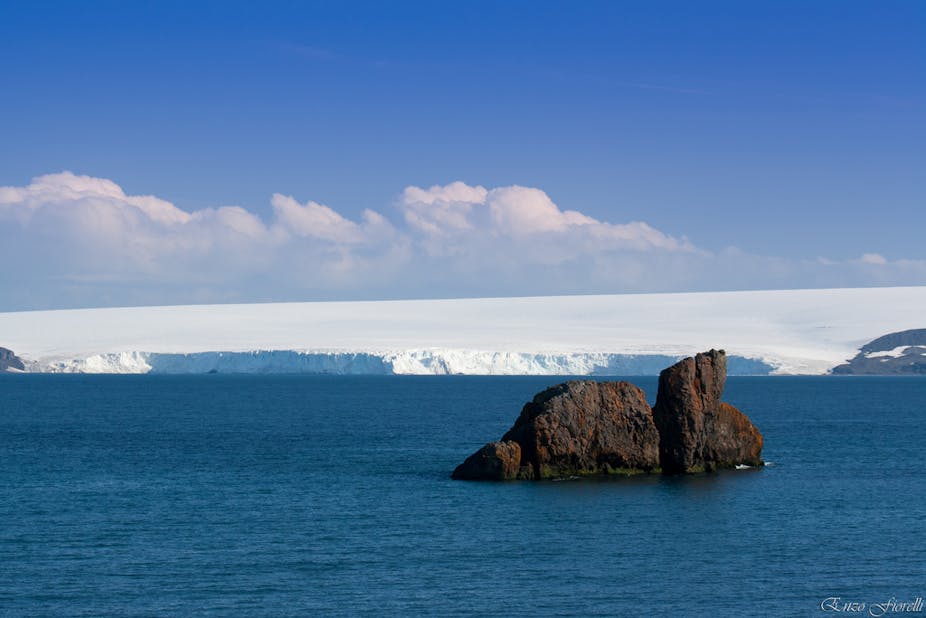
Ocean acidification is most acute in the polar regions. Enzofloyd/flickr

Ocean acidification is often referred to as the “evil twin” of climate change.

Greenhouse gasses are doing more than just warming the globe. Increasing C0₂ levels are also changing the chemical make-up of our oceans.

What is the ocean’s role is absorbing CO₂?

We live on the blue planet. With nearly three-quarters of the Earth covered in ocean it is not surprising that it plays a crucial role in capturing CO₂.

Currently, approximately half the CO₂ we emit stays in the atmosphere, a quarter is absorbed by the biosphere (plants and soils) and a quarter is absorbed by the ocean. The set of chemical processes that occurs when CO₂ is absorbed in seawater is known as “ocean acidification”.

The current concentration of CO₂ in our planet’s atmosphere (more than 390 parts per million) is higher than has been experienced on Earth for hundreds of thousands of years. The rate of increase of atmospheric CO₂ since the industrial revolution – driven by human fossil fuel combustion and deforestation – is faster than has occurred for millions of years.

Because of the amount of CO₂ absorbed by the oceans, this increase in emissions is changing the acidity and therefore the chemistry of our oceans.

Ocean acidification 101 – the chemistry

When carbon dioxide dissolves in seawater it forms a weak acid – carbonic acid – that rapidly releases a bicarbonate ion and hydrogen ion.

Some of the excess hydrogen ions seek out carbonate ions to make even more bicarbonate. This decreases the availability of carbonate ions otherwise available to shell-forming and skeleton-building organisms. The remaining free hydrogen ions lower the ocean’s pH, that is, make it more acidic.

While these chemical processes are well understood and scientifically validated, our understanding of how this will impact on shell-forming and skeleton-building organisms – known as calcifiers – and its implications for whole ocean ecosystems is in its infancy.

We do know that we are likely to see the impact of ocean acidification in our coldest waters first. This is because CO₂ is more soluble in cold water – the principle that sees an open bottle of champagne keep its fizz longer in the fridge than at room temperature – so we are particularly concerned that our polar oceans will bear the heaviest burden of ocean acidification.

Why is this a serious issue?

Modelling based on a continuation of the current emissions scenario projects that by 2054, 50% of the Arctic Ocean will have crossed a chemical threshold known as aragonite undersaturation.

This is the point at which the most fragile of shell-makers – those that use aragonite, the most soluble form of calcium carbonate – can no longer make their shells as they do today.

”Business as usual” modelling also projects that the entire Southern Ocean will become undersaturated in aragonite by 2100, and as early as 2030 in some parts.

These projections have implications for the rich communities of calcifiers, including foraminifera and the aragonitic pteropods and cold-water corals (below), which are a significant component of high-latitude ocean ecosystems.

Foraminifera: Globigerina bulloides (scale bar=100µm: Andrew Moy-AAD), Pteropod: Limacina retroversa australis (scale bar=1mm: Donna Roberts-ACE CRC), Antarctic coral community: 800m below sea surface (Martin Riddle-AAD)

Researchers at the Antarctic Climate & Ecosystems Cooperative Research Centre have found that natural populations of foraminifera (single celled shelled zooplankton) in the Southern Ocean are already 30 to 35% lighter than their pre-industrial counterparts.

Additionally, populations of some species of pteropod (shelled planktonic molluscs more poetically known as “sea butterflies”) appear to be declining in monitoring traps in the Sub-Antarctic Southern Ocean.

As foraminifera and pteropods are integral to polar and sub-polar food webs (pteropods alone account for up to 45% of the diet of Alaskan pink salmon) we have increasing concern for their health and longevity in a high CO₂ ocean.

Ultimately, impacts on polar calcifiers will have impacts on higher levels of the food chain and across latitudinal boundaries. Polar calcifiers are important food sources for marine predators including salmon, mackerel, herring, cod and baleen whales in the Arctic, and krill, fur seals, Adelie penguins and whales in the Antarctic.

The loss or reduction in habitat of these “potato chips of the sea” are likely to have serious consequences for the wider ocean community.

Perhaps closer to most people’s hearts (or stomachs) are the likely impacts of ocean acidification on fish. Some of the richest and most heavily exploited fishing areas in the world are located in high-latitude seas.

More than half the total current US fishery landings – a $4-billion-per-year industry – are derived from Alaskan waters. The Southern Ocean currently supports krill and Patagonian toothfish fisheries. Under current global emission scenarios, ocean acidification is likely to severely affect the waters that support these industries before the end of the century.

Our oceans matter

As the custodians of this blue planet we must be mindful of the role the ocean plays in mitigating climate change. We must understand that ocean ecosystems are important to us economically, socially and environmentally.

Scientists in this field are now taking the steps to determine the impacts of continuing ocean acidification on these ecosystems.

Sign in to Favourite

Want to follow The Conversation?

Sign up to our free newsletter to get the day's top stories in your inbox each morning, with a special wrap on Saturday.

Spinner
Become a friend of The Conversation and donate

Join the conversation

14 Comments sorted by

  1. Douglas Cotton

    B.Sc.(Physics), B.A.(Econ), Dip.Bus.Admin

    I think you will find that this is not the end of the carbon cycle. If the climate warms (for other reasons of course - not CO2) the additional acidity will lead to increased weathering of rocks and the end products will be limestone beds on the ocean floor - in effect trapping the original carbon dioxide so that it does not build up endlessly in the atmosphere. Just look at historic records and you will see that carbon dioxide levels do decrease by natural means FOLLOWING the temperature trend.- about 800 years later. http://joannenova.com.au/global-warming/ice-core-graph/

    report
    1. Ryan Owens

      PhD Student

      In reply to Douglas Cotton

      The silicate weathering feedback will take much longer to come into effect, i.e. >10000 yrs. In the meantime surface ocean pH (and saturation state for CaCO3) will be reduced. The rate of this acidification and the environmental pressure on marine calcifiers appears to be unprecedented for the last 65 million years.

      report
    2. Douglas Cotton

      logged in via Facebook

      In reply to Douglas Cotton

      More detail on the carbon cycle:

      By a process called photosynthesis, carbon dioxide reacts with water and sunlight to form carbonic acid and oxygen. Carbon dioxide also dissolves in the waters of the oceans, lakes and rivers up to a point where it is in equilibrium with that in the atmosphere. Some of the carbon dioxide in the water then converts to carbonic acid which is instrumental in weathering processes in rocks etc. This weathering yields bicarbonate ions (and other ions) and these end up in limestone beds on the ocean floor. Now the process of weathering is enhanced by warmer temperatures and the additional acidity due to greater photosynthesis. But, by LeChatelier's Principle, equilibrium will be maintained by more carbon dioxide being dissolved out of the atmosphere to provide more carbonic acid.

      report
    3. Alex Cannara

      logged in via Facebook

      In reply to Douglas Cotton

      Wishful thinking, Doug. The weathering sources will never be great enough to counter the >20x swamping of the natural carbon cycle by our >500Gtonnes of emitted fossil carbon. For example,..

      AAAS Science Vol 339 I Feb 2013, p533-
      http://tinyurl.com/ceaceja
      http://energyseminar.stanford.edu/node/461

      The last above has links to the DePaolo Planetary Sciences group's papers on the overall swamping of the natural carbon cycle, implying thousands of years of future threats no one will appreciate.

      report
  2. John McLean

    logged in via email @connexus.net.au

    Hmmm... talks of "acidification" when what's really meant is a small decrease in alkalinity, relies on a model with no hint of the assumptions in the model, implies that changes since pre-industrial times must be due to CO2 ... rather insubstantial, don't you think?

    Against that, take a look at the database on this subject at http://www.co2science.org/data/acidification/acidification.php. Perhaps jump straight to the "results and conclusions" page if you don't want to read about every paper in the database. The conclusion seems to be that a small decrease in pH, which is all that we reasonably can expect unless we burn all the available fossil fuel and then some, will be largely positive.

    report
    1. Ian Enting

      Honorary Senior Associate, Faculty of Science at University of Melbourne

      In reply to John McLean

      of course a small decrease in alkalinity (0.1 PH unit), means a 25% increase in hydrogen ion concentration (since the pH scale is logarithmic).

      Anyway, thanks John for the reference to the Idsos' co2science.org and the Tans 2009 paper that they cite. For others who'd missed it like I did, Pieter Tans concludes that
      IF no more conventional fossil fuels a found (beyond existing proven reserves) and IF none (or almost none) of the unconventional sources (shale oil, bitumen heavy oil) are exploited
      THEN (since emissions will be down to well below present levels by 2050 and maybe 15% or present levels by 2100) that pH may only increase by another 0.1 (a compounded 25% increase in hydrogen ion concentration) and we will get back
      to about where we are now by 2500.

      It's not clear why the Idsos think that this is the most likely future (compared to the other case that Tans analyses where unconventional fossil fuels are used).

      report
  3. Shane Perryman

    logged in via email @gmail.com

    So we have a BSc in Physics who obviously failed chemistry and chooses as his reference debunked climate denier Jo Nova, and a PhD student, who has as his reference the well known front site CO2 science.

    Doug. Put some limestone into vinegar and record the consequences. Its a crude experiment but should indicate the direction of proceedings.

    John. The boring "models cant be trusted meme" indicates to me that you are not really trying to earn the "philosophy" part of your title, should it ever…

    Read more
    1. Ken Fabian

      Mr

      In reply to Shane Perryman

      I'm not sure that vinegar is a good example, not when human breath bubbled through a beaker of water - let's take the ph meter and beaker to the coast and use real sea water - will clearly show lowering pH from actual CO2.

      What's happening won't make the oceans 'turn acidic' but the changes to the oceans' carbonate chemistry - upon which so much ocean life is dependent - turn out to still be profound and serious. Serious enough to question the wisdom of using them as ongoing Emissions Sinks. I don't believe that any serious scientific organisation with a long history of studying oceans - eg WHOI or CSIRO or any others - can show that the net result of acidification will be benign, let alone positive. Quite the contrary.

      report
    2. Shane Perryman

      logged in via email @gmail.com

      In reply to Ken Fabian

      I did say it was a crude experiment meant only to demonstrate the direction of change.
      Maybe a better choice would be soda water.

      report
    3. James Szabadics

      Technical Development and R&D Manager, Plantation Timber Industry

      In reply to Shane Perryman

      Doesn't the crude experiment you propose show that an acid will dissolve limestone? I dont think this is relevant. A better choice would be some basic liquid like sea water and changing atmosphere above the water sample using CO2 to observe the effects in the water and its inhabitants. The ocean is not acidic (ph < 7) and will not be acidic even if we burnt all known reserves of fossil fuels, it will become a little less basic. The ocean is big.

      I dont think anybody is suggesting that the ocean…

      Read more
  4. Doug Cotton

    Yes it might have to be a trade off between marine life and human life. Spend the money on expensive green energy, rather than food for the starving - like refugees leaving their children on the side of the road to die as they try to escape with no food or water (on ABC News 24 today.)

    And all to no avail so far as mankind's supposed control of climate. Read why the Greenhouse theory is seriously flawed and does not stand up to basic Physics. Note how "science" does not recognise the role of heat from the Earth's core maintaining over 95% of the temperature in which we live - see http://climate-change-theory.com

    report
  5. Daniel Wilson

    logged in via email @gmail.com

    Great article Donna, very informative. I wanted to bring to your attention and that of your readers, that Fairfax Media is running a competition to set their climate change agenda. The top ten questions, as voted by the public, will be investigated by Walkley-award winning journalist Michael Bachelard and The Sunday Age team. There is only question on ocean acidification, languishing far at the bottom, and perhaps you would like to support it with your vote: http://oursay.org/s/iq

    report