Fat Free TV – one step towards tackling childhood obesity

The impact of junk food advertising on childhood obesity is a topic often debated in the media. One side calls for banning junk food advertising during children’s television viewing times while the other questions whether ad bans will work, decrying a “nanny state”. Some commentators choose to lay blame…

Z9vj59tv-1328064603
Children remember advertisements and, more often than not, they want what they see. Dimitris Papazimouris

The impact of junk food advertising on childhood obesity is a topic often debated in the media. One side calls for banning junk food advertising during children’s television viewing times while the other questions whether ad bans will work, decrying a “nanny state”.

Some commentators choose to lay blame squarely on parents’ shoulders, as if that alone will be enough to reverse the worrying levels of childhood obesity in Australia. But the complexity surrounding childhood obesity and the need to act cannot be denied.

One in four Australian children is considered overweight, and unfortunately a high proportion of these kids will become overweight adults. This increases their chance of developing chronic diseases such as cancer, heart disease and diabetes.

What’s more, obesity is costing us more than $58 billion a year. So it’s essential to put aside the rhetoric, assess evidence and consider a multifaceted approach.

The role of junk food advertising

Tackling junk food advertising is one part of a wider approach to fighting childhood obesity. It’s all about setting healthy habits for life early on – prevention, as they say, is better than cure.

Admittedly, junk food advertising aimed at children is a bugbear of mine and it’s an issue I feel strongly about. Children are like sponges, noticing everything. So when it comes to advertising, they remember the jingles, the tempting toy offers, and the “cool” factor.

Children remember advertisements and, more often than not, they want what they see. Of course, this is exactly what junk food advertisers want, as successfully targeted young children will have brand allegiance for life. The Australian food industry spent more than $400 million on marketing in 2010; they spend big bucks because it makes them big bucks.

And how does this translate to the shopping trolley? Research shows that, on average, children pester their parents 15 times during every trip to the supermarket and are successful in half of these attempts.

The main question we need to ask ourselves, in light of Australia’s current levels of obesity, is do we really want children surrounded with enticing junk food advertisements? Evidence suggests that the more junk food advertising children see, the more likely they are to prefer high fat, salt or sugar foods.

So it’s an uphill battle for parents to get their kids to eat healthy food.

The blame game

Unfortunately, there’s a tendency to blame parents within mainstream media and online forums, such as The Punch; parents should just say “no” is often cited as the solution.

Of course parents can say no, but we have to acknowledge they’re up against Goliath. We’re talking about multimillion-dollar junk food giants with big bucks to produce advertising carefully designed to influence kids (and sometimes parents) into buying their unhealthy products.

Their advertising and marketing is very sophisticated, with advertisers having many more avenues for reaching children. Children today have the internet, email, various smartphone Apps, children’s magazines and mobile phones – none of which existed when we were kids.

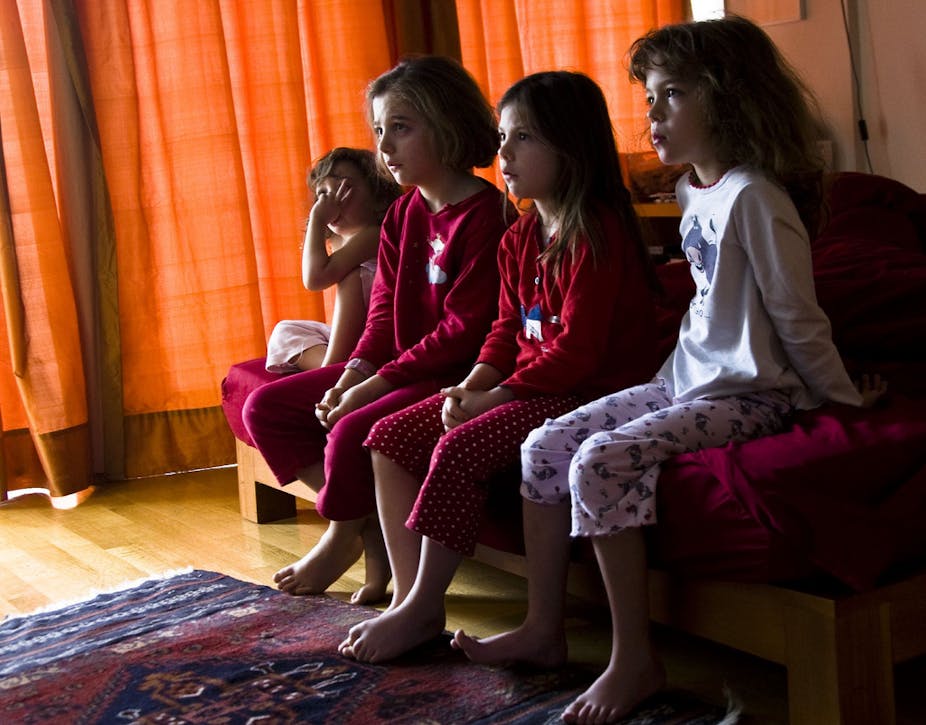
Family TV viewing times, such as Saturday nights, are saturated with junk food advertising. Mike Riversdale

Also, parents don’t necessarily have control over what their children eat when away from home. So just saying no is like closing the door after the horse has bolted.

What, then, is the solution? Ever the pragmatist, I think it’s multifaceted. I believe government legislation is essential and much has been written about this previously.

It’s also important to increase parents' understanding of the role junk food advertising and marketing plays in influencing their child. Parents need information at the fingertips so they can make choices on what their kids are exposed to.

This week Cancer Council NSW launched Fat Free TV Guide, an interactive website which allows parents to search over 100 popular television shows, rating and ranking the best and worst, based on how much junk food is advertised to children.

Saturday night programs such as the AFL, family movies and X-Factor have topped the list, with children exposed to 26 junk food advertisements for products such as chocolate, high-sugar and caffeine-added energy drinks, and for fast-food chains over a six-hour viewing period. Armed with this knowledge, parents may choose to turn the television off, record these shows (to skip the advertisements) or mute the ads.

Like it or not, we live in a brand-driven society and big businesses aren’t going to stop advertising junk food without a fight.

In the absence of regulations, the Fat Free TV Guide gives parents a little knowledge to help them even up the playing field. But let’s be clear, this is only one part of a wider solution to junk food advertising and childhood obesity.

Join the conversation

10 Comments sorted by

  1. Lyndal Wellard

    Nutrition Project Officer

    @James,
    We used Nutrient Profiling from the FSANZ calculator - anything that doesn't pass was classified as junk. If you have a read through the About pages (http://www.fatfreetv.com.au/about) it explains our methods.

    report
  2. Jac Hancox

    BSc. Agriculture - Biotech undergraduate

    Whilst understanding that this is indeed a complex issue I am still firmly in the camp that believes parents need to take full responsibility for what food is made available to their children and for educating their children to become media-literate so that the children themselves can gain some degree of critical thinking skills to assess what they are seeing when they are exposed to junk food ads.

    I am a parent of 3 children, aged 9, 7 and 6 and we rarely have what I consider junk food in our…

    Read more
  3. Jodie Broadbent

    logged in via Facebook

    Last time I checked, watching an advert on TV didn't make anyone obese. As a mum of four kids, I can attest that the easiest thing to do is say "No". It's really not that hard. We very rarely have junk food in our house; kids drink milk or water, we have take away and one bag of Natural Confectionary lollies to share while watching a movie maybe once a fortnight, and by the way, from a dental perspective, not a filling for any of us. This knee-jerk reaction to ban certain kinds of advertising comes back to people not wanting to accept responsibility for their actions, which stems from the generation that disciplined their children using a 'softly-softly' approach. If kids learnt that there were consequences to their actions, we wouldn't even be having this debate. Would probably solve a lot of other problems in our communities too.

    report
    1. Lennert Veerman

      Senior Research Fellow, School of Population Health at University of Queensland

      In reply to Jodie Broadbent

      "This knee-jerk reaction to ban certain kinds of advertising comes back to people not wanting to accept responsibility for their actions."

      What a very interesting reaction, Jodie. Tough. Almost callous, I'd say. You're basically priding yourself on being such an excellent mother, and why cannot everybody do the same?!

      Why do you use the word 'knee-jerk'? Many studies have been done into the effects of junk food advertising and several overview studies have concluded that it is associated with…

      Read more
  4. Chris Rowley

    logged in via Facebook

    The key here is the last sentence - it is one part of a wider solution. To Jody and Jac and all those others out there who believe it is a parents responsibility - well done you are doing a great job - and I agree. However for every Jody and Jac out there, we have countless others who don't achieve the same result and need some help, prompting and assistance. Because without a change in approach it will be those people - and their children - who continue to cost us in public tax dollars treating conditions that are largely preventable.

    report
  5. Rosemary Stanton

    Nutritionist & Visiting Fellow at University of New South Wales

    Jac - your parenting skills sound excellent.

    However, the fact is that official viewing data confirms that commercial TV stations attract far more viewers than the ABC. I'd love adults to take your approach and talk to their kids about the purpose of advertising and the nature of the junk being advertised, but it's more likely that busy parents use TV as a 'nanny' for kids. Many homes also have more than one TV set - perhaps because parents and kids may be watching different shows.

    Kathy Chapman…

    Read more
  6. James Jenkin

    EFL Teacher Trainer

    When the Government tells parents they need advice on how to bring up children, you can suggest this undermines parents' confidence and authority. Ironically it might be making it harder for them to say 'no'.

    report
  7. Jean-Paul Gagnon

    Honorary Research Fellow, POLSIS and SMP at University of Queensland

    This attention to curbing junk food advertising is most welcome! I recall a similar campaign occurring in Ontario, Canada for the removal or reduction of junk food from school vending machines and tuck shops (cafeterias). Truly one part of the solution. Perhaps the harder part is getting kids off the TV!

    report