Feels like an election year? Here’s why

The former British Prime Minister, Harold Wilson famously said a week is a long time in politics. If this is the case, then you have to wonder how long it will feel if the current Parliament runs it full course. Lately, Australian politics has seen a flurry of activity on issues as diverse as asylum…

7zgbs3qn-1346372755
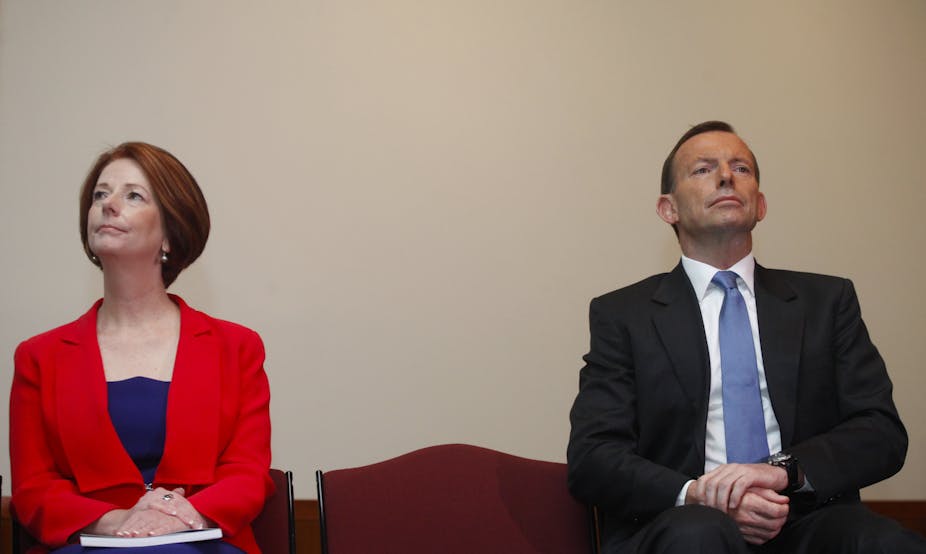
Both political parties are lining up their elections strategies now, even though an election could still be a year away. AAP Image/Lukas Coch

The former British Prime Minister, Harold Wilson famously said a week is a long time in politics. If this is the case, then you have to wonder how long it will feel if the current Parliament runs it full course.

Lately, Australian politics has seen a flurry of activity on issues as diverse as asylum seekers, dental health, the National Disability Insurance Scheme and the carbon floor price – along with sideshows such as Tony Abbott’s encounter with the ABC’s Leigh Sales and Julia Gillard’s combative press conference. And there’s more to come too, with the government’s imminent policy response to the Gonski recommendations on schools funding.

All of this activity points to a Parliament focusing hard on the next federal election. For different reasons, both the Coalition and the ALP will be desperate to see the end of minority government and return it to what they see as its natural state – a strong majority government. Strategists in both parties, faceless or otherwise, will be sharpening their marketing tools to make this happen.

So it’s timely to consider the election strategies of the major parties and speculate on what might get them into government.

Voting drivers

Smart political strategy understands how voters make their decisions. A useful starting point is to reflect upon the last federal election, and consider the drivers of voting behaviour. The ANU runs the Australian Election Study (AES) a comprehensive survey after each election, and this data gives key insights.

In 2010, we know that most voters claim that they had made up their mind a long time before the election (at least 40%); yet we also know that the major parties have far fewer “rusted on” supporters than they used to. Interestingly, about a quarter of the voters polled claim they only decided their vote either a few days or even on election day itself.

This poses a problem for the major parties. If you set out the “big picture” policies too soon you risk losing your message, but leave it too late and your party looks like it is locked in a policy vacuum.

The 2010 AES gives a good sense of the policy priorities that drive voting intention. Health policy (and not sound economic management) was cited as the main issue in how people settled on their vote (27.3% compared with 21.6%). Just 7.6% cited global warming as the main issue – despite the attention given to the carbon tax.

But the 2010 election, of course, is just one example – some issues will feature more prominently than others at different times. But the usual policy suspects appear again and again: the economy, health and education. If parties get these key areas right, it can help a lot when it comes to election time.

Despite the media attention and public spats on the issue – immigration, while a concern, is unlikely to be one of the key deciding issues.

The Labor strategy

What does this all mean for the parties?

For the Gillard government, there is an interesting policy space which has now opened up. The ALP will be hoping that they have finally lanced a few poisoned policy boils, namely the mining tax, the carbon tax, and now off-shore processing.

The hope is that public support will at least soften on these issues. Labor will be pushing hard to renew its economic story, but as the Howard government could testify in 2007, this alone is not enough.

There are also lessons from the recent state elections for the ALP. The Northern Territory election was a reminder that the parties cannot take their traditional supporters for granted. Clearly local factors are at play, but Labor’s heartlands are disillusioned with the party. Its indigenous support fell away, and the party’s own review noted the declining support from other culturally and linguistically diverse (CALD) groups.

Labor will have to remind them that they offer a distinctive social policy agenda.

The recent dental announcement, along with the National Disability Insurance Scheme may well be an outlier of other social policies to bolster support from low to middle income earners. Housing policy, the most unsexy of all social policies, might well form part of this strategy.

The Liberal strategy

What of the Liberals? There is a tension at the heart of Tony Abbott’s highly effective and aggressive strategy. The polls indicate it is working, but it is based on what the opposition won’t do, rather than what it will, if elected.

The current strategy puts repealing the carbon tax front and centre. Yet, as shown by the recent decision by BHP not to expand the Olympic Dam (while explicitly stating it was due to capital costs and not Australian taxes), this is a strategy with its limits.

The Liberals will also have to offer a positive vision, and its pledge on fiscal conservatism does little to demarcate it from Labor.

Herein lies the other problem for Abbott. He is the party’s most conservative leader in many years, yet the party also needs to appease its liberal base. At the last election, its commitment to a paid maternity leave scheme was an attempt to out-flank Labor from its left, and also address Abbott’s unpopularity with many women voters. The Liberals may well find a new policy area to attempt this again – perhaps work-life and childcare issues.

Whilst Labor might raise the spectre that the Coalition will launch Workchoices 2.0, Tony Abbott is determined to down-play the issue.

Both parties will also need to rebuke any suggestion that they occupy too much of the same policy space. AES data shows some hope here in that most voters do see some differences between the two.

A creeping Presidentialism in Australian politics means the importance of party leadership is growing in the minds of voters. All you need to do is look at the knifing of Kevin Rudd to see the role of leadership can be crucial.

Rational voters?

Whilst the policy debate is important, it also presupposes a focus on the “rationality” of how voters make decisions. Yet in truth, it remains a combination of many factors. To win outright, the parties will need to calibrate their strategies around this complexity.

Indeed, as the other famous Harold of British politics (MacMillan, not Wilson) is credited with saying, “politics, is events, dear boy, events”.

The fallacy of strategy is that it does not allow for the unexpected.

Sign in to Favourite

Want to follow The Conversation?

Sign up to our free newsletter to get the day's top stories in your inbox each morning, with a special wrap on Saturday.

Spinner
Donate and become a friend of The Conversation

Join the conversation

20 Comments sorted by

  1. Peter Ormonde

    Peter Ormonde is a Friend of The Conversation.

    Farmer

    Gee Rob, I'd take a deep breathe before labelling Abbott's display on 7.30 with Leigh Sales as a "sideshow".

    Not so much for those few who watch the ABC but for the way Abbott appears to the Press Gallery and commenters. Sales gave them a carpet-bag of issues on which Abbott is personally vulnerable. She also might have reminded a few journalists what the job is about, what a probing interview actually looks like..

    There are very good reasons why Abbott refuses to confront in-depth questioning…

    Read more
    1. Riddley Walker

      .

      In reply to Peter Ormonde

      Yep, and in his "doorstop" interviews, if anyone asks a hard question he either stands there saying nothing, or runs and hides behind Peta Credlin's skirts. It's time the news crews started publishing Tony stonewalling or running from questions as a standard part of the interview process.

      report
    2. Dale Bloom

      Laboratory Analyst

      In reply to Riddley Walker

      The cracks are string too show. How long before Turnbull makes his move.
      Gillard looks stronger now too and labor are starting to make a few hits on Abbot. Who would have thought.

      report
    3. Peter Ormonde

      Peter Ormonde is a Friend of The Conversation.

      Farmer

      In reply to Dianna Arthur

      Morning Ms A....

      I reckon we the People should be clamouring - driving to Cambra wiff petitions - demanding that the Coal-ition stop hiding their big guns in their pockets like they were glad to see us.

      Yes bring Barnaby Bombastus Joyce in out of the cold now! I wanna hear Barnaby's views on everything! It's the vision thing.

      Unlike the elected god-king of the US presidency, it's a team sport in Australia this politics business and geez what a team is crouched behind Tony Abbott's simian shadow!

      report
    4. Dianna Arthur

      Dianna Arthur is a Friend of The Conversation.

      Environmentalist

      In reply to Peter Ormonde

      Top o' the mornin' back to you.

      "geez what a team is crouched behind Tony Abbott's simian shadow!"

      With Petro Georgiou and others I can't recall (old age fast approaching), just what does lurk behind the little ape?

      Is there anyone of good conscience still in the Liberal party?

      report
    5. Peter Ormonde

      Peter Ormonde is a Friend of The Conversation.

      Farmer

      In reply to Dianna Arthur

      Barely Ms A. They are tolerated. But only through gritted teeth. And they are kept in a cardboard box under Andrew Robb's desk.

      Mal Wacher strikes me as a decent man. Malcolm Turnbull is capable of a decent turn at policy when he's not polishing his teeth.

      That's about it I'm afraid. It's a dark cardboard box indeed - who'd know what they really think ... even they themselves have a lot of trouble sorting that out.

      report
    6. Dianna Arthur

      Dianna Arthur is a Friend of The Conversation.

      Environmentalist

      In reply to Peter Ormonde

      Whoever told Turnbull that following Gordon Grech's advice should be placed in the box of no return. I just can't get past that particular low point in muck raking. If not for that, Turnbull would be the Libs' saving grace.

      Must check out Mal Wacher - have to confess I tend to run, hide and generally pay no attention, whenever I hear anything about the Liberal Party - yes I think they are that bad and yes, I am that remiss in educating myself more fully in our cough, cough, 'political leaders'.

      Not really on topic, but furthering the awful truth, please check out following link:

      http://www.tetherdcow.com/?p=15442

      Question: do ammunitions require iron as part of their manufacture? Apart from banking, weaponry appear very lucrative. A bit of an investigation into who owns vast iron ore shares in Australia, betting it includes the partners and other relatives of some of our pollies.

      report
    7. Dianna Arthur

      Dianna Arthur is a Friend of The Conversation.

      Environmentalist

      In reply to Peter Ormonde

      Mr O

      While I was skimming through the mass of info in the link you provided, I kept thinking "dots, joining of, Wikileaks..."

      Beware ANY moves by ANY government on controlling the internet as we know it today.

      Assange is looking more like a warning to any of us, than a threat to civilisation as the "Land of the Free" would have us believe. Something to consider when casting a vote. Which politicians favour centralised authority?

      report
  2. Peter Elepfandt

    Medical Doctor

    On the point of needing to end a minority government:

    1. I always wondered how the leader of THE COALITION was able to run around after the last election and tell everybody the world is going to end because somebody has to form a coalition to govern.....

    2. If you look at other countries (like Germany which has a very stable democracy) it is the norm that two parties have to get together and agree on policies (which always is a bargaining process and leads to the policies of the smaller party…

    Read more
  3. Adam Butler

    Engineer and Data Analyst

    "For different reasons, both the Coalition and the ALP will be desperate to see the end of minority government and return it to what they see as its natural state"

    Therein lays much of the problem. As Peter pointed out above, countries like Germany function quite well with so-called "minority" governments. This propensity in Australia to flip flop from one plutocratic entity to another is stifling our ingenuity and "can-do" attitude. Instead we are generally left with politicians dreaming of the easy-ride (a.k.a majority government) so they don't have to explain to us mortals why they wish to do want they want to do. I, for one, have enjoyed having a "minority" government and all the discussion it has created on a whole manner of issues.

    report
    1. Dan Smith

      Network Engineer

      In reply to Adam Butler

      Very well said. En masse we seem to vote passively as risk avoiders or for individual gain, two reasons which our limited media can easily make base appeals to. Brings to mind the old saying about us voting governments out, not in.

      report
  4. Dianna Arthur

    Dianna Arthur is a Friend of The Conversation.

    Environmentalist

    I started laughing at this:

    "The Liberals will also have to offer a positive vision."

    And still haven't stopped.

    The only way for the Libs to give the 'impression' that they are not destroyers of communal equity will be to remove the canker, Tony Abbott.

    I used italics around the word "impression" because if anyone needs to know what lies at the heart of Liberal policy it is the outmoded beliefs of Tony Abbott. Even if they did reinstate Turnbull, he would be a figurehead only. Liberal…

    Read more
  5. Byron Smith

    PhD candidate in Christian Ethics at University of Edinburgh

    "What does this all mean for the parties?"
    I see analysis for Labor and Liberal, but what about Nationals? Greens? Australian parliament (now more than ever) is not a two party system.

    report
    1. Byron Smith

      PhD candidate in Christian Ethics at University of Edinburgh

      In reply to Byron Smith

      In the 2010 federal election more than 30% of Australian voters did not vote for the ALP or Liberals as 1st preference in the House of Representatives (over 25% in the Senate).

      In 2007, non-ALP/Lib votes comprised approx 20% of both houses.

      When we have such a sizeable minority voting for parties other than the two main ones, then political analysis that focuses exclusively on these two starts to appear quite narrow.

      report
    2. Rob Manwaring

      Lecturer, Politics and Public Policy at Flinders University

      In reply to Byron Smith

      Hello all,
      Enjoyed the comments, and thanks for the feedback. Wanted to add a couple of thoughts.

      On reflection, i think you are right Peter - the ABC interview as 'sideshow' is probably not the right term. I think rather I was interested in how the performance of Abbott almost overshadowed the content, and the subsequent furore and description of Leigh Sales as a 'cow' by Grahame Morris.

      Yes, it is too early to say, but I wonder if there is a shift now underway, and the voter de-allignment from the major parties will continue. The problem is that a majoritarian system can struggle with this - much like the current situation in the UK. The major parties do cling to this view of Australia as a de facto two party system, and this is becoming far less so over time.

      Finally, I was keen to reflect upon the strategies of the other parties, but alas, space, and indeed my 'brief' was to concentrate on the two majors. Perhaps the next article!

      Rob

      report
  6. Jo Schofield

    logged in via Facebook

    Unfortunately, I think Harold (MacMillan) was correct - politics is about events!
    Housing may not be sexy to policy analysts' - but it's likely to be to women - economically, socially and historically.
    Outside of the rhetoric, women think - somewhere to live, bring up children, make a home, impress their identity - central to their world (separate from the external) is important. Abbott [and the author] should take note -
    Yes Abbott has separated himself from some controversial issues being aired, but hmm.... sleep with dogs... get fleas....

    Question: Are Australian voters rational - does rational even work as a strategy with such complex issues/policies now faced?

    And if technology/social media is the key - why are our political party websites so uninspiring?

    report