


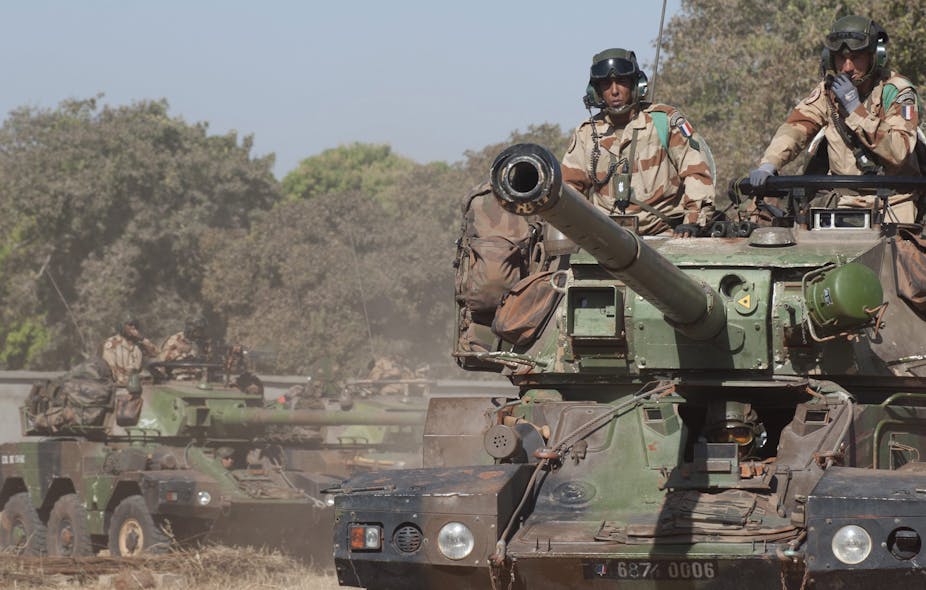
Why the French intervention in Mali? Last week, French daily Le Monde asked this question of André Bourgeot, specialist on Sub-Saharan Africa with France’s National Centre for Scientific Research (CNRS). Bourgeot gave two main reasons, the first of which was that without intervention, Islamist troops that had already conquered the north of the country were likely to take over the international airport at Sévaré, blocking access for any international military intervention, and opening the way to take over the capital, Bamako.
The second reason? Because they were asked to. Interim president Dioncounda Traoré appealed to his French counterpart François Hollande to help prevent an Islamist takeover of his country.
The French action is conducted within the framework set out in [UN Security Council Resolution 2085](http://www.un.org/ga/search/view_doc.asp?symbol=S/RES/2085(2012) of 10 December 2012, on the situation in Mali. A special meeting of the Security Council further supported the action, calling on all member states of the UN to provide support to Mali.
French rhetoric on the intervention remains in line with the Western mantra of “war on terrorism”, and French interests in the region are no doubt economic as much as political. Apart from some 6,000 French citizens living in Mali and a significant Malian diasporic population in France, this former French colony is Africa’s third gold producer as well as the site of as-yet unexploited uranium, gas and petroleum reserves.
Whatever the official or unofficial reasons for the French intervention — and notwithstanding Hollande’s previously expressed intention to become less interventionist in Africa - it can certainly arouse suspicion, given France’s dubious history of military and political intervention in Africa.
There has been a suggestion, for example, that the current intervention in Mali is reminiscent of France’s intervention in Libya over six months in 2011, which cost the French state some 350 million euros. Yet the reasons for the intervention, and the circumstances, are different.
At the time of the Libya intervention, then French president Nicolas Sarkozy needed to save some political face following France’s Tunisian fiasco. Almost exactly two years ago, during the beginning of the Arab-world uprisings, then French foreign minister Michèle Alliot-Marie committed a huge political gaffe when she proposed that France send security forces to help the Tunisian police maintain order, in the country where the revolts had started the previous month.
It was quickly revealed that Alliot-Marie and her family had close links to subsequently ousted Tunisian president Zine El-Abidine Ben Ali, and that she had even spent her Christmas 2010 holiday there as the uprisings spread across the country. Sarkozy, ever muscular in his aspirations, used Libya to put on a display of military might, a year out from the 2012 presidential and legislative elections that were to defeat him and his party. And of course, getting rid of Gaddafi was the icing on the cake.
France (and Britain for that matter) acted out of political self-interest in Libya, and the NATO action was criticised for going beyond what the international community, and the UN Security Council, considered necessary action. Among the most vocal critics of the NATO action was political historian Hugh Roberts who, writing in the pages of the London Review of Books, set the Libyan crisis apart from the uprisings in Tunisia and Egypt, not the least because the Libyan opposition quickly became military, unlike that in Egypt and Tunisia. And once they had triumphed over Gaddafi, the Libyan rebels were equally quick to triumphantly proclaim Sharia law.
In sub-Saharan Africa, France has a long and stained history of political intervention, best summed up by the term “Françafrique”, initially employed in 1955 to describe the cosy relationship between Ivory Coast president Houphouët-Boigny and French president Charles de Gaulle’s chief adviser Jacques Foccart. The term soon took on a negative connotation as designating all that was wrong with French neocolonialism.
One of the most horrific examples of Françafrique in action was of course France’s role in supporting and arming the Hutu militia in Rwanda, thus contributing to the 1994 genocide that killed an estimated 800,000 Tutsis over roughly three months.
In the face of French government inaction, a civil-society Citizens Enquiry Commission was set up in 2003; its 592-page report published in 2005 eloquently implicated the French state in the genocide. The Commission remains active and the secret history of France in Rwanda continues to be revealed, most recently in a front-page article in the news daily Libération. In 2010, during the first visit to Rwanda by a French leader for 25 years, then President Sarkozy acknowledged the French “errors” of the 1990s but stopped short of a formal apology.
In Mali, by contrast, the French state seems to be on the side, if not necessarily of the angels, at least of those legitimately attempting to avert violent overthrow by an extremely well-organised Islamist army. (In Libya, France had in fact supported the islamist army, as an opportunity to get rid of Gaddafi.) Such an overthrow would not be pretty for the Malian people, as those living in the Islamist-controlled north can attest. According to a Human Rights Watch report published in July 2012, there was clear evidence of torture, disappearances and other abuses, and HRW has since reported on the use of child soldiers as well as of civilians as “human shields” in the face of French troops.
Ultimately, we return to the same vexing questions: is military intervention in another country ever justified? If so, under what circumstances? And how does one know for sure?
History has damned British leader Chamberlain and French leader Daladier for signing a non-aggression pact with Hitler in 1938, when the situation called for a quite different response. When Bosnian women were being raped en masse by Serbian soldiers in 1992, feminists worldwide cried out for intervention even as they affirmed their opposition to all violence. In 1994, the international community’s initial indifference condemned hundreds of thousands of Tutsis to death.
At the same time, even humanitarian intervention has always left deep damage in its wake, and postwar reconstruction is usually where the international community falls down badly on the job (if it hasn’t already by making the conflict worse).
One can only hope that France has learned the hard lessons of Françafrique and that other Western powers have learned those of Afghanistan, Iraq and Libya, and that their intervention in Mali will be more of a help than a hindrance.