
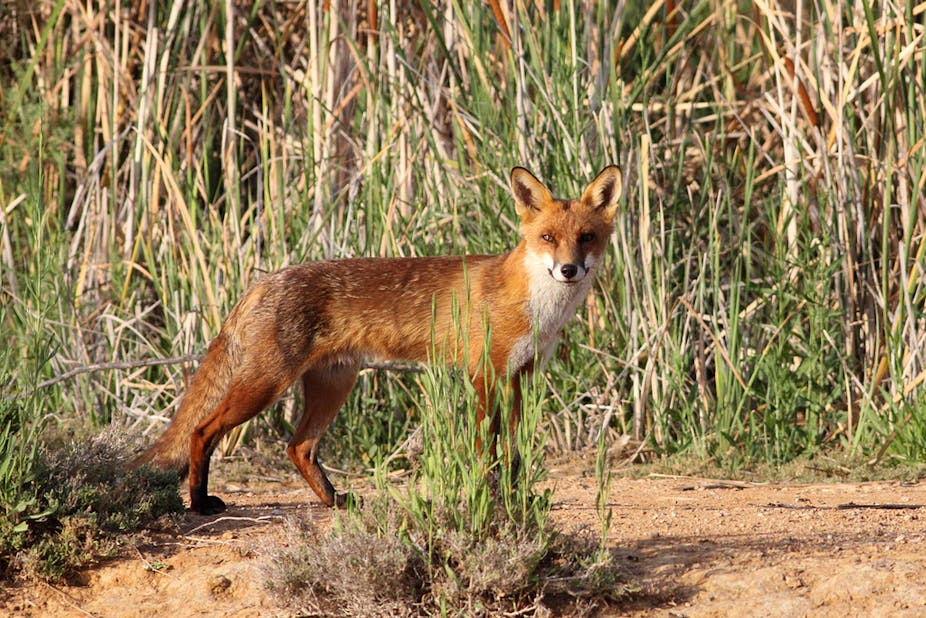
Is it too late to bring the red fox under control?

The red fox may be the most destructive species ever introduced to Australia. For a start, it carries most of the blame for Australia’s appalling record of recent mammal extinctions. Since European settlement, mainland Australia has lost at least 20 mammal species, far more than any other country over…

X2ghzpdt-1360283961
The red fox is significantly implicated in wiping out native mammals, but there are some promising methods for reducing its impact. Harley Kingston

The red fox may be the most destructive species ever introduced to Australia. For a start, it carries most of the blame for Australia’s appalling record of recent mammal extinctions.

Since European settlement, mainland Australia has lost at least 20 mammal species, far more than any other country over the same time period. Mostly these were bandicoots, bilbies, rat-kangaroos, quolls and hare-wallabies, along with relatively large rodents. Over vast areas of southern mainland Australia there are simply none of these medium-sized native mammals left – just seemingly limitless numbers of foxes and rabbits.

Did the fox act alone to cause these extinctions, or did it have help? Maybe other pressures – like competition from rabbits, changed fire regimes, or unknown diseases – were also important. The evidence, however, points consistently to foxes as the dominant cause. If other factors contributed it was probably by amplifying the predation pressure from foxes on native prey species. The European rabbit, for example, had an important subsidiary role by boosting fox numbers, and keeping them high even as native prey crashed to extinction.

The fox is also a significant pest to agriculture, mainly through preying on lambs and poultry. It can spread disease to domestic animals, and would be a carrier of rabies if that disease ever got into Australia (which is a distinct possibility). The combined environmental and agricultural impacts of foxes, and the effort expended on attempts to reduce that impact, probably costs Australia more than $200 million each year.

But it could all have been so different. A brilliant piece of historical research by Ian Abbott shows how difficult it was to introduce the fox to Australia. Victorian settlers, who were keen to indulge the “noble sport of fox-hunting”, released foxes on many occasions, beginning in the 1840s. Some early releases were evidently quite serious attempts to establish wild populations, such as a liberation of a group of at least six foxes in the Dandenong Ranges in 1864.

Released animals were rarely, if ever, seen again. They may have been killed by hunters or dingoes, or they might have taken poison baits that were laid for dingoes and stray dogs. In any case, they did not establish viable populations.

It was not until about 1874 that a fox population finally took off, on the Werribee Park property of the wealthy Chirnside family. From that point the fox was unstoppable. Despite all attempts at control it swept like an avenging fire through all of the southern half of Australia in just a few decades.

This history nicely illustrates an important biological principle. Small, newly introduced populations face a high intrinsic likelihood of going extinct. The small numbers of animals in such populations might be hard to find, but even poorly targeted control efforts can be useful if they increase those individuals’ risk of death, and therefore make it even more likely that the population will go extinct.

This history may now be repeating in Tasmania where an illegal release of several foxes in about 1998 has evidently resulted in a widely dispersed but extremely low-density fox population.

The Tasmanian State Government is attempting to push this population towards extinction using broad-scale poison baiting. This is controversial, but is the most sensible response to the risk that foxes will do to the Tasmanian environment what they have already done to mainland Australia.

As with any other well-established invasive species, it is very hard to turn back the clock and reduce the impact of foxes. Trapping and shooting generally have little effect on population size unless they are done intensively in well-defined areas where rates of re-invasion are low. Bounty schemes set up to encourage broad-scale fox removal by shooters, such as the program recently established by the Victorian State Government, are likely to be ineffective and wasteful.

There are four control options that can produce sustained reductions of fox impact.

First, poison baiting using 1080 can give good results, because foxes readily take poison baits. There is a particular advantage in the use of 1080 to protect wildlife from fox predation in Australia, because while foxes are highly susceptible to this toxin, native Australian mammals are much less so because it occurs naturally in some Australian plants. A drawback is that reduction in fox abundance can result in increased feral cats (which are also susceptible to 1080 but generally do not take baits), because foxes aggressively suppress cats. For some prey species, cats are just as significant a threat as foxes, or more so.

Fencing can be used to exclude foxes from high-value areas such as nature reserves, although the investment needed to protect large areas in this way is huge.

Livestock guardian dogs, such as the maremma sheepdog, have proved their worth in protecting livestock from many species of predators, including foxes. Guardian dogs have even been used to keep foxes away from seabird colonies in southern Victoria.

Finally, in some situations dingoes can reduce populations of both foxes and feral cats. They do this partly by hunting and killing them. Intriguingly, dingoes have been recorded killing foxes and cats but not eating their victims, as if the killing was motivated by simple malice. This is a good thing, because it means that foxes and cats fear and avoid dingoes, so that habitats in which dingoes are active can serve as refuges for prey species that are especially vulnerable to both foxes and cats.

Join the conversation

30 Comments sorted by

  1. Edward Cannella

    Edward Cannella is a Friend of The Conversation.

    Zoologist

    Good article. Yes, the Fox is an issue. Here are some observations - reduce the rabbit population, foxes and other introduced carnivores turn to native fauna. Wipe out dingoes and fox and cat numbers increase. Wipe out foxes and cat numbers increase. Poison control of feral predators impacts on raptors, varanids and dingoes (which have been here long enough to be regarded as part of the native fauna). These are qualitative assessments made over a number of years of field work and mentioned to suggest that any feral predator control measures need to be comprehensive and well thought out if they are to work.

    report
    1. Karen Witcombe

      logged in via Facebook

      In reply to Edward Cannella

      The fox is certainly an issue on the mainland. It's presence in Tasmania has not been established despite several attempts to introduce it over the last two centuries. Such evidence of its alleged presence as has been publicised does not stand up to proper scrutiny.

      report
    2. Darcy Bennett

      logged in via Facebook

      In reply to Karen Witcombe

      So what is your explanation of a history of (admittedly anecdotal) introductions since the mid-1800's, roadkill carcasses, and 60-plus scats? The government is perpetuating a giant conspiracy to employ a couple of dozen people. There are a few individuals in Tasmania pushing that line but fortunately decision-makers ignore them (but that's more proof of the conspiracy you see).

      report
  2. Karen Witcombe

    logged in via Facebook

    Chris Johnson, you must certainly be aware that this story of foxes being introduced into Tasmania has been thoroughly investigated and police were unable to find ANY corroborating evidence; subsequent assertions of sightings, roadkills etc have been discredited yet the DIPIPWE persists in repeating the allegation aided and abetted by a story-starved media. For twelve years the Tasmanian government, largely funded by Commonwealth grants, has conducted a 1080 poison baiting program in defiance of…

    Read more
    1. Peter Banks

      Associate Professor in Conservation Biology, School of Biological Sciences at University of Sydney

      In reply to Karen Witcombe

      Karen and John, you should read Sarre et al 2012 in press in Journal of Applied Ecology entitled "Foxes are now widespread in Tasmania: DNA detection defines the distribution of this rare but invasive carnivore". Chris provided a link to it in his article. The Sarre paper summarises the "hard evidence" for foxes in Tasmania, including >50 scats with fox DNA. They map possible fox distribution too.

      report
    2. Karen Witcombe

      logged in via Facebook

      In reply to Peter Banks

      I have read Sarre et al and understand that the paper's references and conclusions are disputed by Professor Clive Marks et al. The Journal of Applied Ecology has, I am advised, been asked to withdraw the paper.

      report
    3. Peter Banks

      Associate Professor in Conservation Biology, School of Biological Sciences at University of Sydney

      In reply to Karen Witcombe

      Requests for retractions and replies to research are quite common, especially when about controversial topics which also have public interest. Whether the replies actually get published depend on the strength of their scientific argument and usually the orginal authors get a reply- all of which is peer reviewed. It will certinaly be interesting to read any replies that do get published about this paper given the significance of its findings.

      report
    4. Paul Richards

      strategic foresight

      In reply to Karen Witcombe

      Karen Witcombe wrote: "..... and police were unable to find ANY corroborating evidence" Well that is comforting, the perpetrators of this type of environmental crime will be shaking in their boots.
      Do you seriously believe an event Christopher Johnson outlines is not probable?
      Karen Witcombe wrote: "The Conversation was a forum for serious, fact-based debate."
      Was a forum for serious fact-based debate! Well, that may be your opinion but this is still a forum for academics and a portal to their critical thinking. Sorry to hear the vitriole in your voice.
      Perhaps it is simply resentment economic resources are spent on our environment before humans. If so thank you for for once again outlining your neoliberal values.
      P.S. Why are you breaking long standing online etiquette shouting for emphasis using caps? [rhetorical]

      report
    5. Karen Witcombe

      logged in via Facebook

      In reply to Paul Richards

      Paul, I'm afraid you are way off the beam here. I have absolutely no objection to expenditure on the environment when it is warranted. My problem here is that the case for the presence of foxes in Tasmania has not been able to be made or substantiated with any evidence that stands up to critical and informed evaluation. I expect a lot more from academic circles than a parroting of departmental media releases. I dispute your labelling of my values as neoliberal - I consider myself politically neutral. That is a product of many years observing and evaluating opinions from all sides of politics and finding myself in sympathy with very few of the ideas expressed by those who wear their politics on their sleeves. As for shouting - one word for emphasis hardly constitutes a tirade.

      report
    6. Paul Richards

      strategic foresight

      In reply to Karen Witcombe

      Karen Witcombe wrote: "...... I'm afraid you are way off the beam here."
      "Do you seriously believe an event Christopher Johnson outlines is not probable?" Yes, this is crystal clear as cast iron proof is wanted. The article is about risk management, your perception of risk are part of your personal values and quite separate from the authors. All good.
      Karen Witcombe wrote: "I was under the impression that The Conversation was a forum for serious, fact-based debate." Clearly you still feel this…

      Read more
    7. Darcy Bennett

      logged in via Facebook

      In reply to Karen Witcombe

      My understanding is that the police couldn't SUBSTANTIATE the allegations. How hard they looked is one question the government asked and I understand the police officer who led the investigation is now one of the key critics of the effort. As for hunters and farmers (and you forgot bushwalkers) not seeing foxes, how do you know. The Fox Eradication Program reports about 5 sightings a week and have told me that it includes hunters, farmers, bushwalkers and everyone in between. There was recent media…

      Read more
    8. Paul Richards

      strategic foresight

      In reply to Darcy Bennett

      Darcy Bennett wrote: "My understanding is that the police couldn't SUBSTANTIATE the allegations ....." That is how most evolved thinkers read the situation. It is risk management issue, some do not believe the risk is great enough to deserve management, sadly this applies to all environmental issues. Value systems differ greatly, obviously yours is evolved and it is easy to forget it makes up around 3 - 4% of our culture.
      It does not help shouting using caps, but thanks for your comment directed at Karen Witcombe's neoliberal mindset.

      report
    9. Karen Witcombe

      logged in via Facebook

      In reply to Paul Richards

      I dispute (again) your inference of my meaning. I most certainly do not stand "firmly against our environment", I object most strongly to the environmental damage wrought by the laying of 1080 poison baits on a very large scale in Tasmania, especially as the case for the presence of foxes here has not been substantiated. Where is the evidence of foxes breeding here, where are the breeding sites, who has heard foxes calling and why, after thousands of sightings and widespread distribution of mobile phones with cameras, has no-one provided photographic evidence to substantiate their sighting? Even if foxes were introduced some 15 years ago (and that has not been established) with no evidence of breeding any such animals are long dead.

      Thank you for again castigating me for using caps - I apologise for offending your sensibilities - will you now apologise for name-calling (or do I mean labelling or bullying) in return?

      You may choose to find my comments offensive if you wish.

      report
    10. Karen Witcombe

      logged in via Facebook

      In reply to Darcy Bennett

      The only allegation I am making is that the case for foxes in Tasmania has not been made. As for proof, I think the burden of proof rests with those who continue to assert that foxes are present in Tasmania.

      The community is paying a very heavy risk premium for the application of a precautionary principle over a very extended period of time. Some money could have been more effectively spent in tightening security at our points of entry if risk mitigation strategies are what is sought. It…

      Read more
    11. Paul Richards

      strategic foresight

      In reply to Karen Witcombe

      Karen Witcombe wrote: "The only allegation I am making is that the case for foxes in Tasmania has not been made. That is crystal clear, your written meaning is in stone once again.
      Karen Witcombe wrote: "The community is paying a very heavy risk premium for the application of a precautionary principle" Yes, once again your writing is and was quite clear.
      Karen Witcombe in reply to Darcy Bennett; "Some money could have been more effectively spent in tightening security at our points of entry if…

      Read more
  3. John Newlands

    tree changer

    I believe there are 0 foxes in Tasmania. The fox task force is a solution looking for a problem. The absence of road kill, the fact that chooks can wander freely at night and the lack of distinctive cries as we hear in night scenes of any episode of Miss Maple all lend support. Other signs would be video clips of running foxes with Tasmanian road signs in the background, fresh (ie moist) fox scat and a mangy odour in rabbit borrows.

    If someone's beloved pet dies a horrible death due to 1080 I hope the fox task force will take a hard look at themselves.

    report
  4. Seán McNally

    Market and Social Researcher

    Chris, I've wondered why remote traps are not used instead of baits. This would be akin to drones used overseas and in coastline surveillance. While not likely to ever be the sole solution it would potentially allow removal without impact on non-targeted species.

    In terms of Tasmania’s Fox population. I’d rather spend the money and find nil then wait for bodies to appear on the road and know the population is already big enough to have already done significant damage. Having lived in areas with Fox populations the disappearance of domestic animals and road kill well underestimates their presence.

    report
  5. Russell T

    IT Consultant

    Foxes are a problem. One or more got my chickens on Monday. They have a signature kill. They bite the heads off the chickens and then it will take off with one of the chickens and I guess hope to come back and get the rest the next night.

    One thing I have noticed. When foxes pelts were worth something there were very few about. Now on the drive home there will be 2 or 3 carcasses of foxes on the road and when I ride my bike early in the morning out across the plain I will see 1 or checking out the various roads kills or often with small birds in their mouths.

    I would guess that they don't seem to do as much damage as my neighbours cats to wildlife. They are both large and I have seen them with rabbits. However I have found a number of dead magpies, parrots, lizards and more.

    report
  6. Deborah Kerr

    Manager, Natural Resource Management at National Farmers' Federation

    Two observations. The best fox control occurs when farmers coordinate their baiting efforts, i.e. 10 farmers are better than 1. Secondly, while Maremma dogs have their place in protecting livestock, there is some evidence to suggest that these are also mating with wild dog populations resuling, over time, with a bigger wild dog as a predator. Sometimes perverse outcomes result from very well intentioned solutions (think cane toads).

    report
  7. pennie scott

    Senior Consultant - Food Security and Risk Manaagement

    Interesting article and I, too, have heard that foxes keep cat populations down in some areas - which is preferable....the devil you or the one you don't?
    Prior to the releases of foxes and cats, did dingoes ever prey on the ground-dwelling mammals which have disappeared?
    In every ecololical systems there are the higher order carnivores and wondering if the dingoes kept the bilby, numbat, rat-kangaroo and quoll populations from exploding or becoming unbalanced.
    Thanks for your feedback

    report
  8. Bernie Masters

    environmental consultant at FIA Technology Pty Ltd, B K Masters and Associates

    The article states: "Bounty schemes set up to encourage broad-scale fox removal by shooters..... are likely to be ineffective and wasteful." Possibly true, but they are very effective at getting farmers and other landowners cooperatively working together to achieve a common goal; plus they raise the public profile of the fox issue. Considering how 80% or so of Australians live in larger urban areas, raising their awareness of a serious rural/conservation/agricultural issue is a very good thing.

    report
  9. John Foley

    Various ...

    I have worked on Sydney's north shore for several years now, during which time the council and NPWS have been baiting foxes. The increase in Long-nosed Bandicoots and Brush Turkeys has been staggering! Signs of the Bandicoots are all the way up to the highway, they are even becoming a favorite to spotlight for families. Some gardeners aren't so enthused about this, but ... if you can't appreciate this little miracle ... hmmm.

    As for shooting ... definitely needs to be part of a broader program. The problem for hunters is finding somewhere to hunt. If a program directed them to a place / gave them an opportunity, there'd be no shortage of takers. Would they need a bounty to make it worth their while? It'd be nice, but it would most likely come from some other part of the conservation / control effort.

    report
    1. Russell T

      IT Consultant

      In reply to John Foley

      I live out of town and can tell you most of the foxes aren't appreciated by the farmers. Reason being is the impacts on chickens, lambs, and wildlife. Some are willing to participate in baiting programs however if your neighbour has a hilly block and doesn't bait the problem remains.

      I am sorry to say that observation (sample size 1) indicates to me that shooters did make an impact and foxes were rarer when they were being shot for fur. Secondly the majority of farmers are happy to have professional shoot pests. I can't see too many being happy with just anyone running around with a gun. However many of the farmers welcome professional and reputable shooters to remove feral pests. Foxes in city areas would by nature have to be baited or trapped.

      I suspect people are ruling this won out on they ideology rather than the effectiveness. Maybe a study could be developed to test the theory.

      report
    2. Keith Thomas

      Retired

      In reply to Russell T

      We have not mentioned here that professional shooters take advantage of the bounties on offer for both foxes and wild dogs. I hope this series looks at wild dogs, feral goats and also feral pigs (whose numbers are said exceed the human population).

      report
  10. Ian Rist

    Professional Hunter and Guide

    We have the usual misinformed "academics" commenting on the Tasmanian Fox issue.
    Firstly an extensive and thorough Tasmania Police Investigation in 2001 involving six detectives assisted by NPWS personnel found absolutely no evidence of the alleged 1998 - 1999 fox importation claim - none -zero- zilch.
    It was all a beat-up put by a jealous taxidermist that wanted to even the score with several people.
    I have every Tasmania Police report on the investigation and can supply same.
    email…

    Read more
    1. Russell T

      IT Consultant

      In reply to Ian Rist

      Well if there are no foxes there that is a good thing. Be happy about that.

      report
    2. Ian Rist

      Professional Hunter and Guide

      In reply to Russell T

      Russel T let me assure you there isn't anyone more pleased than I am with the Tasmanian Fox situation...my interest in a Game Birds dictates foxes would be the last thing I would want in Tasmania, we are having enough problems with the out of control feral cat situation.
      However what I do object to is the deceit, hoaxing and fabrication that I know has taken place to try and create the impression that we do have a fox population!!!
      The Australian Federal Police should investigate this because it is the Federal taxpayer that is being hoodwinked and ripped off by bureaucrats and politicians in this mendicant and funding dependant little State.

      report