Labour pains cause ALP to see red over Greens

Governments and their partisans are usually reluctant to admit that they might be unpopular for a reason. Labor partisans have offered many explanations for the unpopularity of the Gillard government: for a long period Tony Abbott was credited with truly magical powers, despite all the evidence that…

Pd52yqnp-1342159189
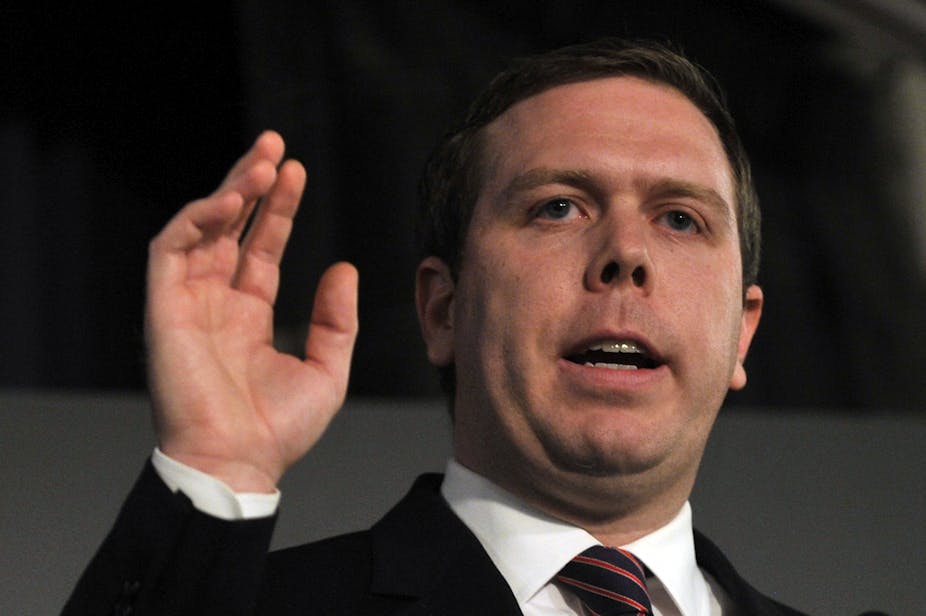
Paul Howes (pictured) believes the Greens represent a threat to Labor’s electability. AAP

Governments and their partisans are usually reluctant to admit that they might be unpopular for a reason. Labor partisans have offered many explanations for the unpopularity of the Gillard government: for a long period Tony Abbott was credited with truly magical powers, despite all the evidence that he is an unpopular opposition leader.

Perhaps Labor’s campaign against the Greens represents another development in Labor’s crisis. Political operatives and much of the media define politics as about symbolism and “leadership”. Both left and right wildly overestimate the ability of elites to drive public opinion. It has been suggested that John Howard could have stopped Pauline Hanson by a few words or that if Labor MPs after 1996 had said kinder words about Paul Keating, John Howard’s Liberals would never have come to be perceived by voters as great economic managers or the preferred party on economic management.

This magical thinking has reached a new height with the assertion that voter dislike of the carbon tax is because of the government’s supposed “alliance” with the Greens, as if Labor could have somehow assembled a parliamentary majority by force of will alone. I suggest that behind the rhetorical absurdities of Paul Howes and his colleagues lies a more coherent argument: Labor has become too left wing.

It is no coincidence that a leader of the Australian Workers’ Union should believe this. The AWU now incarnates the spirit of the contemporary Australian labour movement as it did once before World War II. Then the AWU was the backbone of the Labor right. It was a union that represented poorly skilled workers who worked in small workplaces and who (particularly before World War I) were often small farmers. Thus the AWU leadership were zealous champions of the industrial arbitration system.

During World War I, the AWU spearheaded the exclusion of the extreme pro-conscriptionist right from the ALP. After the war, the AWU leadership’s cautious pro-arbitration labourism was challenged both by many AWU members and by industrial unions. Eventually the challenge from the left was defeated. Many techniques were employed: the corruption of AWU and Labor Party elections, alliances with employers against militant workers and the repression and victimisation of militant workers by sympathetic state Labor governments.

Paradoxically the strength of class identity in Australia aided the cause of the Labor right represented by the AWU. Workers were intensely loyal to political labour; once the right had reasserted its control over the party, Labor was secure from electoral challenges to the left – even although many workers were disappointed with Labor’s record in government. This crusade of the AWU’s leadership was not a pretty one, but perhaps from a narrowly electoral perspective the AWU was correct. The radicalism of the industrial left frightened voters. Interwar Labor was strongest in those states where the AWU dominated the labour movement.

The AWU’s dominant position within the labour movement eroded after World War II. Economic change undercut the pastoral workforce. In the 1950s, the AWU played a leading role in the expulsion of the extreme right from the ALP when it mobilised against the industrial groups. However, in the post-split ALP, the AWU was progressively excluded by the ascendant left within the party, and the union was no longer strong enough to carry the ALP right on its own. The AWU’s model of pacific unionism, which was dependent on arbitration and sympathetic Labor governments, was less relevant to the affluent and conservative 1950s and 1960s. In these decades Labor governments were rare, and workers now often secured wage increases by collective bargaining rather than arbitration. The AWU’s archaic and racist rhetorical labourism also repealed the Whitlamite social democrats of Labor’s right.

The upheavals in the Australian economy from the 1980s set the ground for an AWU resurgence. The union benefited by advantageous mergers, but more significant was that the industrial relations landscape came to resemble that of interwar Australia. Unemployment was high and the arbitration system became much more important as a means of securing wage increases. Conservative governments championed employer prerogative to an even greater extent than those in interwar years. The balance of power between unions and the ALP reversed. Most unions were now dependent on state support just as the AWU had always been. Thus the priority of industrial labour became to keep the Labor Party in government. Industrial and political labour became increasingly integrated.

In the golden post-war years, the Communist Party had rivalled Labor as a pole of attraction for many union activists, but now political Labor activists enjoy an unprecedented dominance of industrial labour. The Greens, however, pose far greater electoral challenge to Labor than the Communists ever did. Anti-unionism now seemed hardwired into the federal Coalition to a much greater extent than in the 1970s or 1980s or even the 1920s and 1930s. In the logic, then, of Paul Howes and many others in the ALP, the Greens represent a threat to Labor’s electability and hence, “objectively”, to the union movement. They have argued that as Green voters will always preference the ALP their concerns can be entirely ignored.

Labor’s current rhetoric against the Greens is partially an expression of frustration, but it also reflects a deeper anxiety about the survival of the labour movement. Panic may come to supplant realistic analysis and coalition-building for industrial and political labour.

Join the conversation

22 Comments sorted by

  1. Lynne Newington

    Lynne Newington is a Friend of The Conversation.

    Researcher

    Maybe selfishly, I'm going to regrett the forging ahead of Greens Senator David Shoebridge, and his vigorious pursuance of justice for abuse victims within the Catholic Church may suffer.
    Especially the Parliamentary Inquiry, which he wasn't limiting to Victoria with it's dozens of suicides.
    He was such a breath of fresh air, puting many Catholic politicians to shame.
    With new high profile Catholic bedmates, Leader of the opposition Tony Abbott and Attorney-General Greg Smith things may no longer fare so well.

    report
  2. Comment removed by moderator.

  3. Terry Flew

    Professor of Media and Communications at Queensland University of Technology

    Geoff, I wasn't sure that the conclusion to your piece followed from your historical analysis. The historical analysis would suggest that Howes as an AWU leader is taking a decision based upon 'realistic analysis" rather than "panic" in proposing that the ALP cut the Greens adrift.

    report
    1. mark dastoli

      strategic planner

      In reply to Dianna Arthur

      Sadly, acting to spite their face is what the ALP has been best at for a number of years now. Hard to tell if it's panic or 'realistic analysis', tho if it's the latter I do wonder which reality is informing it.

      Had we a more constructive, mature and diverse political process, there might be more negotiations in pursuit of a strategic alliance among the left, rather than lazily slagging off The Greens or ignoring them on the (spectacularly naive) assumption that their preferences (and parliamentary…

      Read more
    2. Yuri Pannikin

      Director

      In reply to mark dastoli

      I agree. Rejecting Rudd's ETS was the biggest blunder of the Green's time in office. They need to learn the art of compromise -- on some issues. The progressive policy approach can be more productive in the longer term.

      report
  4. Trevor S

    Jack of all Trades

    Noting to contribute, I just wanted to say this was an excellent piece.

    report
  5. Michael Gioiello

    High school music teacher/ freelance Opera singer

    I am no expert in politics, however, my own observations tell me that it seems that politicians these days do not pass laws that are designed to benefit all. It seems that they pass laws that benefit the people who vote for them. I do not understand how it is in any way democratic that politicians, or political parties accept "donations" from anyone. I my mind, this seems totally undemocratic, because politicians are obliged to pass laws that are of benefit for the people/ corporations who give them money. Why has this phenomenon not been stoped, so democracy is allowed to work for the benefit of all, instead of the ones who can afford to give political donations?

    report
    1. James Walker

      logged in via Facebook

      In reply to Michael Gioiello

      Politicians passing laws for those who vote for them is democratic (or at its' worst, ochlocratic) since they need to work together, and so each law needs the support of the majority.

      Campaign donations can warp this of course, but if donations are capable of corrupting the process, then they are also capable of corrupting the process of removing them: ie you can only get rid of donations if they are fundamentally benign. No, I don't see a solution - other than ignoring political advertising, and thus weaken the value of the donations.

      report
  6. Allan Kessing

    retired

    Too many non sequitors, question begging assertions and, what i assume to be typos. - eg <I>The AWU’s archaic and racist rhetorical labourism also repealed the Whitlamite social democrats of Labor’s right.</I>. Presumably you mean <b>repelled</B> or maybe it was just more alphabet soup.
    Were this article half coherent, I might have made some comment other than "must do better - FAIL".
    Having just noted what the author does, for a tax payer funded crust, all I can say is ... well nothing.
    Is this screed demonstrates the quality of teachers, we are sunk.

    report
  7. David Doe

    Videogame Producer

    "Labor has become too left wing."

    Oh pish posh.

    If you really think that, you're so far to the right you wouldn't even be able to see left from your position.

    Some notable absences in the ALP's "left-wing" policies - scrapping casual labour, higher taxes on mining conglomerates, more funding for state owned media, no private infrastructure companies, no PPPs, marriage equality, free tertiary and technical education, legalising all recreational drugs, nationalising major industries, no FTAs.

    Oh, but please tell me all about how 'left-wing' they are, when the Right in their party has been in the driving seat for decades.

    Allan Kessing said it all - "must do better - FAIL".

    report
    1. Doug Green

      logged in via email @gmail.com

      In reply to David Doe

      "Labor has become too left wing"

      Surely the only policy movement that has taken place in the Labor Party for a long time has been a gradual abandonment of, retreat from, or dilution of, any policy that could remotely be described as Left Wing? Hence the general consensus that Labor is leeching more left-leaning voters to The Greens.

      The Liberal party, through a gradual purging and sidelining of its moderate elements, has also been moving inexorably to the Right with its current incarnation…

      Read more
    2. James Walker

      logged in via Facebook

      In reply to Doug Green

      So, the Libs are incredibly right wing: when their leader is on record as having voted Labor. Labor is right wing - while implementing a carbon tax, dropping support for traditional marriage etc.

      Get real.

      The decision on whether a party is too left/right wing is made by swinging voters. Labor could afford to be solidly Left if they'd focus on the needs of their core electorates, but the pink batts disasters etc have shown the that the ALP doesn't give a stuff about workers, so they're seen as just another trendy leftie lattie sipping party - and the Greens have got that niche sewn up nicely. So swinging voters are going to kick Labor to the curb: and keep doing so until they shape up.

      report
    3. Doug Green

      logged in via email @gmail.com

      In reply to James Walker

      James, I would like to see the reference to Tony Abbott voting Labor! Especially given that, even in his early days in student politics, he has been a belligerent warrior for the Right.

      He is of course on record as holding every possible position on every possible thing (see climate science/policy) depending on political advantage so I guess it is theoretically possible in one so unprincipled.

      "Labor is right wing - while implementing a carbon tax, dropping support for traditional marriage…

      Read more
  8. Yuri Pannikin

    Director

    Yep, me too: "Labor has become too left wing." What nonsense. Compared to the Whitlam days, it's about as right as possible, with the AWU having the most power it has, federally, in 40 years.

    The attack on the Greens is just more smokescreen to hide the horrendous mistake they made in dumping Rudd. The AWU in power, Shorten et al, would be a disaster for the environment. (I've been opposing the anti-environment policies of this bunch for four decades.)

    On the other hand, if the Greens move…

    Read more
    1. Yuri Pannikin

      Director

      In reply to Yuri Pannikin

      I should add that there is a precedent for the Greens not allocating preferences, or allocating on a seat by seat basis to Labor depending on the candidate.

      In Queensland in 1995, the Greens did not allocate preferences absolutely to Labor because of Premier Wayne Goss' intransigence and disrespect for certain environment issues. Labor lost. BTW, the KRudd was his chief of staff and hopefully learned something from that.

      report
    2. Robert Tony Brklje

      retired

      In reply to Yuri Pannikin

      The Greens policies are about as conservative as they can be on every issue. What has become warped is the political scale, where actual conservation is seen as extreme left and gross exploitation as be normal conservative right, with the Australian Labour Party attempting to balance on the fence.
      The ALP simply became cognisant of losing too many votes to the Greens and reacted against it. The Greens only real failure has been not to promote their true conservationist agenda and target conservative voters, they have too readily allowed right wing exploitative politics and mass media to paint them as the loony left, rather than the reality of being true conservatives, those that prefer the least risk solutions.

      report
    3. Yuri Pannikin

      Director

      In reply to Robert Tony Brklje

      Yes, I agree. I'm always amused (and frustrated) when some pundit or politician talks about "getting the balance right" when it comes to conservation issues.

      My response is always: "like, compared to what or when? 1788?"

      For most resource issues - forests, fish, soil, pollution etc - the 'balance' is long gone and now we need to dramatically conserve what's left.

      report
    4. Doug Green

      logged in via email @gmail.com

      In reply to Yuri Pannikin

      Unfortunately we can now add "getting the balance right" to the semantic sludge that the feral Right has concocted for the easily confused. The environment was barely on the political agenda at all until the advent of The Greens. It was often carte blanche, after a cursory 'environmental assessment', for rapacious developers, miners and polluters. Now the Right wishes to reverse some minimal improvements, and return to the days of laissez faire, under the banner of 'balance'.

      Similarly the "return…

      Read more
  9. rob elliott

    marketing manager

    "I suggest that behind the rhetorical absurdities of Paul Howes and his colleagues lies a more coherent argument:"
    Fear of losing the seat of Melbourne for the first time in 108 years?
    The bleating from the Right isn't surprising...what is...
    is the lockstep commentary from both sides of the Party at the same time...
    orchestrated vitriol from the same songsheet suggests fear...which then raises the question - why now?

    If Dastyari et al came up with this 'masterstroke' might I suggest they're no further down the road than Bitar and Arbib were. Forget the Greens...concentrate on the real problem behind the Labor Party - the power of the factions and a lack of policy differentiation from the other mob.

    report
  10. Gary Murphy

    Independent Thinker

    It's payback for the Green's intransigence on asylum seekers.

    This issue could kill Labor's reelection chances and the Greens refuse to compromise and seem more interested in using the issue to try to poach more votes from Labor.

    report