
The risk with climate change is not with the direct effect of humans on the greenhouse capacity of Earth’s atmosphere. The major risk is that the relatively modest human perturbation will unleash much greater forces. The likelihood of this risk is intimately tied to the developments over the next decade in the Arctic.
Accelerating ice loss and warming of the Arctic is disturbing evidence that dangerous climate change is already with us. As I have argued earlier, now that we have realised this our efforts should be directed at managing the situation in the Arctic and avoiding the spread of dangerous climate change elsewhere.
The Arctic is a core component of the earth system. Six of the 14 climate change tipping points of the earth system are located in the Arctic region.
Whereas the term tipping point was initially introduced to the climate change debate in a metaphoric manner, it has since been formalised and introduced in the context of systems exhibiting rapid, climate-driven change, such as the Arctic. Tipping points have been defined in the context of earth system science as the critical point in forcing at which the future state of the system is qualitatively altered.
Tipping elements are defined, accordingly, as the structural components of the system directly responsible for triggering abrupt changes once a tipping point is passed. This is because they can be switched into a qualitatively different state by small perturbations.
Of the many tipping elements in the Arctic, that with potentially greatest consequences if perturbed is the vast methane deposit. Methane is a greenhouse gas. A molecule of methane has 20 times the greenhouse effect of a CO₂ molecule, and the release of methane has been linked to climatic transitions along the history of planet Earth.
The Arctic contains vast reserves of methane stored as methane hydrate, a gel-like substance formed by methane molecules trapped in frozen water. The methane hydrate deposits are estimated at between 1,000 and 10,000 Gigatons (109 tons) of CO₂-equivalents as methane, much of which is present in the shallow sediments of the extensive Arctic shelves. This amount of greenhouse gas is several times the total CO₂ release since the industrial revolution.
Even moderate (a few degrees C) warming of the overlying waters may change the state of methane from hydrates to methane gas, which would be released to the atmosphere. If this release is gradual, methane will add a greenhouse effect to the atmosphere. This will only be temporary, as it will be oxidised to CO₂, with a decline in the greenhouse effect of 20-fold per unit carbon.
However, if the state shift is abrupt it may lead to a massive release of methane to the atmosphere, which could cause a climatic jump several-fold greater than the accumulated effect of anthropogenic activity.

Recent assessments have found bubbling of methane on the Siberian shelf. Models suggest that global warming of 3°C could release between 35 and 94 Gt C of methane, which could add up to an additional 0.5°C of global warming. Moreover, frozen soils and sediments contain large amounts of methane hydrates that can be released to the atmosphere. Indeed, rapid thawing of the Arctic permaforst has been reported to lead to the release of large amounts of methane.
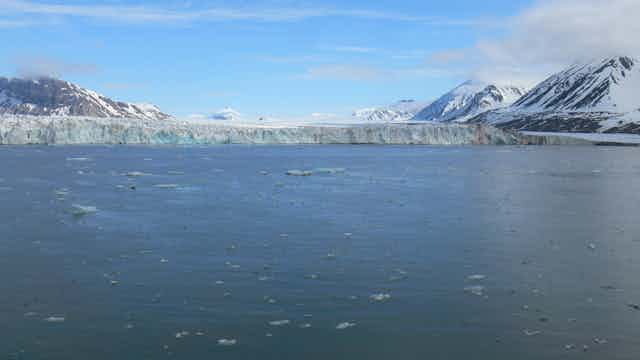
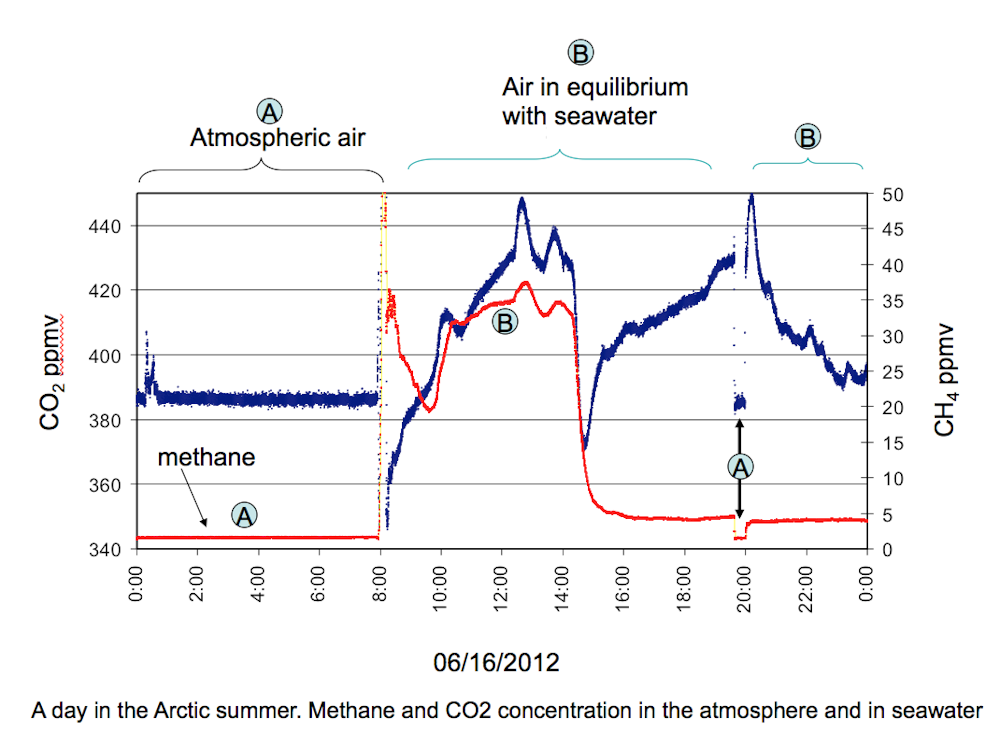
In our most recent cruise this summer (June 2012) along the Fram Strait and Svalbard Islands we found concentrations of methane in the atmosphere of about 1.65 ppm. However our equilibrium experiments (air atmospheric with Arctic surface water) reached values that were generally between 2.5 ppm and 10 ppm, with maximum values up to 35 ppm. These results confirm that this area of the planet is emitting large amounts of methane into the atmosphere.
Understanding and forecasting the response of Arctic methane hydrate deposits to rapid warming and thawing in the Arctic is of the utmost importance.
Provided the magnitude of these risks, and those associated with other tipping elements in the Arctic, our collective response to climate change appears to be a careless walk on the razor edge.

Tim Scanlon
Debunker
This feedback mechanism was one that really scared me. Permafrost and Artic ice melt are quickly looking like a reality rather than a potential risk. The record lows and general declining trend in the Artic ice show that action is needed now, not by 2050.
John Bloomfield
Retired Engineer
Where are all the deniers?
Tell me its not happening - please!
Arthur James Egleton Robey
Industrial Electrician
They are the reason I clicked on this page. They certainly are vociferous over at PhyOrg. (Even that is not true any more.) The ones who hung around the longest were the Big Carbon whores.
Jonathan Maddox
Software Engineer
It is happening.
*BUT* ...
Methane concentrations in the atmosphere are proportional to recent worldwide emissions. It does not build up over decades in the way that carbon dioxide does.
Arctic methane emissions have only been observed closely quite recently (largely due to concern over exactly the runaway scenario depicted here). Yet it's a given that they have always happened, faster or slower depending on temperature. The huge Siberian gas deposits are only what has been trapped beneath…
Read moreMartin Turner
Innovation Fellow at Macquarie University
Methane has a shorter half-life than CO2 but its greenhouse effect is about 70 times stronger than CO2 over 20 years. Since the next 10 - 20 years will determine our climate fate, the increase in methane emissions is very scary. We may already be on the slowly rising part of an exponential curve that is uncontrollable runaway climate change.
Jonathan Maddox
Software Engineer
That's quite true, but there's 220 times as much CO2 in the atmosphere as CH4 (391parts per million vs. 1770 parts per billion), and the recent rate of increase is also dominated by CO2 (2.1 parts per million or 0.6% per year vs. 6 parts per billion or 0.3% per year).
More to the point, human activity has huge direct influences over atmospheric methane concentration since a very large portion of emissions is directly due to agriculture and fugitive emissions from our fossil fuel use.
http://www.jpl.nasa.gov/news/news.php?release=2012-263
David Arthur
n/a
Thanks Jonathan. (As of 2012, I understand atmospheric CO2 is ~400 ppm, not 390 ppm).
If methane's warming potential is 70 times that of CO2, then 1770 ppb of methane is roughly equivalent to a further 124 ppm of CO2. (From Wikipedia, pre-Industrial methane may have been ~700 ppb). What's more, even if that methane only has an atmospheric lifetime of 20 years, bear in mind that methane is being emitted at ever-increasing rates from thawing Arctic sources.
Do you think it plausible that the long-term cooling trend experienced since the Eocene Optimum (so-called) may have been largely the result of carbon sequestration in permafrost and submarine clathrates? It is thought that there were no polar icecaps back then (world average T 12 deg C warmer than 1750, http://en.wikipedia.org/wiki/File:65_Myr_Climate_Change.png), so sea levels were about 80 m higher than present.
Jonathan Maddox
Software Engineer
Permafrost is much younger -- pretty much by definition it can only exist during periods with ice caps, but it can only form in nearby regions that are not under permanent ice cover. The oldest permafrost I'm aware of whose age has been determined is under one million years old :
http://www.canada.com/topics/news/story.html?id=66862d4b-6c4f-44f4-b0fc-325a10190d5b
I think the general theory about the Paleocene-Eocene temperature spike is that (maybe) it was a positive feedback of ocean-floor…
Read moreJohn Bloomfield
Retired Engineer
An interesting and informative 2012 lecture from Prof Schellnhuber at the University of Melbourne is at this link:-
file:///C:/Global%20Warming/2012%20Prof%20Schnellnhuber%20Live%20@%20Melbourne.htm
The whole presentation is about 65 minutes in length - the section from 34 to approx 40 mins touches on methane hydrates concerns.
Jonathan Maddox
Software Engineer
Did you mean this one, from July 2011? I can't see the copy on your Windows machine from here.
http://live.unimelb.edu.au/episode/climate-change-critical-decade
John Bloomfield
Retired Engineer
Yes -that's it.
Well worth a listen.
(I nominated an incorrect presentation year.)
Kim Peart
Researcher & Writer
With the rush for black gold gearing up in the Arctic, as the ice vanishes, we appear to be gunning for the final binge, rather planning for a safe Earth.
With China seeking access to Arctic energy, to drive growth and empire building, we cannot expect a sudden global change of heart.
Geoengineering is, to date, the main proposal to manage the carbon crisis, so that growth can continue.
Without growth, we risk collapse, an end game for us and still a damaged Earth.
In the light of the…
Read moreJonathan Maddox
Software Engineer
Space power? This is not a good energy investment.
http://physics.ucsd.edu/do-the-math/2012/03/space-based-solar-power/
That doesn't stop some people actually trying to do it. That's fine as a proof-of-concept, as long as analysts don't pretend the development is not profitable in energy terms.
http://www.solarenspace.com/
With genuinely unlimited stellar energy, we would cook the planet in short order.
http://physics.ucsd.edu/do-the-math/2012/04/economist-meets-physicist/
Yes, a small fraction of the CO2 in our atmosphere is the product of atmospheric methane which has oxidised in the air. That's quite apart from the much larger fraction which is the product of methane combustion (same chemical reaction, different physical circumstances).
Kim Peart
Researcher & Writer
Thanks for the links Jonathan.
Is energy from the Sun a good investment?
Considering that Mother Nature has been using stellar energy for 3.5 billion years to run the life engine and produce all fossil fuel that we have used to build our space age technology, there is one rather solid example of the Sun proving its worth.
Our challenge is to figure out how to make the Sun work for us.
The heat problem already exists, as the Sun is now 25 percent hotter than at the dawn of life and over…
Read moreJonathan Maddox
Software Engineer
Um.
I said that space-based solar power was a poor investment compared to terrestrial solar power, not that solar power was a bad investment.
Both forms of solar power are ultimately viable, but one is something that involves low-cost existing manufacturing processes and low-cost surface transportation. The other is something that involves immense technical sophistication (not yet developed at scale), very long lead times, and immense consumption of rocket fuel (last time I looked, rockets…
Read moreArthur James Egleton Robey
Industrial Electrician
I am on Kim's side on this one.
The surface of a planet is not the correct place for industry.
And yes, we are going to have a date with the Infinite.
The illusion is to think that somehow, please dear God, somehow let us continue to live on the surface of this teeny tiny little ball of rock. We promise to be good. So You see Dear merciful Father we are being good, so you had better keep your side of the bargain, Bastard.
Grow up. Pack your gear. Time to leave home.
Arthur James Egleton Robey
Industrial Electrician
Hows this for a grounding in Reality?
Humanity is not going to make it. The Big Brain thingy was a failed evolutionary experiment.
Staying on the planet runs the risk of merging as one with Nature. I will guess that not many on the forum have done the "becoming one with nature" thing.
We either use our brains and escape from this womb or die.
Aye, and I am familiar with the exponential function.
Humanity will not survive, his attention span is too short, but his descendants might.
Jonathan Maddox
Software Engineer
Um.
I'm all in favour of expanding off-world. We're a spacefaring people, let's act like one.
But space power as a solution to the short-term problem of greenhouse gases? No.
I disagree about the surface of a planet not being the correct place for industry. People need somewhere nice to live and work. Just don't foul it.
Kim Peart
Researcher & Writer
I was surprised to discover Jonathan,
that infinity is a natural part of the Universe and for us, many apparently finite aspects are as good as infinite.
We cannot see the edge of the cosmos and there may be no edge to the space-time continuum.
An infinite return on the investment includes from among the stars and galaxies, as with space, we know no limit.
Though we know the Sun must ultimately whimper away, it is so distant in time, it is like an infinity, for us.
It is impossible…
Read moreJonathan Maddox
Software Engineer
Each of your brief paragraphs seems to contradict the next. Particularly, most of them contradict:
"We have totally failed to keep a safe planet, so the ways that have led us into failure are not the ways to secure our cosmic survival insurance policy."
Expansionism is precisely the way that has "led us into failure".
If we're fighting them on the beaches and on the landing grounds and in the fields and in the streets and on the hills ... the enemy is us.
Nevertheless...
I do agree that we should expand beyond the confines of Earth and the neighbourhood of our one fickle star.
Just not before tackling our urgent domestic problems inside the atmosphere.
Kim Peart
Researcher & Writer
My turning point Jonathan,
came in 1993, when I began asking "What does Nature want?"
This is not to say that Nature is conscious, but there is a powerful momentum in Nature and life.
One of the fundamentals of the cosmos is expansion toward increasing diversity, seen from the beginning of time.
Life has filled the Earth and if it could, would expand into the cosmos, so that we would see bizarre lifeforms floating around the Solar System, soaking in stellar energy and feasting on in-coming…
Read moreJonathan Maddox
Software Engineer
So in all the chaos of human development and political turmoil, you think we, as a species, missed the boat to go stellar in the 70s (incidentally precisely when US oil production began its decline), squandered the fossil fuel bonanza and brought about climate change -- in some sense morally as a consequence of abandoning the project of space colonisation.
The only problem with that argument is all the chaos of human development and political turmoil. Oh, and the fact that terrestrial insolation…
Read moreKim Peart
Researcher & Writer
The business plan for launching a stellar civilization Jonathon,
was developed by Professor Gerard K. O'Neill and his associates at Princeton University in the early 1970s, is embodied in his 1977 book 'The High Frontier' and related research found at the Space Studies Institute that he founded.
NASA and the National Space Society also hold much information on this work and vision.
In my view, the killer question is, why didn't we act?
I am left wondering if this is yet another competitor…
Read moreEclipse Now
Manager of design firm
Hi Kim Pert,
You wrote: "Though many lobby for the nuclear alternative, that is hardly an option, compared with the volume of energy needed and the speed of transition required." First, energy efficiency programs and transport electrification (to wean off oil) are essential means of reducing our overall energy consumption. Unfortunately electrifying transport (and heating in cooler climates) will both add to the demand for more electricity.
Second: nuclear power is the *only* means of massively…
Read moreJonathan Maddox
Software Engineer
Like I said, I'm entirely in favour of expanding off-world. I'll even agree the sooner the better. But there's no energy surplus to fund it with from our present economic, energy and political situation, unless some dictator who shared your views were miraculously to take over most of the world economy without destroying it, then devote all our energies to it while retrenching bread, circuses and legions. It's clear that there's plenty of scope to retrench fossil fuels and avoid catastrophic climate…
Read moreJonathan Maddox
Software Engineer
Nuclear power is the best form of energy available, except for all the others we've tried.
Nothing you say about nuclear energy is wrong, though a few points aren't quite true *yet*, because further technical and political hurdles must be overcome for them to be accurate. Almost everything you say about renewables *is* wrong, given a few technical advances that also haven't happened yet.
Neither intermittent renewables nor nuclear power can scale to replace present fossil energy demand without several significant developments. The race is on :-)
Jonathan Maddox
Software Engineer
If I recall correctly, last time we discussed this race between nuclear and renewables, somebody mentioned Saudi Arabia was buying nuclear reactors from Korea.
http://www.guardian.co.uk/environment/2012/oct/19/saudi-arabia-renewable-energy-oil
Kim Peart
Researcher & Writer
I read the article Jonathan,
and found Greer's views a bit selective.
There was no mention of the role of Wernher von Braun and his amazing team that built the Saturn V ~ the most powerful rocket built to date ~ which delivered the Moon landing.
If Von Braun's vision had been followed, which came out of Germany, the space plane would have been on top of a rocket.
After the assassination of Kennedy, space budgets were slashed and the Moon landing was achieved, but the Saturn V was canned…
Read moreEclipse Now
Manager of design firm
"There may need to be radical changes, such as shifting long-haul transport to airships." Hi Kim, it depends what you mean by long-haul. Check out these figures:
C17 plane ton-mile per gallon 7
Aeros Airship Ton-Mile per Gallon of Fuel 23
Rail fuel efficiency (Ton-mile per gallon) 156 to 512
Trucks 68 to 133
Trucks seem better than Airships, but no where near as good as trains.
Read morehttp://nextbigfuture…
Kim Peart
Researcher & Writer
I am impressed Eclipse,
with the heavy lift Australian design for an airship ~
http://www.theage.com.au/business/introducing-skylifter-a-new-giant-of-the-sky-20101007-168v8.html
Australia is also pumping out some advanced designs for solar power ~
http://www.abc.net.au/science/articles/2012/05/31/3514559.htm
A large airship, like the one in your link, could be powered by the Sun and with energy storage systems rapidly improving ~
http://www.abc.net.au/science/articles/2012/06/28/3534975.htm
could cruise through the night until dawn.
I look toward a slow Earth lifestyle, that includes koalas, as we reach for the stars.
Kim Peart
http://www.islandearth.com.au/
Jonathan Maddox
Software Engineer
No Kim, the "oil embargo" in 1973 was a bit of a sham really. Withheld oil production volume from the world market was pretty small. Though that's when prices rose of a sudden, the ground was laid for that event in the USA in the years preceding.
For 60 years the Texas Railroad Commisson regulated oil production within that state, in order to keep prices steady after an ugly local experience with oil booms and busts in the early years of the 20th century. And indeed the state authority was…
Read moreYoron Hamber
Thinking
Jonathan, a sweet piece of reason. Not that I'm sure it's correct as in being the sole 'drivers', but it makes a lot of sense when you put it together as that. Just one thing, around 30-33% of all methane get lost it transports through pipelines according to several independently made studies. So at no time would I expect runaway methane fro our handling to become invisible, but it might well be that it was worse say 15-20 years ago. that's a real problem with all venting of methane from sea bottoms etc. You can't 'see' it, it's just possibly some bubbles in the water, and maybe not even that. And what people don't see they don't believe.
Jonathan Maddox
Software Engineer
30% sounds really high ... I've read numbers like 0.1% leaked gas in some parts of the world, up to 10% in others. It varies depending on quality control and safety measures. Still, it's way too much. Total "Fugitive emissions" includes coal-seam methane and "associated gas" from oil fields that escapes without ever entering a pipeline -- and I suspect that with hydraulic fracturation that quantity has soared in the last decades.
I'll try to rustle up some numbers on leaks.
Yoron Hamber
Thinking
And i''ll try to link my figures too :) They're not that new admittedly, but got stuck in my mind reading them, as I too found them worryingly high. And looking at I see that I was discussing the Russian pipelines primary, but I won't be much surprised to see the same figures everywhere. After all, a pipeline is a pipeline, and??
The IEA (International Energy Association) made a study 2006. In it they observe that " In 2004 Russia emitted an estimated 298 million tonnes of CO2 equivalent of…
Read moreKim Peart
Researcher & Writer
The current public reaction and government response to nuclear power in Japan and Germany cannot be taken lightly.
We have totally failed to keep a safe Earth, which the losing of the Arctic ice sheet testifies.
And now we wait for the methane to explode from the clathrates.
If nuclear was a perfect choice, why haven't we gone there already?
If renewables were a perfect choice, why not there already?
Unfortunately, the focus on Earth-only solutions to energy problems has been a boon…
Read moreEclipse Now
Manager of design firm
While I love the idea of a space-faring civilisation, I'm utterly underwhelmed by fanciful speculation about solar thermal's capacity to replace coal. It cannot. Not yet. One has to overbuild capacity to a ridiculously expensive extent.
http://bravenewclimate.com/2009/12/06/tcase7/
http://bravenewclimate.com/2009/03/18/the-solar-fraud/
Now, I can *imagine* (or is that dream?) of future self-replicating AI micro-fabbing technologies, or, put simply, Breeding Robot Ships, that might be fired out…
Read moreKim Peart
Researcher & Writer
Concerning your charge that I have hijacking the article Jonathan,
in the last line the authors write ~ "Provided the magnitude of these risks, and those associated with other tipping elements in the Arctic, our collective response to climate change appears to be a careless walk on the razor edge."
The core concern of the authors would appear to be why we have failed to keep the Arctic ice sheet in our world and thus opened the way for the explosive release of methane from the clathrates and…
Read moreJonathan Maddox
Software Engineer
I don't think anyone has claimed that solar thermal generation can be cheaper than coal in 2012. It's clearly still several times more expensive than wind, nuclear, solar PV or new coal, let alone *old*, amortised coal.
Even so, it's an emerging industry and if aggressively developed (Australia being an ideal location to do so) its costs would certainly fall to a level comparable with more established technologies.
Jonathan Maddox
Software Engineer
There's a bit of arithmetic to do there, since every percentage you quoted is a proportion of different things!
The Wuppertal one seems to be the most relevant. The link you pasted didn't work for me (permission denied) so I googled and found it here instead:
http://www.wupperinst.org/uploads/tx_wiprojekt/1203-report-en.pdf
and the most relevant thing I found there, to the question as to how much gas leaks, is
"... emissions from the export network -- not including the distribution…
Read moreYoron Hamber
Thinking
Hmm, yeah. Seems i jumped the gun there :) It's been some years since i looked at it, and I remember getting rather upset reading " Just under 31% of greenhouse emissions are due to the release of CH4" (methane), but rechecking I'm not sure how they got the number, relative what? The total amount of emissions from pipelines including CO2 from gas turbines etc? Where did you see the number 'one percent' being the loss through venting etc?
As for leaks being worse inside Russia I expect that to be true. Saw 'unreported' leaks that lighted a nearby town (with photos) in the middle of the night, making it rain in the winter. But my info is at least two years old, and the tundra which they and the Canadians too build pipelines on are weakening constantly due to the warming near the arctic, creating morasses.
I would dearly like to see if it 'only' is one percent though, so if you have some relevant links to that statement I'm interested.
Yoron Hamber
Thinking
Thought I had stopped this :) Got really tired reading about the common stupidity of mankind.
But you got me interested again. If Australia allow underwater mining and supertankers digging for frozen methane? As well as Russia is planning several new fields and pipelines, some (most) of them under water. Which the Nordic Countries in their impenetrable wisdom have given a green light for?
Don't really think we need to worry about any methane 'tipping point' not being visible (as far as I know) geologically/historically. We will do just as fine without it. And the real trump should be placing those pipelines under water :)
And with Gazprom being owned by the mob, more or less :)
And the rest (western) being 'ethical' green, although ever so private enterprises for profit.
Brainacs are us.
Yoron Hamber
Thinking
This one seems relevant to your thoughts, as a guess. It says "Researchers from Princeton University, Duke University, the Rochester Institute of Technology and EDF have distilled some of the existing data on methane leakage and calculated just how climate-friendly natural-gas electricity and natural-gas-powered vehicles are. And the answer is: it depends.
On the whole, for both power plants and vehicles, natural gas beats conventional energy sources only if leakage rates are very low. The redline…
Read moreJonathan Maddox
Software Engineer
The quotation is right there in the Wuppertal Institute report pdf, at the end of §1.2, near the top of p. 4 (which is the 12th page of the pdf due to cover sheets and contents pages).
http://www.wupperinst.org/uploads/tx_wiprojekt/1203-report-en.pdf
I'd copy and paste the whole paragraph but the silly pdf is "locked" against copying and pasting (and I'm using a Apple, so the lock is enforced without me jumping through hoops).
Jonathan Maddox
Software Engineer
I think the low methane leakage rates reported are from well-managed "conventional" (large permeable field) production and well-regulated pipeline systems, where keeping leaks below 1% seems to be relatively easy. The occasional accidental "spill" such as the one described in the Time article may well make a mockery of such low figures for the gas system as a whole, however.
Higher ongoing rates of leakage are from poorly maintained pipelines and (significantly) from fractured gas wells.
Other…
Read moreYoron Hamber
Thinking
Interesting Jonathan, and mining under water is a dangerous way of extracting methane as it is a unstable 'ice product' as I understands it, prone to disassemble into a 'invisible' gas. Life gets more complicated the more you learn it seems :) Sometimes i long for that simpler time, like the fifties, when everything seemed possible and we all would have our flying car :) by now..
Hollister David
logged in via Facebook
In Why Not Space? some of Murphy's arguments are silly straw men. And his math is wrong. Those who cite this article demonstrate they haven't actually done the math. http://hopsblog-hop.blogspot.com/2012/02/in-his-blog-stranded-resources-tom.html
Jonathan Maddox
Software Engineer
Thanks for that David. Valid, constructive criticisms, all of them.
I don't know that any of those void the basic point that space-based solar power is hugely more expensive than obtaining the same energy from the same source here on the surface of the Earth, or that we don't have the option to defer addressing climate change until after we establish a "sustainable" presence off-world.
Let's establish a sustainable presence here, first.
Kim Peart
Researcher & Writer
When you write Jonathan,
"Let's establish a sustainable presence here, first."
is it OK to wonder why this hasn't happened already?
Considering the rapid rate of deterioration in conditions on Earth, what are the chances of this ideal ever being achieved?
That way does not offer hope or vision for a better world.
Establishing a sustainable presence beyond Earth will place our species in a better survival position and this simple act will generate hope on Earth.
By driving a vision…
Read moreJonathan Maddox
Software Engineer
Our presence on Earth WAS sustainable, until we harnessed fossil fuels.
If our sustainable presence on the home planet is a failed idea, we ourselves are a failed idea.
I think more highly of us than that.
Kim Peart
Researcher & Writer
Currently Jonathan,
our civilization has failed to keep a safe Earth, let alone a sustainable presence on this planet.
With the tipping points tumbling like gamblers cards in the Arctic, we must now face the prospect that our survival is at risk.
Human evolution has been on a trajectory that led to the Moon landing, but then we lost the plot.
The "failed idea" is that we have to work everything out on Earth alone.
Following Apollo, we should have been working everything out in the context of the Solar System as a whole.
By getting back into the trajectory of evolution, we can win back the plot, assure our survival, design a stellar economy without poverty and pick up the pieces of our failure on Earth.
The alternate rests in the detail of the Arctic methane clathrates waiting to explode into the atmosphere and send the planet off into a runaway greenhouse.
Kim Peart
http://www.islandearth.com.au/
Jonathan Maddox
Software Engineer
"We" didn't "lose the plot", America hit an economic ceiling.
Working things out on Earth isn't a failed idea. As you said at the start, Nature has been working things out quite nicely on this planet for a few billion years now.
Kim Peart
Researcher & Writer
Anyone interested in the history of space development Jonathan,
will be aware that before the Moon landing happened, NASA budgets were being slashed in the 1960s.
Kennedy's space vision was cut back to the bone.
Von Braun was promoted into a Washing office and his rocket team dispersed.
The Saturn V was canned.
The money was there to run a war in Vietnam and a nuclear weapons arsenal.
The WILL to act was lost, well before the economy did any pinching.
Considering how much fossil…
Read moreHollister David
logged in via Facebook
I agree with Murphy's overall message that we should conserve our resources and live within our means. And I'd also agree that space based solar power isn't the panacea some hope for.
I disagree that space resources will remain beyond our reach. I am giving better than even odds that Planetary Resources will realize a profit from mining asteroids.
If Planetary Resources can enjoy a profit, growth of space infrastructure is a natural development. As space based economic activity grows, so does…
Read moreHollister David
logged in via Facebook
The money that goes to space exploration is a minute fraction of the budget. And we haven't hit peak oil yet, much less where we approaching it in the Apollo days.
Jonathan Maddox
Software Engineer
The money that goes to space exploration *now* is a minute fraction of the budgets of the nations that still pursue it. The money to make a permanent "sustainable" human presence off-planet would not be -- it would be freaking enormous.
I didn't say "we" (the globe) have hit peak oil. I said the USA hit an economic ceiling, triggered by its own domestic oil production peak in 1971. This is a matter of record. It perhaps isn't as directly connected to the decline of the space program as I…
Read moreHollister David
logged in via Facebook
If entities like Planetary Resources can profitably mine asteroids, an increased human presence and growing space infrastructure would follow as a matter of course.
Given propellant sources other than at the bottom of earth's gravity well, space transportation becomes much less difficult and expensive.
Given these same propellant sources, life support consumables are available onsite, no need to haul them from the bottom of earth's gravity well.
Given Moore's Law and advances in telerobotics, we will be able to an increasing amount of work in high radiation, vacuum environments from the safety of a hab.
There are a number of routes to an affordable (even profitable) human presence in space.
Jonathan Maddox
Software Engineer
The problem with talking about "profits" is that all the money is down here.
The only possible profit to Space Resources in the short term is in finding minerals on an asteroid that are scarce and highly prized on the surface of the Earth (nickel? Is there really that much demand for it?) and bring them down. They won't be going to asteroids specifically for propellants and the like (water ice?) -- that would be a component of a seriously long-term project involving space-based processing…
Read moreYoron Hamber
Thinking
I agree with Jonathan in that we should 'repair the best spaceship ever invented :)
Earth.
It's our home, and it's also a lifetime of excitement for those using their own muscles exploring it. We've lost track of what puny things we are here, considering how fast everything seems to go today. But that's a illusion, any of us lost out in the outback will very fast realize what we are, compared to a Earth, and no money will help you there. I don't think we will become SpaceTime 'masters' :) although I do hope we will become intrepid SpaceTime explorers.
Nano is very good for building stuff that will hold, and work, for long time periods. At least i expect it to be so. And running away from our messed up planet won't inspire confidence in us, if we now ever meet any other SpaceTime explorers btw. Nobody likes locust.
Hollister David
logged in via Facebook
"The problem with talking about "profits" is that all the money is down here."
Wrong. There are many billions of orbital assets in cislunar space. Communication sats. Weather. GPS. Surveillance. Easier access to these extremely valuable assets would be an immediate economic benefit.
The first resource Planetary Resources hopes to bring back is water. Propellant high on the slopes of earth's gravity well would break the exponent in Tsiolkovsky's rocket equation and make space transportation much more economical.
Given more economic space transportation, it becomes easier to maintain and upgrade our orbital assets. It also becomes easier to reach near earth asteroids, some of which are rich in platinum group metals.
Here is Planetary Resources page on water usage: http://www.planetaryresources.com/asteroids/usage/
Nickel? Nanobots?! Where have I written about nanobots? Please don't waste my time asking me defend positions I haven't made.
Hollister David
logged in via Facebook
I have already written "I agree with Murphy's overall message that we should conserve our resources and live within our means." That we should take good care of earth is not in dispute.
I have written articles urging people to insulate their homes. To walk, bike or use public transportation, better yet work from home via the internet. I hope for zero population growth or even reducing our population. So where do you get off painting me as a locust eager to abandon our messed up planet?
In fact I would argue using space resources is part of looking after earth. Better to mine resources on barren asteroids or on the moon than in our biosphere.
Jonathan Maddox
Software Engineer
Interesting, I hadn't read such detail on the Planetary Resources site when I first visited there some months back.
You're being pretty defensive. Just because we're arguing against propositions doesn't mean we're asking you, personally, to defend them. Nanobots was just an idea I threw out there -- if anything I was proposing it, not opposing.
Yoron Hamber
Thinking
Methane is indeed a scary kind of 'time bomb' but as far as I know we still have to find it being let loose historically? And when we're speaking of methane we're also speaking of CO2, as that will be a end product of it, with a possible time span of ?? A thousand years before we can relax slightly, possibly? And the tundra releases both CO2 and methane, in Canada as well as in Russia.
As for this Earth growing too small :) Nah, our transports has grown too fast I would say. Slow down, consume…
Read moreKim Peart
Researcher & Writer
As you say Yoron,
we cannot hope to expand into space with "a depleted Earth."
I fear that if we do not act now on our survival presence beyond Earth, we will be left on Earth with our survival at risk and the real prospect of the Earth falling to a runaway greenhouse, as a direct consequence of changes already in place.
Though it may seem that we will behave badly in space, I suggest that a new dynamic will come into play beyond Earth, because of the security needs in space.
To assure…
Read moreYoron Hamber
Thinking
I always loved 'first and last men' myself (Olaf Stapeldon). Ignoring the politics described, that book still stands as a visionary masterpiece to me. And your vision isn't a bad one either, with one reservation. We better stop behaving as locust. First fix where we live, then move on.
Yoron Hamber
Thinking
Hmm, last and first men? Ahh, nevermind :)
Thomas Edwin Yeats
Mr
For better or worse the world's anthropogenic system of political economy has has decided that it is all too hard to wind back the clock and stop all this from happening through reductions in anthropogenic emissions. The implied reliance on the adaptability of the human species and technological solutions to the problem is really just a hope or assumption. The technology does not yet exist to reverse the gaseous accumulations nor replace energy sources with sustainable sources of equivalent capacity…
Read moreJonathan Maddox
Software Engineer
"The technology does not yet exist to reverse the gaseous accumulations nor replace energy sources with sustainable sources of equivalent capacity and price."
That's not actually true. Trees, sugarcane ethanol and nuclear power are existence proofs, but there are many other techniques equally capable of inexpensively separating carbon dioxide from air, of making non-fossil liquid fuels at prices comparable to oil, and of generating electricity at prices comparable to those of fossil-fuelled power…
Read more